
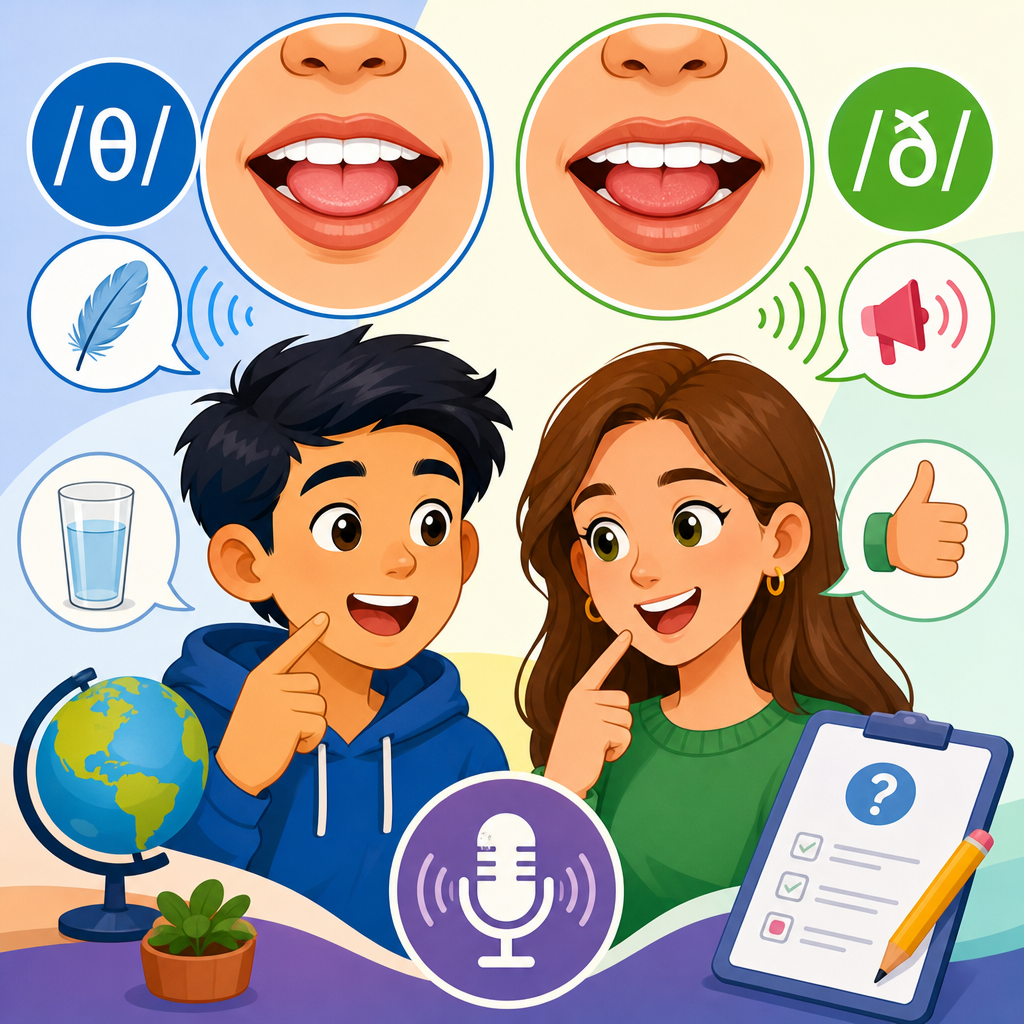
The /θ/ and /ð/ sounds, both spelled with “th,” are among the most challenging consonants for English learners because they are rare across world languages, easy to confuse with /s/, /z/, /t/, or /d/, and highly visible in conversation. In ESL teaching, /θ/ is the voiceless sound in think, bath, and author, while /ð/ is the voiced sound in this, mother, and breathe. I have taught these sounds to learners from Spanish, Japanese, Mandarin, Arabic, and Russian backgrounds, and the same pattern appears repeatedly: students often understand the rule, yet their tongue placement, airflow, and voicing do not coordinate consistently in real speech.
This matters because “th” affects both intelligibility and confidence. A learner who says tin for thin or dis for this is often still understood from context, but repeated substitutions can slow conversations and create listener effort. These sounds also appear in very common function words such as the, this, that, they, and those, so even small pronunciation shifts influence overall fluency. As a hub page for Speaking Miscellaneous, this guide covers mouth position, voicing, listening strategies, audio practice, common errors, minimal pairs, and a mini-quiz, while also pointing learners toward connected speaking skills such as rhythm, connected speech, and self-recording routines.
The key definition is simple. Both sounds are dental fricatives: the tongue touches or lightly protrudes between the teeth, and air continues to flow through a narrow gap, creating friction. The difference is voicing. /θ/ uses no vocal cord vibration. /ð/ uses vibration. If learners master these three elements—tongue placement, controlled airflow, and voicing—they usually improve quickly. The challenge is not theory; it is building reliable muscle memory and hearing the contrast clearly in natural speech.
Mouth Position: How to Physically Make /θ/ and /ð/
Start with the tongue tip. Place it lightly between the upper and lower teeth, or just behind the top teeth with the tip still visible. In my coaching sessions, “lightly” is the word that fixes the biggest problem. Many learners press too hard, block the air, and accidentally produce /t/ or /d/. Others keep the tongue fully behind the teeth and produce /s/ or /z/. The correct position allows a small, steady stream of air to pass over or around the tongue tip.
For /θ/, hold the tongue in place and blow air without using your voice: thhhh. You should hear soft friction, not a stop. For /ð/, keep the same tongue position but add voicing: thhhh with vibration in the throat. A practical test is to touch your neck. If you feel buzzing, you are producing /ð/. If not, you are producing /θ/. Mirrors help because learners can check whether the tongue is actually visible; phones help because slow-motion video reveals whether the tongue retracts too soon.
Lip tension should stay relaxed. Jaw opening is small and natural. Do not overbite the tongue or stick it out dramatically. Native speakers often show only a little tongue, especially in fast speech. The goal is not exaggeration forever; it is exaggerated practice first, then efficient movement in conversation.
Voicing, Spelling Patterns, and Why “Th” Has Two Sounds
English spelling does not reliably tell learners whether “th” is /θ/ or /ð/, so memorizing common word groups is more effective than chasing one universal rule. In general, many content words like think, thank, three, theater, and tooth use /θ/. Many high-frequency grammar words like the, this, that, these, those, they, them, there, and then use /ð/. Final “-th” can vary: bath has /θ/, while breathe has /ð/ because the verb is voiced.
This pattern matters for fluency. Because /ð/ appears in common function words, learners need it not just in isolated drills but inside chunks such as this is, they are, there is, and the other. When I train advanced learners for presentations, we practice these frequent sequences more than rare vocabulary because they occur constantly and shape a listener’s impression of natural speech.
| Sound | Type | Examples | Common Substitutions |
|---|---|---|---|
| /θ/ | Voiceless dental fricative | think, author, bath, three | /t/, /s/, /f/ |
| /ð/ | Voiced dental fricative | this, mother, breathe, they | /d/, /z/, /v/ |
The most efficient learning approach is to separate pronunciation from spelling at first. Learn the mouth action, then connect it to frequent words and phrases. Good dictionaries such as Cambridge Dictionary, Longman, and Merriam-Webster provide IPA and audio, which makes them valuable speaking resources for this Miscellaneous hub.
Audio Tips: How to Hear and Practice the Contrast
Most learners need listening training as much as speaking training. If your ear does not notice the difference between /θ/ and /t/, your mouth will repeat the old habit. Use a simple three-step audio routine. First, listen to isolated words: thin, then, thank, they. Second, repeat immediately, matching not just the consonant but the stress and vowel. Third, record yourself and compare wave by wave if possible. Tools like Forvo, YouGlish, and built-in phone recorders are enough for effective self-study.
One highly practical method is delayed repetition. Play a short phrase such as this thing or thank them, pause, then repeat after one second. This short delay forces your brain to hold the sound pattern instead of reading from spelling. Another method is minimal pair listening: compare thin/tin, thank/tank, then/den, and those/doze. If the pair still sounds similar, slow the audio to 0.75 speed. Most podcast apps and video platforms support this.
For learners in the Speaking section, I also recommend sentence-level shadowing. Repeat whole lines such as, “I think they’re there,” or, “This is the third time.” Shadowing links consonants to rhythm and connected speech, which is where classroom accuracy often breaks down. In real conversation, /ð/ in the may be very short, but the tongue movement is still there.
Common Errors by Language Background and How to Fix Them
Different first languages produce different substitutions. Spanish speakers often replace /ð/ with a soft /d/, especially because Spanish has a related dental approximant sound between vowels. Japanese speakers may substitute /s/, /z/, or /d/ because dental fricatives are absent in Japanese phonology. Mandarin speakers frequently use /s/ or /z/ for /θ/ and /ð/, while Arabic speakers may do better if their dialect already includes similar tongue-front friction patterns, though consistency in English words can still be difficult. Russian speakers often prefer /s/ or /z/ because those sounds are acoustically close and easier to stabilize.
The fix depends on the error type. If the learner stops the airflow and says /t/ or /d/, the instruction is: “Show the tongue and keep the air moving.” If the learner says /s/ or /z/, the instruction is: “Move the tongue forward to the teeth.” If the learner confuses /θ/ and /ð/, use the neck-touch voicing test and alternate pairs like thigh/thy or ether/either. In my experience, the fastest improvement comes from targeted correction on just five to ten frequent words rather than hundreds of random examples.
Be aware of accent goals. Not every substitution causes major communication problems, and some learners prefer intelligibility over accent reduction. That is a valid choice. Still, because “th” appears so often, even modest improvement has a high payoff in meetings, interviews, customer service, and classroom discussion.
Practice Routine, Mini-Quiz, and Next Steps in Speaking
A strong daily routine takes five minutes. Minute one: exaggerate the mouth position in a mirror, alternating /θ/ and /ð/. Minute two: practice isolated words such as think, thought, author, this, those, mother. Minute three: say minimal pairs—thin/tin, thank/tank, then/den, they/day. Minute four: read short phrases like the third chapter and those three things. Minute five: record one sentence and listen back. This routine works because it moves from mechanics to words to connected speech.
Try this mini-quiz. First, identify the sound: does the “th” in think use /θ/ or /ð/? What about this, bath, father, and thumb? Correct answers: think /θ/, this /ð/, bath /θ/, father /ð/, thumb /θ/. Second, choose the better pronunciation target: in they, should the first sound feel voiced or voiceless? Voiced. In three, should the tongue stay hidden? No; it should touch or slightly show at the teeth. Third, say this sentence clearly: “Those three brothers think this weather is better.” If you can produce each “th” intentionally, you are building reliable control.
The main lesson is straightforward: the /θ/ and /ð/ sounds are learnable because they depend on visible mechanics, not talent. Put the tongue at the teeth, keep airflow steady, and add voicing only for /ð/. Then train your ear with audio, practice frequent words, and record yourself regularly. As the Speaking Miscellaneous hub, this page gives you the foundation for related work on rhythm, linking, minimal pairs, and pronunciation feedback tools. Start with ten target words today, practice them in short phrases, and make your next conversation clearer and more confident.
Frequently Asked Questions
1. What is the difference between /θ/ and /ð/, and why are they so difficult for ESL learners?
The difference is voicing. The /θ/ sound is voiceless, which means your vocal cords do not vibrate when you say it. You hear this sound in words like think, bath, and author. The /ð/ sound is voiced, which means your vocal cords do vibrate. You hear it in words like this, mother, and breathe. Both sounds are spelled with th, but they are produced differently from many other consonants learners already know.
These sounds are difficult because they are uncommon in many languages. Learners often replace them with sounds that feel more familiar, such as /s/, /z/, /t/, or /d/. For example, think may become sink or tink, and this may become zis or dis. This is a very common pattern across language backgrounds, including Spanish, Japanese, Mandarin, Arabic, and Russian. The challenge is not intelligence or effort. It is simply that the mouth is being asked to make a movement that may not exist in the learner’s first language.
Another reason they feel hard is that they are highly visible and frequent in English. Words like the, this, that, think, and thank you appear constantly in daily speech. That means even a small pronunciation problem gets repeated often. The good news is that these sounds are very teachable. Once learners understand the exact tongue position, the airflow, and the voicing difference, accuracy usually improves quickly with focused repetition.
2. How should I position my mouth and tongue to pronounce the “th” sounds correctly?
For both /θ/ and /ð/, the key is the same basic mouth position: place the tip of your tongue lightly between your teeth, or let it gently touch the back of your top front teeth so that a small part of the tongue is visible. Do not press hard. Do not pull the tongue too far out. You only need a small, relaxed placement. Then let the air move out across the tongue. That narrow passage creates the sound.
To make /θ/, keep the vocal cords off and simply push air out. It should feel soft and breathy, like a controlled stream of air. You can test it by putting your hand in front of your mouth while saying think or bath. You should feel air moving, but no throat vibration. To make /ð/, use the same tongue placement, but now turn your voice on. Put your fingers lightly on your throat and say this or mother. You should feel vibration.
A very common mistake is keeping the tongue behind the teeth. If that happens, the sound usually turns into /s/, /z/, /t/, or /d/. Another common mistake is biting the tongue too strongly, which makes the sound tense and unnatural. Aim for light contact and steady airflow. A mirror can help a lot here. If you can see a little bit of the tongue and keep the jaw relaxed, you are usually in the right position. Start with isolated sounds, then short words, then phrases such as think about it and this is theirs.
3. Are there good audio and listening tips for hearing and practicing /θ/ and /ð/ more accurately?
Yes. One of the best strategies is to combine listening discrimination with slow, deliberate speaking. First, train your ear to hear the difference between /θ/ and /ð/, and between “th” and similar sounds like /s/, /z/, /t/, and /d/. Minimal pairs are especially useful. Try comparing think and sink, thin and tin, they and day, or breathe and breeze. Listen several times, pause, and repeat. The goal is not only to copy the sound, but also to notice the physical difference in how it is made.
Use audio tools in short sessions. Play one word or one short phrase, pause, and imitate it immediately. This shadowing method works well because it connects listening and speaking in real time. It helps if the audio is clear and slightly slower than natural conversation at first. Record yourself and compare your pronunciation to the model. Many learners are surprised that what feels correct does not always sound correct, so recording is one of the fastest ways to improve. If possible, wear headphones and listen for the difference between a breathy, voiceless /θ/ and a buzzing, voiced /ð/.
You can also practice in sequences. Start with the sound alone: /θ/, /ð/. Then add vowels: tha, thee, tho. Then move to words: think, thank, three, this, those, father. Then move to short sentences: Think about three things or Those are their clothes. This progression helps build accuracy without overwhelming you. Finally, pay attention to common function words like the, this, that, these, and those. Because they occur so often, mastering them gives you a noticeable improvement in everyday spoken English.
4. Why do I keep replacing “th” with /s/, /z/, /t/, or /d/, and how can I fix that habit?
This happens because your brain naturally reaches for the closest sound that already exists in your first language. If your language does not use /θ/ or /ð/, your mouth and ears may classify them as something more familiar. Voiceless /θ/ often gets replaced by /s/ or /t/, while voiced /ð/ often becomes /z/ or /d/. These substitutions are predictable and extremely common. They are not random mistakes. They are transfer patterns from your first-language sound system.
To fix the habit, focus on contrast practice instead of repeating only the target word. For example, do not practice only think. Practice think, sink, tink and notice how each one changes the tongue position and airflow. For /ð/, compare they, zey, day or then, den. This helps your brain build a new category for the sound rather than treating it as a version of an old one. Touch your throat for voicing, watch your tongue in a mirror, and exaggerate the tongue placement slightly in early practice so your muscles learn the difference clearly.
Another helpful strategy is to practice high-frequency words and short chunks, not just isolated pronunciation drills. Say phrases like thank you, I think so, this one, that’s right, and they are there. Repetition in useful expressions creates automaticity. If you are a teacher or self-studier, target one error pattern at a time. For example, spend a week correcting /ð/ in this, that, these, those before moving on to more advanced words. Consistency matters more than intensity. A few minutes every day usually works better than one long practice session once a week.
5. What kind of mini-quiz or self-test can I use to check whether I’m pronouncing /θ/ and /ð/ correctly?
A good mini-quiz should test three things: identification, production, and sentence use. First, test identification. Listen to a list of words and decide whether you hear /θ/ or /ð/. For example: thin, those, thank, weather, thumb, they. Mark each one as voiceless /θ/ or voiced /ð/. This shows whether your ear can hear the contrast clearly. If listening is weak, speaking will usually stay weak too.
Next, test production. Read a short list aloud and record yourself: think, three, bath, this, that, mother, breathe. As you listen back, ask yourself three questions: Is my tongue coming forward enough? Can I hear airflow for /θ/? Can I hear throat vibration for /ð/? If many words still sound like sink, tree, <em





