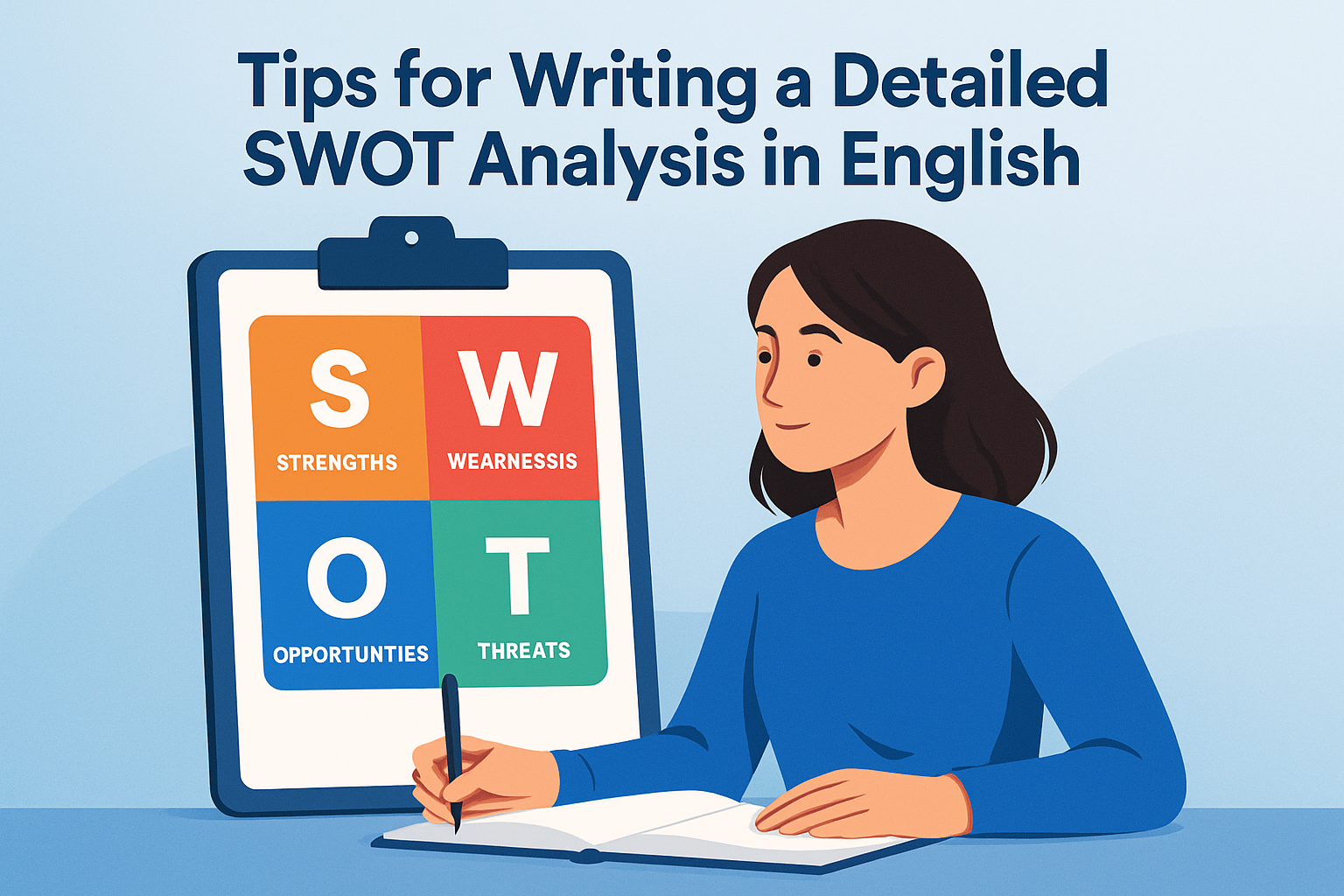
A detailed SWOT analysis in English helps teams turn scattered observations into a structured strategy. SWOT stands for strengths, weaknesses, opportunities, and threats, and it remains one of the most practical planning frameworks for businesses, nonprofits, students, and consultants. I have used SWOT exercises in market-entry projects, annual planning sessions, and website content audits, and the quality of the final document always depends on how clearly it is written. A vague matrix filled with buzzwords does not guide action. A detailed SWOT analysis, by contrast, explains what each factor means, why it matters, and what decision it should influence.
Writing the analysis in English adds another layer of importance. English is often the working language for international teams, investors, agencies, and academic reviewers. That means your wording must be precise, readable, and easy to interpret across cultures. Terms such as market share, customer retention, operating margin, brand equity, compliance exposure, and product differentiation have specific meanings. If you use them loosely, readers may misunderstand your conclusions. If you define them carefully and support each point with evidence, your SWOT becomes useful not only as a planning document but also as a communication tool.
Many people ask a simple question: what makes a SWOT analysis detailed? The answer is specificity. A detailed SWOT analysis does not say, “Our marketing is strong.” It says, “Our email campaigns average a 38% open rate, well above the industry benchmark, because our customer segmentation is mature and our lifecycle automation is consistent.” It does not say, “Competition is a threat.” It says, “Two lower-priced regional competitors entered the category in Q2, increasing price pressure in our mid-tier offer and reducing win rates in procurement-led deals.” Specific language gives decision-makers something they can act on.
This matters for search visibility and answer engines too. People search for terms like how to write a SWOT analysis, SWOT analysis example in English, and tips for writing strengths and weaknesses clearly. To satisfy those queries, the best article must explain the framework, show how to gather evidence, and demonstrate how to phrase points in professional English. It should also reflect E-E-A-T principles by grounding advice in real business practice, not textbook abstraction. In my experience, the strongest SWOT documents are concise in structure, rich in evidence, and disciplined in language. The tips below will help you write one that readers can trust and use.
Start with a clear objective and scope
The first tip for writing a detailed SWOT analysis in English is to define the objective before drafting a single point. SWOT is not a brainstorming game. It is a decision support tool. Ask what the analysis is for: launching a product, reviewing a department, preparing a funding pitch, entering a new market, improving a website, or evaluating a personal career plan. When I facilitate SWOT workshops, the biggest source of confusion is usually scope. Participants mix company-wide issues with product-level issues, or current internal factors with long-term external uncertainties. A written objective prevents that drift.
State the scope in one sentence near the beginning of your document. For example: “This SWOT analysis evaluates the English-language e-commerce performance of our skincare brand in the UK market for the next 12 months.” That sentence defines the business unit, language context, geography, and time horizon. Readers immediately know what belongs in the analysis and what does not. A broad statement such as “This SWOT looks at our business” invites unfocused writing and generic points.
Good English writing also depends on consistent categories. Strengths and weaknesses are internal factors you can influence directly, such as staff capability, pricing architecture, CRM quality, production efficiency, or brand reputation. Opportunities and threats are external factors, such as regulation, macroeconomic shifts, competitor moves, or changing consumer behavior. Many weak SWOT documents confuse these categories. For instance, “high demand” is not a strength; it is usually an opportunity. “Poor supplier reliability” may be a weakness if tied to your vendor management process, but a threat if it results from geopolitical disruption outside your control. Clear categorization improves credibility.
Collect evidence before you write each quadrant
A detailed SWOT analysis should be evidence-led, not opinion-led. Before writing, gather internal and external data from reliable sources. Internal sources may include sales dashboards, customer service logs, Net Promoter Score surveys, CRM reports, employee feedback, financial statements, website analytics, and product return rates. External sources may include competitor pricing pages, government statistics, industry reports, analyst briefings, review platforms, and keyword research tools such as Semrush, Ahrefs, or Google Trends. When I write SWOT summaries for executives, I rarely begin with prose. I begin with evidence folders and notes.
The reason is simple: evidence sharpens language. If churn rose from 8% to 13% after a price change, you can write a precise weakness. If organic traffic grew 42% after technical SEO improvements, you can document a strength with confidence. If a new regulation will raise compliance costs next year, you can describe the threat in concrete terms. English becomes clearer when facts lead the sentence. This is especially important when your audience includes non-native speakers, because numbers and named indicators reduce ambiguity.
Use the table below to organize source material before drafting the full analysis.
| SWOT Area | Question to Answer | Useful Evidence | Example in Plain English |
|---|---|---|---|
| Strengths | What do we do better than alternatives? | Retention data, margins, reviews, delivery time | “Our repeat purchase rate is 31%, showing strong customer loyalty.” |
| Weaknesses | Where do we underperform internally? | High error rates, low conversion, staff gaps | “Our mobile checkout converts poorly because page speed averages 4.9 seconds.” |
| Opportunities | What external change could we use to grow? | Rising search demand, new channels, policy change | “Search interest for refillable packaging is rising, supporting a sustainability-led offer.” |
| Threats | What external factor could harm results? | New entrants, inflation, regulation, platform risk | “Marketplace fees are increasing, which may reduce margin on entry-level products.” |
Write each point as a complete insight, not a label
One of the best tips for writing a detailed SWOT analysis in English is to turn bullet labels into full business insights. A weak SWOT point is just a noun phrase: “strong brand,” “limited budget,” “new market,” “competition.” A strong SWOT point explains the fact, the evidence, and the strategic implication. Think in a simple formula: factor plus proof plus impact. This style helps human readers and answer engines because each sentence can stand alone as a complete answer.
For example, instead of writing “Strong customer support” as a strength, write: “Our support team resolves 84% of tickets within 24 hours, which contributes to high review scores and reduces refund requests.” Instead of “Weak social media” as a weakness, write: “Our social content generates low engagement because posting is irregular and creative assets are not adapted to platform format.” The second version is useful because it points toward action. It also reads naturally in professional English.
Detailed writing requires disciplined verbs. Use verbs that convey analysis: drives, limits, improves, weakens, enables, exposes, differentiates, constrains, accelerates, or erodes. Avoid inflated language such as world-class, revolutionary, unbeatable, or game-changing unless you can prove those claims. Trustworthy SWOT writing is balanced. If your brand is strong in one segment but weak in another, say so. If a trend creates opportunity but also raises operational complexity, acknowledge both sides. Nuance increases authority.
I also recommend writing in short paragraphs rather than isolated fragments when the audience includes investors, management, or academic readers. A paragraph allows you to define the point, give evidence, and explain relevance. This is especially helpful in English, where tone can become too abrupt if every line is only two or three words. Clarity is not the same as oversimplification.
Use precise English and consistent business vocabulary
If your goal is to write a SWOT analysis in English that sounds professional, vocabulary choice matters. Start by preferring concrete terms over broad ones. “Revenue declined” is clearer than “performance was bad.” “The sales cycle lengthened from 21 to 34 days” is clearer than “sales were slower.” “Customer acquisition cost increased after paid social CPMs rose” is more valuable than “advertising became expensive.” Precise wording shows expertise and prevents readers from making different interpretations.
Consistency matters just as much. If you use the phrase target audience in one section, do not switch to customer base, user group, and market segment as if they all mean exactly the same thing. They may overlap, but they are not always identical. The same principle applies to terms like profit and revenue, branding and brand awareness, traffic and conversions, or risk and uncertainty. In professional writing, small differences in wording change the meaning.
Another practical tip is to avoid translation patterns that sound unnatural in English. Many international teams write phrases such as “we have many possibilities to grow” or “the competence of workers is enough.” Native business English would usually say “we have several growth opportunities” and “the team has the required capability.” If English is not your first language, use trusted style tools such as Grammarly, DeepL Write, or the Microsoft Editor suggestions panel, but never accept revisions blindly. Check whether the proposed wording preserves the business meaning.
Tone should be direct and objective. SWOT analysis is not ad copy. You are not trying to impress readers with enthusiasm; you are helping them make decisions. That is why plain English works best. Short sentences, familiar terminology, and logical transitions usually outperform complex constructions. In my own drafting process, I ask a simple question after every paragraph: could a senior manager, a client, and a junior analyst all understand this the same way on first reading? If the answer is no, I rewrite it.
Balance depth with prioritization
A detailed SWOT analysis does not mean listing everything you can think of. It means selecting the factors that matter most and explaining them well. I often see documents with twenty strengths, fifteen weaknesses, ten opportunities, and twelve threats, all at the same level of importance. That is not analysis; it is storage. Readers need prioritization. Focus on the factors with the highest strategic impact, strongest evidence, or most immediate relevance to the objective you defined earlier.
One method that works well is to rank points by impact and controllability. A weakness such as “legacy software slows order processing and causes stock errors” may deserve priority because it affects customer experience, staff efficiency, and margin at the same time. By contrast, a minor issue like “our office location is less convenient” may not belong in the final version unless it clearly influences hiring or operations. Prioritization makes the document more readable and more persuasive.
Depth comes from explanation. If you identify five major factors in each quadrant and explain each one properly, your SWOT will be stronger than a longer list of shallow items. For example, an opportunity related to AI-assisted customer service should explain the specific use case, likely benefits, implementation needs, and any trust or compliance concerns. A threat related to platform dependence should state which platform, what policy changes could occur, and how exposed your current model is. Rich detail turns the framework into strategy.
There is also a practical SEO benefit here. Search engines and generative engines prefer content that answers clear questions completely. When a section explains one factor in depth, it is easier for systems to extract a useful answer. That same principle helps your business audience. A reader should be able to scan the page and immediately understand what is most important, why it matters, and what action it suggests.
Connect SWOT findings to strategy and action
The final and most important tip for writing a detailed SWOT analysis in English is to connect every major point to a likely decision. SWOT on its own is descriptive. Its value appears when it informs strategy. After writing each quadrant, ask: so what? If a strength exists, how should the organization use it? If a weakness is serious, what should be fixed first? If an opportunity is attractive, what capability is required to capture it? If a threat is credible, how can exposure be reduced?
For example, if your analysis shows strong organic search performance as a strength and rising informational keyword demand as an opportunity, the strategic implication may be to expand content clusters, improve internal linking, and build comparison pages. If your weakness is low conversion on mobile and your threat is higher paid media costs, the action is even clearer: improve page speed, simplify checkout, and reduce waste before increasing acquisition spend. A good SWOT paragraph naturally points toward these decisions.
It is also useful to identify relationships across quadrants. This is where many average documents stop too early. A mature analysis might say, “Our experienced regulatory team is a strength that can help us capture the opportunity created by new public-sector procurement rules.” Or, “Our dependence on one marketplace is a weakness that increases exposure to the threat of fee changes.” These cross-links show strategic thinking, not just categorization.
When writing in English for leadership teams or clients, end the document with a short action summary. Keep it practical: protect strengths, correct weaknesses, invest in opportunities, and monitor threats. Name owners, timelines, and metrics where possible. That turns SWOT from a classroom exercise into an operating tool.
Writing a detailed SWOT analysis in English is ultimately about disciplined thinking expressed in clear language. Define the objective and scope first so the document stays focused. Gather evidence before drafting so every point rests on facts rather than impressions. Write each item as a complete insight with proof and business impact, not as a vague label. Use precise English vocabulary, keep terminology consistent, and favor plain language over inflated claims. Prioritize the most important factors instead of creating a long but shallow list. Most importantly, connect each finding to a strategy, decision, or next step.
When these principles are applied well, a SWOT analysis becomes more than a four-box framework. It becomes a credible planning document that aligns teams, clarifies risk, and supports smarter choices. That is why it remains useful across industries, from startups and exporters to universities and nonprofits. If you are preparing your own SWOT analysis, start with one defined objective, collect your evidence, and rewrite every vague phrase until it says something measurable and actionable. Do that, and your English SWOT will be detailed, professional, and genuinely worth reading.
Frequently Asked Questions
What makes a SWOT analysis detailed instead of vague?
A detailed SWOT analysis goes beyond short, generic labels and explains what each point means, why it matters, and how it affects decision-making. Instead of writing a strength such as “good reputation,” a stronger entry would specify what supports that reputation, such as high customer retention, strong online reviews, repeat referrals, or recognition in a particular market. The same principle applies to weaknesses, opportunities, and threats. Clear writing turns broad impressions into usable insights.
To make a SWOT analysis more detailed, each item should be specific, evidence-based, and connected to a practical implication. It helps to describe the current situation, include examples or data where possible, and clarify whether the factor is internal or external. Strengths and weaknesses are internal factors, while opportunities and threats come from the external environment. When the language is precise, readers can quickly understand priorities, compare issues, and use the analysis to support strategy rather than treating it as a simple brainstorming exercise.
How should I write each section of a SWOT analysis in clear English?
The best approach is to use direct, plain English and complete thoughts rather than fragments that are open to interpretation. In the strengths section, describe what the organization, project, or individual does well and why that advantage is meaningful. In the weaknesses section, explain the limitations, resource gaps, process issues, or skill shortages that may reduce performance. In the opportunities section, focus on favorable trends, market openings, unmet needs, partnerships, or changes that could create growth. In the threats section, identify the external risks that could slow progress, increase costs, reduce demand, or strengthen competitors.
Clarity improves when each point follows a simple structure: name the factor, explain it briefly, and state its likely impact. For example, rather than listing “limited budget” alone, write that the project has a limited promotional budget, which may reduce reach in competitive channels and slow customer acquisition. This style makes the analysis easier for international readers, managers, students, and clients to understand. It also helps avoid the common problem of filling a SWOT table with words that sound important but do not lead to action.
What are the most common mistakes to avoid when writing a SWOT analysis in English?
One common mistake is being too general. Phrases such as “strong team,” “market risk,” or “growth potential” do not say enough on their own. Without explanation, they add little strategic value. Another frequent issue is mixing internal and external factors. For example, poor time management is a weakness, while new regulations are a threat. When categories are confused, the logic of the analysis becomes weaker and the recommendations that follow may be inaccurate.
Writers should also avoid unsupported claims, overly promotional language, and long lists without prioritization. A SWOT analysis is not a place for vague optimism or marketing slogans. It should be honest, balanced, and supported by observation, experience, or data. Another mistake is failing to connect the findings to strategy. If the document ends with four separate lists and no interpretation, it remains incomplete. A well-written SWOT analysis should guide the reader toward decisions, such as where to invest, what to improve, which risks to monitor, and which opportunities deserve immediate attention.
How can I make my SWOT analysis more professional and useful for teams or clients?
Professional SWOT writing depends on structure, consistency, and relevance. Start by defining the purpose of the analysis so that every point supports the same objective, whether that is entering a new market, reviewing a business plan, improving website performance, or evaluating a nonprofit program. Then keep the wording consistent across all four sections. If one item includes a short explanation and likely outcome, the others should follow the same pattern. This makes the document easier to scan and more credible in meetings, presentations, and reports.
It is also important to prioritize the points rather than treating all observations as equally important. Teams and clients benefit most when the analysis highlights the issues with the greatest strategic impact. Adding brief evidence, examples, or context can strengthen the document significantly. For instance, if a website audit identifies a strength in organic traffic, mention whether the traffic comes from high-ranking pages, branded searches, or strong informational content. If there is a threat from competitors, explain whether they are improving pricing, visibility, product range, or customer experience. These details show careful thinking and make the final SWOT analysis far more useful for planning.
What is the best way to turn a written SWOT analysis into action?
The most effective SWOT analysis does not stop at description. After listing and explaining the strengths, weaknesses, opportunities, and threats, the next step is to identify patterns and strategic priorities. A useful method is to compare sections directly. Ask how strengths can be used to capture opportunities, how weaknesses may make threats more serious, and which weaknesses should be addressed first to improve results. This turns the document from a static summary into a practical decision-making tool.
From there, create specific actions linked to the most important findings. A strength such as strong subject expertise may support an opportunity in content marketing. A weakness such as inconsistent reporting may need an internal process fix before expansion. A threat such as rising competition may require better differentiation, pricing adjustments, or faster execution. The key is to convert written observations into measurable next steps, assigned responsibilities, and realistic timelines. When written clearly in English, a detailed SWOT analysis becomes more than a planning framework; it becomes a foundation for focused and informed strategy.