
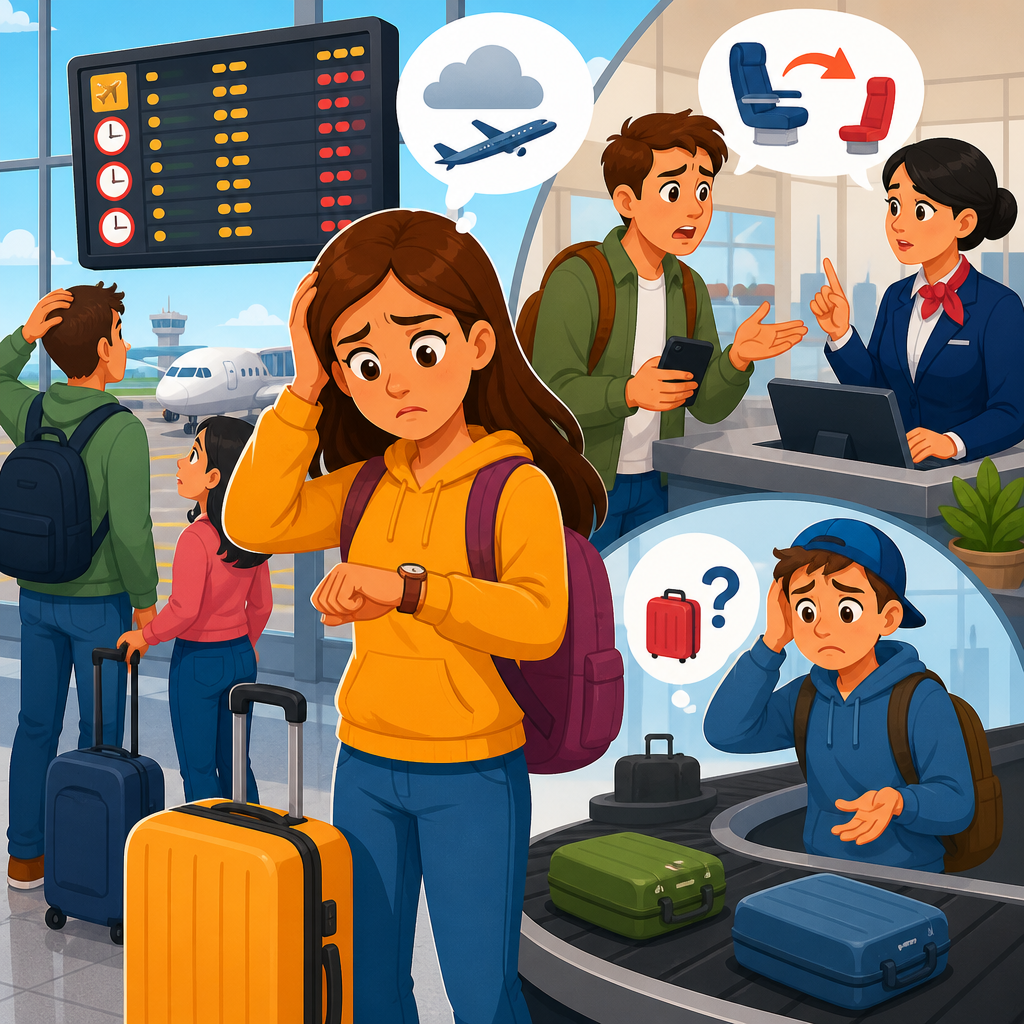
Travel problem vocabulary helps English learners handle the moments that matter most: a delayed flight, a missed connection, a rebooked ticket, or a lost suitcase. These situations create stress because the language is specific, fast, and often unfamiliar. I have coached travelers before international trips, and the same issue appears again and again: people know basic travel words like passport, gate, and boarding pass, but they freeze when staff say your flight has been delayed due to a mechanical issue or please proceed to the service desk for rebooking. Travel problem vocabulary means the words and phrases used when a trip stops going as planned. Delays are interruptions to the schedule. Rebooking is moving a traveler to a new flight, train, or hotel reservation after disruption. Lost items include baggage, documents, electronics, and personal belongings that are missing, stolen, or left behind. Knowing this vocabulary matters because it saves time, reduces misunderstandings, and helps you ask precise questions when every minute counts.
In practical terms, strong travel problem vocabulary lets you understand announcements, explain your situation clearly, and confirm what the company will do next. It also helps you recognize important differences. A delayed flight is not the same as a canceled flight. A missing bag is not always officially lost. A refund is different from a travel voucher, and a reissue can differ from a rebooking depending on the airline fare rules. When I prepare students for real travel conversations, I focus on exact phrases they will hear at airports, train stations, hotels, and customer service counters, because broad textbook English is rarely enough.
Travel providers also use standard operational language. Airlines talk about estimated departure time, final call, standby, involuntary change, and baggage claim. Hotels may use terms like reservation error, no vacancy, key card failure, or incident report. Public transport staff may say service disruption, replacement bus, platform change, or partial suspension. If you understand these terms, you can move from confusion to action quickly. That is why this article stays focused on three high-value areas: delays, rebooking, and lost items, with clear meanings, common phrases, and examples you can use immediately.
Delay vocabulary you will hear and need
A delay means a service will happen later than scheduled. The key question is whether the trip is still operating. If staff say delayed, the service is expected to continue. If they say canceled, it will not. Common causes include weather, air traffic congestion, mechanical problems, crew availability, security issues, and late inbound aircraft. In stations and airports, I often hear learners miss the phrase due to, which introduces the reason: The train is delayed due to signaling problems. Your flight has been delayed due to adverse weather. That small phrase carries the explanation.
Important nouns include departure, arrival, connection, platform, gate, schedule, update, disruption, and announcement. Important adjectives include delayed, postponed, rescheduled, and disrupted. Useful verbs are depart, arrive, miss, wait, hold, and notify. If you miss a connection because of a delay, say, My incoming flight was delayed, and I missed my connection to Madrid. If you need specifics, ask, What is the revised departure time? Is this the estimated delay or the confirmed departure time? Will boarding start at the original gate?
There are also status phrases worth memorizing. On time means no delay. Running late is common in everyday English, especially for trains and buses. Indefinitely delayed means there is no clear new time yet. Grounded is used for planes that cannot depart. Held at the gate can mean passengers are waiting to board or remain onboard. Service suspended means operations on that route are temporarily stopped. During major disruptions, staff may announce rolling delays, meaning the estimate may keep changing.
Travelers should also know compensation and support vocabulary, even if policies differ by country and carrier. You may hear meal voucher, hotel accommodation, transport assistance, duty of care, refund eligibility, and compensation claim. In the European Union, many passengers refer to EU261 rights for certain flight disruptions, while in the United States compensation rules are narrower and depend heavily on the situation. The vocabulary matters because the right question changes the outcome: Am I eligible for meal vouchers during this delay? Will the airline provide hotel accommodation if the delay extends overnight?
Rebooking language for changing plans fast
Rebooking is the process of moving your reservation to a new service after a disruption or personal change. At an airport desk, the staff member may say, We can rebook you on the next available flight. That phrase sounds simple, but next available does not always mean the next flight chronologically. It may mean the next flight with an open seat in your ticket class or under an airline agreement. Related terms include standby, confirmed seat, waitlist, itinerary, fare difference, change fee, waiver, ticket reissue, and alternate routing.
When I help travelers practice these conversations, I teach them to separate three questions: when can I travel, what will it cost, and what happens to my bags. A clear model sentence is, I need to be rebooked today if possible; what are my options through another city? Another is, Has the change fee been waived because the cancellation was involuntary? If the airline caused the disruption, involuntary rebooking usually means the company changes the reservation without charging the standard change penalty. If the traveler chooses to change plans for personal reasons, voluntary change rules usually apply.
| Term | Meaning | Useful question |
|---|---|---|
| Standby | You can travel only if a seat becomes available | Am I confirmed, or am I on standby? |
| Alternate routing | A different path to the same destination | Can you offer alternate routing through Chicago? |
| Fare difference | Extra price between old and new booking classes | Will I need to pay any fare difference? |
| Ticket reissue | A new ticket document reflecting the change | Has the ticket been reissued successfully? |
| Waiver | Permission to skip a normal fee or rule | Is there a waiver for weather disruptions? |
Other high-frequency expressions include direct flight, nonstop, layover, overnight connection, same-day change, and protected booking. Protected means the carrier has placed you on another service and reserved your place. Always ask for the booking reference, new departure time, terminal, and baggage status before you leave the desk. I also advise travelers to ask whether their seat assignment, meal preference, and checked baggage transfer automatically. Those details are often lost during irregular operations.
If you want broader housing and travel survival language, see the main guide on English for renting an apartment: words you need before you sign. Even though that guide covers a different situation, the same principle applies: precise vocabulary gives you leverage. In real service interactions, the person who can describe the problem accurately usually gets faster help.
Lost item vocabulary for baggage, documents, and valuables
Lost items create a different kind of problem because the traveler must describe an object, a timeline, and a location. The most common categories are lost baggage, misplaced personal items, stolen valuables, and missing documents. In airline language, delayed baggage means the bag did not arrive yet but may still be in transit. Lost baggage usually means the bag has not been located after a set period. Baggage claim is the pickup area, while a baggage service office handles reports. The formal document is often called a property irregularity report, or PIR.
To report a problem clearly, use a sequence. First identify the item: My checked suitcase did not arrive. Second give the last known location: I checked it in at Gatewick for the Lisbon flight. Third describe it precisely: It is a medium-sized black hard-shell suitcase with a yellow ribbon on the handle. Fourth mention valuables or essentials carefully: My medication and charger are inside. Fifth ask about next steps: Could you file a report and give me the reference number? This structure works because staff need exact details to search efficiently.
For personal items left behind, key verbs include leave, misplace, recover, retrieve, and hand in. If something may have been stolen, use stolen rather than lost. That difference affects reporting. A passport is especially urgent. Say, My passport is missing; I need to report it and contact my embassy. For phones and laptops, you may need serial numbers, tracking tools like Find My or Find My Device, and a police report for insurance claims. Hotels often use the term lost and found for items discovered after checkout.
Travelers should also know the vocabulary of follow-up. Useful nouns are claim number, reference number, receipt, reimbursement, replacement, inventory, declaration, and compensation limit. Many baggage claims require receipts for essential purchases such as toiletries or basic clothing. Some airlines apply daily or item-specific limits, and international carriage may be governed by the Montreal Convention, which sets liability rules for checked baggage on many international flights. The practical lesson is simple: ask what documents are required, what expenses are covered, and when to expect an update.
How to speak clearly under pressure
In stressful travel situations, short sentences work better than complex explanations. Start with the problem, then the request. Say, My flight to Seoul was canceled. I need to be rebooked tonight. Or, My backpack is missing. I think I left it in the taxi outside Terminal 2. Avoid long stories until staff ask for more detail. Confirm important information by repeating it: So the new flight leaves at 8:40 a.m. from Gate B12, and my bag will be transferred automatically, correct? Repetition prevents expensive mistakes.
Pronunciation and listening matter too. Numbers, letters, and times cause many errors. Practice saying booking references, flight numbers, and dates aloud. Know the phonetic alphabet for names if possible. Listen for hedging language such as estimated, subject to change, and currently, because those words signal uncertainty. In my experience, travelers who ask one direct follow-up question after every answer make fewer mistakes than travelers who nod politely and walk away confused.
Travel problem vocabulary is practical English with immediate value. Learn the exact difference between delayed and canceled, rebooked and waitlisted, missing and stolen. Memorize a few reliable question patterns, keep your requests brief, and always get a reference number when an item or reservation problem is reported. These words will help you protect your time, money, and peace of mind when plans change unexpectedly. Before your next trip, review the phrases in this article and practice saying them out loud once. That small step makes real travel problems much easier to manage.
Frequently Asked Questions
What travel problem vocabulary should English learners know first for delays, rebooking, and lost items?
The most useful place to start is with the exact words you are most likely to hear when something goes wrong. For delays, learn words and phrases like delayed, canceled, boarding time, departure time, estimated departure, gate change, missed connection, and mechanical issue. Airport staff often speak quickly and use short announcements, so recognizing these terms immediately can make a big difference. For example, if you hear “Your flight has been delayed due to a mechanical issue,” the key meaning is that the airplane needs technical attention and will not leave on time.
For rebooking, focus on vocabulary such as rebook, next available flight, standby, itinerary, travel voucher, confirmation number, connecting flight, and final destination. These words appear at service desks, on airline apps, and in customer support conversations. If your original flight is no longer possible, staff may say, “We can rebook you on the next available flight,” which means they can move your reservation to another plane with open seats.
For lost items, especially baggage, learn lost luggage, delayed baggage, baggage claim, carousel, baggage tag, file a report, claim number, and found items. It is also helpful to know the difference between something that is lost and something that is delayed. A delayed suitcase may still be located and on the way, while a lost suitcase may require a longer investigation. When learners build vocabulary in these three categories, they become much more confident because they can understand not just single words, but the whole situation around them.
How can I understand airport staff when they explain a delay or missed connection?
The first step is to listen for the core problem words rather than trying to understand every single sentence. In stressful travel situations, many English learners get stuck because they think they need perfect listening comprehension. In reality, you usually only need the key terms. If staff say, “There has been a delay due to weather conditions, and passengers with connecting flights should speak to customer service,” the important pieces are delay, weather conditions, connecting flights, and customer service. Once you catch those words, you understand the main action you need to take.
It also helps to know common reasons for delays. Airlines frequently mention weather, mechanical problems, air traffic control restrictions, crew availability, or late arrival of the aircraft. These phrases sound technical, but they appear again and again. If you miss part of an announcement, ask a direct question such as, “Is the flight delayed?” “What is the new departure time?” or “Will I miss my connection?” Short questions are easier to ask under pressure and usually produce clearer answers.
You should also be comfortable asking staff to repeat or simplify information. Phrases like “Could you say that more slowly, please?” “Can you repeat the new gate number?” and “Can you write that down for me?” are extremely practical. This is not a sign of weak English. It is exactly what effective travelers do. In real airports, even native speakers ask for clarification because announcements can be fast, noisy, and unclear. The goal is not perfect English. The goal is accurate understanding when timing matters most.
What should I say in English if I need to rebook a ticket after a delay or cancellation?
When you need to rebook, clarity matters more than complexity. Start with a simple explanation of the problem: “My flight was canceled,” “I missed my connection because of a delay,” or “I need to be rebooked.” These sentences are direct and immediately understandable to airline staff. Then follow with the result you need: “What is the next available flight?” “Can you rebook me today?” or “Do you have any other options to get me to my destination?” This kind of language is practical because it moves the conversation toward a solution.
It is also useful to understand common rebooking responses. Staff may say, “We can put you on standby,” which means you may get a seat if space becomes available. They may say, “The next available flight is tomorrow morning,” which means there are currently no open seats today. You may also hear, “We have reissued your ticket,” meaning your travel reservation has been officially changed. If a new route includes a transfer, staff might explain, “You will connect through another city,” so you should be ready to confirm the new itinerary, departure time, gate, and baggage instructions.
Good follow-up questions include: “Will my checked bag go to the new flight?” “Do I need a new boarding pass?” “Is there a hotel or meal voucher?” and “Can you send the updated itinerary to my email?” These questions are especially important because rebooking often creates additional issues beyond the flight itself. Travelers sometimes focus only on getting a seat and forget to ask about luggage, overnight accommodation, or visa-related timing. The most confident English learners are not the ones who use the fanciest words. They are the ones who ask clear, complete questions and confirm the details before leaving the desk.
What is the difference between lost luggage, delayed baggage, and missing personal items?
These terms sound similar, but they describe different travel problems. Delayed baggage usually means the airline knows where your suitcase is, but it did not arrive on the same flight as you. This can happen if your bag missed a connection or was loaded onto a later plane. In this case, staff often tell you the bag is “in transit” or “will be delivered.” Lost luggage is more serious. It usually means the airline cannot immediately locate your suitcase and needs time to trace it through its baggage system. You may need to file a formal report and wait for updates.
Missing personal items refers to things like a phone, wallet, passport, headphones, laptop, or jacket left on a plane, at security, in a taxi, or at the gate. These items are often handled through a lost and found office rather than the baggage desk. That distinction is important because many travelers waste time standing in the wrong line. If the missing item was checked in as luggage, speak to the airline’s baggage service team. If it was something you carried yourself, ask about lost and found, airport security, or the transportation company involved.
Knowing the correct term helps you describe the situation accurately. For example, “My suitcase did not arrive” suggests a baggage issue. “I left my backpack on the plane” points to a lost personal item. “My baggage tag says it should be here, but it is not on the carousel” gives staff a clear starting point. Specific vocabulary leads to faster help. It also reduces confusion at a moment when every minute feels stressful, especially after a long flight or during an international connection.
How can I report a lost suitcase or missing item in English effectively?
Start by stating the problem in one sentence: “My suitcase did not arrive,” “My bag is missing,” or “I left my phone on the plane.” Then give the most important identifying details. For baggage, staff usually need your baggage claim tag, boarding pass, passport, and details about the bag itself. Be ready to describe the suitcase by color, size, brand, and any distinctive features, such as ribbons, stickers, or a hard-shell case. A useful sentence is: “It is a large black suitcase with a red luggage strap.” That kind of description is much more helpful than simply saying, “It is a normal bag.”
You should also be prepared for common questions. Staff may ask, “Where did you last see it?” “Was it checked or carry-on?” “Do you have the baggage tag?” “What flight did you arrive on?” or “What is the address where you will be staying?” If the bag is delayed, the airline may deliver it to your hotel or home address. If the item is truly lost, they may give you a reference number or claim number so you can track the case. Make sure you understand how to use that number and how updates will be sent to you.
Finally, ask practical follow-up questions that protect your time and money. You can say, “When should I expect an update?” “How can I track the report?” “Will the bag be delivered to me?” and “





