
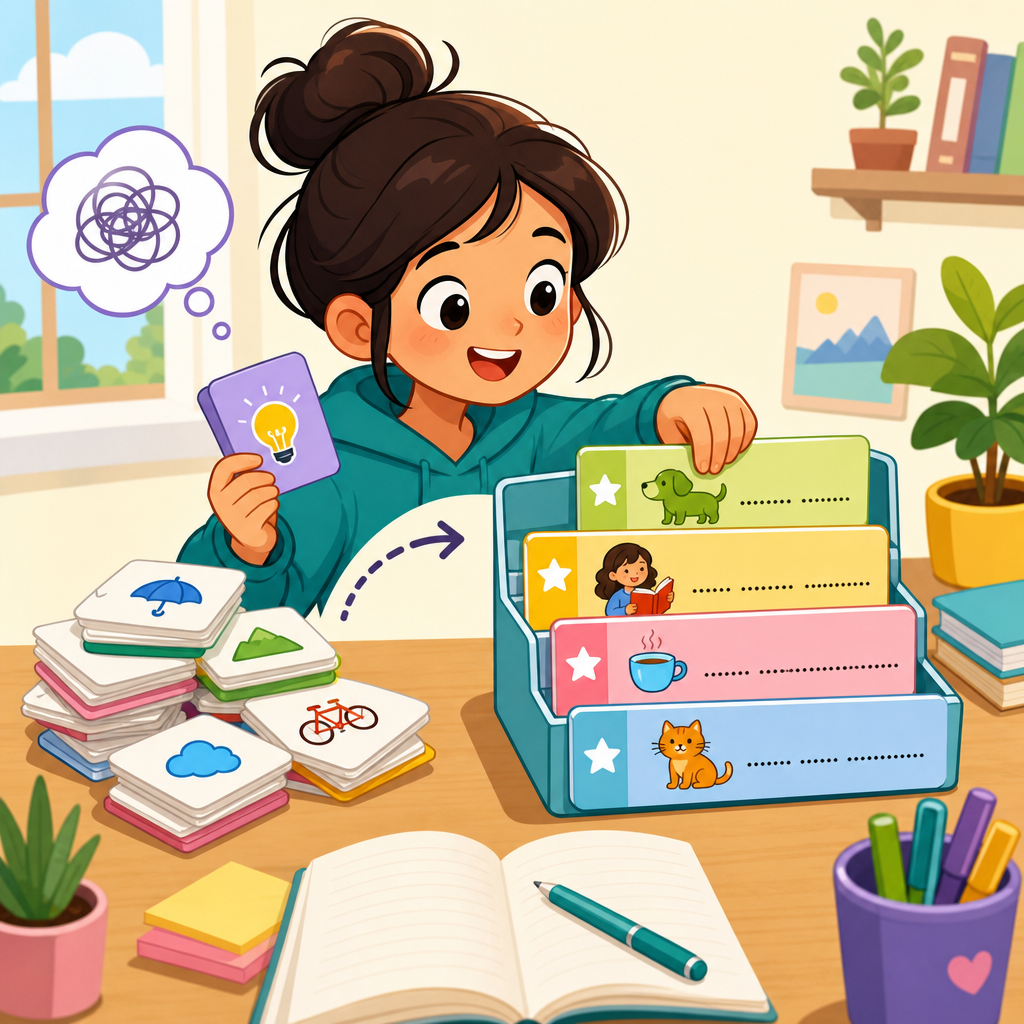
Turning new words into sentence banks instead of flashcards changes vocabulary study from isolated memorization into usable language practice. A sentence bank is a curated collection of example sentences built around words you are actively learning, usually drawn from sources you read, hear, or write yourself. Unlike a flashcard, which often reduces a word to a definition on one side and a translation on the other, a sentence bank preserves grammar, collocation, register, and context. That difference matters because words are not stored or retrieved in real communication as dictionary entries. They are recalled in patterns: “take responsibility,” “heavy traffic,” “raise an objection,” “under considerable pressure.”
I started recommending sentence banks after watching learners score well on vocabulary quizzes yet fail to use the same words accurately in essays, meetings, or conversation. The problem was not effort. It was the unit of study. Flashcards are efficient for testing recognition, especially in the early stage, but they often encourage a brittle kind of knowing. A learner may recognize “allocate” on a card and still hesitate when needing to say “allocate resources efficiently” in a real sentence. Sentence banks close that gap by teaching the word together with its natural partners, syntax, and typical meaning range.
For language learners, exam candidates, and even native speakers expanding professional vocabulary, this method improves retention and transfer. It also fits how memory works. Retrieval becomes easier when information is encoded with multiple cues: topic, sentence structure, speaker intent, and surrounding vocabulary. In practical terms, a sentence bank helps you remember not just what a word means, but when to use it, how to modify it, and what usually comes next. That is why turning new words into sentence banks instead of flashcards is one of the most effective focused vocabulary strategies available.
What a sentence bank captures that flashcards usually miss
A strong sentence bank captures five things flashcards often miss: collocation, grammar, connotation, register, and recall pathways. Collocation means the words that naturally appear together. Native-like use depends heavily on these combinations. We say “file a complaint,” not usually “make a complaint” in some formal service contexts, and “commit a crime,” not “do a crime.” Grammar matters too. Some adjectives are followed by specific prepositions, such as “responsible for,” while some verbs strongly prefer a certain pattern, such as “suggest doing” rather than “suggest to do.”
Connotation and register are equally important. “Slim” and “skinny” refer to similar physical ideas but carry different social meanings. “Terminate” and “end” can overlap, yet one sounds legal or bureaucratic while the other is neutral. In my own teaching notes, I often mark whether a sentence comes from academic writing, workplace conversation, news reporting, or casual speech. That small label prevents learners from sounding oddly formal in everyday talk or too casual in professional writing. A flashcard definition rarely carries all of that information clearly.
Most importantly, sentence banks create stronger recall pathways. When the brain stores a word inside a meaningful sentence, retrieval can start from several directions. You might remember the topic first, then the phrase, then the target word. Or you may recall the grammatical frame and fill in the missing item. This is similar to corpus-informed learning used in many advanced language programs. Teachers often use concordance lines from tools such as the British National Corpus, COCA, or SkELL because repeated sentence-level exposure reveals how words really behave. A personal sentence bank applies the same principle at learner scale.
How to build a sentence bank that is actually useful
The most useful sentence banks are selective, not massive. Start with words you genuinely expect to reuse within the next week or two. For each word, collect or write three to five sentences, each showing a different but common pattern. If the word is “issue,” one sentence might show the noun meaning problem, another might show the verb meaning distribute, and a third might show a standard workplace phrase such as “raise an issue during the meeting.” This range prevents false confidence based on only one use.
Source quality matters. Pull sentences from reliable places: graded readers, reputable news outlets, transcripts, textbooks, industry documents, or your own corrected writing. Avoid copying random examples that are too literary, culturally obscure, or structurally complex for your level. I advise learners to edit borrowed sentences slightly so they become personally relevant. “The committee allocated funds to rural schools” becomes “Our team allocated extra time to customer interviews.” Personal relevance improves memory because the sentence connects to lived experience, not just abstract language input.
Keep the format simple and consistent. A spreadsheet, notes app, or document works well if each entry includes the target word, sentence, source, and a brief note about pattern or usage. Bold the target word, but do not hide it immediately. First reread the sentence aloud, then cover the word and reconstruct it from context. The goal is not passive review. The goal is active retrieval from meaningful language. Over time, delete weak or unnatural examples and keep only sentences that feel memorable, accurate, and reusable.
A practical workflow for turning one new word into five usable examples
Many learners ask how to move from seeing a new word once to owning it in speech and writing. The fastest workflow I have used has four stages: notice, collect, adapt, and recycle. Notice the word in a real source and confirm its meaning with a good learner dictionary such as Cambridge, Longman, or Oxford. Collect two authentic example sentences that show common usage. Adapt two more sentences so they fit your work, studies, or daily life. Then recycle the word by writing one original sentence from memory later that day.
| Stage | What to do | Example with “allocate” |
|---|---|---|
| Notice | Check meaning and pattern | Verb meaning to distribute for a purpose |
| Collect | Save authentic examples | “The agency allocated emergency funds.” |
| Adapt | Personalize the sentence | “I allocated two hours to revision.” |
| Recycle | Use it from memory | “We need to allocate staff more carefully.” |
This workflow works because it combines comprehension and production. Authentic examples show frequency and natural form. Adapted examples make the language easier to retrieve because the content belongs to you. Memory research consistently shows that generation strengthens recall better than rereading alone; the “generation effect” is one reason self-produced sentences outperform copied definitions. In class, I have seen learners remember a word for months when they tied it to a real deadline, problem, or opinion, while copied flashcards faded within days.
Another practical rule is to vary the sentence environment without making the word unrecognizable. If you learn “maintain,” include one sentence about keeping something in good condition, one about sustaining a claim, and one about preserving a level: “maintain equipment,” “maintain that the policy is fair,” “maintain momentum.” That spread teaches semantic range while still staying within common usage. After five strong examples, stop. The point of a sentence bank is not volume. It is repeated contact with high-value patterns.
How sentence banks improve speaking, writing, and long-term retention
Sentence banks improve speaking because they give you ready-made frames, not just single words. In conversation, speed matters. You rarely have time to assemble grammar and collocation from scratch. If you have stored “I’m reluctant to commit before we see the data,” the word “reluctant” arrives together with a usable structure. Writing benefits in the same way. Learners who keep sentence banks usually produce fewer awkward combinations because they are drawing from tested patterns rather than translating directly from their first language.
Retention improves because review becomes richer. Instead of seeing “negotiate = discuss to reach agreement,” you review several situations: salary negotiation, negotiating deadlines, negotiating with a supplier. Each sentence acts as a retrieval cue. This mirrors distributed practice and interleaving principles used in effective study design. Reviewing smaller sets across several days beats cramming long vocabulary lists once. I recommend revisiting a bank after one day, three days, one week, and two weeks, with quick recall checks rather than long rereading sessions.
There is also a diagnostic benefit. Sentence banks reveal what you do not yet know. If you cannot produce a natural sentence with a word, you probably do not own it. If all your examples share one rigid pattern, your understanding may be too narrow. That visibility helps learners target weak points earlier. In exam preparation, I often ask students to highlight the sentence they could actually use under time pressure. The gap between “I recognize this word” and “I can deploy it accurately” becomes obvious, and that honesty leads to better study decisions.
Common mistakes and the best way to replace flashcards gradually
The biggest mistake is copying sentences that are too difficult, too long, or too rare. A sentence bank should support reuse, not admiration. If a sentence contains three unknown words, a passive clause, and an idiom you would never say, it will not help much. Another common mistake is storing only one sentence per word. One example can mislead you into thinking a pattern is universal when it is only one possibility. A third mistake is reviewing by reading only. Effective review means covering part of the sentence, completing it, paraphrasing it, or using the word in a new sentence.
You do not need to abandon flashcards completely. They still have value for high-frequency beginner vocabulary, technical terms, and quick recall checks. The better approach is gradual replacement. Keep flashcards for initial exposure, then promote important words into a sentence bank once they become relevant for actual use. Think of flashcards as a doorway and sentence banks as the room where the word lives. This hybrid system is practical, especially for busy learners who already use Anki, Quizlet, or paper cards and want deeper retention without rebuilding their entire routine.
The key takeaway is simple: if you want vocabulary you can actually use, study words in sentences you can actually imagine saying. Build a small, high-quality sentence bank from real sources, personalize it, and review it through active recall. Over time, your vocabulary stops feeling like a stack of definitions and starts functioning as language. Choose five new words this week, give each of them three strong sentences, and let context do the work flashcards cannot.
Frequently Asked Questions
What is a sentence bank, and how is it different from using flashcards for vocabulary study?
A sentence bank is a personal collection of example sentences built around words and phrases you are actively learning. Instead of storing a word by itself with a definition or translation, you save it inside a real sentence that shows how it behaves in natural language. That difference matters. A flashcard often teaches recognition of a word in isolation, but a sentence bank helps you notice grammar patterns, collocations, tone, word order, and the kinds of situations where the word actually appears.
For example, a flashcard might teach you that a word means “to improve,” but a sentence bank can show whether native speakers usually say “improve performance,” “improve significantly,” or “improve over time.” It also reveals whether the word sounds formal, conversational, academic, or emotional. In other words, sentence banks train usage, not just recall. They turn vocabulary study into a form of reading, listening, and writing practice at the same time, which is why many learners find the words easier to remember and easier to use correctly later.
Why are sentence banks often more effective than flashcards for long-term vocabulary retention?
Sentence banks tend to support stronger long-term retention because they connect each new word to multiple memory cues instead of just one. When you learn a word inside a sentence, you are not only remembering its meaning. You are also remembering the grammar around it, the neighboring words, the situation it appeared in, and sometimes even the source where you found it. Those layers of context make the word more memorable and more retrievable when you want to speak or write.
They are also effective because they mirror how language is actually used. In real communication, words do not appear alone. They arrive in patterns. You do not just know a word; you know what tends to come before it, what follows it, what tone it carries, and what structures it fits into. Sentence banks build that practical knowledge over time. As a result, learners often move beyond “I recognize this word” to “I can naturally use this word in my own sentence.” That shift is the real goal of vocabulary learning, especially for anyone who wants active command of a language rather than passive recognition.
How do I create a useful sentence bank without making the process too complicated or time-consuming?
The best sentence bank is simple enough to maintain consistently. Start by collecting sentences only for words you genuinely want to use, not every unfamiliar item you come across. A good rule is to save vocabulary that appears repeatedly, seems highly useful for your goals, or fills a gap in your speaking or writing. Then record one to three strong example sentences for each word or phrase. These can come from books, articles, podcasts, subtitles, conversations, or your own corrected writing.
Choose sentences that are clear, natural, and rich in useful patterns. If possible, include examples that show different forms or uses of the same word. You can organize your bank in a notebook, spreadsheet, notes app, or database, as long as it is searchable and easy to review. Many learners also highlight the target word, add a short note about meaning, and include tags such as topic, register, grammar pattern, or source. The key is not building a perfect system. The key is creating a bank you will revisit often enough that the sentences become familiar and reusable.
What kinds of sentences should I include in a sentence bank to make the vocabulary easier to use in real life?
Include sentences that are natural, specific, and representative of how the word is truly used. Avoid overly literary lines, awkward textbook examples, or sentences that are so complex that the target word gets buried. A good sentence should clearly demonstrate meaning while also showing useful structure. It should help you see how the word connects to common verbs, adjectives, prepositions, or sentence frames. That is where much of real fluency comes from.
It is also smart to include variety. One sentence might show the word in everyday conversation, another in a more formal or written context, and a third in a sentence you wrote yourself after receiving correction. That combination helps you understand flexibility and limits. If the word is part of a common phrase, save the entire phrase rather than isolating the single word. If it has multiple meanings, collect one sentence for each important meaning. Over time, your sentence bank should become a usage map, not just a storage list. The more your examples reflect language you actually want to speak, write, or understand, the more transferable your study becomes.
How should I review and use a sentence bank so the vocabulary becomes active instead of just familiar?
To make vocabulary active, review your sentence bank in ways that require production, not just recognition. Read the sentence aloud, cover part of it and try to reconstruct it, rewrite it with a different subject or tense, or use the same pattern to create a new sentence of your own. You can also group related sentences together and compare them to notice repeated structures. That helps you internalize not only the target word but the broader pattern it belongs to.
Another effective strategy is to recycle sentence-bank vocabulary into writing and speaking on purpose. Before a conversation, journal entry, or essay, choose a small set of words from your bank and challenge yourself to use them naturally. Afterward, check whether you used them correctly and refine your examples if needed. This creates a feedback loop: collect, review, use, adjust, and repeat. Sentence banks work best when they are living resources rather than static archives. If you keep interacting with your examples and turning them into your own language, the words stop being items you studied and start becoming tools you can actually use.





