
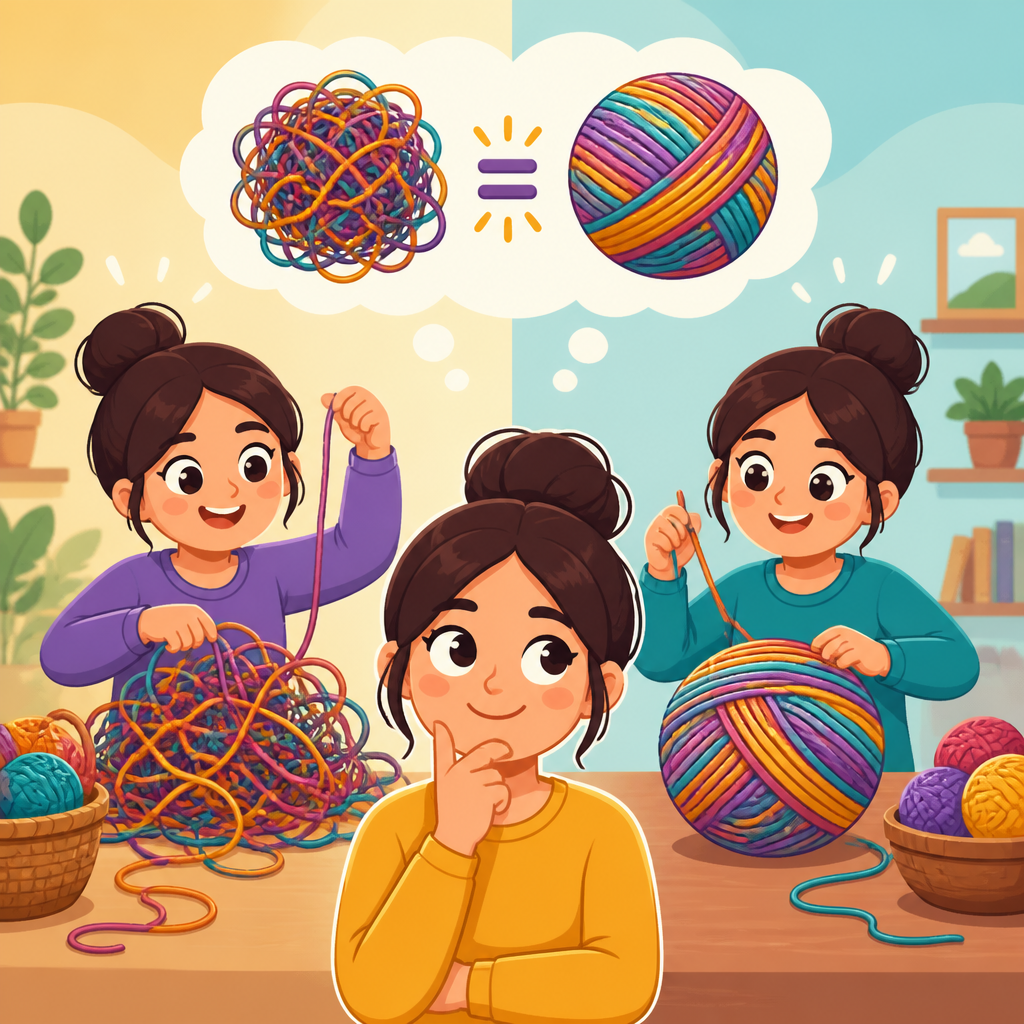
English is full of pairs that seem designed to trip up careful writers, but few are stranger than unravel and ravel. At first glance, they look like opposites: one appears to undo, while the other appears to do. Yet in standard usage, both verbs can mean “to disentangle” and “to come apart.” That apparent contradiction is exactly why this topic belongs at the center of any serious guide to confusing words in grammar. Understanding how these terms developed, where they overlap, and when one is clearer than the other helps writers avoid ambiguity without flattening the rich history of English.
In grammar and usage discussions, confusing words are terms that resemble each other in spelling, sound, or structure but differ in meaning, tone, or standard acceptance. Some, like affect and effect, are distinct words with distinct jobs. Others, like flammable and inflammable, create trouble because prefixes do not behave as readers expect. Unravel and ravel belong to a smaller, more fascinating class: words that look morphologically opposed but ended up sharing meanings through historical change. If you edit professionally, teach writing, or simply want cleaner prose, this distinction matters because reader expectations often clash with dictionary definitions.
I have seen this pair cause problems in everything from student essays to polished marketing copy. A sentence like “The mystery slowly raveled” may be technically defensible, but many readers will hesitate, wondering whether the mystery became more tangled or less so. That pause is a usability problem. Good grammar is not just about being right according to a dictionary; it is about choosing forms that communicate immediately. This article explains the history, current meaning, style implications, and broader lessons of unravel versus ravel, while also serving as a hub for the larger confusing words category under grammar.
What unravel and ravel mean today
In current English, unravel has two common meanings: first, to untangle threads, rope, hair, or another twisted material; second, to solve, explain, or break down something complex, such as a mystery, plot, plan, or relationship. You can unravel a knot, unravel a conspiracy, or watch a negotiation unravel. That range is well established in major dictionaries and in edited publication. It is the safer choice in nearly every context because readers instantly understand it.
Ravel is the tricky partner. In one established sense, it means to tangle, twist together, or complicate. Fabric can ravel at the edge, though in textile use that often means fray or come apart. In another documented sense, ravel can also mean untangle or disentangle. This is the source of the confusion. The same verb has been used for both “tangle” and “untangle,” while unravel settled more firmly into the meaning most people now expect. Because usage has standardized around unravel for clarity, ravel often feels archaic, literary, technical, or ambiguous depending on context.
The practical rule is simple: if you mean “to sort out” or “to come apart,” use unravel. If you mean “to tangle” or you are writing in a textile context where ravel means fray, use ravel only when the surrounding sentence removes doubt. This approach respects dictionary evidence while prioritizing readability.
How two opposite-looking verbs converged
The reason these verbs share meaning is historical, not logical. English did not build them in a neat modern system and then break its own rules. Instead, the words evolved across centuries, borrowing and shifting sense along the way. Ravel entered English with meanings related to entangling, fraying, and disordering. Over time, speakers also used it for the reverse action in some contexts, likely because dealing with threads naturally involves both tangling and untangling. Unravel emerged later and became the clearer, more widely preferred form for undoing tangles.
This kind of semantic overlap is not rare in English. Language changes through actual use, not through mathematical symmetry. A prefix like un- often signals reversal, as in untie or unlock, but not every apparent base verb behaves consistently enough to support a tidy opposite. Historical dictionaries such as the Oxford English Dictionary document these layered developments, and modern desk dictionaries preserve both senses because published evidence supports them. The result is a pair that looks contradictory only if you expect word formation to be perfectly regular.
For writers, the key lesson is that etymology explains usage but does not overrule audience perception. A historically defensible word can still be the wrong choice if it forces readers to stop and decode your intention.
When usage becomes a style decision
In editing, dictionary correctness is only the starting point. Style asks a different question: what wording delivers the intended meaning with the least friction? On that measure, unravel wins almost every time. Newsrooms, academic editors, and corporate style guides consistently favor the form that readers process fastest. If you write “investigators unraveled the fraud,” no one stumbles. If you write “investigators raveled the fraud,” many readers will assume an error, even if a dictionary somewhere allows the sense “untangle.”
That does not mean ravel is useless. It can be effective in literary prose, especially when a writer wants to suggest simultaneous fraying and complication. A novelist might describe a family history that “raveled at the edges,” combining the textile image of fraying with emotional disorder. In technical sewing or fabric care contexts, ravel remains precise. Instructions may note that loosely woven linen ravels easily, meaning threads separate at the cut edge. Here the domain tells readers exactly what is meant.
The best writers balance precision with expectation. Clear grammar is not merely adherence to possibility; it is the disciplined selection of the least ambiguous option.
Examples that show the difference in plain terms
Consider these examples from everyday writing situations. “She unraveled the necklace chain in ten minutes” clearly means she removed tangles. “The committee’s plan unraveled after the budget cuts” means the plan fell apart. “The detective unraveled the timeline” means the detective solved or clarified it. These are standard, natural uses that suit school, business, and publishing contexts.
Now compare sentences with ravel. “The yarn raveled in the wash” usually means the strands frayed or came loose. “His explanation only raveled the issue further” can mean made it more tangled or complicated. “She began to ravel the cord” may confuse readers because they cannot know at once whether she tangled it or untangled it. That uncertainty is the heart of the problem.
| Word | Most reliable meaning | Typical contexts | Best practice |
|---|---|---|---|
| unravel | untangle; solve; fall apart | mysteries, plans, threads, relationships | Use for general writing and clear communication |
| ravel | tangle; fray; sometimes untangle | textiles, literary prose, specialized usage | Use only when context removes ambiguity |
This same decision-making framework applies across confusing words more broadly. Good writers ask three questions: What does the word mean in dictionaries? What will most readers think it means? What choice produces the clearest sentence right now?
What this pair teaches about confusing words in grammar
Unravel versus ravel is more than an isolated curiosity. It illustrates the wider reasons confusing words persist in English. Some pairs become troublesome because sound changes collapse distinctions, as with disinterested and uninterested. Others become unstable because historical meanings overlap, as with imply and infer in casual speech, or because prefixes create false expectations, as with invaluable meaning extremely valuable rather than lacking value. Writers who understand these patterns make better choices across the whole grammar landscape.
As a hub for confusing words, this topic should connect readers to several recurring categories. The first category is look-alike forms, including compliment and complement. The second is sound-alike forms, such as peak, peek, and pique. The third is pairs split by function, such as who and whom or affect and effect. The fourth is words changed by context, where register or field determines meaning, as with ravel in textile writing. Building skill in one category makes the others easier because the underlying habit is the same: verify meaning, test context, and prefer reader clarity over cleverness.
When I train writers, I recommend consulting Merriam-Webster, Oxford, Collins, or the American Heritage Dictionary before assuming a word is wrong. Then I recommend a second test that dictionaries cannot do for you: imagine a busy reader encountering the sentence once, on a screen, without footnotes. If the wording slows comprehension, revise it. That practice improves grammar more reliably than memorizing rigid myths.
How to choose the right word every time
If your goal is strong, modern prose, treat unravel as the default verb for “untangle,” “solve,” and “fall apart.” Reserve ravel for contexts where fraying, tangling, or domain-specific usage is unmistakable. In formal writing, especially educational, professional, or web content, this choice reduces friction and strengthens trust. Readers should spend their energy on your ideas, not on decoding a historically complicated verb.
The broader payoff is larger than one word pair. Mastering confusing words sharpens revision habits, improves sentence precision, and reduces accidental ambiguity. English rewards writers who know both the rules and the exceptions, but it rewards clarity most of all. If you are building your grammar skills, start with high-impact pairs like unravel and ravel, then continue through the rest of the confusing words family. Review your usual trouble spots, check a reliable dictionary, and choose the form your reader will understand instantly.
Frequently Asked Questions
What do unravel and ravel actually mean, and do they really share the same meaning?
Yes. In standard English, both unravel and ravel can mean “to disentangle,” “to separate threads,” or “to come apart.” That is what makes the pair so striking. Most readers expect the prefix un- to reverse the meaning of the base word, so unravel looks as though it should be the opposite of ravel. In actual usage, however, the two verbs overlap heavily. You can unravel a knot, but historically and in many dictionaries, you can also ravel a knot out or say that fabric has raveled at the edge, meaning it has frayed or come loose.
The important point is that these are not neat logical opposites in the way learners might expect. Unravel commonly means to undo something twisted, tangled, or woven together, and it also extends naturally to figurative uses, as in unraveling a mystery or watching a plan unravel. Ravel can refer to tangling up, but it can also refer to loosening into threads or becoming unwoven. That dual history is why the pair often appears in discussions of contronyms and confusing verbs. If your goal is clarity for modern readers, treat unravel as the safer everyday choice, but do not assume that ravel must always mean the opposite.
Why do two opposite-looking verbs end up meaning almost the same thing?
The short answer is historical change. English did not build these words according to a tidy modern logic and then keep them frozen in place. Instead, meanings shifted over time through regional use, analogy, and repeated association with cloth, thread, knots, and fraying. The verb ravel developed senses connected both with entangling and with the loosening or fraying of woven material. Once that happened, unravel emerged and naturally took on the sense of undoing or disentangling. The result is a pair in which the newer form appears to reverse the older one, but the older one had already developed more than one direction of meaning.
This kind of semantic overlap is unusual, but it is not impossible in English. The language contains several words whose meanings split, broaden, or even turn back on themselves over centuries of use. With ravel and unravel, speakers ended up preserving both the idea of becoming tangled and the idea of coming apart into threads. Because textiles provide such vivid physical imagery, those senses stayed alive long enough to overlap in dictionaries and literature. So the contradiction is real only on the surface. Historically, both forms evolved through actual use rather than through strict word-building rules, and English often rewards usage more than logic.
Is there a difference between how ravel and unravel are used in modern writing?
Yes, and this is where usage advice becomes practical. In contemporary writing, unravel is far more common and far less likely to confuse readers. It is the standard choice when you mean to untangle yarn, decode a complicated situation, expose hidden facts, or describe something falling apart. Phrases such as unravel the plot, unravel the truth, the sweater began to unravel, and their agreement unraveled all sound natural and widely accepted in present-day English.
Ravel, by contrast, often feels more specialized, literary, or potentially ambiguous. Some readers know it mainly in the sense of “to tangle,” as in the threads raveled together. Others encounter it in textile contexts where it means “to fray” or “to come apart.” Because the word can pull readers in two directions, it may slow them down unless the context is very clear. That does not make ravel wrong. It simply means it carries more interpretive risk. In formal, instructional, academic, or broadly accessible prose, many editors would prefer unravel unless there is a stylistic reason to choose ravel. If you want precision and immediate comprehension, unravel usually wins.
When should writers choose unravel instead of ravel for the sake of clarity?
Choose unravel whenever you want your meaning understood instantly by the widest possible audience. That includes most grammar articles, business writing, news writing, academic prose, and general web content. If you are describing the solving of a puzzle, the explanation of a complex problem, or the breakdown of a relationship, system, or plan, unravel is the clearest and most familiar option. For example, investigators unraveled the fraud is easier for most readers to process than investigators raveled the fraud, which may sound odd or even incorrect to modern ears.
You should also favor unravel in figurative contexts. Readers readily understand expressions like the case unraveled, her story unraveled under questioning, or the committee unraveled the timeline. Those uses are firmly established. Use ravel more cautiously, especially if a sentence could be read either as “become tangled” or “come apart.” For instance, the hem began to ravel may be perfectly acceptable in a sewing context, but outside that context some readers may hesitate. As a general rule, if you are writing for clarity, searchability, and broad readability, unravel is the better default, while ravel works best when context removes any possible ambiguity.
Are ravel and unravel examples of a larger pattern in English grammar and vocabulary?
Absolutely. They are a memorable example of how English vocabulary does not always behave according to clean logical formulas. Many learners are taught to expect prefixes like un- to create a simple opposite, but real language history is messier. Words shift meaning, absorb regional variations, develop technical senses, and gain figurative uses that can overlap or conflict. In that sense, ravel and unravel illustrate an important principle in grammar and usage: form does not always predict meaning.
They also belong in the broader conversation about confusing words, semantic drift, and what some linguists call auto-antonyms or contronym-like behavior. Even if ravel is not always presented as a textbook contronym in every source, it certainly behaves in a way that surprises people because it can point toward entangling in one context and loosening or fraying in another. For writers, the lesson is valuable. Do not rely only on how a word looks; rely on established usage, dictionary evidence, and reader expectation. That is why this pair matters so much in serious grammar guidance. It reminds us that good writing depends not just on rules, but on understanding how English words actually live and change in real use.





