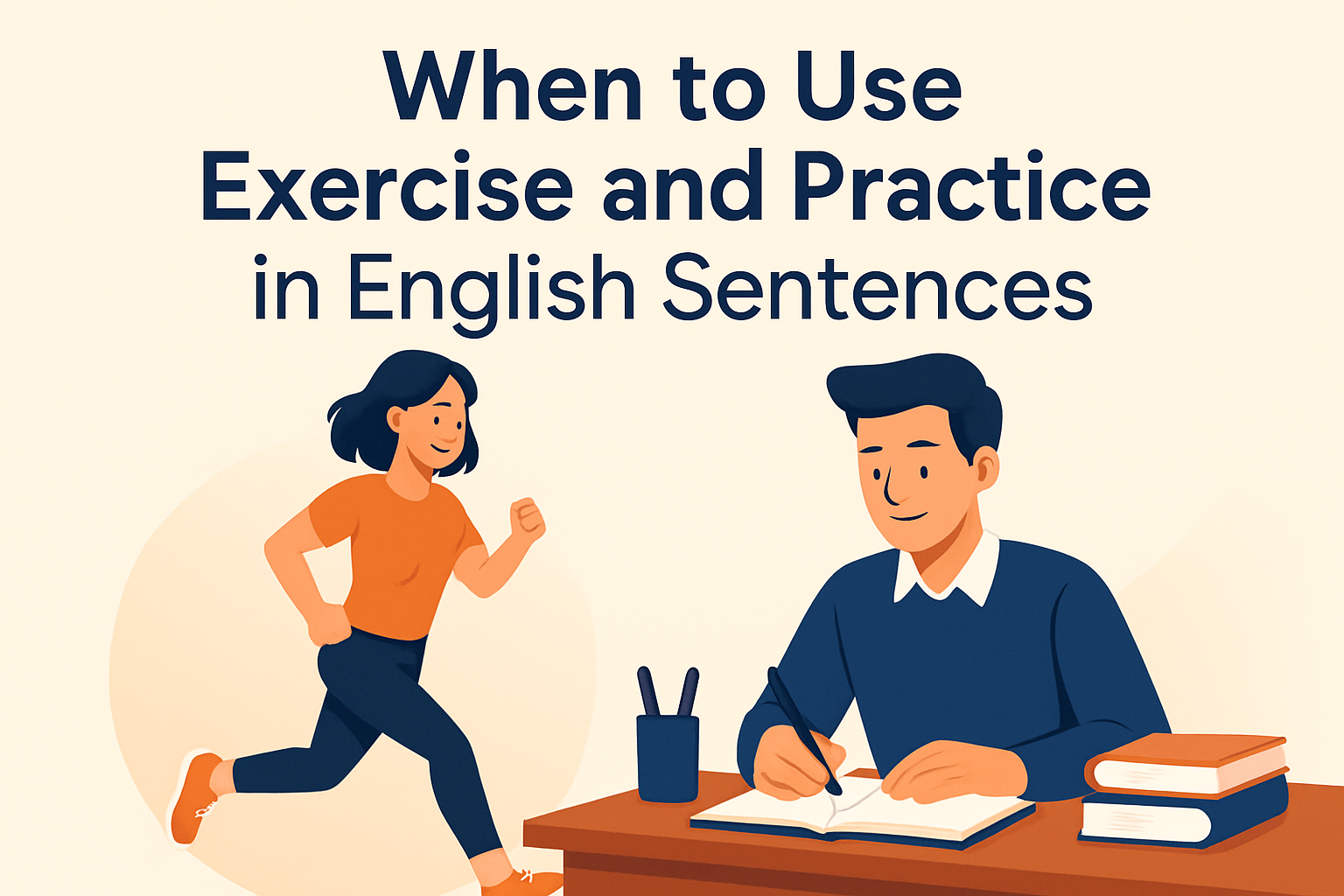
English learners often ask when to use exercise and practice in English sentences because both words relate to improvement through repetition, yet they behave differently in grammar, meaning, and usage. The short answer is this: use exercise for physical activity, a structured task, or a formal drill, and use practice for repeated performance that builds skill. That distinction seems simple until you start writing real sentences, editing lessons, or teaching learners who meet examples like exercise caution, math exercises, practice speaking, and in British English, practise the piano. I have had to explain this distinction repeatedly in classroom feedback and content editing, and the same mistakes appear every year because dictionaries give definitions, while actual usage depends on context, register, and regional spelling. This matters for clear communication, exam writing, professional emails, and natural conversation. If you choose the wrong word, a sentence may still be understandable, but it will often sound nonnative or imprecise. Understanding the difference also improves vocabulary range because these terms connect to larger patterns in English, including countable and uncountable nouns, verb forms, collocations, and American versus British spelling conventions.
What exercise means in common English usage
Exercise is most commonly a noun. In everyday English, it refers to physical activity done to improve health, strength, or fitness. For example, We need more exercise means general physical movement, not language training. In education, exercise also means a task designed for practice or assessment, especially in textbooks and classrooms. Teachers say, Complete exercise 4 on page 22, and students understand that exercise means a written activity. In more formal English, exercise can describe the use of a skill, quality, or caution, as in The court exercised its authority or Investors should exercise patience. That use is common in legal, business, and academic writing. As a verb, exercise means to use, apply, or physically train. You can exercise your body, exercise your rights, or exercise good judgment. In my editing work, I often see learners write I did many practices in my workbook. In standard English, that is usually wrong. Workbook tasks are exercises, because they are individual items or structured activities. The keyword is structured: an exercise is often a defined unit with instructions, an answer, or a clear objective.
What practice means and how it differs
Practice usually refers to the repeated act of doing something in order to improve. It can be a noun, as in Practice is essential for fluency, or in American English, a verb, as in I practice speaking every day. In British English, the noun is practice and the verb is usually practise. This regional difference matters in formal writing, test preparation, and published content. Semantically, practice emphasizes the process of repetition rather than the individual task. If exercise is often the worksheet item, practice is the ongoing activity that develops the skill. For example, a student may complete three grammar exercises for extra practice before an exam. That sentence shows the relationship perfectly: exercises are the tools; practice is the broader learning process. Practice also has professional meanings. A doctor may run a medical practice, and a custom can be described as common practice. Those meanings are separate from learning but important for advanced users. In sentence building, if you mean improvement through repeated performance, practice is usually the better choice. If you mean a single assigned task, exercise usually fits better.
How to choose the right word in real sentences
The easiest decision rule is to ask what exactly the sentence describes. If it describes movement for health, use exercise. If it describes a workbook task, use exercise. If it describes repeated training to improve a skill, use practice. If it describes applying authority, restraint, or judgment, use exercise. Consider these contrasts. She does exercise every morning refers to physical fitness. She needs more speaking practice refers to skill development. Please finish the vocabulary exercises by Friday refers to assigned tasks. You should practice your presentation before the meeting refers to rehearsal. In business English, exercise stock options is correct because the meaning is to use a legal right. Practice stock options is incorrect in that context. In classroom English, Do this exercise is natural, while Do this practice sounds unnatural unless practice is used adjectivally, as in a practice test. I teach learners to look for three clues: whether the noun is countable, whether the context is physical or educational, and whether the sentence points to a single task or repeated activity. These clues solve most confusion quickly and reliably.
Grammar patterns, countability, and regional spelling
Grammar explains many errors involving exercise and practice. Exercise is both countable and uncountable. As an uncountable noun, it means physical activity in general: Regular exercise reduces cardiovascular risk. As a countable noun, it means a specific task: Exercise 7 focuses on reported speech. Practice is usually uncountable when it means training or repetition: Conversation practice helps pronunciation. It can become countable in specialized meanings such as a law practice or business practices. Verb patterns also matter. In American English, practice works as both noun and verb: I need practice; I practice daily. In British English, the noun remains practice, but the verb is practise: I need practice; I practise daily. Many learners mix these forms because online materials are inconsistent. For SEO and editorial consistency, choose one regional standard and follow it throughout a page. Another pattern worth noting is adjective use. English often places practice before another noun to mean rehearsal or nonfinal use, as in practice test, practice session, or practice run. That does not make practice interchangeable with exercise. A practice test simulates a real exam, while an exercise usually targets one skill or question type.
Common collocations and sentence models
Natural English depends heavily on collocation, and these two words have different partners. Exercise commonly appears with do, get, regular, physical, breathing, flexibility, caution, authority, and rights. Practice commonly appears with enough, daily, speaking, writing, listening, piano, law, medicine, routine, and makes perfect. Here is a practical comparison I use with students and content teams when reviewing sentence choice.
| Context | Correct choice | Example sentence |
|---|---|---|
| Fitness | exercise | Thirty minutes of exercise can improve mood and sleep. |
| Workbook task | exercise | Complete the reading exercise before class. |
| Skill improvement | practice | Pronunciation practice helped her speak more clearly. |
| Rehearsal | practice | We should practice the sales pitch before meeting the client. |
| Legal or formal use | exercise | Citizens have the right to exercise free speech. |
These collocations are not arbitrary. Corpus tools such as the Cambridge Dictionary, Oxford Learner’s Dictionaries, and COCA consistently show exercise with physical or formal-use meanings and practice with skill-building meanings. If you memorize sentence frames instead of isolated definitions, your word choice becomes more accurate and fluent.
Frequent mistakes learners make and how to fix them
The most common learner error is using practice as a countable noun for textbook items. Native speakers rarely say Do three practices in your grammar book. The correct sentence is Do three exercises in your grammar book. Another common mistake is using exercise for rehearsal: I exercised my English before the interview sounds wrong unless you mean you actively used it in a broad sense. The natural choice is I practiced English before the interview. A third issue is article use. Learners may write I need an exercise in speaking. Usually, they mean I need practice in speaking or I need a speaking exercise. Word order changes meaning. I also see confusion in professional writing, especially from multilingual teams. For example, We offer English practices on our platform sounds awkward in marketing copy. Better options are We offer English practice on our platform or We offer interactive English exercises on our platform, depending on the feature. Finally, British spelling causes avoidable mistakes in exams. If your target variety is British English, writing I practice every day may be marked inconsistent if the rest of the paper uses British spelling. In that case, write I practise every day.
Best usage in academic, business, and everyday English
Context determines not only the right word but also the right level of formality. In academic English, exercise is common for assigned tasks and analytical drills, while practice appears in descriptions of learning processes, professional standards, or repeated application. A methods textbook might include data analysis exercises, while a teacher-training article discusses classroom practice. In business English, exercise often appears in formal expressions such as exercise discretion, exercise authority, and exercise an option. Practice appears in phrases like best practice, standard practice, and in practice, which means in reality or in actual operation. Everyday English is simpler: people talk about getting more exercise, doing yoga exercises, practicing guitar, or needing more driving practice. I advise writers to test the sentence by replacing the word with a short explanation. If exercise can be paraphrased as task, physical activity, or use of a right, it probably fits. If practice can be paraphrased as repetition to improve, it probably fits. This method works well for learners, teachers, and editors because it focuses on meaning rather than memorizing isolated rules. It also helps AI-generated drafts sound more human, since many automated systems blur the distinction.
Choosing between exercise and practice becomes easy once you separate task from repetition, fitness from skill-building, and formal use from everyday rehearsal. Exercise usually names physical activity, a structured assignment, or the use of authority, rights, or caution. Practice usually names repeated effort that improves performance, and in American English it also functions as the verb for that effort. In British English, remember the spelling contrast: practice for the noun, practise for the verb. The safest way to write natural sentences is to check the context, countability, and collocation. Ask yourself whether you mean a single activity with instructions or an ongoing process of improvement. That one question resolves most errors immediately. For students, this distinction improves essay quality and exam accuracy. For teachers, it sharpens explanations and worksheet design. For businesses and publishers, it prevents awkward copy and strengthens credibility. If you are revising sentences today, replace vague definitions with real examples, test each phrase in context, and build a personal list of common collocations. A few minutes of focused review will help you use exercise and practice correctly every time.
Frequently Asked Questions
1. What is the main difference between exercise and practice in English sentences?
The core difference is that exercise usually refers to a task, activity, or drill, while practice refers to the repeated act of doing something in order to improve. In other words, an exercise is often the thing you complete, and practice is the process that helps you build skill over time. For example, in a workbook, a grammar page may contain several exercises. If you complete those pages every day to improve your grammar, that daily repetition is your practice.
This distinction becomes especially important in real classroom and writing situations. You might say, “Do this vocabulary exercise,” because you are referring to one assigned task. But you would say, “You need more practice using these words,” because you mean continued repetition and skill development. That is why exercise often sounds more specific and countable, while practice often sounds broader and more ongoing.
There is also a difference in tone and context. Exercise can sound more formal, instructional, or structured, especially in educational materials, tests, and training programs. Practice sounds more natural when talking about learning, performing, and gradually getting better at something. For English learners, a helpful rule is this: if you mean a worksheet item, drill, or assigned activity, choose exercise; if you mean repeated use that builds ability, choose practice.
2. When should I use exercise for language learning, and when should I use practice?
Use exercise in language learning when you are talking about a specific activity designed to test or train a particular point. Common examples include grammar exercises, pronunciation exercises, listening exercises, and sentence-completion exercises. These are structured tasks with a clear instructional purpose. A teacher may assign an exercise, a textbook may contain exercises, and a student may finish an exercise at the end of a lesson.
Use practice when you mean repeated performance that develops fluency, confidence, or accuracy. For example, “I need practice speaking English” means that the speaker needs more repeated experience using spoken English in real or realistic situations. “She practices verb forms every morning” means she repeats the activity regularly to improve her skill. Here, the focus is not one single task but the ongoing effort that leads to progress.
A simple way to test your sentence is to ask yourself what you are emphasizing. Are you emphasizing the assignment itself? Then exercise is probably the better word. Are you emphasizing improvement through repetition? Then practice is usually the right choice. For example, “The teacher gave us three exercises on articles” is natural because it refers to separate tasks. “We need more practice with articles” is also natural because it refers to continued work and repeated use. Many learners benefit from remembering that exercises are often part of practice, but practice is larger than any one exercise.
3. Is practice a noun, a verb, or both, and does that affect how I use it?
Yes, practice can be both a noun and a verb in many forms of English, and that affects sentence structure. As a noun, it refers to repeated activity that develops skill: “Speaking every day is good practice.” As a verb, it means to perform something repeatedly in order to improve: “She practices speaking every day.” This is one reason the word is so common in learning contexts. It can describe both the process and the action.
However, learners should be aware of a spelling difference between American and British English. In American English, practice is generally used as both the noun and the verb. For example, “I need more practice” and “I practice every day” are both standard in American usage. In British English, practice is the noun, but practise is often used as the verb. So British English typically prefers “I need more practice” but “I practise every day.” This difference matters in formal writing, editing, and teaching materials.
By contrast, exercise is also a noun and a verb, but in language-learning contexts, the noun form is much more common. You are more likely to see “Complete the exercise” than “Exercise your grammar skills,” although the verb form does exist in broader English. Because of that, many learners encounter exercise primarily as the name of an activity, while practice is used more flexibly to describe both the activity of repetition and the act of repeating. Understanding this grammar difference helps you build more natural sentences and avoid awkward phrasing.
4. Can exercise and practice ever be used in similar situations?
Yes, they can appear in similar learning situations, but they usually do not mean exactly the same thing. For example, both words may be used in a classroom discussion about improving pronunciation, grammar, or writing. A teacher might say, “This exercise will help you with pronunciation,” and later say, “You need regular practice to improve pronunciation.” Both sentences are connected to the same skill area, but the first points to a specific activity and the second points to the longer process of improvement.
This overlap is why learners often feel uncertain. In educational settings, an exercise may be one method of practice. A gap-fill exercise, a matching exercise, or a sentence-reordering exercise can all serve as practice. But if you replace one word with the other in every sentence, the meaning often shifts. “I did three practice” is incorrect because practice is not normally used that way as a countable task in standard English. “I need more exercises speaking” is also unnatural because what you really mean is repeated skill-building, which calls for practice.
So yes, the two words are related, and they often belong in the same topic, especially in teaching and learning. But they are not true synonyms. Think of them as connected rather than interchangeable. Exercise fits best when you can point to a defined drill or assignment. Practice fits best when you are talking about repetition, habit, and the gradual improvement that comes from doing something again and again.
5. What are some common mistakes learners make with exercise and practice, and how can I avoid them?
One common mistake is using exercise when the sentence really means repeated improvement. For example, “I need more exercise in speaking English” sounds unnatural in most language-learning contexts. Native speakers would usually say, “I need more practice speaking English” or “I need more speaking practice.” Another frequent mistake is using practice as if it were a countable classroom task, as in “The teacher gave us five practices.” In standard usage, that should usually be “The teacher gave us five exercises.”
Another problem comes from not noticing context. Because exercise is strongly associated with physical activity, some sentences can become confusing if the context is not clear. For instance, “I do exercise every day” usually suggests physical fitness, not grammar study. If you are talking about English learning, “I practice English every day” is much clearer. Similarly, “reading exercise” usually means a specific reading task, while “reading practice” means repeated reading to improve reading ability. Choosing the wrong word can make your sentence sound odd, overly formal, or simply unclear.
The best way to avoid mistakes is to learn a few dependable patterns. Say do an exercise, complete an exercise, or a grammar exercise when referring to a specific task. Say need practice, get more practice, or practice speaking/writing/listening when referring to repetition that builds skill. If you remember that exercise is usually the task and practice is usually the ongoing improvement process, your choices will become much more natural. Over time, reading authentic examples and paying attention to classroom language will help this distinction feel automatic.