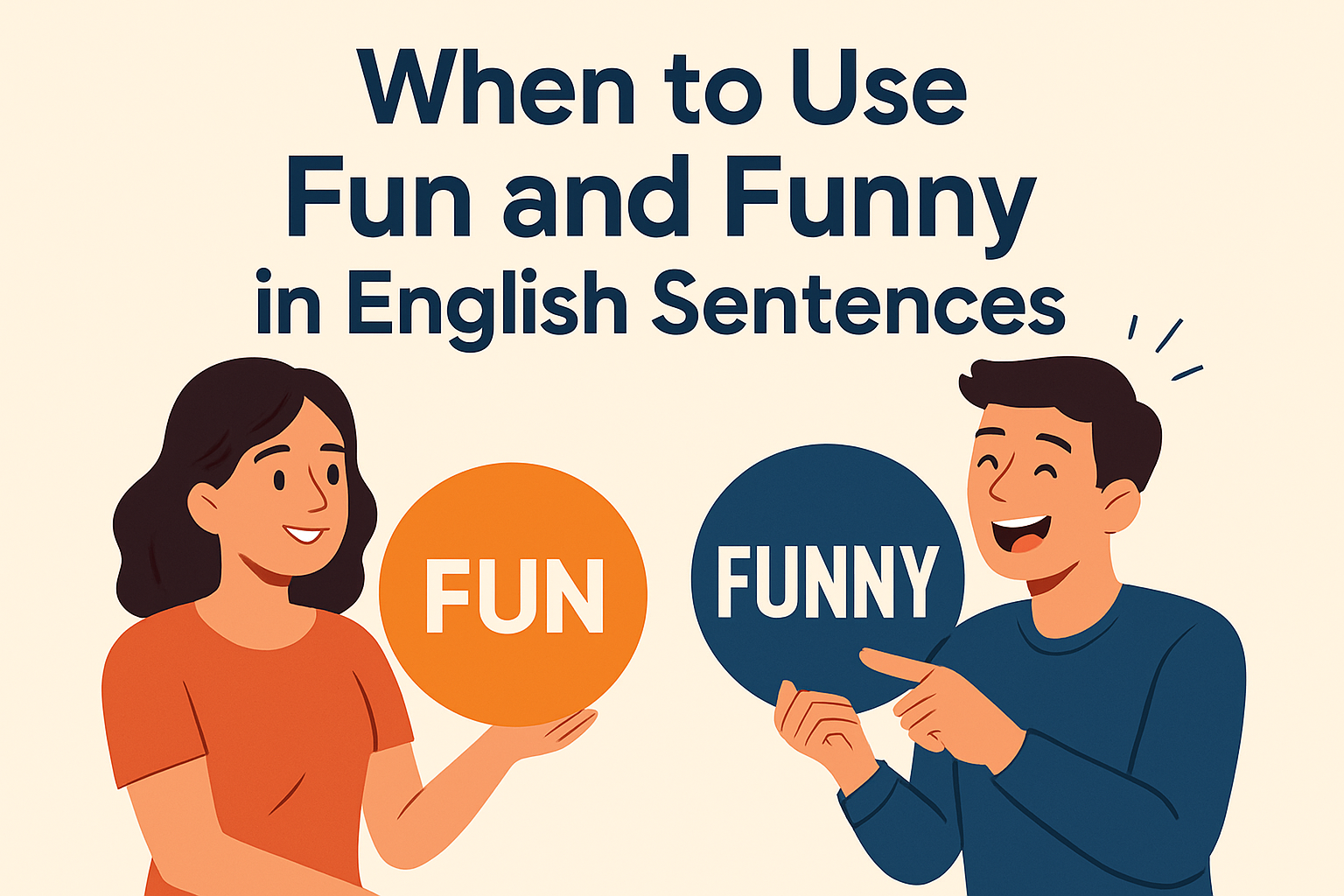
English learners and native speakers alike often hesitate over fun and funny, because the two words seem close in meaning but behave differently in real sentences. Understanding when to use fun and funny in English sentences matters because the choice affects clarity, tone, and even whether a sentence sounds natural to an educated reader. In everyday speech, people sometimes swap them casually, yet standard usage still follows clear patterns. Fun usually refers to enjoyment, pleasure, or an activity that creates a good time. Funny usually refers to something that causes laughter, amusement, or a sense that something is odd. That basic distinction sounds simple, but in actual writing and conversation the boundary is where mistakes happen.
I have edited business emails, school essays, and website copy where writers used funny when they meant enjoyable, or fun when they meant humorous. A sentence like “The workshop was funny” suggests the workshop made people laugh, perhaps because the speaker was entertaining. “The workshop was fun” means participants enjoyed it. That difference is not minor. It changes the reader’s picture completely. In SEO writing, educational content, and customer-facing communication, precise vocabulary builds trust. In spoken English, it prevents confusion. In formal contexts, it also helps a writer sound fluent rather than translated or uncertain.
There is also a grammar issue behind this topic. Fun has long been used as a noun, as in “We had fun,” and in modern English it is also commonly used as an adjective, as in “It was a fun trip.” Funny is an adjective, not a noun in this sense, and it describes either humor or strangeness, depending on context. Because language changes, style guides and dictionaries now accept adjectival fun widely, but some older speakers still prefer phrases like “a pleasant trip” or “an enjoyable trip” in very formal writing. Knowing that nuance helps writers choose the most effective word for audience, purpose, and register.
If you want a direct answer, use fun for experiences you enjoy and funny for things that make you laugh or seem strange. That rule covers most real situations. The rest of this article explains the grammar, common sentence patterns, frequent learner errors, and practical examples so you can use both words naturally and confidently.
The Core Difference Between Fun and Funny
The simplest distinction is this: fun describes enjoyment, while funny describes humor or unusualness. If you say, “The party was fun,” you mean the party was enjoyable. If you say, “The comedian was funny,” you mean the comedian made people laugh. English speakers rely on this difference constantly, and it appears in conversation, journalism, advertising, classrooms, and workplace communication. Searchers often ask, “Is fun the same as funny?” The direct answer is no. They are related because both can involve positive emotion, but they describe different qualities.
Here is the practical test I use when editing. Replace the word with enjoyable. If the sentence still makes sense, fun is probably right. Replace it with humorous, laughable, or amusing. If one of those works, funny is probably right. For example, “The game was enjoyable” supports “The game was fun.” “Her story was amusing” supports “Her story was funny.” This substitution method is especially useful for learners who speak languages where one adjective covers both ideas.
Funny also has a second meaning that learners miss. It can mean strange, suspicious, or slightly wrong. “My phone is acting funny” does not mean the phone is telling jokes. It means the phone is behaving oddly. “There is a funny smell in the kitchen” means the smell is unusual, not hilarious. This meaning is common in spoken English and appears often in American English. Context usually makes the meaning obvious, but writers should remember that funny does not always signal humor.
Fun, by contrast, almost always stays connected to enjoyment. You can have fun, make something fun, plan a fun activity, or describe someone as fun when they are enjoyable to be around. In contemporary English, “She is fun” is natural and common. It means she creates enjoyable experiences, not that she is a comedian. That distinction matters in social descriptions, dating profiles, event marketing, and team culture writing.
How Grammar Shapes Correct Usage
Grammar explains many of the mistakes people make with these words. Fun traditionally functions as a noun in sentences like “Did you have fun?” “The children had so much fun,” and “Learning can be fun.” In modern usage, especially in American English, it also works clearly as an adjective: “a fun class,” “a fun teacher,” “a fun weekend.” Major dictionaries such as Merriam-Webster and Cambridge recognize this adjective use, and it is standard in current speech and most informal to mid-formal writing.
Funny is a straightforward adjective. You can say “a funny movie,” “a funny comment,” or “He looks funny in that hat.” You would not normally say “We had funny” to mean “We had fun.” That sounds ungrammatical because funny does not fill the noun role that fun does. This is one reason learners should memorize common sentence frames rather than only definitions.
The most useful sentence patterns are easy to apply:
| Purpose | Correct Pattern | Example |
|---|---|---|
| Describe enjoyment | have fun | We had fun at the science museum. |
| Describe an enjoyable thing | fun + noun | It was a fun lesson on idioms. |
| Describe a humorous thing | funny + noun | She told a funny story about travel. |
| Describe a humorous person | be funny | He is funny without trying too hard. |
| Describe odd behavior | act/look/smell funny | The engine sounds funny today. |
One subtle point is comparison. Native speakers naturally say “more fun” and “funnier.” For example: “Board games are more fun with four people,” and “This joke is funnier in context.” Although funner appears in casual speech, especially with children or in playful tone, more fun remains the safer choice in professional writing. If you aim for polished English, use more fun, most fun, funnier, and funniest.
Common Real-World Examples and Mistakes
In classrooms, the most common learner mistake is saying “It was so funny” after an enjoyable activity that was not humorous. For instance, after a beach trip, a learner may say, “Yesterday was very funny.” A native speaker may pause because the sentence suggests a comic or bizarre event rather than a pleasant day. The intended meaning is “Yesterday was very fun” or, more naturally, “Yesterday was a lot of fun.” That last pattern is extremely common and worth memorizing.
At work, confusion between these words can create an unintended tone. Imagine a manager writing, “Thank you for the funny training session.” If the session was about compliance or software procedures, funny may imply the presenter made jokes or that the session was unintentionally ridiculous. If the manager means participants enjoyed the format, fun is the correct choice. I have rewritten client newsletters where this exact problem weakened the professional message.
Marketing copy also benefits from precision. A travel company can honestly promise “a fun family itinerary” because that highlights enjoyment. Calling an itinerary “funny” would sound strange unless the tour specifically features comedy shows or humorous guides. Likewise, a toy brand may describe a product as “fun and educational.” If it says “funny and educational,” buyers expect humorous content, perhaps a talking puppet or joke book, not just an engaging learning tool.
Social descriptions create another frequent issue. “My friend is fun” means your friend is enjoyable to spend time with. “My friend is funny” means your friend makes people laugh. A person can be both, of course. Many strong social profiles use both words with distinct meanings: “She is funny, fun to travel with, and easy to talk to.” That sentence sounds natural because it separates humor from general enjoyment. Using both accurately makes descriptions more vivid and believable.
Entertainment reviews show the distinction clearly. A movie can be fun without being especially funny. Action films, adventure stories, and many video games are often described this way. Critics might say a superhero film is “fun, fast-paced, and visually inventive” even if it is not a comedy. A stand-up special, by contrast, should be funny. If a comedy is described as fun but not funny, the reviewer usually means the energy is enjoyable while the jokes themselves are weak.
Register, Style, and Modern Usage Nuance
Many people ask whether fun is acceptable in formal English. The accurate answer is yes, in most modern contexts, but audience still matters. In business blogs, educational articles, email newsletters, and standard web copy, “fun” as an adjective is completely natural. Sentences such as “We designed a fun onboarding process” or “The lesson includes fun practice activities” no longer feel incorrect to most readers. Corpus evidence from contemporary English usage supports this shift, and major dictionaries reflect it.
That said, very formal or traditional writing may prefer alternatives like enjoyable, engaging, entertaining, or pleasurable. If you are writing a legal memo, an academic paper, or a highly conservative institutional report, “fun” may sound slightly informal. In those settings, the issue is not correctness but tone. Choosing the more formal synonym can better match the document’s purpose. Good writers understand this register difference instead of applying one rule everywhere.
Funny also requires attention to tone because it can be positive, critical, or ambiguous. “She gave a funny speech” could mean she was witty, but in some contexts it could suggest the speech was odd or inappropriate. If clarity matters, use a more exact adjective such as humorous, witty, amusing, odd, suspicious, or bizarre. Precision is especially important in journalism, performance reviews, and intercultural communication, where readers may not infer your intended shade of meaning.
Regional and generational variation also plays a role. Older style preferences sometimes resist “a fun day,” while younger speakers use it freely. American English generally embraces adjectival fun more strongly than older British usage did, although modern British English also uses it widely now. In practical terms, global readers will understand “fun” without difficulty. The bigger risk today is not that fun sounds wrong, but that writers fail to distinguish it from funny clearly enough.
As a working rule, choose the word that matches the exact experience. If the focus is pleasure, use fun. If the focus is laughter, use funny. If the focus is strangeness, funny may also work, but consider whether odd or unusual would be clearer. This habit makes your English more precise, natural, and trustworthy across formal and informal contexts.
A Quick Decision Framework You Can Use Every Day
When you need to decide quickly, ask one of three questions. First, did the person, event, or thing create enjoyment? Use fun. Second, did it make people laugh? Use funny. Third, did it seem strange or suspicious? Funny may fit, but check whether odd or unusual communicates better. This framework is simple enough for learners and robust enough for professional writers, teachers, and editors.
Let us apply it to common sentences. “The children had fun at the park” is correct because the experience was enjoyable. “The clown was funny” is correct because the clown caused laughter. “I heard a funny noise in the basement” is correct because the noise seemed unusual. “Our accounting seminar was fun” works if the session was engaging. “Our accounting seminar was funny” works only if the speaker or examples were humorous. The difference is entirely about meaning, not about level of enthusiasm.
You can also remember two high-frequency chunks: have fun and be funny. These fixed patterns appear constantly in spoken and written English. “Have fun at the concert” is a standard farewell. “Try to be funny” refers to making jokes or acting in a humorous way. Because these phrases are so common, mastering them improves fluency immediately. Learners who internalize chunks usually make fewer mistakes than learners who rely only on dictionary definitions.
Another useful strategy is proofreading for unintended implications. If you wrote funny, ask whether you truly mean humorous or strange. If not, change it. If you wrote fun, ask whether enjoyable is the core idea. If yes, keep it. This takes seconds and prevents many awkward sentences. In content writing, product pages, and email communication, that small check can make your message sound much more natural to native readers.
The takeaway is practical: fun and funny are not interchangeable, but they are easy to manage once you link each word to its main function. Build your sentences around enjoyment, laughter, or oddness, and the correct choice becomes obvious. If you want to sound more fluent, start noticing how native speakers use “have fun,” “a fun experience,” “a funny joke,” and “that seems funny” in real contexts. Then apply those patterns in your own speech and writing today.
Frequently Asked Questions
1. What is the main difference between fun and funny in English?
The main difference is that fun relates to enjoyment, while funny relates to humor or something that causes laughter. If something is fun, it is pleasant, entertaining, or enjoyable to do. For example, “The game was fun” means the game was enjoyable. If something is funny, it is amusing or makes people laugh. For example, “The joke was funny” means the joke was humorous. This distinction is important because the two words are not normally interchangeable in standard English. Saying “The party was funny” suggests the party was odd or laughable, not simply enjoyable. Saying “The comedian was fun” can sound unnatural unless you mean that being around the comedian was enjoyable. In most everyday situations, choosing fun for enjoyable experiences and funny for humorous things will make your meaning clear and natural.
2. Can fun and funny ever describe the same thing?
Yes, but they describe different qualities of that same thing. An activity, person, movie, conversation, or event can be both fun and funny, but each word highlights a separate idea. For example, a comedy show can be fun because attending it is enjoyable, and it can also be funny because the jokes make people laugh. A friend can be fun if spending time with that friend is enjoyable, and funny if that friend often says humorous things. This is where learners often get confused: both words may fit the same general situation, but they answer different questions. Fun answers, “Did you enjoy it?” while funny answers, “Did it make you laugh?” Keeping that difference in mind helps you choose the right word more naturally. In real conversation, a sentence like “It was a fun and funny evening” sounds perfectly natural because it tells the listener the evening was enjoyable and full of humor.
3. Is fun an adjective, and is it correct to say “It was fun”?
Yes, in modern English it is completely correct and natural to say “It was fun.” Traditionally, fun began primarily as a noun, as in “We had fun,” but in current standard usage it is also widely accepted as an adjective, especially in everyday speech and writing. Sentences such as “The trip was fun,” “That sounds fun,” and “She is fun to be with” are all common and natural. This matters because some learners are taught older rules that make them overly cautious. Today, educated native speakers regularly use fun as an adjective in both spoken and written English. However, it still behaves differently from funny. You would usually say “a fun game,” “a fun class,” or “a fun teacher,” meaning enjoyable, but you would not use fun when you specifically mean humorous. So while “It was fun” is correct, “It was funny” changes the meaning entirely. One means enjoyable; the other means amusing, strange, or laugh-inducing depending on the context.
4. Why does funny sometimes mean “strange” instead of “humorous”?
Funny has more than one common meaning in English. Its primary meaning is “amusing” or “causing laughter,” but it can also mean “strange,” “odd,” or “suspicious.” Context usually makes the intended meaning clear. For instance, “That movie was funny” usually means the movie was humorous. But “There’s something funny about this message” usually means something seems unusual or suspicious, not amusing. This second meaning is very common in natural English, especially in conversation. That is why speakers need to be careful when using funny. If you say, “My boss is funny,” listeners may understand that your boss is humorous, but depending on tone and situation, they might also think you mean your boss is odd. If your meaning is simply that your boss is enjoyable to be around, fun may be the better word. Understanding this extra meaning of funny helps avoid ambiguity and makes your sentences sound more precise.
5. What are the most common mistakes learners make with fun and funny?
One of the most common mistakes is using funny when fun is needed. For example, learners may say “The beach was very funny” when they mean it was enjoyable. In standard English, that sounds incorrect or at least very strange, because beaches are not usually humorous. Another common mistake is using fun when talking about jokes, comedians, or stories that cause laughter. For example, “That joke was fun” is less natural than “That joke was funny,” unless you mean the whole experience around the joke was enjoyable. Learners also sometimes struggle with sentence patterns. “We had fun” is correct, but “We had funny” is not. “She is funny” is correct, but it means she is humorous or perhaps a little odd, not simply enjoyable. A useful strategy is to pause and ask what exactly you want to express: enjoyment or humor. If the focus is pleasure, use fun. If the focus is laughter or amusement, use funny. Making that small distinction consistently will improve clarity, tone, and overall naturalness in both speaking and writing.