
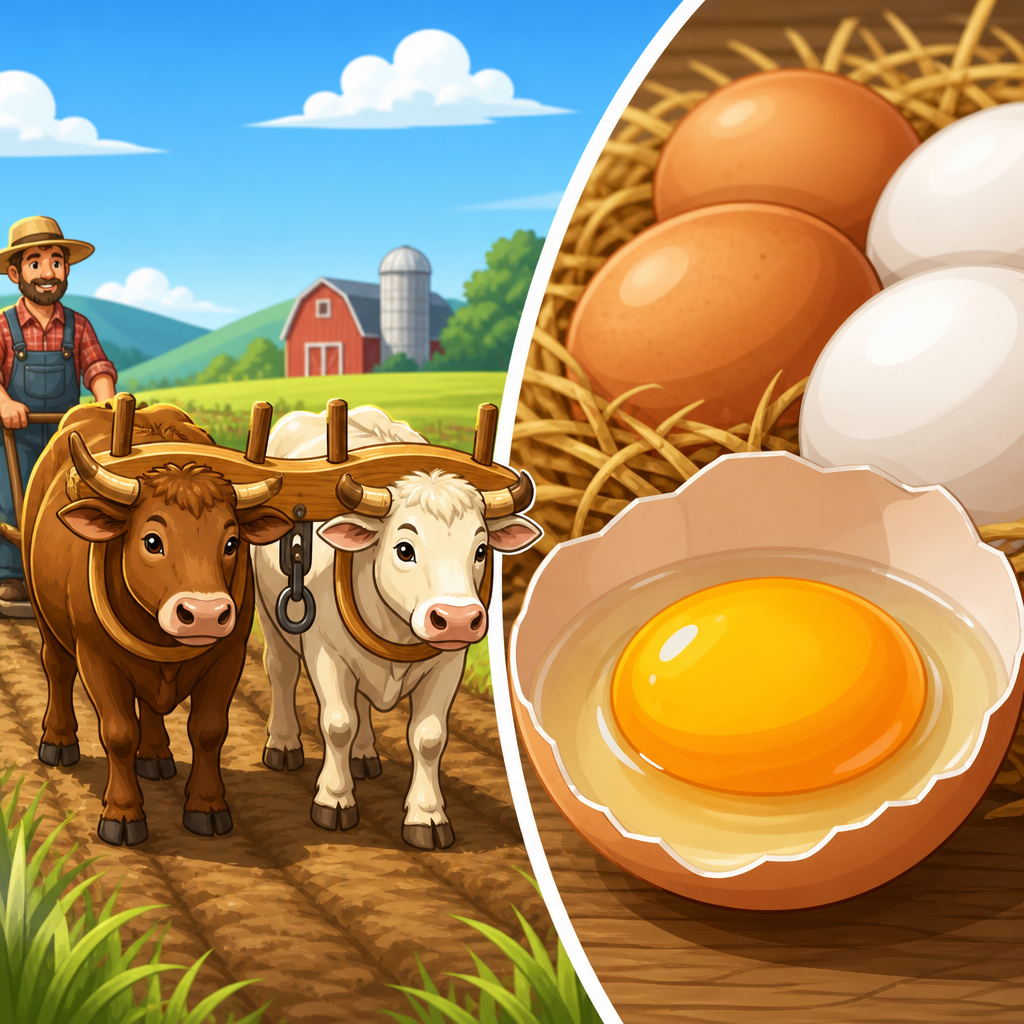
Yoke vs yolk is a classic example of confusing words: two terms that sound almost identical yet refer to completely different things. In grammar and vocabulary work, pairs like this matter because a single misplaced letter can change a sentence from clear to absurd. I have edited enough school papers, product descriptions, and farm-history articles to see this confusion appear in real drafts, especially when writers rely on spellcheck instead of meaning. A grammar hub on confusing words should start here because the contrast is vivid, memorable, and useful for building better proofreading habits.
A yoke is a wooden or shaped harness used to join draft animals such as oxen so they can pull a load together. By extension, yoke can also mean a burden, a bond, or a frame placed across the shoulders to carry pails. Yolk, by contrast, is the yellow center of an egg, the nutrient-rich portion that nourishes a developing embryo and gives color and richness to many recipes. The pronunciation overlap makes these words homophones in many accents, which is exactly why they cause trouble in writing.
Understanding yoke vs yolk matters for more than spelling accuracy. It improves reading comprehension, supports precise search intent, and helps writers choose the right word in academic, culinary, agricultural, and religious contexts. Someone researching ox harness design needs content about a yoke, not omelet ingredients. Someone learning how emulsification works in mayonnaise needs yolk, not animal traction history. When a grammar article answers these distinctions directly, readers can fix mistakes faster and build a reliable method for handling other confusing words such as there, their, and they’re or affect and effect.
What Is a Yoke?
A yoke is a device, traditionally made of wood, used to fasten two draft animals together at the neck or shoulders so they can pull as a team. The most recognized form is the ox yoke, a heavy crosspiece fitted over the necks of two oxen and secured with bows. In historical agriculture, the yoke was essential technology. Before tractors became standard in the twentieth century, farmers around the world depended on yokes with oxen, water buffalo, or other animals to plow fields, haul timber, and move carts.
The word also has figurative meanings. In literature, religion, and political writing, yoke often symbolizes oppression, obligation, or partnership. Phrases such as “under the yoke” refer to subjugation, while “take my yoke upon you” uses the image of shared labor and guidance. There is also a carrying yoke, a pole balanced across the shoulders with loads hanging from each end, still associated with traditional water carrying in many cultures. Context usually makes the meaning obvious, but the spelling remains constant: if it involves harnessing, bearing, joining, or burden, yoke is usually the correct word.
What Is a Yolk?
Yolk is the rounded yellow or orange center of an egg. In biological terms, it contains lipids, fat-soluble vitamins, minerals, and proteins that support embryo development in fertilized eggs. In cooking, yolk provides richness, color, and thickening power. Egg yolks are central to custards, lemon curd, hollandaise, aioli, carbonara, and many baked goods. The lecithin in yolk acts as an emulsifier, which is why it helps oil and water-based ingredients combine into stable sauces.
Not every yolk is bright yellow. Its color depends largely on a hen’s diet, including carotenoid-rich feed such as marigold petals, alfalfa, or corn. A deeper orange yolk does not automatically mean the egg is more nutritious, though consumers often assume it does. In writing, yolk should appear whenever the topic is eggs, nutrition, cooking, poultry science, or breakfast. If the sentence could logically involve frying, whisking, poaching, separating whites, or discussing cholesterol, the correct spelling is yolk.
Yoke vs Yolk: The Core Difference
The simplest distinction is this: yoke belongs to farming, harnessing, joining, and figurative burdens; yolk belongs to eggs and food. One useful editing test is to replace the word mentally with a definition. If your sentence means “wooden harness” or “burden,” choose yoke. If it means “egg center,” choose yolk. This direct substitution method is one of the fastest ways to correct homophone errors because it forces you to check meaning instead of sound.
Consider these examples. “The farmer repaired the ox yoke before spring plowing” is correct because the sentence refers to farm equipment. “The baker whisked the egg yolk into the custard” is correct because it refers to the inside of an egg. Errors become obvious when definitions clash: “The baker whisked the egg yoke” suggests a wooden harness in a mixing bowl, while “the farmer repaired the ox yolk” imagines livestock wearing breakfast. That absurdity is memorable, and memory is useful in grammar instruction.
| Word | Meaning | Common Contexts | Correct Example |
|---|---|---|---|
| Yoke | Harness, crosspiece, burden, joining device | Farming, history, religion, metaphor | The oxen wore a wooden yoke. |
| Yolk | Yellow center of an egg | Cooking, nutrition, poultry, biology | The yolk made the sauce silky. |
Why Writers Confuse These Words
Writers confuse yoke and yolk because English spelling does not always map neatly to pronunciation. In many dialects, both words are pronounced the same way, making them homophones. When people draft quickly, they often choose the spelling that looks more familiar rather than the one that matches the intended meaning. Autocorrect does not reliably catch this mistake because both spellings are valid words. Grammar checkers can miss it too if the sentence remains structurally acceptable.
I see this most often in three settings: student essays, recipe blogs, and general-interest history writing. A student discussing symbolism may write “the yolk of oppression” after hearing the phrase aloud in class. A food writer may accidentally type “runny yoke” because yoke feels visually closer to yoke-like shape words. Search behavior contributes as well. People often hear a term in a video or conversation, then type the version they guess. That is why confusing words pages need to answer both definitions clearly and provide immediate examples.
How to Remember Yoke vs Yolk
The best memory devices are simple and tied to meaning. For yoke, think of the letter e in the middle as standing for equipment. A yoke is a tool used with animals or for carrying loads. For yolk, think of the letter l as standing for liquid center, even though a yolk can be partly set when cooked. These mnemonics are not linguistic history, but they work in practice because they attach spelling to function.
Another method is category association. Put yoke in the farm and metaphor box; put yolk in the kitchen and biology box. When proofreading, ask which box your sentence belongs in. If you are still unsure, look at nearby words. Terms such as oxen, plow, burden, neck bow, and harness point to yoke. Terms such as shell, white, whisk, scramble, cholesterol, and custard point to yolk. This contextual reading habit scales well to the full confusing words category, where surrounding vocabulary often reveals the correct choice faster than a dictionary check.
Usage Examples, Idioms, and Edge Cases
Yoke appears in both literal and figurative English. Literal examples include “The carpenter carved a new yoke for the team of oxen” and “She balanced two water buckets with a shoulder yoke.” Figurative examples include “The colony threw off the yoke of imperial rule” and “They entered a marriage yoke,” though that last phrasing is now uncommon outside formal or religious contexts. Historical writing may also use yoke as a unit, as in “a yoke of oxen,” meaning a paired team.
Yolk has a narrower range but appears across scientific and culinary registers. Examples include “Separate the yolk from the white,” “Duck egg yolks are prized in some pasta recipes,” and “The yolk sac nourishes the embryo early in development.” One edge case worth noting is metaphor. Writers sometimes describe the sun as “a golden yolk” in poetic imagery. That usage still points back to the egg meaning. There is no standard English context where yolk means burden or harness. If you see that usage, it is almost certainly a misspelling.
How This Pair Fits the Larger Confusing Words Category
Yoke vs yolk is one entry in a much broader set of confusing words that every grammar hub should organize clearly. These pairs and sets usually fall into three groups: homophones, near-homophones, and look-alikes. Yoke and yolk are homophones in common pronunciation, like bare and bear or right and write. Other confusing words are near-homophones, such as accept and except, where pronunciation differs slightly but not enough to prevent errors. Then there are look-alikes such as adapt and adopt, which are visually similar and semantically close enough to trip up hurried writers.
The most effective way to learn confusing words is not by memorizing isolated lists but by studying contrast, context, and consequence. Contrast means defining each word side by side. Context means showing the fields where each word naturally belongs. Consequence means demonstrating how the wrong choice changes meaning. If you are building an internal grammar resource, link this article to pages on homophones, commonly confused nouns, and editing strategies. Then use the same structure across the cluster so readers can compare patterns and improve accuracy article by article.
Yoke vs yolk is easy to master once you tie each spelling to a clear mental image. Yoke is the wooden harness, carrying frame, or figurative burden. Yolk is the yellow center of an egg and a key ingredient in cooking and nutrition. The reason this distinction matters is practical: precise word choice improves clarity, credibility, and search accuracy, especially in a grammar hub devoted to confusing words.
The larger lesson goes beyond this single pair. Confusing words cause mistakes when writers focus on sound instead of meaning, or when they skip careful proofreading because both spellings look legitimate. The fix is straightforward: define the word, check the context, and test the sentence with a plain-language substitute. That process works for yoke and yolk, and it works for hundreds of other commonly confused terms.
If you are organizing your grammar reference library, use this page as a starting point for the wider confusing words topic. Review the examples, apply the memory tricks, and link next to related word pairs so readers can keep building skill. Better spelling begins with better distinctions, and this is one of the easiest useful ones to learn.
Frequently Asked Questions
What is the difference between “yoke” and “yolk”?
The difference is simple once you connect each word to its meaning. A yoke is traditionally a wooden bar or harness placed across the necks of two oxen or other draft animals so they can pull a plow, cart, or wagon together. By extension, yoke can also refer to any kind of burden, bond, or joining force, especially in historical, religious, or metaphorical writing. A yolk, by contrast, is the yellow or orange center of an egg. It supplies nutrients to the developing embryo and is the rich part many people associate with flavor in cooking and baking.
Although the words sound almost identical, they are not interchangeable. If you write “the farmer lifted the yolk onto the oxen,” the sentence becomes unintentionally absurd, because an egg component cannot function as a farming harness. Likewise, “the recipe calls for two yokes” is incorrect if you mean the centers of two eggs. This is why confusing-word pairs matter so much in grammar and vocabulary work: one letter can completely change the image, meaning, and credibility of a sentence.
Why do so many writers confuse “yoke” and “yolk”?
Writers confuse “yoke” and “yolk” because they are near-homophones: they sound almost the same in everyday speech, especially across different accents. When people learn words by hearing them more often than seeing them in print, it is easy to store the sound correctly but attach the wrong spelling later. That problem becomes even more common when someone is drafting quickly, relying on autocorrect, or trusting spellcheck to catch mistakes that are actually real words. Since both yoke and yolk are correctly spelled English words, most writing tools will not flag the error if you choose the wrong one.
Context also plays a role. In school essays, historical articles, product descriptions, recipes, and vocabulary exercises, both words can appear in legitimate English. That means the brain may substitute the more familiar spelling without the writer noticing. This is exactly why careful proofreading matters. Spellcheck can identify typos, but it usually cannot determine whether you meant a wooden farming harness or the yellow center of an egg. Only the writer or editor can judge meaning. In grammar-focused writing, this pair is a good reminder that correct spelling is not just about letters; it is about choosing the word that fits the idea.
How can I remember when to use “yoke” and when to use “yolk”?
A practical way to remember the difference is to tie each word to a strong visual image. Think of yolk as the egg word because it contains an l, and many people mentally connect that letter with the rounded, golden center that sits inside the shell. Picture cracking an egg into a bowl and seeing the bright yellow middle. That image makes yolk easier to recall in food, cooking, and biology contexts.
For yoke, imagine a pair of oxen in a field with a wooden bar across their shoulders. The word looks firmer and more structural, which suits its meaning as a harness or joining device. You can also remember that yoke often appears in historical, agricultural, and figurative language, such as “under the yoke of oppression” or “joined in a common yoke.” If the sentence involves eggs, breakfast, baking, or nutrition, you almost certainly want yolk. If it involves farming, harnessing, burden, union, or metaphorical restraint, you probably want yoke. Building these category associations is one of the easiest ways to avoid mixing them up.
Can “yoke” be used in ways that have nothing to do with farming?
Yes. While the original and most concrete meaning of yoke refers to a wooden harness for draft animals, the word has developed several extended meanings. In religious, literary, and historical writing, yoke often refers to a burden, control, obligation, or form of subjection. For example, a writer might describe a population living “under the yoke” of a harsh ruler. In another sense, yoke can refer to joining or linking two things together, whether physically or figuratively. Because of this broader use, the word appears well beyond farm history.
That expanded meaning is part of what makes the term useful and occasionally confusing. A reader may encounter yoke in an agricultural article about oxen, in a biblical passage, or in a political essay about oppression. In every case, however, the core idea remains similar: something is being connected, constrained, or made to bear a shared load. Recognizing that central concept helps distinguish it from yolk, which stays much narrower in meaning. Yolk belongs to eggs and biology; yoke belongs to harnessing, burden, and union, both literal and metaphorical.
What are some correct example sentences using “yoke” and “yolk”?
Seeing the words in context is one of the best ways to master them. Here are a few correct uses of yoke: “The farmer placed the wooden yoke across the oxen before plowing the field.” “The museum displayed an antique yoke used in nineteenth-century farming.” “The essay described how people struggled under the yoke of unjust laws.” In each of these examples, the word points to either a literal harness or a figurative burden or form of control.
Now compare those with correct uses of yolk: “She separated the egg white from the yolk before making custard.” “A bright orange yolk often suggests a richly colored egg.” “The recipe uses three egg yolks to create a smoother texture.” These examples all relate to eggs, cooking, or food science. If you keep reading your sentence and ask, “Am I talking about animals and harnessing, or am I talking about eggs?” the answer will usually lead you to the correct word immediately. That quick context check is often more reliable than spellcheck and helps prevent one of the most common confusing-word mistakes in English.





