
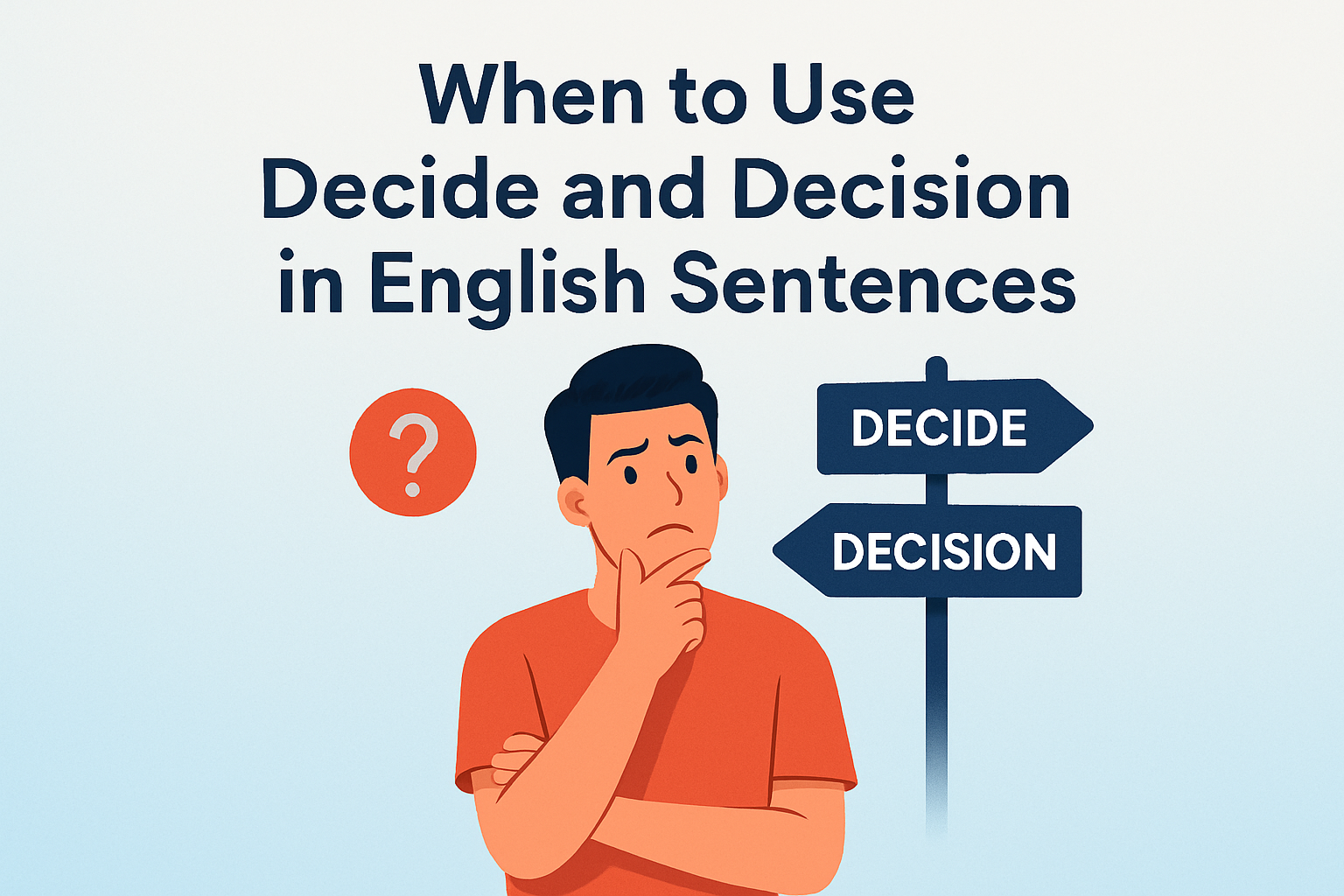
English learners often confuse decide and decision because the two words come from the same root yet play different roles in a sentence. Understanding when to use decide and decision matters because choosing the wrong form creates grammar errors, awkward phrasing, and unclear meaning in both speech and writing. In practical classroom work, I have seen even advanced learners write sentences like “I made a decide” or “She decision to leave,” which immediately signals a problem with parts of speech. The simplest distinction is this: decide is a verb, and decision is a noun. A verb names an action, while a noun names a thing, event, or concept. So if the sentence needs an action, use decide; if it needs the result or act of choosing as a thing, use decision. This difference sounds basic, but it affects sentence structure, collocations, prepositions, and formality. It also appears often in business English, academic writing, emails, exams, and job interviews. If you want natural English, you need more than a dictionary definition. You need to know where each word fits grammatically, which patterns native speakers prefer, and which common mistakes to avoid. This guide explains the difference in plain English, answers the questions learners usually ask, and gives examples you can apply immediately in everyday communication.
The Core Difference: Verb Versus Noun
The fastest way to choose between decide and decision is to identify the job the word must do in the sentence. Use decide when someone performs the act of choosing: “We decided to wait,” “The manager decided against the proposal,” or “I cannot decide which laptop to buy.” In each example, the word expresses action. Use decision when you refer to the choice itself as an object, idea, or outcome: “It was a difficult decision,” “Her decision surprised the team,” or “The board announced its decision on Friday.” Here, the sentence needs a noun phrase, not an action word.
One reliable test is substitution. If you can replace the word with another verb like choose, determine, or select, then decide is probably correct. If you can replace it with a noun like choice, judgment, or conclusion, then decision is likely right. For example, “They decided quickly” works because “They chose quickly” also works. But “Their decide was quick” fails because the sentence needs a noun: “Their decision was quick.” This part-of-speech awareness is a foundational grammar skill and supports better writing across related word families such as inform/information, respond/response, and permit/permission.
How to Use Decide Correctly in Sentences
Decide commonly appears in several predictable patterns. The most frequent is decide to + base verb: “She decided to study abroad,” “We decided to postpone the launch,” and “He decided to call the client directly.” Another common pattern is decide on + noun, which means choose from options: “They decided on the blue design,” “I decided on the annual plan,” and “The couple decided on a small wedding.” You will also see decide between for two or more options, as in “I am deciding between law and medicine,” and decide against to show rejection: “The company decided against hiring externally.”
In my editing work, the most common learner error is using decide where a noun phrase should stand after an article or possessive. English allows “a decision,” “the decision,” and “my decision,” but not “a decide” or “my decide.” Another issue is tense. Because decide is a regular verb, its common forms are decide, decides, decided, and deciding. Learners often forget agreement and write “She decide” instead of “She decides.” In polished business writing, clear verb choice matters: “The committee decided to revise the budget” is stronger and more direct than “A decision was made to revise the budget,” unless you intentionally want a more formal or passive tone.
How to Use Decision Correctly in Sentences
Decision is a countable noun in most contexts, so it usually appears with an article, determiner, adjective, or plural ending. Typical examples include “a decision,” “the final decision,” “our decision,” and “several important decisions.” As a noun, it often functions as the subject, object, or complement of a sentence: “The decision took weeks,” “We respected her decision,” and “His decision was reasonable.” It can also appear in high-frequency collocations such as make a decision, reach a decision, announce a decision, and reverse a decision. These collocations matter because natural English depends heavily on fixed word partnerships.
Prepositions are especially important with decision. Native speakers usually say decision about, decision on, or decision to + base verb. For example: “We made a decision about staffing,” “The court issued a decision on the case,” and “Her decision to resign was unexpected.” That last pattern, decision to do something, is one of the most useful because it mirrors the verb pattern decide to do something. Compare the pair: “They decided to expand” and “Their decision to expand increased costs.” Both are correct, but the noun form lets you discuss the choice as a topic rather than simply report the action.
Quick Comparison Table and Meaning Shifts
Although decide and decision are closely linked, choosing one over the other can shift the tone, focus, and sentence structure. The verb form usually sounds more direct and active, while the noun form can sound more formal, analytical, or abstract. In reports, legal writing, and management communication, the noun often helps package the idea as a subject for further explanation. In conversation, the verb often sounds more natural and immediate. This is why “I decided to leave early” feels conversational, while “My decision to leave early” sounds more reflective or explanatory.
| Need in the sentence | Use | Example |
|---|---|---|
| An action of choosing | decide | We decided to renegotiate the contract. |
| The choice as a thing or result | decision | The decision affected every department. |
| Direct, active wording | decide | She decided against moving. |
| Formal discussion of an outcome | decision | The committee reached a decision after review. |
A useful editing trick is to ask what you want to emphasize. If you want to highlight the person doing the choosing, use the verb. If you want to highlight the choice itself and discuss its impact, timing, or quality, use the noun. This distinction improves clarity in essays, internal documentation, and professional email writing.
Common Mistakes English Learners Make
The most frequent mistake is confusing sentence patterns. Learners often write “I took a decide” because they know English uses verbs like take with some nouns, but the fixed expression is make a decision, not “take a decide.” Another widespread error is “I am decision” when the intended meaning is “I am deciding” or “I have made a decision.” Errors also happen around articles. Since decision is countable, singular forms usually need an article or determiner: “It was a decision,” not “It was decision.”
Another issue is overusing the noun form because it sounds formal. In many cases, simpler verb-based sentences are better. Compare “We made the decision to cancel the meeting” with “We decided to cancel the meeting.” Both are grammatical, but the second is shorter and stronger. Style guides in business communication often prefer active verbs for clarity. However, there are cases where the noun is the better choice, especially when modifying it with adjectives or discussing consequences: “The difficult decision to cut costs improved cash flow.” Accuracy means matching grammar to purpose, not choosing the more formal option every time.
Examples from Everyday, Academic, and Business English
In everyday English, decide appears constantly in spontaneous speech: “Have you decided what to eat?” “I can’t decide,” and “We decided on the train instead of the bus.” The noun appears when speakers reflect on the result: “That was a smart decision” or “It’s your decision.” In academic English, the distinction becomes more useful because writers often move between action and analysis. A student might write, “The researchers decided to exclude incomplete surveys,” then later explain, “This decision reduced the sample size but improved reliability.” That is strong writing because it uses the verb to report action and the noun to analyze impact.
Business English follows the same logic. In meetings, people say, “We need to decide by Thursday,” “The CFO decided against a price change,” or “Have you decided on a vendor?” In follow-up documents, the noun dominates: “The final decision will be shared with stakeholders,” “Management’s decision reflects budget constraints,” and “Please document the decision in the project tracker.” I use this verb-to-noun shift often when turning meeting notes into formal summaries. It creates coherence: first record who decided what, then explain why the decision matters. That pattern is common in project management, HR communication, legal drafting, and executive reporting.
Practical Rules You Can Apply Immediately
If you need a fast rule, use decide after a subject when describing the act of choosing, and use decision after an article, adjective, possessive, or preposition when naming the choice. These practical checks work in most cases. Ask yourself: Does the sentence need an action? Use decide. Does it need a thing you can describe, count, or discuss? Use decision. For example, “They decided immediately” is correct because immediately modifies an action. “It was an immediate decision” is also correct because immediate modifies a noun.
Another reliable method is transformation. Convert the sentence mentally from verb form to noun form and see whether the structure still makes sense. “She decided to transfer departments” becomes “Her decision to transfer departments.” “The board reached a decision on expansion” becomes “The board decided on expansion.” This transformation skill is valuable for paraphrasing, which improves exam performance in tests such as IELTS and TOEFL and strengthens content writing for SEO, internal linking, and featured-snippet optimization. When you control both forms confidently, your English becomes more flexible, precise, and natural.
Decide and decision are not interchangeable, but the difference is straightforward once you focus on grammar and function. Use decide as a verb for the action of choosing, and use decision as a noun for the choice itself. Remember the most common patterns: decide to, decide on, decide against, make a decision, and decision to. Also remember the style point: the verb usually sounds more direct, while the noun often sounds more formal or analytical. Strong English writing depends on these small distinctions because they affect clarity, tone, and credibility.
If you want to master this pair, start noticing it in real sentences. Check emails, news articles, meeting notes, and academic texts, and ask why the writer chose the verb or noun form. Then rewrite a few of your own sentences both ways: once with decide and once with decision. That practice builds accuracy quickly. Use these patterns consistently, and your English sentences will sound clearer, more natural, and more professional.
Frequently Asked Questions
What is the difference between decide and decision in English grammar?
The main difference is that decide is a verb, while decision is a noun. A verb shows an action, so decide is used when someone performs the act of choosing. For example, in the sentence “I decided to study tonight,” the word decided describes the action. By contrast, a noun names a thing, idea, or result, so decision refers to the choice itself. In “It was a difficult decision,” the word decision names the final choice. This distinction is essential because English sentence structure depends heavily on parts of speech. If you use decision where a verb is needed, or decide where a noun is needed, the sentence becomes ungrammatical. That is why phrases like “I made a decide” are incorrect, while “I made a decision” is correct. Once learners clearly separate action words from naming words, they make fewer errors and write more naturally.
When should I use decide in a sentence?
Use decide when you need a verb that expresses choosing, making up your mind, or reaching a conclusion. It often appears after a subject, because it tells what the subject does: “They decided to cancel the trip,” “She cannot decide yet,” and “We need to decide between the two options.” You will also commonly see it in different verb forms, such as decide, decides, decided, and deciding, depending on tense and grammar. For example, “He decides quickly” is present simple, “He decided yesterday” is past simple, and “He is deciding now” is present continuous. The verb is frequently followed by an infinitive, as in “decide to go,” or by a prepositional phrase, as in “decide on a color” or “decide between two schools.” If your sentence needs an action rather than a thing, decide is usually the correct choice. A good test is to ask whether the word can logically fit after a helping verb such as will, can, or should. You can say “I will decide soon,” but you cannot say “I will decision soon,” which shows why only the verb works there.
When should I use decision instead of decide?
Use decision when you need a noun that refers to the result of choosing or the act of choice as an idea. It often follows articles, adjectives, or verbs that commonly take nouns. For example, we say “a decision,” “the final decision,” “an important decision,” “make a decision,” and “reach a decision.” In each case, decision functions as a thing that can be described, discussed, delayed, regretted, or changed. This is why “She made a decision to leave” is correct, while “She made a decide to leave” is not. The sentence needs a noun after made a. You will also see decision used in formal, academic, and professional English, such as “The committee announced its decision” or “Good decision-making requires careful analysis.” A useful clue is to check whether the word comes after a, the, my, his, this, or an adjective like difficult or smart. Those patterns usually signal that a noun is required, so decision is the right form.
Why are sentences like “I made a decide” and “She decision to leave” incorrect?
These sentences are incorrect because they break basic English grammar rules about word class and sentence pattern. In “I made a decide,” the structure made a + noun requires a noun after the article a. Since decide is a verb, it cannot fill that position. The correct form is “I made a decision.” In “She decision to leave,” the problem is different but related. After the subject She, English usually needs a verb to complete the main clause, but decision is a noun, not a verb. So the sentence is missing the action word. Correct alternatives include “She decided to leave” or “She made a decision to leave.” These errors are especially common among learners because the two words are closely related in meaning, but English does not allow them to be swapped freely. The solution is to look at the grammar frame around the word. If the sentence needs an action, choose decide. If it needs a thing or result, choose decision. This habit helps learners produce clearer, more accurate English in both writing and speaking.
What are some easy ways to remember whether to use decide or decision?
A practical way to remember the difference is to connect each word to its job in the sentence. Think of decide as the action and decision as the result. Someone decides, and then that person has a decision. Another useful memory trick is to watch for surrounding words. If you see a modal or helping verb such as will, must, can, or should, you usually need the base verb decide: “We must decide today.” If you see an article or adjective, such as a, the, this, important, or difficult, you usually need the noun decision: “It was a difficult decision.” You can also memorize common chunks of English: decide to, decide on, make a decision, and reach a decision. Learning these fixed patterns is often easier than trying to analyze every sentence from scratch. Finally, reading your sentence aloud can help. If it sounds like you are naming a thing, use decision. If it sounds like you are describing what someone does, use decide. With enough exposure and practice, the difference becomes much more natural.





