
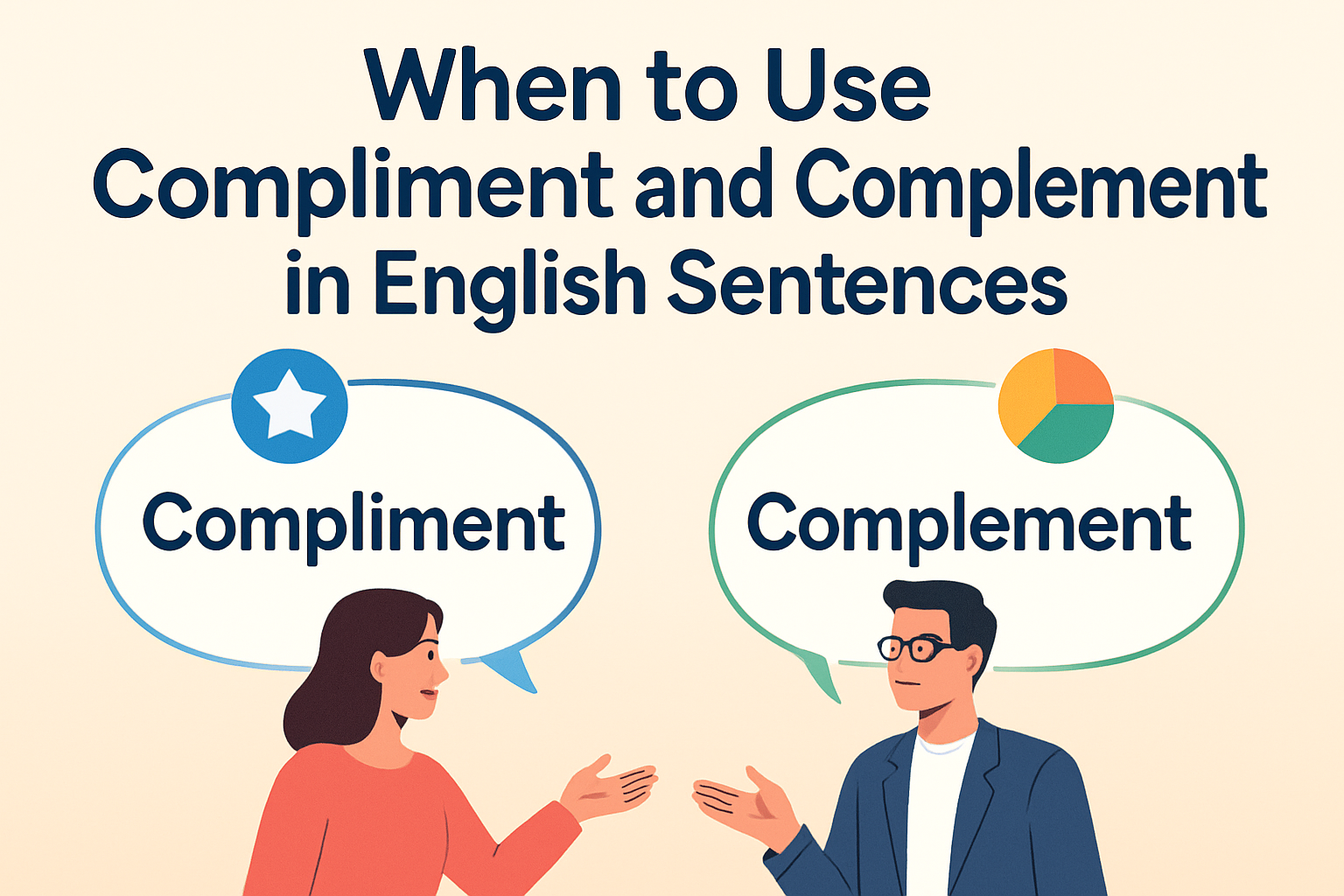
English learners and native speakers alike often hesitate over compliment and complement because the words sound identical yet carry different meanings, functions, and usage patterns. A compliment is a polite expression of praise or admiration, while complement refers to something that completes, enhances, or goes well with something else. Knowing when to use compliment and complement in English sentences matters because these terms appear in business writing, academic work, marketing copy, customer service emails, and everyday conversation, where a single wrong word can undermine clarity and credibility.
I have edited thousands of business documents, web pages, and training materials, and this pair is one of the most common homophone errors I see, especially in polished writing where the mistake stands out immediately. The confusion is understandable: both words come from related historical roots, both can function as nouns, and both can appear in positive contexts. Yet the distinction is firm. If you are giving praise, use compliment. If one thing completes or improves another, use complement. This is the core rule, and most correct choices flow directly from it.
Writers benefit from mastering this distinction for more than correctness alone. Search engines reward content that is precise and authoritative, employers expect clean communication, and readers trust writers who control commonly confused words. In English grammar and style guidance, especially in resources such as Merriam-Webster, Cambridge Dictionary, and The Chicago Manual of Style, these terms are treated as separate entries with non-overlapping primary meanings. Understanding them fully helps with spelling, sentence construction, and tone. It also prevents errors in formal phrases such as complimentary close, complementary colors, and complementary products, all of which are common in professional contexts.
What compliment means and when to use it
Use compliment when you mean praise, approval, or a courteous remark. As a noun, a compliment is something nice said about a person, idea, performance, or appearance. For example: “Her manager gave her a compliment on the presentation,” and “Thank you for the compliment about my article.” As a verb, to compliment means to praise someone directly: “The client complimented the team on its fast response time.” In each case, the word is tied to spoken or written admiration.
One reliable test I teach writers is substitution. If you can replace the word with praise, flattering remark, or commend, then compliment is correct. “He complimented her design” becomes “He praised her design,” so compliment fits. “The blue scarf complimented the jacket” fails this test because the sentence is not about praise; it is about matching or enhancing. That sentence needs complement instead. This simple replacement method catches most errors in seconds and works especially well during proofreading.
Compliment also appears in specific fixed expressions. A complimentary ticket is free of charge, extending from the idea of courtesy or favor. A complimentary close in a letter refers to the polite ending, such as “Sincerely” or “Best regards.” These uses are standard and should not be confused with complement. In customer service writing, for instance, “We offered a complimentary dessert” means the dessert was provided free, not that the dessert completed anything. Context makes the meaning clear, but correct spelling is still essential.
What complement means and when to use it
Use complement when one thing completes another, improves it, or forms an effective match. As a noun, complement can refer to something that makes another thing better or whole: “The sauce is the perfect complement to the fish.” As a verb, complement means to complete or enhance: “The lighting complements the room’s modern design.” This is common in fashion, interior design, branding, product descriptions, and art criticism because it captures the idea of harmony rather than praise.
The fastest way to remember complement is to focus on complete. Both words begin with comple-, and their meanings are closely linked. If an item completes a set, strengthens a feature, balances a flavor, or pairs naturally with another element, complement is the correct spelling. For example, “These skills complement each other” means the skills work well together. “The research complements earlier findings” means the new research adds useful support or balance to what already exists.
Complement also has technical uses beyond everyday writing. In grammar, a complement is a word or phrase that completes the meaning of a subject, object, or verb, as in “She is confident,” where confident functions as a subject complement. In mathematics, computer science, and biology, complement has specialized meanings as well, including set complement and complementary DNA. Those fields reinforce the same core concept: something that completes, corresponds to, or fills out a system. Because of these established uses, complement carries a broader technical range than compliment.
How to tell the difference quickly in real sentences
The most effective decision rule is this: if the sentence is about saying something nice, choose compliment; if it is about matching, completing, or enhancing, choose complement. Consider these examples from workplace writing. “I want to compliment Jordan on her leadership” is correct because it expresses praise. “Jordan’s analytical strengths complement the sales team’s communication skills” is correct because the strengths work well together. In e-commerce copy, “This lamp complements minimalist décor” is right, while “Customers complimented the lamp’s finish” is also right for reviews containing praise.
Because the two words are homophones, spellcheck does not always save you. Both are valid English words, so software may miss the error entirely. I regularly see mistakes in product pages such as “curtains that compliment your furniture” and in emails like “please accept my complement.” These are credibility problems, not tiny details. Readers notice them because the intended meaning clashes with the word chosen. Careful writers rely on meaning first, not autocorrect.
| Situation | Correct Word | Example Sentence | Why It Is Correct |
|---|---|---|---|
| Praise or admiration | compliment | She complimented him on his research. | The action is verbal praise. |
| Free item or service | complimentary | The hotel offered complimentary breakfast. | The meaning is courtesy or free of charge. |
| Matching or enhancing | complement | The rug complements the wall color. | One thing improves or completes another. |
| Working well together | complement | The two departments complement each other. | Their strengths combine effectively. |
| Polite praise noun | compliment | That was a thoughtful compliment. | The noun means a flattering remark. |
Another quick check is to ask what the subject is doing. People usually compliment people, teams, or work by speaking or writing positively. Objects, colors, flavors, and skills usually complement other objects, colors, flavors, and skills by fitting together. While a person can complement another person’s abilities, that usage still means complete or enhance, not praise. This subject-object pattern is practical because it aligns with how the words behave in ordinary usage.
Common mistakes, memory tricks, and style advice
The most frequent mistake is using compliment for visual harmony: “Your shoes compliment your dress.” Unless the shoes are speaking, this is wrong. The shoes complement the dress because they go well with it. Another common error appears in thank-you notes: “Thanks for the nice complement.” That should be compliment because the writer received praise. These mistakes often happen because people learn the sound before the spelling, then guess based on familiarity. Repetition and intentional proofreading solve the problem.
The best memory trick remains simple and durable. Compliment has an i, and so does praise when you think of “I admire you.” Complement has an e, and so does complete. I use this exact explanation in editorial training because it is easy to apply under time pressure. Another device is to connect complement with pairings: complementary colors, complementary products, complementary skills. In each case, the items fit together into a stronger whole. That idea of completion never changes, even across technical disciplines.
From a style perspective, use these words only when they are the most precise choice. In some sentences, simpler alternatives read better. Instead of “The data complements our previous analysis,” you might write “The data supports our previous analysis” if support is the exact relationship. Instead of “He offered a compliment,” you might write “He praised her work” for stronger directness. Good style is not just about choosing the correct word; it is about choosing the clearest correct word for the reader and context.
Examples in business, academia, and everyday English
In business English, compliment appears in performance reviews, client feedback, and customer communication. “Several customers complimented our support team” is standard because customers expressed approval. Complement appears in strategy, branding, and product positioning. “Our software complements existing CRM tools” means the product works well alongside systems such as Salesforce or HubSpot. That distinction matters in sales copy, where complement suggests interoperability and added value, while compliment would sound careless and reduce trust.
In academic writing, compliment is less common unless discussing rhetoric, social behavior, or dialogue in literature. Complement is far more frequent because it names relationships in grammar, logic, and scientific description. A linguistics paper may discuss subject complements and object complements. A biology text may mention complementary base pairing in DNA, specifically adenine pairing with thymine and cytosine with guanine. These are not optional spellings. They are discipline-specific terms, and using compliment in their place would be an outright factual error.
In everyday English, both words remain useful and easy to separate once you anchor them in meaning. “That was a lovely compliment” is natural after someone praises your cooking. “Lemon complements grilled fish” is natural when discussing flavor. “Her calm style complements his energy” works for relationships, teamwork, and personality descriptions. If you build a habit of checking whether the sentence is about praise or completion, the right spelling quickly becomes automatic.
The key takeaway is straightforward: use compliment for praise and complement for completion, enhancement, or a good match. That single distinction covers nearly every sentence you will write, from emails and essays to product descriptions and social posts. Remember the practical link: compliment relates to admiration, while complement relates to complete. When in doubt, test the sentence by swapping in praise or completes. If you want cleaner, more professional English, apply that check during proofreading and start correcting this pair every time you see it.
Frequently Asked Questions
What is the difference between compliment and complement in English?
The difference comes down to meaning, even though the two words are pronounced the same way. Compliment refers to praise, admiration, or a polite expression of approval. For example, if you tell a coworker, “You gave an excellent presentation,” that is a compliment. Complement, by contrast, refers to something that completes, improves, or matches something else well. For example, “The blue tie complements his suit” means the tie goes well with the suit and enhances its overall appearance.
This distinction matters because the words are not interchangeable. If you write, “Her skills compliment the team,” you are technically saying her skills praise the team, which does not make sense in most contexts. The correct word would be complement, because her skills complete or strengthen the team. A helpful memory trick is this: compliment usually relates to kind words, while complement usually relates to completion or enhancement. Once you connect each word to its core idea, choosing the correct one becomes much easier in everyday writing and speech.
When should I use compliment in a sentence?
Use compliment when you are talking about praise, flattery, admiration, or courteous remarks. It can be used as both a noun and a verb. As a noun, it means a statement of praise, as in “She gave me a nice compliment about my writing.” As a verb, it means to praise someone, as in “He complimented the chef on the meal.” In both cases, the idea is the same: someone is expressing approval or appreciation.
This word appears often in social, professional, and customer-facing communication. In business writing, you might say, “The client complimented our fast response time.” In personal conversation, you might say, “I want to compliment you on your dedication.” In marketing or hospitality settings, you may also see the related adjective complimentary, which can mean something given free of charge, such as “complimentary breakfast,” although that usage is separate from direct praise. If the sentence involves saying something nice or showing admiration, compliment is almost always the word you want.
When should I use complement in a sentence?
Use complement when you mean that one thing completes, balances, improves, or pairs well with another. Like compliment, it can function as both a noun and a verb. As a noun, it can refer to something that completes a whole, as in “This sauce is the perfect complement to the dish.” As a verb, it means to enhance or go well with, as in “The lighting complements the room’s design.” The focus is not on praise, but on fit, harmony, or added value.
This word is common in design, branding, fashion, food, business, and academic writing. You might write, “Her analytical skills complement his creativity,” or “The new software complements our existing workflow.” In both examples, the idea is that one element strengthens or completes another. In grammar, complement also has a technical meaning, referring to a word or phrase that completes the meaning of another element in a sentence. Even if you are not using it in a grammar lesson, the core idea remains consistent: complement is about completing or enhancing, not praising.
Are there easy tricks to remember which word to choose?
Yes, and simple memory devices can be surprisingly effective. One of the best-known tricks is to remember that compliment contains the letter i, which you can associate with “I like what you said” or “I admire you.” That helps link the word to praise. Meanwhile, complement contains the letter e, which you can connect with “enhance” or “complete.” If one thing improves another or makes it whole, complement is likely correct.
Another practical method is to test the sentence with a substitute word. If you can replace the word with praise or admire, use compliment. If you can replace it with complete, match, or enhance, use complement. For example, “She complimented his work” becomes “She praised his work,” so compliment fits. But “The colors complement each other” becomes “The colors enhance each other,” so complement is correct. These quick checks are especially useful when editing emails, essays, reports, and website copy.
Why do people confuse compliment and complement so often?
People confuse these words because they are homophones, meaning they sound exactly alike in spoken English. Since pronunciation does not help distinguish them, writers have to rely on meaning and spelling. The confusion is also common because both words can be used as nouns and verbs, and both appear in formal as well as everyday communication. That overlap makes them easy to mix up, especially when writing quickly.
Another reason is that the concepts can seem loosely related. A compliment makes someone feel good, and a complement improves something, so both words can carry a positive sense. However, their functions are different: one is verbal praise, and the other is completion or enhancement. To avoid mistakes, slow down and ask what the sentence is actually trying to say. Is someone expressing admiration, or is something improving or completing something else? That one question usually reveals the correct choice. Over time, repeated exposure to correct examples makes the distinction feel much more natural, whether you are an English learner, a student, or a professional writer.





