
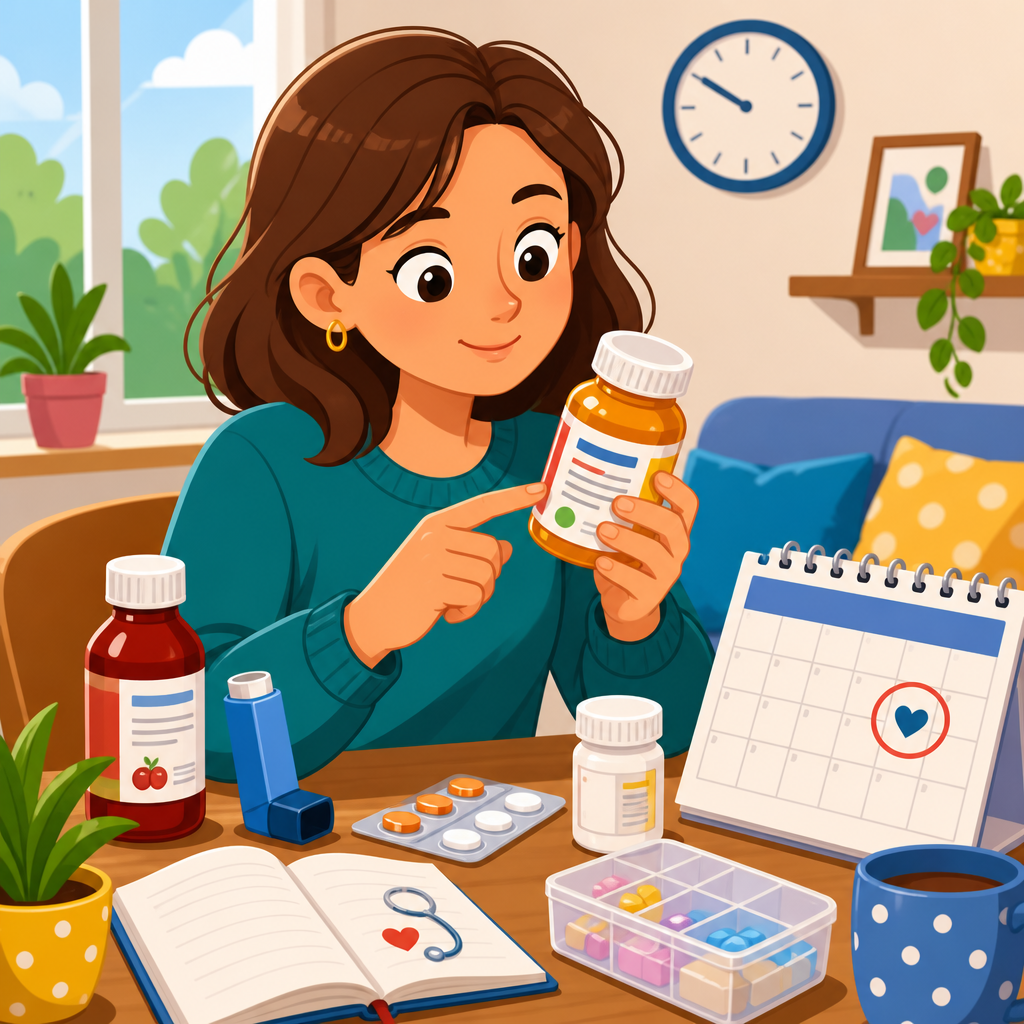
A2 reading practice with medicine labels and appointment reminders helps English learners handle two common real-life texts safely and confidently. At A2 level, readers can usually understand short, simple messages, familiar vocabulary, dates, times, and basic instructions, but they still need support with health-related words, abbreviations, and polite reminder language. That is why this topic matters. In my work with adult learners, I have seen students read a shop sign with no problem, then freeze when a cough syrup label says “take two teaspoons twice daily after meals” or when a clinic text says “arrive 15 minutes early for check-in.” These are not rare situations. They affect daily health decisions, missed appointments, and medication mistakes.
Medicine labels are the printed instructions found on prescription bottles, over-the-counter packets, or pharmacy stickers. Appointment reminders are short messages sent by clinics, dentists, hospitals, or health apps to confirm the date, time, location, and preparation steps for a visit. Both text types are short, but they are dense with meaning. A single line can include dosage, frequency, warnings, or deadlines. For A2 learners, strong reading practice means learning to spot key information fast: who the medicine is for, how much to take, when to take it, where to go, and what to bring. Building this skill improves comprehension, independence, and safety, especially for learners managing healthcare in English-speaking environments.
Unlike longer reading passages, these texts reward careful scanning rather than broad interpretation. Learners must identify exact details and understand functional language such as “before bedtime,” “do not exceed,” “fasting required,” or “reschedule if unwell.” The goal is not advanced medical knowledge. The goal is practical reading accuracy. For learners who already practice everyday notices, the next useful step is applying the same strategies to health communication. A strong foundation begins with short, high-frequency texts, which is why this deep dive stays focused on medicine labels and appointment reminders rather than the wider reading syllabus.
What A2 learners need to understand on medicine labels
Medicine labels usually follow a predictable structure, and that predictability makes them good material for A2 reading practice. Most labels include the medicine name, the patient name, the dose, timing instructions, storage information, and warnings. Learners do not need to understand every pharmaceutical term to succeed. They need to recognize common action words and quantity words. The essential verbs are take, shake, swallow, use, store, keep, and call. The essential quantity markers are one tablet, two capsules, 5 ml, one spoonful, once daily, twice daily, every six hours, and after food.
For example, “Take 1 tablet by mouth twice daily after meals” contains four testable ideas: quantity, method, frequency, and timing. A2 readers should learn to break the sentence into chunks instead of translating word by word. “Take 1 tablet” answers how much. “By mouth” shows method. “Twice daily” means two times each day. “After meals” gives timing. Another common label, “Do not drive if drowsy,” introduces a warning linked to side effects. Even if the learner does not fully know the word drowsy, the phrase “do not drive” clearly signals a safety rule.
In class, I have found that learners improve faster when labels are treated as problem-solving tasks. Ask direct questions: What is the medicine for? How many tablets? How often? Before or after food? Any warning? This mirrors what real patients must do. It also prepares learners for labels with abbreviations. While some older labels use Latin-based shorthand such as “bid” or “prn,” many pharmacies now prefer plain English because the Joint Commission and other safety bodies have pushed for clearer prescribing communication. That is helpful for learners, but abbreviations still appear in older materials and online examples, so teachers should explain them carefully and show safer plain-language equivalents.
How to read appointment reminders accurately
Appointment reminders look easier than labels, but they often contain hidden difficulty because they combine logistics with polite instructions. A reminder may arrive as a text message, email, printed card, or app notification. The reader must usually identify six pieces of information: provider, date, time, place, action needed, and preparation. A typical message reads: “Reminder: Dental appointment with Dr. Kim on Tuesday, 14 May at 3:30 p.m. Please arrive 10 minutes early and bring your insurance card.” Every phrase serves a purpose, and missing one detail can cause a late arrival or failed check-in.
Time and date formats are the main barrier. Learners may know numbers well, but still confuse 3:30 and 13:30, or Tuesday the 14th and Thursday the 15th. This is why good A2 reading practice includes both digital and written formats: “03/06,” “6 March,” “March 6,” and “Fri, 6 Mar.” Learners should also practice routine clinic verbs such as confirm, cancel, reschedule, check in, arrive, fast, and contact. In health settings, these words are operational. They tell the patient exactly what to do.
Another issue is conditional language. A reminder might say, “If you have fever symptoms, call before visiting,” or “Reply YES to confirm.” These are short sentences, but they require readers to understand action triggers. If this happens, do that. Many learners can read the words individually but miss the logic. The best remedy is repeated exposure to authentic reminder formats. If you need a simpler starting point before health texts, the broader reading foundation at this main guide builds the scanning habits that support this next step.
High-frequency language patterns that appear again and again
The fastest way to improve A2 reading on health microtexts is to master repeated patterns rather than memorize isolated vocabulary. Across medicine labels and appointment reminders, the same structures return consistently. Imperatives are common: “Take with water,” “Store below 25°C,” “Bring ID,” “Call to cancel.” Time phrases appear constantly: before meals, after meals, at bedtime, every morning, next Monday, 30 minutes early. Negatives are especially important because they carry risk: do not chew, do not skip, do not eat after midnight, do not miss your appointment.
Numbers deserve special attention because one small mistake changes the meaning completely. “1 tablet” and “11 tablets” are visually similar for a weak reader. “Every 4 hours” is not the same as “4 times a day.” “0.5 ml” may be misread as “5 ml” if learners are unfamiliar with decimal points. In my experience, reading practice becomes much safer when teachers isolate numbers from the sentence first, then place them back in context. Learners should say the meaning aloud: “two times each day,” “half a milliliter,” “fifteen minutes early.” That confirms comprehension.
| Text phrase | Plain meaning | What the reader should do |
|---|---|---|
| Take twice daily | Use it two times each day | Choose two regular times |
| After food | Take it after eating | Do not take on an empty stomach |
| Do not exceed 4 tablets in 24 hours | Four is the maximum in one day | Count total tablets carefully |
| Arrive 15 minutes early | Come before the appointment time | Plan extra travel and check-in time |
| Reply C to confirm | Send the letter C as a response | Answer the message exactly as asked |
This kind of phrase table works because it converts short health language into direct action. That is exactly how real reading happens outside the classroom. The learner is not analyzing literature. The learner is deciding what to do next, and the language must support that decision quickly.
Common comprehension mistakes and how to prevent them
Most A2 errors with medicine labels and appointment reminders are predictable. Learners confuse frequency words, ignore warning lines, misread dates, or focus on one familiar word and skip the rest. For instance, a student may recognize “tablet” and stop reading before noticing “half tablet.” Another may understand “appointment” but miss “cancelled.” These are attention errors as much as language errors. Training should therefore include short tasks that force complete reading, such as matching each text to one exact action.
False friends and everyday assumptions also cause trouble. “Take with food” does not mean take while buying food or take food with you. “Repeat prescription” does not mean say the prescription again. “Nil by mouth,” used in some hospital contexts, is especially confusing because the word nil is uncommon in general English. Teachers should not overload A2 learners with rare terms, but they should expose them to high-impact phrases that matter for safety. The National Health Service, Mayo Clinic, and major pharmacy chains all use straightforward patient language online, making them useful sources for realistic examples.
One effective method is a three-pass reading routine. On the first pass, the learner circles names, dates, times, and numbers. On the second, the learner underlines action verbs such as take, bring, call, or reply. On the third, the learner answers one practical question: what must I do? I have used this routine with multilingual groups, and it consistently improves accuracy because it reduces panic. Learners stop trying to understand everything at once and start reading by priority.
Best practice activities for focused A2 reading improvement
The most productive activities stay close to real tasks. Gap-fill exercises help with spelling, but they are not enough on their own. Better practice includes label matching, reminder sorting, mini role cards, and error correction. For example, give learners four medicine labels and four patient situations: cough at night, eye infection, child fever, skin cream. Ask them to match the text to the person and explain the key words. With reminders, ask learners to choose the correct calendar entry, clinic location, or item to bring. These tasks measure understanding, not guessing.
Short dictation from authentic wording also works well when used carefully. If learners hear “Take 5 ml every six hours as needed,” then read the label, they connect spoken and written forms. Another useful exercise is comparing two very similar texts, such as “before meals” and “after meals,” or “arrive at 9:00” and “arrive by 9:00.” This develops precision, which is essential in health reading. Digital tools can support this practice. Quizlet is useful for high-frequency terms, while Google Forms can present screenshot-style reminders with quick comprehension checks.
Progress should be measured by task success, not by how many words a learner can define. If a learner can read a pharmacy sticker and correctly explain dosage, timing, and warning, that is meaningful competence. If the learner can read a reminder and arrive on the right day with the right documents, the reading skill is working in real life. Keep practice short, repeated, and realistic. That is how confidence grows.
A2 reading practice with medicine labels and appointment reminders is valuable because it targets language learners genuinely need outside the classroom. These texts are brief, but they carry consequences. Success depends on recognizing patterns, reading numbers accurately, understanding action verbs, and noticing warnings or preparation steps. Learners do not need advanced medical English to manage them well. They need repeated practice with common wording, realistic examples, and clear questions that focus on what action the text requires.
The main benefit is practical independence. When learners can read “take after food,” “do not exceed,” “reply YES,” or “arrive 15 minutes early” without hesitation, they are better equipped to manage health routines safely. Teachers and self-learners should keep the training narrow, frequent, and authentic, using real label formats and reminder messages rather than generic passages. Start with a few high-frequency phrases, build scanning habits, and check understanding through action-based tasks. Use that approach consistently, and everyday health reading becomes clearer, faster, and far less stressful.
Frequently Asked Questions
What can learners usually understand in A2 reading practice with medicine labels and appointment reminders?
At A2 level, learners can usually understand short and simple texts that use familiar words, clear dates, times, and basic instructions. With medicine labels, this often includes information such as how many tablets to take, how often to take them, and simple warnings like “take with food” or “do not drive.” With appointment reminders, learners can often identify the day, date, time, place, and the main action they need to take, such as “arrive 10 minutes early” or “call to cancel.”
However, this does not mean every health-related text feels easy. Many learners at this level are comfortable with everyday reading like signs, menus, or short messages, but they can still feel unsure when they see medical vocabulary, abbreviations, or formal reminder language. Words like “dose,” “prescription,” “clinic,” “reschedule,” or abbreviations such as “mg” and “ml” can slow reading down. That is why focused A2 reading practice is so useful. It helps learners build confidence with the exact kinds of words and text formats they may see in real life.
The goal is not to understand every single word immediately. The goal is to read safely and successfully by finding the most important details. In medicine labels and appointment reminders, those key details are usually who the message is for, what action is needed, when it should happen, and whether there are any warnings or special instructions. A2 learners can make strong progress when they practice recognizing these patterns again and again.
Why are medicine labels and appointment reminders important topics for A2 English learners?
These are important topics because they connect directly to daily life, health, and personal safety. A learner may be able to read many common texts without much difficulty, but medicine labels and appointment reminders are different because mistakes can have real consequences. If someone reads the dose incorrectly, misses a warning, or misunderstands the appointment time, the result can be stressful or even dangerous. That makes this kind of reading practice especially valuable.
Medicine labels teach learners to focus on essential information in a very practical way. They learn to notice dosage, timing, storage instructions, and warnings. Appointment reminders, on the other hand, help learners understand short formal messages that often include dates, times, locations, and polite instructions. These texts are common in everyday life, especially for adults managing work, family responsibilities, and healthcare appointments.
For many adult learners, this topic also reduces anxiety. Health-related English can feel intimidating because the vocabulary is unfamiliar and the context feels serious. When learners practice with simple, level-appropriate examples, they begin to recognize common phrases and patterns. That familiarity builds both language ability and confidence. In other words, this topic is not only about reading better English. It is about helping learners function more independently and safely in the real world.
What words and phrases should students learn first for medicine labels and appointment reminders?
Students should begin with the most common and useful words that appear again and again in real-life texts. For medicine labels, important vocabulary includes “tablet,” “capsule,” “teaspoon,” “take,” “use,” “dose,” “every,” “before খাবার”? No. Let’s correct. “before meals,” “after meals,” “with food,” “at bedtime,” “for pain,” “do not,” “keep out of reach of children,” and “expiry date” or “expiration date.” It is also important to understand simple abbreviations and measurements such as “mg” for milligrams, “ml” for milliliters, and numbers that show quantity and frequency.
For appointment reminders, useful words include “appointment,” “clinic,” “doctor,” “nurse,” “patient,” “date,” “time,” “arrive,” “bring,” “ID,” “cancel,” “confirm,” and “reschedule.” Learners should also practice polite reminder language such as “This is a reminder that…,” “Please arrive 10 minutes early,” “Please call if you cannot attend,” or “Bring your insurance card.” These phrases may sound formal at first, but they are highly predictable, which makes them excellent for A2 reading practice.
The best approach is to teach vocabulary in context, not as isolated lists. Learners remember words more easily when they see them inside realistic labels and reminders. It also helps to group language by function. For example, one group can focus on time and frequency, another on warnings, and another on actions the reader must take. When students learn to connect words to purpose, they read faster and understand more clearly.
How can learners read medicine labels and appointment reminders more accurately and confidently?
A strong strategy is to train learners to scan for key information instead of trying to translate every word. With medicine labels, they should look first for the name of the medicine, the amount to take, how often to take it, and any warnings. With appointment reminders, they should identify the type of appointment, the date, the time, the location, and any special instructions. This step-by-step reading habit is practical and effective for A2 learners because it reduces overload and keeps attention on the most important details.
It also helps to practice common text features. Medicine labels often use short command phrases, while appointment reminders may use polite but direct instructions. Learners benefit from repeated exposure to patterns such as “Take one tablet twice daily” or “Your appointment is on Tuesday at 3:30 p.m.” They should also practice recognizing common time expressions, numbers, and formatting conventions, since misunderstandings often happen when learners confuse times, dates, or frequency words like “once,” “twice,” and “every.”
Confidence grows when learners work with short texts that match their level and then gradually increase difficulty. Teachers can support this by asking focused comprehension questions: How many tablets? What time is the appointment? Should the patient bring anything? Is there a warning? These questions train learners to extract meaning quickly. Reading aloud, matching exercises, and role-play can also help, especially when students need to connect written instructions with real-life actions. Over time, learners become more independent because they know exactly what details to look for.
What are the most common mistakes A2 learners make with these texts, and how can they avoid them?
One common mistake is missing small but important words. For example, learners may see “take two tablets” but miss “after food,” or they may notice the appointment date but overlook “arrive 15 minutes early.” At A2 level, readers often understand the general message but miss a detail that changes the action they need to take. This is why practice should emphasize not just main ideas, but also specific instructions and warnings.
Another frequent problem is confusion with abbreviations, numbers, and time expressions. Learners may not know whether “2x daily” means two times every day, or they may mix up 3:15 and 3:50. Dates can also be difficult, especially when formats differ from one country to another. In health-related texts, these small reading errors matter. Teachers and learners should therefore practice reading numbers, dates, and common abbreviations separately and then in full context.
A third mistake is reading too quickly when the topic feels stressful. Because medicine and appointments feel important, some learners panic when they see unfamiliar words. The best way to avoid this is to build a calm reading routine: identify the text type, scan for key details, underline action words, and check warnings last. Learners should also be encouraged to ask for clarification in real life if they are unsure. Good A2 reading practice does not only teach comprehension. It also teaches safe habits, careful attention, and the confidence to pause and double-check important information.





