
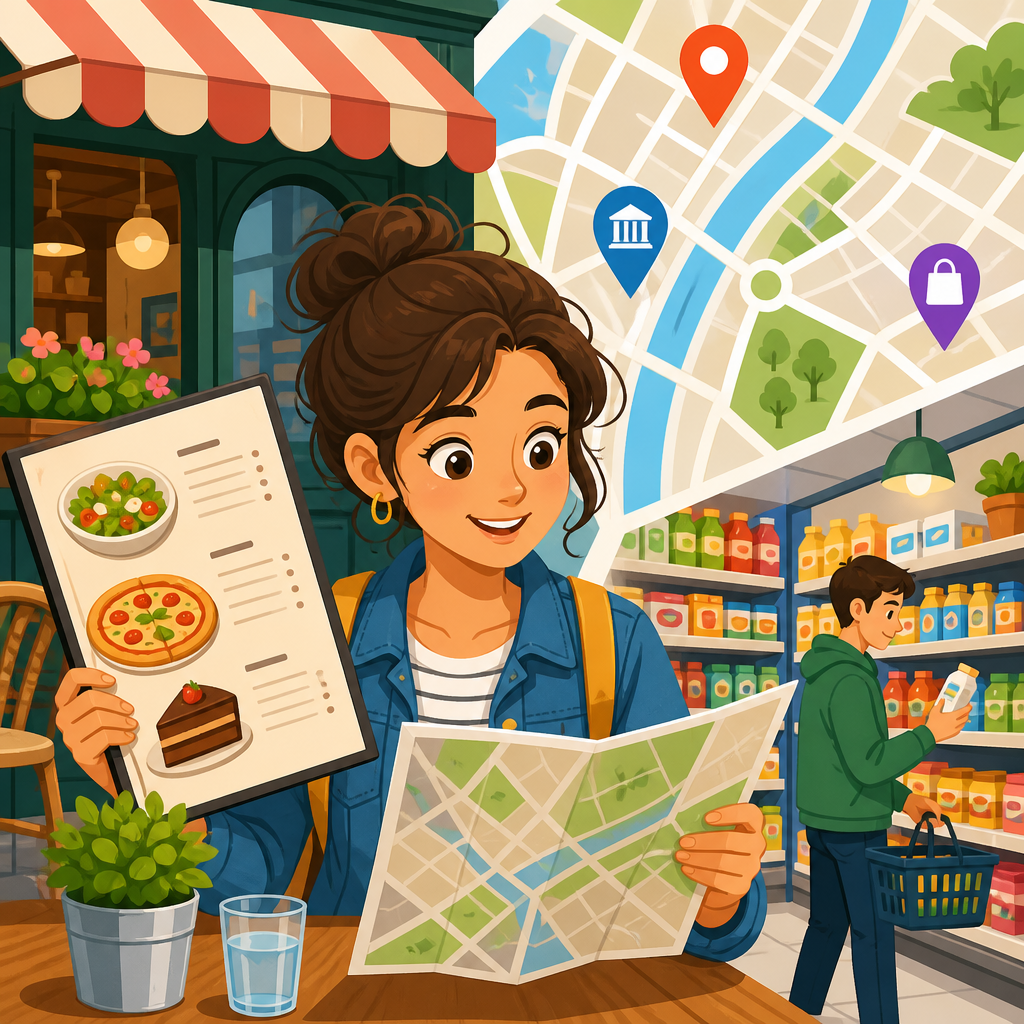
A2 reading practice with menus, maps, and store information helps learners move from decoding single words to understanding short, useful texts they see every day. At A2 level, readers can usually recognize common vocabulary, follow simple directions, and identify basic details such as prices, opening hours, and locations. The challenge is not advanced grammar. The challenge is reading quickly enough to find the right information without getting lost in unfamiliar words. That is why menus, maps, and store notices are ideal practice materials: they are practical, repetitive, and full of patterns that learners can reuse in real situations.
I have used these text types in lessons, placement sessions, and self-study plans because they build confidence fast. A learner who can read a café menu, understand a shopping center map, and check store return information is not just studying English. That learner is using English to solve a problem. This kind of reading matters because real life rarely gives you a full paragraph with easy context. Instead, you get headings, symbols, prices, abbreviations, arrows, opening times, item descriptions, and short instructions. A2 reading practice should train learners to handle exactly that.
In this article, menus means printed or digital lists of food and drink with categories, prices, and short descriptions. Maps means simple public or indoor maps such as subway plans, shopping mall directories, zoo maps, and neighborhood guides. Store information means signs and short written notices about services, payment, delivery, discounts, exchanges, and customer rules. These texts look simple, but each one tests a different reading skill. Menus test scanning for choices and details. Maps test location language and sequence. Store information tests reading for conditions, limits, and exceptions.
The best A2 reading practice focuses on predictable text structures. Menus usually group items under headings like starters, mains, drinks, or desserts. Maps often use landmarks, labels, and directional language such as next to, across from, turn left, and on the second floor. Store information frequently includes exact phrases like cash only, buy one get one free, no refunds without receipt, or open daily from 10 a.m. to 8 p.m. When learners notice these repeated patterns, reading becomes less about translating every word and more about recognizing purpose. That shift is what moves many students from hesitant reading to functional comprehension.
How to Read Menus at A2 Level
Menus are one of the best tools for A2 reading practice because they combine familiar topics with short, information-rich lines. A learner may see “Chicken soup – served with bread,” “Grilled fish with rice,” or “Fresh orange juice.” Each line is brief, but it contains useful clues: food type, cooking method, side dish, and sometimes dietary information. I usually tell learners to start with the section title before reading the item. If the heading says drinks, they already know what kind of words to expect. That prediction reduces reading effort and improves speed.
Good menu reading also requires attention to small differences. “Roast chicken” is not the same as “fried chicken.” “With chips” is not the same as “with salad.” “Large” and “regular” change price and quantity. At A2, learners should practice three specific tasks: finding one item, comparing two items, and choosing based on a condition. For example: Which dessert has fruit? Which sandwich is cheaper? What can a vegetarian order for under ten dollars? These questions reflect how menus are used in real life, and they train learners to scan instead of reading every line slowly.
Short descriptions on menus often include core adjectives that appear again and again in daily English: spicy, sweet, fresh, grilled, homemade, cold, hot, large, and small. Prices also matter. Many learners can read the food name but miss symbols, decimals, or combo offers. A menu that says “Soup + sandwich lunch special $9.50” requires the reader to understand a package, not a single item. In class, I have seen students improve quickly when they underline category words, circle prices, and match dishes to simple needs such as cheap, vegetarian, quick, or healthy.
How to Read Maps Without Translating Every Word
Maps look visual, but they still require strong reading habits. A2 learners must read labels, symbols, and direction phrases together. On a mall directory, “You are here” is the starting point. Store names, floor numbers, restroom symbols, elevators, exits, and food court labels then create the route. On a city map, street names matter less than relationship words: between, near, opposite, behind, at the corner of, and straight ahead. If a learner understands those terms, even a simple map becomes much easier to use.
One mistake I often see is reading maps like stories from top to bottom. That is inefficient. The better method is purpose first. What is the destination? What is the starting point? What symbols or labels give the fastest path? If a train map shows blue, red, and green lines, the learner should identify line color, stop name, and transfer point before worrying about every station. This mirrors real-world reading, where people rarely study the whole map. They search for a route, confirm the next step, and move on. A2 practice should train exactly this behavior.
Direction language needs repeated exposure in context. “Turn right at the bank” and “The pharmacy is next to the bakery” are easier to remember when tied to a map task. Learners should answer practical questions such as: How do you get from the entrance to the bookstore? Which place is opposite the post office? Is the café on the first floor or second floor? These tasks combine vocabulary with logic. If you want a foundation before this stage, the main guide at https://5minuteenglish.com/a1-reading-practice-signs-labels-and-simple-instructions/ builds the simpler sign-reading skills that support A2 map work.
Reading Store Information and Customer Notices
Store information is especially valuable because it teaches learners to read the rules behind everyday transactions. A short notice may seem easy, but one line can change the meaning completely. “Returns accepted within 14 days” sounds simple, yet “with receipt only” and “sale items cannot be returned” add important limits. A2 readers need practice identifying these conditions fast. In real shops, customers scan for answers to direct questions: Can I pay by card? Is the store open now? Can I exchange this item? Is delivery free?
Useful store texts include opening hours, payment signs, discount notices, fitting room rules, pickup instructions, and delivery details. Common phrases include while supplies last, one per customer, final sale, members only, valid until Sunday, and free shipping on orders over $50. These are not rare expressions. They appear constantly in supermarkets, clothing stores, pharmacies, and online checkouts. I recommend practicing with realistic micro-texts instead of long passages. A sign reading “Buy two, get one free” tests quantity. “Closed for lunch 1:00–2:00” tests time. “Second pair half price” tests comparison and math.
| Text type | What to scan for | Typical question |
|---|---|---|
| Menu | Category, item name, price, description | Which meal is vegetarian and under $12? |
| Map | Starting point, destination, direction words, symbols | How do you get from the station to the museum? |
| Store notice | Rule, limit, time, payment, return condition | Can you return sale items without a receipt? |
This kind of reading is also good preparation for digital life. Many learners now encounter store information on apps and websites before they visit a location. A product page may show pickup times, stock status, shipping fees, or return windows in short blocks of text. The language is usually simple, but the consequence of misunderstanding it is real. You may order the wrong size, miss the closing time, or expect a refund that the policy does not allow. A2 reading practice should reflect these realistic outcomes so learners read with purpose.
Effective Practice Methods for Better Results
The most effective method is task-based practice with authentic materials. Instead of giving learners isolated vocabulary lists, use real menus, mall maps, supermarket leaflets, delivery notices, and store signs. Then ask focused questions with one correct answer. For menus, ask learners to choose a breakfast under a specific budget or identify which drink contains no milk. For maps, ask them to trace the shortest path or locate two places on the same floor. For store information, ask whether an item can be exchanged, whether a discount applies, or what time pickup ends. Clear tasks produce measurable improvement.
Timed scanning is another strong technique. Give learners thirty to sixty seconds to find one fact, then review how they found it. This matters because A2 reading is not only about understanding. It is also about efficiency. In real situations, nobody wants to spend five minutes reading a sandwich board or a bus station map. I have found that learners improve faster when they practice noticing anchors such as bold headings, numbers, currency symbols, arrows, and repeated keywords. Those visual signals often carry more meaning than difficult vocabulary does.
Error analysis is equally important. When a learner gets an answer wrong, the teacher or self-study learner should ask why. Did the reader miss the word “only”? Did they confuse “from” and “until”? Did they read the wrong section header? These mistakes are common and fixable. A2 reading practice becomes more effective when learners keep a small notebook of recurring phrases and problem words from menus, maps, and store notices. Over time, expressions like served with, located on, next to, valid until, and not included become automatic. That automatic recognition is the real goal.
Common Problems and How to Solve Them
The biggest obstacle is trying to understand every single word. That habit slows readers down and often causes them to miss the answer that is already visible. The solution is selective reading. Focus on headings, numbers, proper nouns, symbols, and key condition words first. Another common problem is weak vocabulary for everyday categories such as side dishes, floor names, departments, and payment methods. This should be solved through repeated exposure, not memorization alone. Read five menus, five maps, and five store notices over one week, and patterns will start to repeat naturally.
Another issue is background knowledge. Some learners know the language but not the context. They may not understand tipping language on menus, floor numbering in different countries, or store policies such as exchanges versus refunds. Teachers should explain the context briefly because comprehension depends on it. The final step is regular practice with short texts that have a clear purpose. Read to choose, read to find, read to compare, and read to follow directions. That is how A2 learners become faster, calmer, and more independent. Start with one real menu, one simple map, and one store notice today.
Frequently Asked Questions
1. What does A2 reading practice with menus, maps, and store information actually help learners do?
A2 reading practice with menus, maps, and store information helps learners build a very practical kind of reading skill. At this level, students are no longer only matching single words to pictures or reading very short sentences. They are beginning to understand short, useful texts that appear in daily life, such as a restaurant menu, a shopping center map, a store sign, a timetable, or a notice with opening hours. This kind of practice trains learners to find important details quickly, including prices, locations, times, product names, and simple instructions. It also helps them become more confident with common vocabulary and familiar text patterns. For example, when learners read menus, they start to recognize categories like drinks, desserts, starters, and main courses. When they read maps, they learn to follow directions and understand position words such as next to, across from, near, and between. When they read store information, they become better at identifying key facts like when a shop opens, what services it offers, and where it is located. These are real-world reading skills that support independence in everyday situations.
2. Why are menus, maps, and store information good reading materials for A2 learners?
These materials are especially useful because they are short, clear, and connected to real-life communication. A2 learners benefit most from texts that have a clear purpose, and menus, maps, and store information all ask the reader to do something specific. A menu helps the reader choose food and understand prices. A map helps the reader find a place or follow directions. Store information helps the reader know where to go, when to visit, or what is available. This makes reading more meaningful because learners are not reading only to practice grammar. They are reading to solve a simple problem or make a practical decision. Another reason these texts work well is that they usually repeat common vocabulary and predictable structures. For example, store notices often include words like open, closed, entrance, exit, floor, sale, and customer service. Menus often repeat food words, numbers, and short descriptions. Maps use labels, arrows, and landmarks that support meaning even when every word is not understood. This combination of simple language, visual support, and clear purpose makes these texts ideal for learners who need more fluency and confidence at the A2 level.
3. What is usually difficult for A2 students when reading this kind of everyday text?
The main difficulty is often not grammar but speed, focus, and confidence. Many A2 learners can understand individual words or short phrases, but they may struggle when they need to scan a text quickly for one important detail. For example, a student might know the words chicken, soup, and salad, but still take too long to find the cheapest item on a menu. On a map, the learner may understand library and bank, but feel confused when asked to describe how to get from one place to another. With store information, learners sometimes miss important details because they try to understand every single word instead of looking for key information such as days, times, prices, or locations. Unfamiliar vocabulary can also cause unnecessary stress, even when the unknown word is not essential to the task. Another common challenge is understanding how information is organized. Menus may be divided into sections, maps may include symbols and labels, and store signs may use short, compact phrases instead of full sentences. A2 reading practice helps learners manage these challenges by teaching them to read with a purpose, notice patterns, and focus on the information they really need.
4. How can learners improve their A2 reading skills with menus, maps, and store information?
The best approach is regular, focused practice with clear tasks. Learners should not try to read these texts the same way they read a story. Instead, they should practice finding specific information quickly. For menus, useful activities include identifying the cheapest meal, finding a vegetarian option, comparing prices, or choosing a dessert. For maps, learners can practice locating buildings, following simple directions, and describing where places are in relation to each other. For store information, they can answer questions about opening hours, floor numbers, services, discounts, and product locations. It is also helpful to build vocabulary by topic. Learning common food words, direction words, shop names, and time expressions makes reading much faster. Another strong strategy is scanning before reading closely. Learners should first look at titles, headings, prices, bold words, icons, and labels to understand the structure of the text. Then they can read the smaller details. Repeating this process over time improves both speed and accuracy. Most importantly, learners should understand that they do not need to know every word. Strong A2 readers learn to ignore non-essential language and focus on the parts that answer the question.
5. How does this kind of A2 reading practice prepare learners for real-life English use?
This type of reading practice prepares learners for situations they are very likely to face outside the classroom. In daily life, people often need to read quickly and make simple decisions based on short texts. They may need to order food, find a store in a mall, check if a pharmacy is open, locate a train station on a map, or understand where a service desk is. Menus, maps, and store information teach exactly these skills. They also help learners develop confidence in environments where English is used for practical communication rather than academic study. As learners become more comfortable reading everyday texts, they start to trust their ability to function independently. This confidence often transfers to other reading tasks as well, such as signs, advertisements, schedules, and short online information pages. In addition, this practice strengthens important habits like scanning for keywords, identifying the main purpose of a text, and using context to guess meaning. These are foundational reading strategies that support progress beyond A2. In short, this kind of reading practice is valuable because it connects language learning directly to real-world action, helping learners read not just correctly, but usefully.





