In today’s interconnected world, understanding culture has become more important than ever. But what exactly is culture, and how can language and art serve as its vehicles? Culture, in its broadest sense, encompasses the ideas, customs, and social behaviors of particular people or societies. Language, as both a tool and product of culture, plays a crucial role in conveying cultural nuances. English, being a widely spoken global language, offers a unique lens through which one can explore and express diverse cultures. Art, meanwhile, serves as a visual and emotive representation of a culture’s soul. Combining art with language provides a multifaceted platform for expressing culture in a way that’s accessible and engaging. This interplay not only enriches personal experiences but also bridges gaps between different communities, fostering a deeper mutual understanding.
The Role of Language in Cultural Expression
Language is more than just a means of communication; it is the repository of a people’s cultural heritage. In the context of English, language has become a medium through which various cultures can tell their stories to a broader audience. Idioms, phrases, and vocabulary all carry cultural underpinnings that are peculiar to the society where they originated.
Consider the English idiom, “the elephant in the room.” This phrase is widely used to describe an obvious issue that everyone is ignoring. The phrase originated from an 1814 fable and has come to symbolize societal tendencies to avoid uncomfortable truths. As this example shows, language acts as a vessel carrying centuries of cultural lore.
English serves as the lingua franca globally, allowing diverse groups to share their unique cultural stories. Whether it’s through novels, essays, or even Tweets, English is the bridge that enables cultural narratives from different niches to collide and converge. The essence of British humor, Indian spirituality, or American optimism finds expression through English, making the language a powerful tool for cultural transmission.
Art as a Universal Cultural Language
Art transcends linguistic barriers, speaking directly to the human experience. Whether through paintings, sculptures, or digital media, art communicates complex ideas and emotions that language alone might struggle to convey. In this context, English often serves as the accompanying narrator that provides context to these artistic pieces, making them accessible to a broader audience.
Take for example the celebrated street artist Banksy, whose politically charged pieces have been interpreted by audiences worldwide. English captions and critiques accompanying his works help decode the messages embedded within them for a global audience. Through English as an interpretative tool, Banksy’s art becomes more than a localized phenomenon; it becomes a cultural conversation engaging people across borders.
Intersections: Where Art Meets Language
The intersection of art and language is where cultural expression truly blossoms. Literature, for example, is a realm where these two elements naturally coexist, allowing for a richer, more layered experience. Fiction writers, poets, and playwrights use English not only to tell stories but also to delve into the art of language itself, playing with rhythm, form, and symbolism.
A textbook example is Shakespeare’s works. His plays and sonnets are masterpieces that marry poetic language with profound cultural insights. From exploring the human condition to probing societal norms, Shakespeare used English to paint vivid imagery and complex characters. His work remains an essential cultural touchstone studied and beloved around the world.
Moreover, artists increasingly use subtitles and dialogue to provide context in visual art forms like cinema and theater. English serves not merely as translation but as a facilitator of cultural exchange, allowing non-native audiences to appreciate foreign works in their true essence.
Modern Applications and Examples
In today’s digital age, the collaboration between art and language has reached new heights, enabled by technological advancements. Let’s explore some examples that illustrate this partnership in action.
| Medium | Example | Impact |
|---|---|---|
| Digital Art | Instagram Artists | Leveraging hashtags and captions to reach global audiences |
| Film | International Subtitled Movies | Expanding cross-cultural understanding through English text |
| Music | Global Pop Stars | Mixing languages in lyrics to resonate across cultures |
Instagram has become a powerful platform for artists to depict their artwork through images and illuminate them further with English captions. This integration allows them to build large followings across diverse cultural landscapes.
In cinema, globally accessible platforms like Netflix and Amazon Prime provide subtitled content in English, introducing films and series from different cultures to large, international audiences. This dynamic not only enriches viewers’ experiences but also fosters a greater appreciation for storytelling from distinct cultural backgrounds.
In music, global pop stars often integrate multiple languages into their songs. This linguistic blend offers a unique cultural experience, enabling fans to connect with the music on different levels. Whether it’s a Korean pop (K-pop) band inserting English phrases or a Latin pop artist integrating Spanglish, the linguistic diversity enhances the artistic and cultural richness of the work.
The Educational Dimension of Art and Language
With the rise of interdisciplinary courses and educational programs, art and language have been increasingly integrated into teaching frameworks. Such programs frequently utilize English to unpack complex cultural concepts.
Art education, often coupled with English literature courses, explores cultural contexts that enhance students’ understanding of both the art itself and the culture it represents. This synergistic learning fosters not merely academic growth but also cultivates empathetic, culturally aware individuals.
A practical example is the “Art of Understanding” course offered by various universities. This course examines visual art and literature from around the globe with an emphasis on English texts. It casts light on the cultural stories behind these works, offering students a broader perspective on global cultures.
Challenges and Opportunities
As potent as the collaboration between art and language can be, it presents challenges, primarily related to authentic representation. In translating a work, there is often the risk of losing nuances that are pivotal to its cultural context.
However, this also opens doors for opportunity. It calls for more thoughtful and sensitive methodologies in translating and interpreting works, enabling audiences to experience cultural depth. It encourages artists and writers to collaborate across cultural lines, enriching their work and offering a more inclusive perspective.
The advancement of AI technologies in translation offers exciting potential in this area. Developing sophisticated tools that preserve cultural nuances while making works accessible to broader audiences is a frontier worth exploring.
The Future of Art and Language in Cultural Exchange
As globalization continues to weave a tighter network, the intermingling of art and language will likely become even more significant. The challenge for creators and audiences alike is to engage with other cultures respectfully and thoughtfully for genuine cultural exchange.
This requires a commitment to continually learning and adapting, appreciating the subtleties and complexities that different cultures bring to art and language. The scope of what can be achieved through art and language in cultural dialogue offers immense hope and possibilities for the future.
Looking ahead, educational institutions, creative industries, and individual enthusiasts alike must embrace this synergy, facilitating discussions and collaborations that cross cultural boundaries. Such initiatives can foster unity and understanding in a world that sometimes seems increasingly divided.
Conclusion: The Impact and the Way Forward
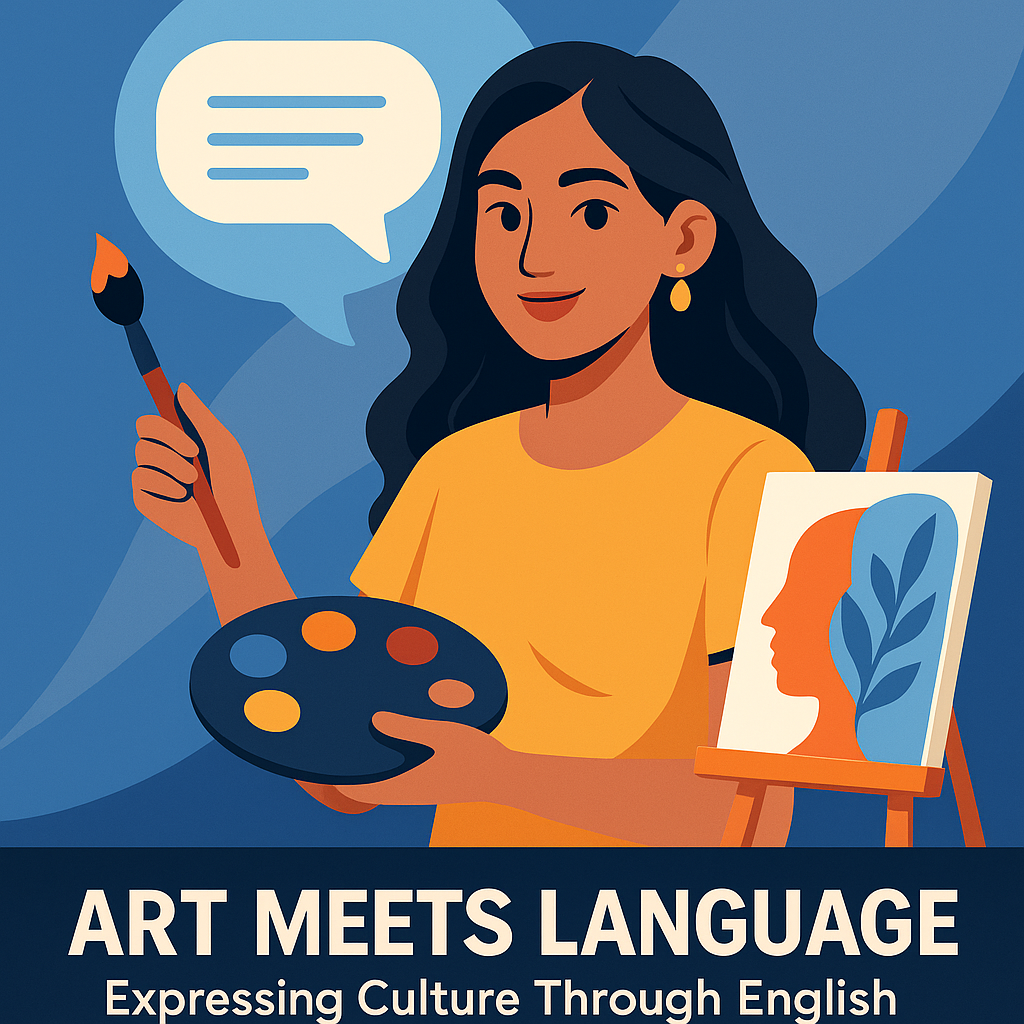
In this exploration of how art meets language to express culture, we have seen the unparalleled role both play in deepening our understanding of diverse cultural identities. Language and art act as interconnected channels that not only capture cultural narratives but also share them with the world.
By leveraging English as a bridge for cultural exchange and combining it with the universal appeal of art, we can transcend cultural barriers, allowing people from different backgrounds to learn from one another. This confluence of language and art enriches individuals and societies, its impact extending far beyond mere aesthetic or linguistic value.
In embracing this partnership, readers are encouraged to explore and appreciate cultural offerings from diverse sources. Starting today, choose an artist from a culture different from your own, learn a new phrase in English that reflects a foreign cultural concept, or delve into a foreign film with English subtitles. Each step taken nurtures a pathway toward greater cultural understanding and unity.
As we continue to navigate an increasingly interconnected world, let us harness the synergy of art and language as both a mirror and a bridge—revealing our shared humanity while celebrating the beautiful diversity of cultures that animate it.
Frequently Asked Questions
1. What is the relationship between art and language in expressing culture?
Art and language are two pivotal components that play an essential role in expressing culture. In essence, art is often seen as a visual representation of the emotions, beliefs, and practices that define a culture, while language serves as the conduit through which these cultural elements are communicated and understood. Language, both spoken and written, can describe ideas, tell stories, and convey emotion in a way that complements the visual narrative that art provides. When considering English as a medium, it has the power to bridge cultural divides, as it is a widely used global language that can introduce cultural art expressions to broader audiences. For instance, a painting may depict a cultural event, but the analysis or interpretation of that art piece often relies on descriptive language to provide context and insight. Together, art and language create a fuller picture of culture, embedding the viewer or listener in the emotions and historical context of a society. In a diverse world, this combination helps facilitate a deeper understanding of different cultures and promotes intercultural communication.
2. How does English influence the interpretation of art from different cultures?
English, being a dominant global lingua franca, profoundly impacts how art from diverse cultures is perceived and interpreted. When art is discussed, critiqued, or publicized in English, it often gains access to a wider audience and can lead to a greater appreciation and understanding of the culture it represents. English can provide a platform for artists from non-English-speaking backgrounds to share their work and cultural narratives on a global stage. However, this also means that nuances and subtle meanings can sometimes be lost or altered in translation. The richness of a native language—the play of words, idioms, and culturally specific expressions—can be challenging to capture in English. On the plus side, English offers a common language through which diverse cultural art forms can be explored and appreciated, igniting interest in cultural exploration and understanding across the globe. The key in interpretation is having skilled translators and culturally aware interpreters who can preserve the original meanings of cultural art while making it accessible to an English-speaking audience.
3. In what ways can art and English be used in education to teach cultural awareness?
Using art and English in education serves as a powerful approach to teaching cultural awareness and fostering an appreciation of diversity. Classrooms can integrate art projects that explore various cultural themes, allowing students to express their understanding of different cultures creatively. Through English, educators can introduce students to literature, poetry, and critical essays that discuss cultural histories and perspectives. For instance, reading stories from different parts of the world in English versions can expose students to the customs and social dynamics of other cultures, generating discussions that promote empathy and understanding. Art assignments—such as creating pieces inspired by different cultural motifs—can be paired with writing tasks that describe the art’s cultural significance. This kind of integration nurtures a holistic appreciation of culture, engaging students visually and linguistically. Furthermore, educational programs can incorporate guest speakers, virtual museum visits, or international pen pal exchanges conducted in English to present firsthand cultural perspectives and experiences. Through these methods, students not only learn the language and artistic techniques but also develop a deeper connection to the global community.
4. What are some challenges faced when using English to express cultural art?
While English offers a robust medium for expressing cultural art to a broad audience, it also presents several challenges. One notable challenge is the potential dilution of cultural specificity, as some cultural concepts and expressions may not have direct equivalents in English. This can lead to a loss of subtlety and depth in the interpretation of the art. The diversity in accents, dialects, and vernaculars across the English-speaking world can also result in varying interpretations, potentially leading to misunderstandings or misconceptions about the original cultural context. Additionally, there may be barriers related to the accessibility of this art to non-English speakers or those who lack proficiency in the language, limiting the reach and understanding of cultural narratives. There’s also the risk that English, being a dominant global language, may overshadow or marginalize the native languages and cultural expressions of those communities that are being represented, leading to homogenization. To mitigate these challenges, translators and cultural interpreters must strive for authenticity and cultural sensitivity, ensuring accurate representation and maintaining the integrity of the original cultural messages.
5. Can you provide examples of how English and art have successfully contributed to intercultural dialogue?
English and art have successfully contributed to intercultural dialogue in several remarkable ways. International art exhibitions and cultural festivals often feature bilingual or multilingual narratives—primarily in English—that explain the art pieces and the cultures they represent. For example, the Venice Biennale, a prestigious international arts exhibition, often uses English to communicate the themes and stories of artists from around the world, thus broadening understanding and appreciation across cultural boundaries. Similarly, literary art forms such as poetry and novels originally written in various languages are often translated into English, allowing them to reach a global audience. Works like Chimamanda Ngozi Adichie’s “Half of a Yellow Sun” provide insight into Nigerian culture and history while addressing universal human themes, fostering a sense of global empathy and connection. Collaborative projects such as international film productions also demonstrate how English can facilitate intercultural dialogue, with art forms transcending language barriers to tell compelling stories that resonate with diverse audiences worldwide. These efforts underscore the power of linguistic and artistic collaboration in creating spaces for meaningful intercultural exchange and mutual understanding.