
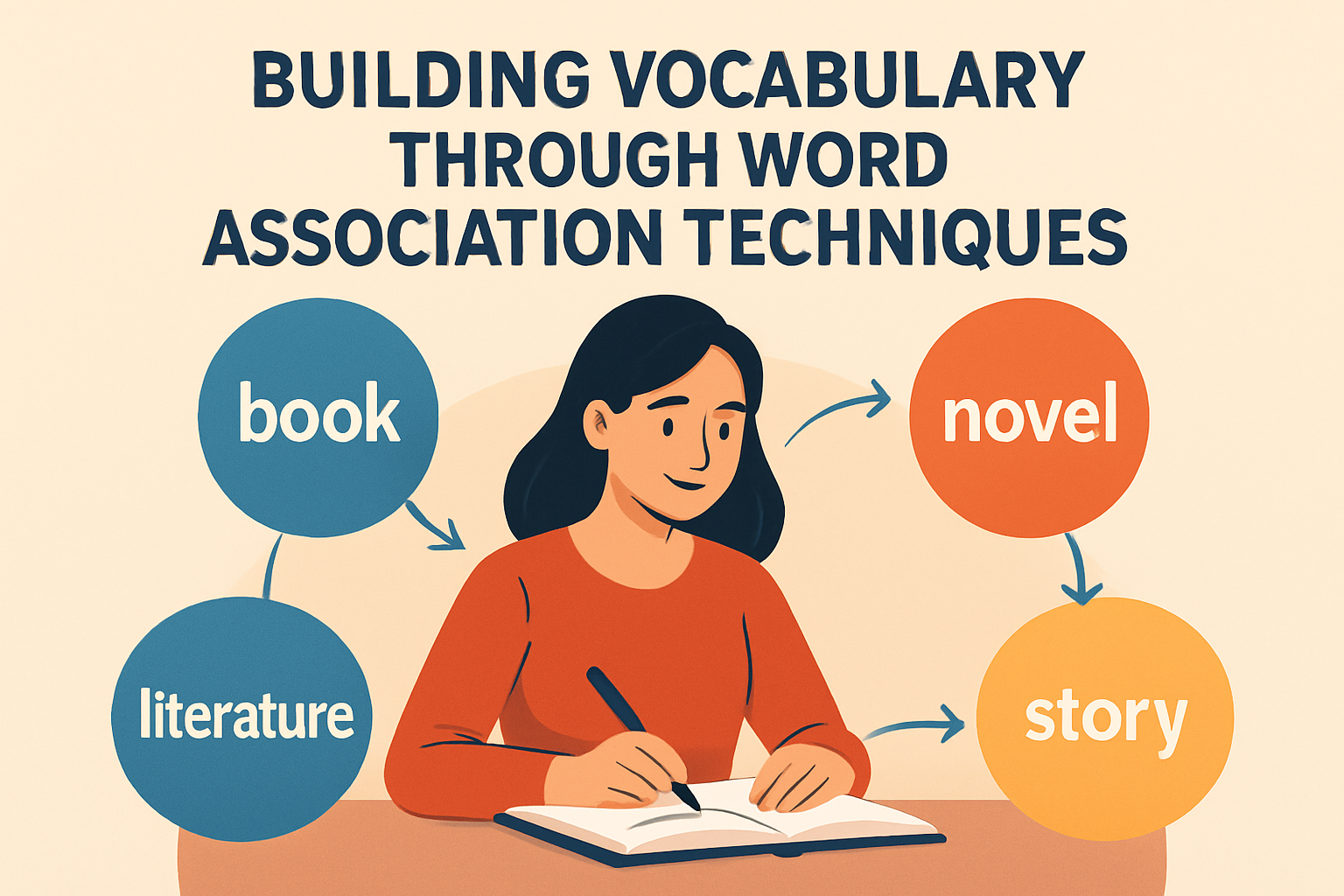
Vocabulary forms the backbone of effective communication. Knowing more words means expressing yourself more freely and understanding others better. Developing a robust vocabulary is crucial for academic success, professional advancement, and personal growth. Word association techniques, a dynamic method of learning, plays a vital role in expanding one’s vocabulary. These techniques involve creating connections between words or phrases, typically enhancing memory retention and recall. Word association not only enriches vocabulary but also deepens comprehension and enables quick learning. By associating meaningful links between words, we can foster a natural and intuitive understanding of language.
Why Word Association Techniques Matter
Understanding the importance of these techniques is vital. Essentially, word association methods hinge on connecting new words with known concepts, leading to more durable memory traces. The psychology behind this practice tells us that the human brain thrives on interconnected data networks. When you learn a new word and associate it meaningfully with an existing idea, you create a mental ‘anchor’ that aids in future recall. Modern research demonstrates that associating words leads to richer, longer-lasting learning compared to rote memorization or flashcards, by tapping into the brain’s natural way of categorizing information. This dynamic learning opportunity encourages an environment of creativity and comprehension.
Simple Associations and Memory Enhancement
A simple method for beginners involves using basic associations to expand vocabulary. If you’re learning a new word, connect it with an image, another word, or even an emotion you’re familiar with. For instance, when learning the word “serene,” you could associate it with a calming image of the beach or the feeling you get while meditating. By forging such connections, the brain autonomically remembers and retrieves the word later with minimal effort.
Consider Alex, a college student struggling with vocabulary for her English Literature classes. She starts associating complex words with pictures and emotions in her personal life. Thus, “erudite” reminds her of her professor, who possesses vast knowledge, helping her recall the term quickly in discussions.
Practical Applications of Word Clusters
Grouping words thematically, or creating word clusters, is another effective word association method that proves beneficial for learners of all ages. By establishing relationships between groups of words, learners can deepen their understanding and associate entire spectrums of vocabulary simultaneously.
For instance, teaching a class on weather terms could encompass terms such as “humid,” “precipitation,” and “forecast.” Not only does this approach offer context, but it enables students to exploit natural language patterns that reinforce learning. Teachers can bolster this process using graphic organizers, letting students visualize relationships and thus concretize their learning experience.
Mind Maps for Comprehensive Understanding
Mind maps offer an advanced approach to learning vocabulary by structuring information in a way that mimics cerebral processes of storing and retrieving data. This tool uses a central concept, branching out into various associations and examples.
Imagine a mind map exploring the word “economy.” At the center is the term itself, with branches leading to related ideas like “trade,” “recession,” “global market,” and “inflation.” Each branch can feature subsequent associations, creating an elaborate web of connected terms. Through this method, learners grasp the vast scope and relevance of vocabulary in real-world contexts.
| Word | Visual Association | Emotion |
|---|---|---|
| Melancholy | Grey Rainy Day | Sadness |
| Euphoria | Sunny Summit | Joy |
| Hesitant | Crossroads | Indecisiveness |
The Power of Mnemonics in Vocabulary Building
Mnemonics, a cornerstone of memorable word association, rely on creating imaginative links between a word and a detail you already know. This tool works particularly well with complex or abstract vocabulary, making it accessible through storytelling, abbreviations, or symbolic imagery.
Tom, struggling with legal terminology, creates a mnemonic for the word “allegation” by imagining a “luggage” filled with “charts” representing his assertion. Whenever he sees luggage, he recalls allegation effortlessly, demonstrating the efficacy of mnemonic devices.
Interactive Technologies and Digital Tools
In the digital age, leveraging technology for vocabulary learning bridges convenience with effectiveness. Numerous apps and platforms employ word association techniques to improve language-learning experiences. These tools incorporate gamified elements — quizzes, interactive flashcards, and adaptive exercises— that engage learners, satisfying curiosity while enabling retention.
- Quizlet: Offers a platform to create digital flashcards, blending images for association.
- Memrise: Provides linguistic mnemonics through innovative, user-contributed memes.
- Anki: Utilizes spaced repetition algorithms paired with visual cues to support enduring recollection.
These applications are reshaping language education, allowing students like Sara to engage with words creatively and independently, reinforcing vocabulary daily without pressure.
Social Learning and Peer Collaboration
Studying in communal settings accentuates the advantages of word association techniques. Through peer learning, students engage with different perspectives and methods, collaboratively building vast vocabulary networks and reinforcing each other’s learning.
In a classroom scenario, organizing discussion sessions where students present words from their reading and share personal associations provokes collective growth. This social dynamic not only sparks curiosity but enhances motivation connecting words with shared experiences.
Cultural Contexts and Language Immersion
Immersing oneself in specific cultural contexts amplifies the potential of word association techniques. By experiencing language firsthand within its natural societal framework, learners grasp nuanced connotations and usages, marrying vocabulary with cultural richness.
An adult learner living in Mexico quickly learns the meaning of “fiesta” beyond its textbook definition by partaking in local festivities. This real-world immersive experience adds dimension and depth, transforming memorized vocabulary into intuitive understanding.
Conclusion: Transformative Impact of Word Association Techniques
In conclusion, word association techniques offer a dynamic, versatile approach to building vocabulary. These methods empower learners to forge meaningful connections, creating robust mental frameworks for memory retention and fluency. From simple associations and mind maps to digital tools and cultural immersions, learners cultivate a vocabulary rich in understanding and application.
By integrating word association techniques into your language-learning journey, you’re actively transforming how you comprehend and utilize vocabulary. Begin today by creating your mind map, downloading an app, or engaging with peers in word games.
The result is your own finely-tuned lexicon, ready to elevate your reading and communicating confidence. Embrace this transformative approach. Unlock the power of words and, consequently, the infinite worlds they represent.
Take the first step now. Begin a new word association technique, and watch your vocabulary blossom.
Frequently Asked Questions
1. What is word association, and how can it help build vocabulary?
Word association is a learning technique that involves linking new information – like unfamiliar words – to existing knowledge that’s already stored in your memory. By associating a new word with something you already know, the brain creates a ‘mental hook,’ making it easier to recall and use the word later on. Think of it like creating a map where new vocabulary words are the destinations, and your existing knowledge is the network of roads that lead there. This method transforms the learning process into an interactive experience, as opposed to the rote memorization of word lists. For instance, if you’re learning the word “elated,” you might link it with the word “elevate” because both relate to a heightened state, whether it’s emotional or physical. These connections deepen your understanding and fortify your recollection, making word association a powerful tool in building vocabulary.
2. Why is a robust vocabulary important for everyday life and personal growth?
Having a strong vocabulary is essential for several reasons. Firstly, it enhances your ability to express thoughts and ideas clearly and effectively. Whether it’s in a workplace meeting or a personal relationship, being able to articulate yourself well can lead to better communication and understanding. Academically, a rich vocabulary supports reading comprehension, writing skills, and overall learning, which are crucial for success in school and beyond. Professionally, individuals with advanced vocabulary are often perceived as more knowledgeable and competent, opening up opportunities for career growth and advancement. Beyond these practical advantages, language is a vital component of our identity, and having a comprehensive vocabulary can contribute to personal growth by empowering us to engage with diverse perspectives, better understand our world, and connect more deeply with others.
3. What are some effective word association techniques?
There are a variety of word association techniques you can use to build your vocabulary. One approach is thematic connection, where you group words based on a common theme or context. For example, if you’re learning vocabulary related to “travel,” you might associate “itinerary” with “passport” or “luggage.” Another technique is the use of mnemonic devices, which involve creating a memorable phrase or story incorporating the new word. Rhyming can also be an effective tool; linking words that sound similar can enhance recall. Visualization is another powerful technique – picturing a vivid image that represents a word or its meaning creates a strong mental association. And don’t overlook the power of storytelling. Wrap new words in narratives where the context provides clues to their meaning and usage, aiding in retention and recall.
4. How can I incorporate word association techniques into my daily routine?
Integrating word association techniques into daily life can be both simple and enjoyable. Start by carrying a small notebook or using a note-taking app to jot down unfamiliar words you encounter as you go through your day. Later, when you have some free time, create associations for each term. Challenge yourself to come up with at least one new association for words you encounter in books, during conversations, or in media. Another effective strategy is turning to mind mapping. Create a mind map for each word, connecting it with synonyms, antonyms, or phrases that you’re already familiar with. Practice makes perfect, so engage in word association games like crossword puzzles or apps designed for language learning. Finally, incorporate these techniques into your daily activities, like cooking or commuting, by thinking of words related to objects or actions you see and perform. Consistency in using these techniques will accelerate your vocabulary development.
5. Are word association techniques suitable for all ages, from children to adults?
Absolutely! Word association techniques are versatile and can be adapted for any age group. For young children, these methods can be particularly engaging and effective when combined with playful learning activities. For instance, parents and educators can use associational games, like matching pictures with words or creating simple rhymes to make learning fun. For teenagers and adults, word association can be tied to interests and hobbies, making it easier and more relevant. The key is tailoring the complexity and type of associations to the individual’s developmental level and interests. For example, adults might use broader and more abstract associations, draw links to existing knowledge in their field of work, or use language apps that employ these techniques. As cognitive abilities evolve, so can the methods used, ensuring that word association remains an effective and enjoyable approach to vocabulary building throughout one’s life.





