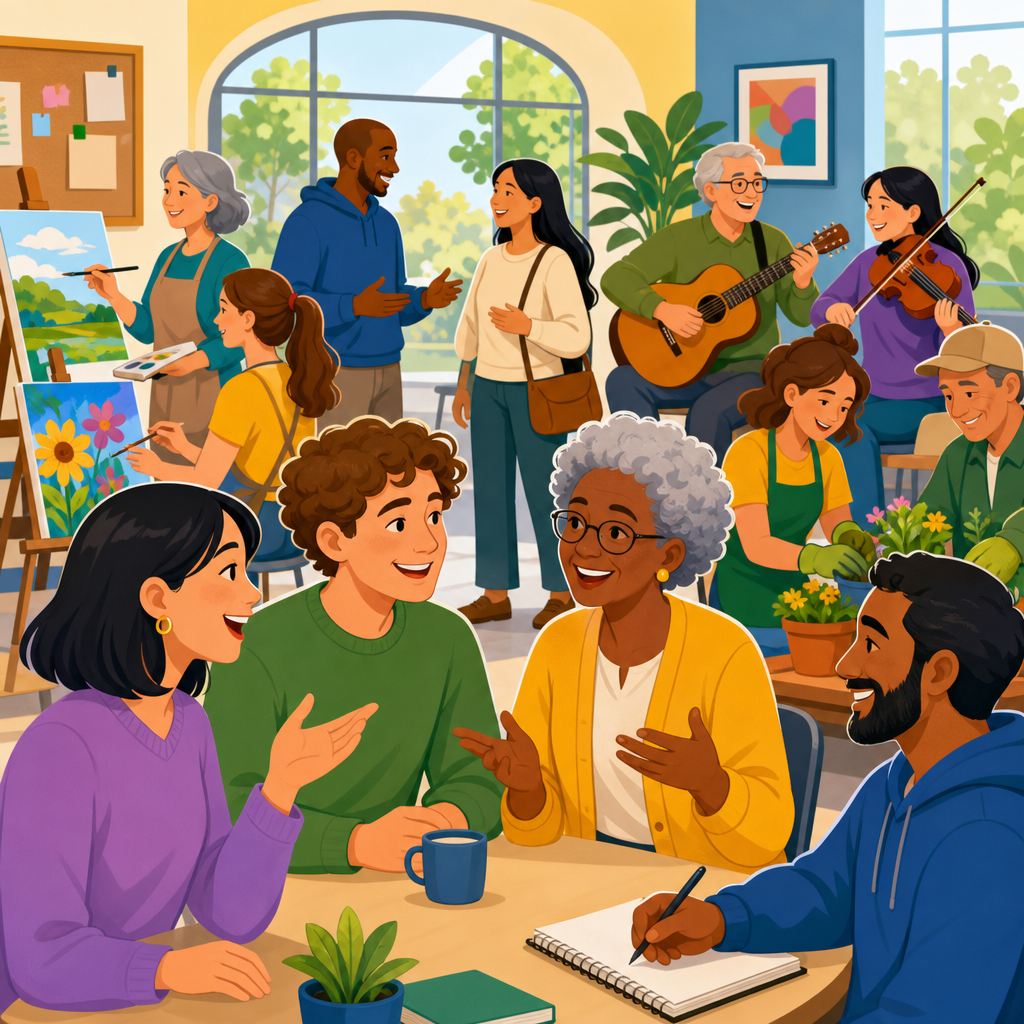
English for community center events and local clubs is the practical language people use to join activities, ask questions, introduce themselves, and build steady relationships in shared local spaces. In my work helping adult learners prepare for neighborhood workshops, library programs, hobby groups, and volunteer meetings, I have seen the same pattern repeatedly: learners often know classroom English, yet hesitate when real conversations move quickly around sign-up desks, folding tables, notice boards, and informal introductions. This matters because community centers and clubs are where language turns into participation. A person who can ask about membership fees, clarify a schedule, offer help at an event, or make friendly conversation before an activity is far more likely to return, contribute, and feel that they belong.
In this context, community center events include public classes, seasonal celebrations, sports sessions, parenting groups, health talks, art workshops, and volunteer drives. Local clubs include book clubs, gardening groups, walking clubs, chess circles, youth programs, and residents’ associations. The English used in these settings is not highly technical, but it is specific. It includes functional phrases such as “Is this open to beginners?” “Do I need to register in advance?” “Who is coordinating today?” and “Could you tell me where to put these chairs?” It also depends on tone. Direct language can sound abrupt if it is not softened with polite forms, while overly formal phrasing can create distance in friendly community spaces. Strong communication here combines clarity, courtesy, listening, and confidence.
People also need this language because community interactions rarely follow a script. A poster may say one thing, a volunteer may explain another detail, and a participant may invite you to a related activity at the end. Good English for community center events and local clubs therefore includes four core skills: understanding announcements, handling registration, joining group conversation, and following up afterward. When learners practice these exact moments instead of only general speaking exercises, their progress is faster and more durable. They stop translating every sentence in their head and start using language as a tool for belonging, contribution, and routine local connection.
Essential English for arrivals, registration, and first contact
The first five minutes at a community event shape everything that follows. Most people enter, look for a desk or organizer, and need language for simple but important tasks. The most useful opening lines are short, polite, and specific: “Hi, I’m here for the cooking class,” “I think I signed up online,” “Is this where we check in?” and “It’s my first time here.” These phrases work because they immediately give context. Staff and volunteers can respond faster when they know whether you are registering, asking for directions, or confirming attendance. I advise learners to memorize these lines exactly, then practice changing the final noun: workshop, club meeting, fitness session, volunteer day, or family event.
Questions about logistics come next. Common examples include “What time does it finish?” “Do I need to bring anything next week?” “Is there a fee for materials?” “Where should I put my name?” and “Which room are we using?” In real settings, these questions prevent confusion and reduce stress. At one community arts center I worked with, learners who practiced room, time, and payment questions in advance were much more willing to attend recurring classes, because they no longer feared missing a detail. Precision matters here. “Fee” is different from “donation,” “register” is different from “join,” and “member rate” is different from “public rate.” Understanding these distinctions helps people make informed decisions.
Introductions should also be simple and warm. “I’m new here,” “I live nearby,” “A friend recommended this group,” and “I’ve wanted to try this for a while” are natural ways to begin. These lines invite conversation without sounding forced. If you want to keep the exchange going, add one question: “How long have you been coming?” or “What do you usually do in this club?” For broader conversational confidence before group activities, this guide on small talk in English before a meeting or class is a useful companion. In practice, people remember friendliness more than perfect grammar, but correct phrase choice still makes interaction smoother and less tiring.
How to participate during activities and group discussions
Once an event starts, learners need English that helps them participate without interrupting or fading into silence. In workshops and clubs, the most valuable language functions are asking for clarification, expressing an opinion, making a suggestion, and showing agreement or uncertainty. Useful clarification phrases include “Could you say that again more slowly?” “Do you mean we work in pairs?” “Are we discussing chapter three today?” and “Can you show me an example?” These questions are practical, respectful, and common even among native speakers. Asking clearly is better than pretending to understand and getting lost halfway through the activity.
Discussion language should be adaptable across club types. In a book club, someone might say, “I liked the ending because it felt realistic.” In a gardening group, “I’ve had better results with tomatoes in containers.” In a residents’ meeting, “I agree with the idea, but parking may still be a problem.” These sentences share a pattern: opinion plus reason. That pattern is easy to learn and immediately useful. When people can give a reason, they sound more engaged and credible. I often teach learners to build comments from three parts: a view, a reason, and an example. “I prefer morning sessions because public transport is easier for me, especially on weekdays” is much stronger than simply saying, “Morning is better.”
Turn-taking matters just as much as vocabulary. Community conversations are collaborative, and people need language that enters the discussion politely. Good options include “Can I add something?” “I had a similar experience,” “That reminds me of another idea,” and “Sorry, just to clarify.” If you need time to think, use holding phrases such as “Let me think for a second” or “I’m not sure, but I think…” These buy time without breaking the flow. In my experience, learners who practice turn-taking markers become more active group members because they know how to join the conversation at the right moment instead of waiting for a perfect invitation.
| Situation | Useful English | Why it works |
|---|---|---|
| Checking in | “I registered online under Maria Gomez.” | Gives a clear action and name immediately |
| Asking for help | “Could you show me where the materials are?” | Polite, direct, and easy to answer |
| Joining discussion | “Can I add something about last week’s plan?” | Signals respect for turn-taking |
| Clarifying instructions | “Are we working in groups of four?” | Checks one detail precisely |
| Offering support | “I can help stack the chairs afterward.” | Shows willingness to participate |
Language for volunteering, organizing, and building local relationships
Many people first attend an event as visitors and later become regulars, helpers, or organizers. That transition requires another layer of English. Volunteers need phrases for offering help, confirming tasks, and coordinating with others: “What would you like me to do first?” “I can take the sign-in sheet,” “Who is responsible for refreshments?” and “Should we set up before six?” These are high-value expressions because community spaces often depend on informal teamwork rather than strict corporate procedures. Clear language prevents duplicated work and last-minute confusion.
Relationship-building is equally important. Local clubs thrive when members remember names, ask follow-up questions, and refer back to previous conversations. That means using lines like “How did your presentation go?” “Did your daughter enjoy the holiday program?” or “You mentioned a hiking trail last week; what was it called?” This kind of follow-up English signals attention and reliability. It is one of the fastest ways to move from acquaintance to familiar member. In neighborhood groups I have supported, regular attendance alone did not build trust; consistent, thoughtful conversation did.
There are also moments when tact matters. Community settings bring together different ages, backgrounds, and communication styles. If you disagree, useful phrasing includes “I see your point, but I have a different concern,” “That could work, although cost might be an issue,” and “Maybe there’s a middle option.” These forms lower friction while keeping the message clear. They are especially important in residents’ associations, parent committees, and planning meetings, where people may care deeply about schedules, budgets, access, or noise. Strong community English is not only about speaking more; it is about helping a group function well.
Common mistakes and the fastest ways to improve
The most common mistake learners make in community center events and local clubs is using language that is either too limited or too formal for the situation. For example, some rely on one question for everything, such as “What is this?” Others choose stiff textbook phrasing like “I would be most grateful if you could furnish me with the relevant information.” Neither works well in ordinary local interaction. The better target is plain, polite spoken English: “Could you tell me how this works?” Another frequent issue is failing to confirm details. If an organizer says, “Bring a small container next time,” repeat the key point: “A small container, okay.” That simple check avoids many misunderstandings.
Improvement is fastest when practice matches the real environment. Read actual event posters, registration forms, WhatsApp announcements, and club emails. Listen for recurring words such as session, facilitator, materials, donation, waitlist, venue, committee, and cancelled. Then rehearse short speaking routines aloud. I recommend three: arrival, participation, and departure. For arrival, practice introducing yourself and asking two logistical questions. For participation, practice one clarification question, one opinion, and one offer to help. For departure, practice “Thanks, I enjoyed that,” “Will this happen again next week?” and “How can I stay updated?” These routines create automaticity, which is what people need when conversation is moving in real time.
English for community center events and local clubs becomes powerful when it is learned as lived language, not as isolated vocabulary. The goal is not to sound perfect. The goal is to understand what is happening, respond appropriately, and become someone who can join, contribute, and return with confidence. Focus on practical phrases for check-in, discussion, volunteering, and follow-up. Notice the tone used by experienced members. Ask direct questions when details are unclear. Most of all, keep showing up and reusing the same useful language until it feels natural. If you want better local connections, choose one nearby event this week, prepare ten key phrases, and use them in a real conversation.
Frequently Asked Questions
Why is English for community center events and local clubs different from classroom English?
Community center English is different because it happens in real time, in shared public spaces, and usually with several goals happening at once. In a classroom, language is often slower, more structured, and focused on correct answers. At a local event, people may be signing in, setting up chairs, greeting new arrivals, answering quick questions, and giving directions all at the same time. That means learners are not just listening for grammar; they are listening for practical meaning. They need to catch phrases like “The sign-up sheet is over there,” “We’re starting in five minutes,” “Do you want to join our table?” or “Feel free to bring a friend next week.” These expressions are simple on paper, but they can feel hard when spoken quickly in a busy room.
Another major difference is that community spaces depend heavily on social comfort. People often use friendly, informal language to make others feel welcome. Instead of textbook-style introductions, you may hear, “Hi, I don’t think we’ve met,” “Are you here for the workshop too?” or “I usually come on Thursdays.” Understanding and using these everyday phrases helps learners move from being present in the room to actually participating. In other words, success is not only about perfect English. It is about being able to ask, respond, confirm, and continue a conversation naturally enough to join the group.
This is why practical preparation matters. Learners do well when they practice the specific language of arrival, registration, introductions, small talk, asking for clarification, and politely ending conversations. Once they know the patterns, they feel less pressure to produce perfect sentences and more confidence in simply communicating. That shift is what makes community English so powerful: it helps people become active members of local life, not just students of the language.
What are the most useful English phrases to know when joining a community event or local club for the first time?
The most useful phrases are the ones that help you enter the space, understand what is happening, and connect with at least one or two people. Start with arrival language. Phrases such as “Hi, is this the right place for the book club?” “I’m here for the workshop,” “Do I need to sign in?” and “Is there a fee?” are extremely practical. They help learners handle the first few minutes, which are often the most stressful. If a person can manage the opening interaction smoothly, the rest of the event usually feels easier.
Next, learners should know how to introduce themselves and ask simple social questions. Useful phrases include “Hi, I’m Maria. It’s my first time here,” “How long have you been coming to this group?” “What kinds of activities do you usually do here?” and “I’m interested in volunteering / art / conversation practice / gardening.” These questions are effective because they are natural, easy to remember, and likely to create a real response. In most local clubs, people appreciate friendliness more than perfect language. A clear self-introduction and one honest question can open the door to a longer conversation.
It is also important to know repair phrases for moments of confusion. Real community conversations move quickly, and even advanced learners may miss part of what someone says. Phrases like “Sorry, could you repeat that?” “Could you speak a little more slowly?” “What time does it start?” “Which room are we in?” and “Can you show me where that is?” are essential. These are not signs of weakness. They are tools for staying involved. Learners who use them confidently often participate more because they do not silently drop out of the interaction when they miss information.
Finally, learners should prepare closing and follow-up language. Examples include “Thanks, that was really helpful,” “I had a great time today,” “Do you meet every week?” “Can I sign up for next time?” and “It was nice meeting you.” These phrases help turn one visit into an ongoing connection. Community participation grows through repeated contact, and repeated contact depends on being able to end conversations warmly and clearly. That is often the language that helps people return.
How can adult English learners build confidence speaking at neighborhood workshops, library programs, and volunteer meetings?
Confidence grows fastest when learners stop trying to be impressive and start trying to be prepared. In local community settings, the goal is not to deliver long, polished speech. The goal is to handle common situations successfully. That means practicing short, reliable language for predictable moments: arriving, asking where to go, introducing yourself, responding to simple questions, and asking for clarification. When learners have these language routines ready, they feel grounded. They no longer have to create every sentence from nothing under pressure.
Another strong strategy is rehearsal with realistic situations. Instead of only memorizing vocabulary lists, learners should practice mini-conversations they are likely to have at a registration table, before a hobby class begins, during a snack break, or while setting up for a volunteer project. For example, they can rehearse: “Hi, I’m new here. Where should I put my name?” or “I’m interested in joining. Can you tell me how this group works?” Repetition builds automaticity, and automaticity reduces anxiety. In real community spaces, speed matters. Familiar phrases give learners something ready to use when the moment comes.
Confidence also improves when learners understand that participation includes listening, reacting, and asking follow-up questions—not only speaking a lot. Many adult learners think they must say something long to sound competent. That is not true. Saying “That sounds interesting,” “Really?” “How did you get involved?” or “I’d like to learn more about that” is meaningful participation. These short responses keep the conversation moving and show engagement. In community groups, being warm, attentive, and willing to connect often matters more than speaking at length.
Finally, learners should expect progress through repetition, not instant comfort. The first visit may feel awkward. The second may feel slightly easier. By the third or fourth visit, familiar faces, repeated phrases, and known routines begin to reduce uncertainty. That is how real confidence is built. It comes from surviving small interactions, then repeating them until they no longer feel threatening. In my experience, learners who return consistently, even when they feel nervous, improve much faster than those who wait until they feel fully ready. Community English becomes easier by being used in the community.
What should learners do if they do not understand fast English during an event or club meeting?
The first step is to remember that not understanding everything is normal, especially in busy local environments. Community events often include overlapping conversations, background noise, informal speech, and speakers who assume everyone already knows the routine. Learners should not interpret one missed sentence as failure. Instead, they should focus on staying active in the conversation. That means listening for key information such as time, location, names, instructions, materials, or next steps, even if they miss smaller details.
It is essential to use clear clarification phrases right away. The most useful ones are simple and direct: “Sorry, could you repeat that?” “Did you say Tuesday or Thursday?” “What time are we starting?” “Which table should I go to?” and “I’m sorry, I didn’t catch the last part.” These phrases help learners recover information before they fall behind. Many adults hesitate to interrupt because they worry about sounding rude, but polite clarification is completely acceptable in these settings. In fact, it usually makes communication easier for everyone.
Learners can also use context to support understanding. They should watch what others are doing, notice where people are moving, look for printed schedules or sign-up sheets, and listen for repeated words. If several people are carrying materials to one room, that may confirm where the activity is happening. If the organizer says a word several times, such as “waiver,” “donation,” “beginner,” or “upstairs,” that word is probably important. Community communication is not only verbal. Visual cues, routines, and group behavior often provide valuable information.
After the event, it helps to review what was difficult. Learners can write down phrases they heard, questions they wished they had asked, or words they saw on flyers and notices. Then they can practice those exact situations before the next visit. This turns confusion into preparation. Over time, repeated exposure to the same kinds of instructions and social exchanges makes fast English more predictable. That is the key point: understanding improves not just by studying harder, but by repeatedly hearing practical language in the places where it is actually used.
How can someone make real social connections in local clubs and community programs using simple English?
Real connection usually begins with consistency and small, repeatable interactions. Many learners assume friendship starts with deep conversation, but in community settings it often starts with recognition. Saying “Hi, good to see you again,” “I was here last week too,” or “How was the last meeting?” helps people move from stranger status to familiar member status. Simple English is enough for this. What matters most is showing up, greeting people warmly, and participating in the shared activity. Familiarity creates trust, and trust makes later conversation easier.
It also helps to focus on the activity itself. Shared tasks are one of the easiest ways to build conversation naturally. In a cooking group, someone can ask, “Have