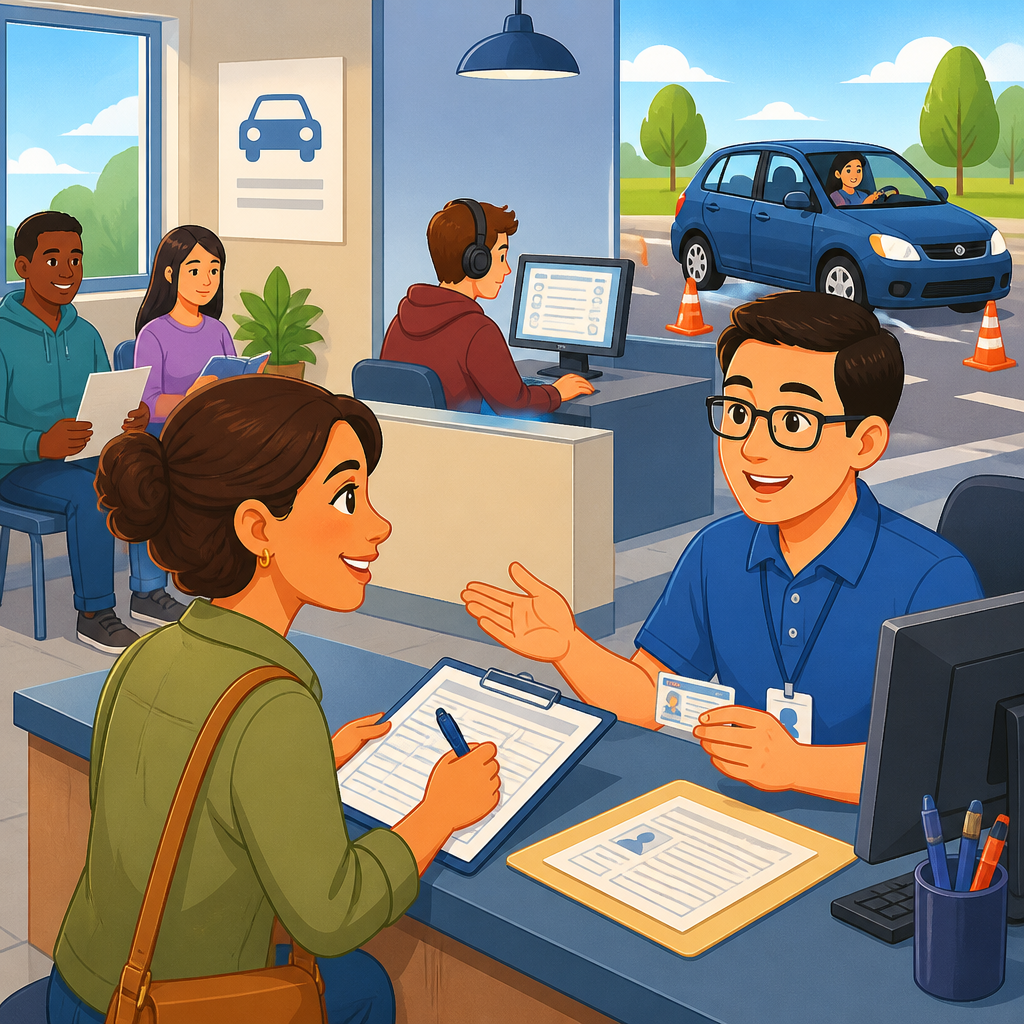
English for DMV visits can feel intimidating because the language is formal, the process is procedural, and the consequences of misunderstanding a form or instruction are immediate. In this context, DMV usually means the Department of Motor Vehicles or a state licensing agency that handles driver licenses, identification cards, vehicle registration, title transfers, and road testing. The English used in these offices includes specific terms such as renewal, proof of residency, vision screening, learner permit, registration fee, and appointment confirmation. I have helped adult English learners prepare for these visits, and the biggest pattern is clear: people often know everyday English but struggle with task-based phrases used by clerks, websites, kiosks, and examiners. That gap matters because a missed document, a misunderstood question, or a wrong answer at the counter can lead to delays, repeat visits, extra fees, or canceled tests. Learning the right English for DMV visits makes the process faster, lowers stress, and gives you more control when you need to ask questions, complete forms accurately, and understand what happens next.
Common DMV vocabulary and the phrases you will hear most often
The fastest way to improve confidence is to learn the small set of words and phrases that appear repeatedly in DMV visits. A clerk may say, “What service do you need today?” or “Are you here for a renewal, replacement, or new application?” Renewal means extending an existing license or registration. Replacement means getting a new copy because the original was lost, stolen, or damaged. A new application usually applies to a first license, state ID, permit, or title. You may also hear “Please take a number,” “Fill out this form,” “Show proof of identity,” “Provide proof of residency,” and “Your documents need to be current.” Current means valid now, not expired.
Know the difference between identity documents and residency documents. Identity documents prove who you are, such as a passport or birth certificate. Residency documents prove where you live, often with a lease, utility bill, bank statement, or official mail. Many states require two proofs of residency, and the name and address must match the application. If the clerk says, “This document is not acceptable,” ask, “What kind of document do you need instead?” That question is direct, polite, and practical.
Testing language also follows patterns. For written exams, you may hear knowledge test, permit test, or computer test. For driving exams, common terms include road test, behind-the-wheel test, examiner, scoring sheet, and automatic fail. An automatic fail is a serious mistake that ends the test immediately, such as running a red light. For appointments, listen for confirmation number, check-in, available slot, reschedule, cancellation, and wait time. If you need broader practice with appointment language, review the main guide at https://5minuteenglish.com/english-for-booking-a-doctors-appointment-by-phone/, then return to DMV-specific vocabulary.
How to understand DMV forms and complete them correctly
Most DMV forms use compressed administrative English. The sentences are short, but the wording can be unfamiliar. Typical sections include full legal name, mailing address, residential address, date of birth, height, weight, eye color, organ donor status, voter registration, and emergency contact. Legal name means the exact name shown on your official identity documents. Mailing address is where you receive mail. Residential address is where you actually live. If those are different, do not guess; ask whether both fields are required.
Checkboxes also cause confusion. A form may ask whether you want to renew, replace, correct, or duplicate a license. Correct usually means changing information, such as a new address or name. Duplicate often means an extra official copy with the same information. Read every option slowly before marking the box. If a question says “Have you ever had your license suspended or revoked?” suspended usually means temporarily removed, while revoked usually means officially canceled and often harder to restore. Those are not the same.
When helping learners fill out DMV applications, I tell them to pause on three high-risk areas: signature lines, penalty statements, and certification language. A sentence such as “I certify under penalty of perjury that the foregoing is true and correct” means you are making a legal declaration. Sign only after checking every answer. If something is unclear, say, “Can you explain what this question is asking?” Clerks may not translate every detail, but they can often clarify the meaning of a field or direct you to official instructions on the agency website.
Booking appointments and checking in without confusion
Many DMV offices now require appointments for licenses, permits, and road tests, while registration services may still accept walk-ins. Online booking systems usually ask you to choose a service category first. That category matters because the available time slots, required documents, and office locations can change depending on whether you need a REAL ID, written test, title transfer, or driving exam. REAL ID is a federally compliant identification standard established under the REAL ID Act of 2005, and states often list separate document requirements for it.
Use exact language when booking. Say, “I need to renew my driver license,” “I need to take the knowledge test,” or “I need to change the address on my registration.” Avoid vague requests like “I need DMV help.” At check-in, a staff member may ask for your QR code, appointment email, or confirmation number. If you are late, ask, “Can I still be seen today, or do I need to reschedule?” That wording is better than simply saying, “I missed my time.”
| Situation | Useful English | Why it works |
|---|---|---|
| Booking online | I need an appointment for a license renewal. | Names the exact service, which improves routing. |
| At reception | I have a 10:30 appointment for a written test. | Gives time and purpose in one sentence. |
| Missing a document | Can you tell me what document is missing? | Gets a specific answer you can act on. |
| Rescheduling | What is the next available appointment? | Moves the conversation toward a solution. |
| After a delay | How long is the current wait time? | Uses standard service language clerks expect. |
If the office uses a kiosk, expect commands like scan your barcode, select a service, verify your address, and print your ticket. Read the screen one line at a time. If a machine times out, start over calmly. In busy offices, the practical skill is not perfect English; it is clear, efficient English focused on the next step.
English for the written test, vision screening, and road test
DMV tests use direct language, but the stakes make every instruction feel heavier. For the written or knowledge test, study the state driver handbook because its terms often appear word for word on the exam. Focus on right-of-way, yield, blind spot, following distance, speed limit, intersection, lane change, school zone, and seat belt law. Right-of-way means which driver or pedestrian is legally allowed to go first. Yield means slow down and let another road user proceed. Blind spot is the area your mirrors do not show. These are not casual vocabulary words; they are decision words tied to safety and legal responsibility.
During a vision screening, staff may say, “Cover your left eye,” “Read line four,” or “Keep both feet on the floor.” If you do not hear clearly, say, “Could you repeat that more slowly?” During a road test, the examiner will often use short commands: “Turn left at the next light,” “Pull over to the curb,” “Back up in a straight line,” “Change lanes when safe,” or “Return to the parking lot.” The important phrase is when safe. It means follow the instruction only after checking mirrors, signaling, and confirming traffic conditions allow it.
I have seen learners fail not because they could not drive, but because they misunderstood a command and acted too quickly. If an instruction is unclear, it is acceptable to ask, “Did you say turn at this street or the next one?” That is safer than guessing. After the test, you may hear pass, fail, points deducted, critical error, or eligibility to retest. Ask for specifics: “What should I improve before the next test?” Useful feedback often includes scanning intersections better, stopping fully, or checking mirrors more consistently.
Handling problems, corrections, and follow-up visits
Even well-prepared visitors run into problems. A name may be spelled differently across documents. A utility bill may be too old. An insurance card may not show the current policy period. In those moments, calm question patterns matter. Say, “What exactly do I need to bring back?” “Does this have to be an original document?” “Can I use a digital copy?” and “Do I need a new appointment for this correction?” Those questions help you leave with a clear checklist instead of general frustration.
Some issues involve status rather than language. A hold on a license can result from unpaid tickets, incomplete documentation, or state-specific compliance rules. If a clerk says there is a hold, ask, “Which office placed the hold, and how can I resolve it?” For address changes, title corrections, or registration mistakes, ask whether the correction can be handled the same day. Policies vary by state, and fees differ. The best habit is to repeat the final instruction back to the clerk: “So I need two proofs of residency and a new appointment for next week, correct?” That confirmation reduces error.
English for DMV visits is not about sounding advanced; it is about understanding procedures, documents, and instructions well enough to complete your task correctly. Learn the vocabulary that repeats, prepare the exact documents required, and practice simple questions that get precise answers. If you have a visit coming up, review your state DMV website, make a document checklist, and rehearse the phrases in this guide before you go.
Frequently Asked Questions
1. What English words and phrases should I know before going to the DMV?
Before visiting the DMV, it helps to understand the most common words used on forms, signs, and during conversations with staff. Important terms include renewal, which means extending your current license, registration, or ID so it remains valid; replacement, which means getting a new copy of a lost, stolen, or damaged document; and duplicate, which often means the same thing as replacement on DMV paperwork. You should also know proof of residency, which refers to documents that show where you live, such as a utility bill, lease agreement, or bank statement. Another frequent phrase is proof of identity, which means documents that confirm who you are, such as a passport or birth certificate. You may also see vision screening, which is a basic eye test, and written test, knowledge test, or permit test, which can all refer to the exam about traffic rules and road signs.
Other useful phrases include title transfer, which means changing legal ownership of a vehicle; vehicle registration, which refers to officially recording a car with the state; road test or driving test, which is the practical exam where you drive with an examiner; and appointment confirmation, which is the notice showing your scheduled time. You may also hear staff say, “Please complete this section,” “Sign where indicated,” “Take a number,” “Wait to be called,” or “Your documents are incomplete.” Knowing these phrases can reduce stress because you will better understand what action is required. If you are unsure, polite and direct questions work well, such as “Could you explain what this section means?” or “What documents do you need for proof of residency?” At the DMV, clear communication matters because even small misunderstandings can delay your application, test, or renewal.
2. How can I understand and fill out DMV forms correctly in English?
DMV forms often use formal, compact language, so the best approach is to read each section slowly and identify exactly what information is being requested. Most forms ask for basic details such as your full legal name, date of birth, residential address, mailing address, and driver license or ID number. Pay close attention to the difference between residential and mailing address. Your residential address is where you actually live, while your mailing address is where you receive mail if it is different. Forms may also ask for your height, weight, eye color, and social security number or the last four digits of it, depending on the state and service requested. If a section says print clearly, it means write neatly in block letters, not cursive. If it says sign within the box, keep your signature inside the marked area because scanned systems may reject it if it goes outside.
You should also watch for legal declarations near the end of the form. These often state that the information is true and correct “under penalty of perjury,” which means there can be legal consequences for giving false information. Words like certify, attest, and acknowledge usually indicate that you are formally confirming something. If a form asks whether your license is being renewed, replaced, or updated, choose the option that matches your purpose exactly. For example, a renewal is for an expiring license, while a replacement is for a lost one. Never guess if you do not understand a question. It is better to ask a clerk, review your state DMV website, or use a translated guide if one is available. Many mistakes happen when people rush through sections, skip required fields, or misunderstand terms like endorsement, restriction, or organ donor designation. A careful, line-by-line review before submitting the form can save time, avoid repeat visits, and prevent processing delays.
3. What should I expect during a DMV appointment, including check-in, testing, and document review?
A DMV appointment usually follows a step-by-step process, and understanding that process in English can make the visit much easier. When you arrive, you may need to show an appointment confirmation email, text message, or printed notice. You might hear instructions such as “Check in at the kiosk,” “Select the service type,” or “Please wait until your number is called.” The service type could be license renewal, ID card application, registration, title transfer, permit testing, or a road test. After check-in, you may receive a ticket number and wait in a seating area until a screen displays your number or a staff member calls your name. In many offices, the first interaction is document review. A clerk checks whether your paperwork matches the service you requested. If something is missing, they may say, “You need additional documentation,” “This proof is not acceptable,” or “This document must show your current address.”
If your appointment includes a written or knowledge test, staff may explain the procedure with phrases like “You will have a limited amount of time,” “Choose the best answer,” or “Please complete the exam on the computer terminal.” If your service includes a vision screening, you may be asked to read letters or numbers from a chart or machine. For a road test, an examiner may use direct commands such as “Turn left at the next corner,” “Come to a complete stop,” “Change lanes when safe,” or “Back up slowly.” These instructions are usually brief, formal, and action-focused. At the end of the appointment, you may receive a temporary paper license, a receipt, a next-step notice, or instructions about when your permanent card will arrive by mail. In general, the DMV process is structured and procedural, so the best strategy is to listen carefully, bring all required documents, and ask concise questions if anything is unclear. Even if the environment feels stressful, the communication is often repetitive and predictable once you know the common terms and sequence.
4. How can I prepare for DMV English used in written tests, vision screenings, and road tests?
Preparation is most effective when you focus on the specific kind of English used in each DMV task. For written or knowledge tests, you should study vocabulary related to traffic laws, road signs, safe driving behavior, and penalties. Common test words include yield, merge, intersection, right-of-way, speed limit, blind spot, school zone, and following distance. Questions are often written in clear but formal English, and they may include phrases such as “What is the proper procedure,” “Under which circumstances,” or “When must a driver.” Practicing with your state driver handbook is important because that handbook uses the same terminology and style you are likely to see on the test. If English is not your strongest language, it helps to read the handbook aloud, make a personal glossary of unfamiliar words, and take practice tests until the wording feels familiar.
For the vision screening and road test, spoken English matters more than reading. The examiner may give short commands quickly, so practice listening to common driving instructions beforehand. Useful commands include “Pull over,” “Proceed through the intersection,” “Parallel park,” “Make a three-point turn,” and “Stop behind the line.” You do not need advanced English to succeed, but you do need to understand action words accurately and respond calmly. If you do not hear an instruction clearly, it is usually better to say, “Could you please repeat that?” than to guess. During the road test, your examiner is evaluating safe driving, but language comprehension is part of following directions correctly. Preparing for DMV English means studying both vocabulary and context: what the words mean, when they are used, and what action they require. The more familiar the language becomes, the more mental energy you can devote to the actual task, whether that is answering a test question, reading an eye chart, or driving safely under observation.
5. What should I do if I do not understand something at the DMV or I am worried about making a mistake in English?
If you do not understand something at the DMV, the most important thing is not to pretend that you do. Small misunderstandings can lead to the wrong form, missing documents, failed testing steps, or delayed processing. DMV staff are used to answering procedural questions, and simple, polite English is usually the best approach. Helpful phrases include “Could you explain this section, please?” “What does this word mean?” “Which documents are acceptable?” “Am I filling this out correctly?” and “Can you repeat the instruction more slowly?” These questions are direct, respectful, and practical. If you are reviewing paperwork, point to the exact line or box that is confusing rather than asking a broad question. This makes it easier for the clerk to explain what is needed