
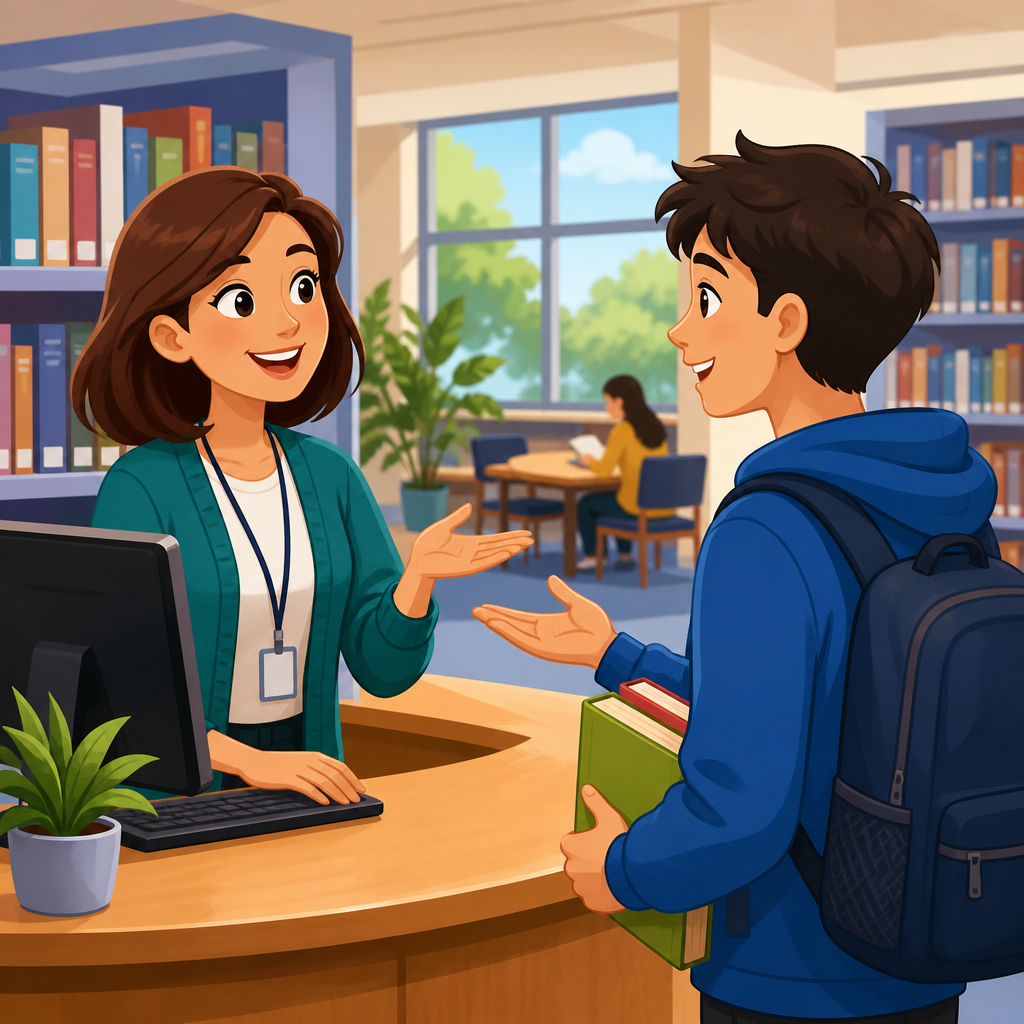
Asking for help at the library in English is a practical skill that makes studying, borrowing materials, using computers, and solving small problems much easier. A library is more than a room full of books. It is a public service space with staff, rules, technology, and specialized vocabulary. If English is not your first language, the hardest part is often not understanding the answer but knowing how to begin the conversation clearly and politely.
In daily life, I have seen learners freeze at the service desk because they know the topic they need help with but not the exact words. The good news is that library English is predictable. Most interactions follow a few common patterns: asking where something is, requesting access, explaining a problem, or clarifying a rule. Once you learn the right phrases, you can handle most situations with confidence.
It helps to define a few key terms before you use them. A librarian is a trained library professional who helps people find information, use resources, and understand services. A library assistant or staff member may help with borrowing, returns, printing, or directions. Borrow means taking an item home for a limited time. Return means bringing it back. Due date is the deadline for returning an item. Hold or reservation means asking the library to save an item for you when it becomes available.
This skill matters because libraries often support essential parts of life: school assignments, job applications, immigration paperwork, language learning, and internet access. In many communities, the library is one of the few places where expert help is free. If you can ask for help well, you save time, reduce stress, and get better results. Clear English does not need to be perfect. It needs to be direct, polite, and specific enough for the staff member to help you quickly.
Start the conversation politely and state your need
The best way to ask for help at the library in English is to open with a simple polite phrase and then name the problem. You do not need complex grammar. A clear opener such as “Excuse me, could you help me?” works in almost every situation. After that, add one sentence explaining what you need: “I’m looking for books about biology,” “I need to print a document,” or “I’m not sure how to renew this book.”
In real interactions, short sentences work better than long explanations. Library staff usually help many people each hour, so direct wording is useful. Good opening phrases include “Could you help me find…,” “Can you show me where…,” “I have a question about…,” and “I need help with….” If you are worried about sounding too direct, add “please” or “when you have a moment.” For example: “Could you help me find the children’s section, please?”
Specific details make your question easier to answer. Instead of saying “I need a book,” say “I need a beginner English grammar book,” or “I’m looking for a history book about ancient Egypt.” If you know the title or author, say both. If you do not know them, describe the subject, level, language, or format. Staff can then search the catalog, suggest similar items, or direct you to the correct shelves.
Sometimes you may need support in other areas of life, not only in the library. If you are building practical English for appointments and public services, this guide on English for booking a doctor’s appointment by phone is a useful next step because it teaches the same core habit: ask clearly, give the key details, and confirm the answer.
Use the right phrases for common library situations
Most library conversations fall into repeatable categories. Learning the exact phrases for each one helps you sound natural. When you need directions, ask, “Where can I find the fiction section?” or “Which floor are the study rooms on?” When you need an item, ask, “Do you have this book?” or “Could you check if this title is available?” When borrowing, ask, “How many books can I borrow?” or “When is this due?”
If you need technology help, be even more precise. Say, “How do I log in to this computer?” “Can I print from my phone?” “Where do I pay for printing?” or “The printer says there is an error.” Libraries often use systems with time limits, guest passes, print credits, and release stations. Staff can solve these issues quickly if you describe the screen message, the device you are using, and what you already tried.
Rules and policies are another common source of confusion. You can ask, “Can I renew this online?” “Is there a fine for late returns?” “Do I need a library card to use the computers?” “How long can I use a study room?” or “Are food and drinks allowed here?” These questions are practical because rules vary by library system. Public libraries, university libraries, and school libraries often have different lending periods, identification requirements, and access rules.
| Situation | Useful question | Why it works |
|---|---|---|
| Finding a book | Could you help me find this title? | Direct and easy for staff to act on immediately |
| Using a computer | How do I log in to this computer? | Shows exactly what step is unclear |
| Printing | Can I print from my phone, and where do I pay? | Combines the process and payment question |
| Borrowing items | How many items can I borrow, and when are they due? | Covers the two most important borrowing details |
| Renewing | Can you show me how to renew this book? | Asks for help and a demonstration |
| Study space | Do I need to reserve a study room? | Clarifies availability and procedure |
Ask follow-up questions and confirm what you heard
Understanding the answer is just as important as asking the first question. In library settings, answers often include directions, time limits, account information, or steps in a process. If you miss one detail, ask a follow-up question immediately. Useful phrases include “Could you say that again, please?” “Could you speak a little more slowly?” “So I need to scan my card first, right?” and “Did you mean the second floor or the third floor?”
Confirmation is a strong communication habit because it prevents mistakes. I often advise learners to repeat the key point back in one short sentence. For example, if the librarian says the book is on hold under your name until Friday, you can reply, “Okay, it’s reserved for me until Friday.” If the staff member explains printing costs, you can say, “So it’s ten cents per page, and I pay at the front desk?” This technique is common in customer service and reduces confusion for both people.
If you do not know a word, do not stop speaking. Describe the item or problem in simple English. You can say, “I’m looking for the machine that makes copies,” if you forget “photocopier,” or “I need the place where I return books,” if you forget “book drop.” This descriptive strategy is highly effective because library staff are trained to infer meaning from context. Communication succeeds when the message is clear enough, not when every word is perfect.
Handle problems politely when something goes wrong
Many library interactions happen because of a problem: a lost card, an overdue item, a blocked account, a missing hold, or a machine that does not work. In these situations, calm and precise language helps most. Start with the facts: “I think I returned this book already, but it still shows on my account,” “My card isn’t working,” “I can’t open this PDF on the computer,” or “I reserved a book, but I didn’t get the email.” These are better than vague statements such as “It’s broken” or “There’s a problem.”
Be honest about what happened and ask what the next step is. If you lost a book, say, “I think I may have lost this item. What should I do?” If you are late returning something, ask, “Is there a late fee, and can I renew it now?” Most libraries have formal policies for damaged or lost materials, account replacement, and appeal procedures. Staff may ask for your card number, photo ID, or the title of the item. Having those details ready makes the conversation faster.
Politeness matters even more during problems because staff usually must follow policy. Phrases such as “Could you explain how this works?” “Is there another option?” and “What do you recommend?” keep the interaction constructive. If the answer is no, you can still ask a useful follow-up: “If I can’t borrow this today, can I place a hold?” That approach often leads to a practical solution.
Build confidence with simple practice
The fastest way to improve is to rehearse a few core questions until they feel automatic. Practice these aloud: “Could you help me find this book?” “How do I renew this?” “Where can I print?” “Do I need a library card?” and “Could you repeat that, please?” Record yourself, listen for clarity, and shorten any sentence that feels difficult. Fluent library English is usually simple English spoken confidently.
It also helps to prepare before you walk in. Write down the title, author, call number, or service you need. Take a screenshot of an email about your hold. Bring your card or identification. If you expect a longer conversation, note the words due date, renew, hold, fine, return, printer, and catalog. Preparation reduces pressure and lets you focus on understanding the answer instead of searching for vocabulary on the spot.
Asking for help at the library in English becomes easier when you use a reliable pattern: open politely, explain the need, give details, ask follow-up questions, and confirm the answer. That pattern works for books, computers, printing, study rooms, and account problems. You do not need perfect English to use the library well. You need practical phrases, careful listening, and the confidence to ask one clear question at a time. Try two new library questions this week, and use them with a staff member the next time you visit.
Frequently Asked Questions
1. What is the easiest way to ask for help at the library in English?
The easiest and most effective way to ask for help at the library in English is to begin with a simple, polite sentence and then clearly explain what you need. You do not need advanced grammar or perfect pronunciation. In most libraries, staff are used to helping people of different ages, language levels, and backgrounds. A strong starting phrase is, “Excuse me, could you help me?” After that, you can add a short reason, such as, “I’m looking for a book,” “I need to print something,” or “I’m not sure how to use the computer.” This approach works because it is direct, respectful, and easy for staff to understand quickly.
It also helps to use key library vocabulary when possible. For example, you might say “borrow” instead of “take home,” “library card” instead of just “card,” or “return” instead of “bring back.” However, if you do not know the exact word, do not worry. You can still communicate successfully by describing the problem in simple language. For example: “I need this book for school, but I can’t find it,” or “My card is not working.” Library workers usually ask follow-up questions to clarify the situation. The important part is starting the conversation instead of waiting silently. A short, polite opening is often all you need to get useful help.
2. What are some polite English phrases I can use when speaking to a librarian?
Polite phrases are especially useful in a library because the environment is usually quiet, organized, and service-focused. Good phrases include “Excuse me,” “Could you help me, please?” “Can you show me where this is?” “I’m looking for…” “Do you have…” and “Could you explain how this works?” These expressions are common, natural, and appropriate for both public and academic libraries. They help you sound respectful without being too formal. For example, you can say, “Excuse me, could you help me find the history section?” or “Could you tell me how to borrow this book?”
It is also useful to know polite follow-up phrases. If you do not understand, you can say, “Could you say that again, please?” “Could you speak a little more slowly?” or “Can you show me?” If the librarian solves your problem, a simple “Thank you very much” is enough. If you need to ask about rules, try phrases such as “Am I allowed to eat here?” “How long can I keep this book?” or “Do I need my library card to use the computer?” These expressions make communication smoother and reduce stress because you are using language that fits the situation. In real life, clarity matters more than complexity, so short and polite sentences are usually the best choice.
3. How can I ask for help if I do not know the right library vocabulary in English?
If you do not know the correct vocabulary, the best strategy is to describe the object, problem, or task in simple English. You do not need the exact term to get help. For example, if you do not know the word “printer,” you can say, “I need the machine that prints paper.” If you do not know “checkout desk,” you can say, “Where do I go to borrow books?” If you forgot the phrase “renew a book,” you can say, “Can I keep this book longer?” This kind of descriptive communication is very effective, and library staff are usually skilled at understanding what you mean.
You can also combine gestures, written information, or physical items with simple speech. For instance, you can show the librarian the title of a book on your phone and ask, “Where can I find this?” You can point to a machine and say, “I need help with this.” You can hold up your card and say, “This is not working.” These methods reduce pressure and help make your meaning clear. If necessary, ask directly for vocabulary support by saying, “I don’t know the word in English, but I need help with this.” That sentence itself is useful because it tells the librarian that you are trying to communicate and may need extra patience or explanation. In many cases, people are more willing to help when they understand that language is the challenge, not the request itself.
4. What kinds of things can I ask library staff for help with?
You can ask library staff for help with many more things than just finding books. Libraries are service spaces with materials, technology, rules, and public resources, so staff often help with borrowing and returning items, locating books by title or subject, using the online catalog, printing, scanning, photocopying, reserving study rooms, accessing Wi-Fi, using public computers, paying fines, renewing loans, and understanding library policies. In many libraries, you can also ask about language learning materials, children’s programs, research databases, community events, and digital services such as e-books or audiobooks.
This is important because many English learners assume they should only ask “Where is this book?” when in reality the library can support many everyday study and life needs. For example, you can ask, “How do I log in to this computer?” “Can I print from my phone?” “Where can I study quietly?” “Do you have English learning books?” or “What do I need to get a library card?” You can also ask for clarification about rules if something is confusing. Staff would usually rather answer a simple question early than fix a larger problem later. If you are unsure whether your question is appropriate, ask anyway. Libraries are designed to help the public, and staff are there to guide users through both small and complex issues.
5. What should I do if I do not understand the librarian’s answer?
If you do not understand the answer, the most important thing is not to pretend that you understood. It is completely normal to ask for repetition or clarification, especially in a place where instructions may include locations, procedures, time limits, or technology steps. Useful phrases include “Sorry, I didn’t understand,” “Could you repeat that, please?” “Could you say that more slowly?” “Can you show me?” and “Do you mean this area?” These phrases are polite and practical. In many cases, the librarian can point, write something down, or walk with you to the correct place, which makes understanding much easier than listening alone.
Another smart strategy is to repeat back the information in your own words to confirm it. For example, you can say, “So I return the book here, and I can renew it online?” or “So the computers are upstairs, right?” This gives the librarian a chance to correct any misunderstanding immediately. If the explanation includes an unfamiliar word, ask directly: “What does that word mean?” or “Can you write it down for me?” Asking these questions shows that you are engaged and trying to follow the instructions carefully. In a library setting, clear understanding matters because it can affect due dates, account access, printing costs, and use of shared spaces. Taking an extra moment to clarify is not a problem at all; it is a responsible and effective way to communicate.





