
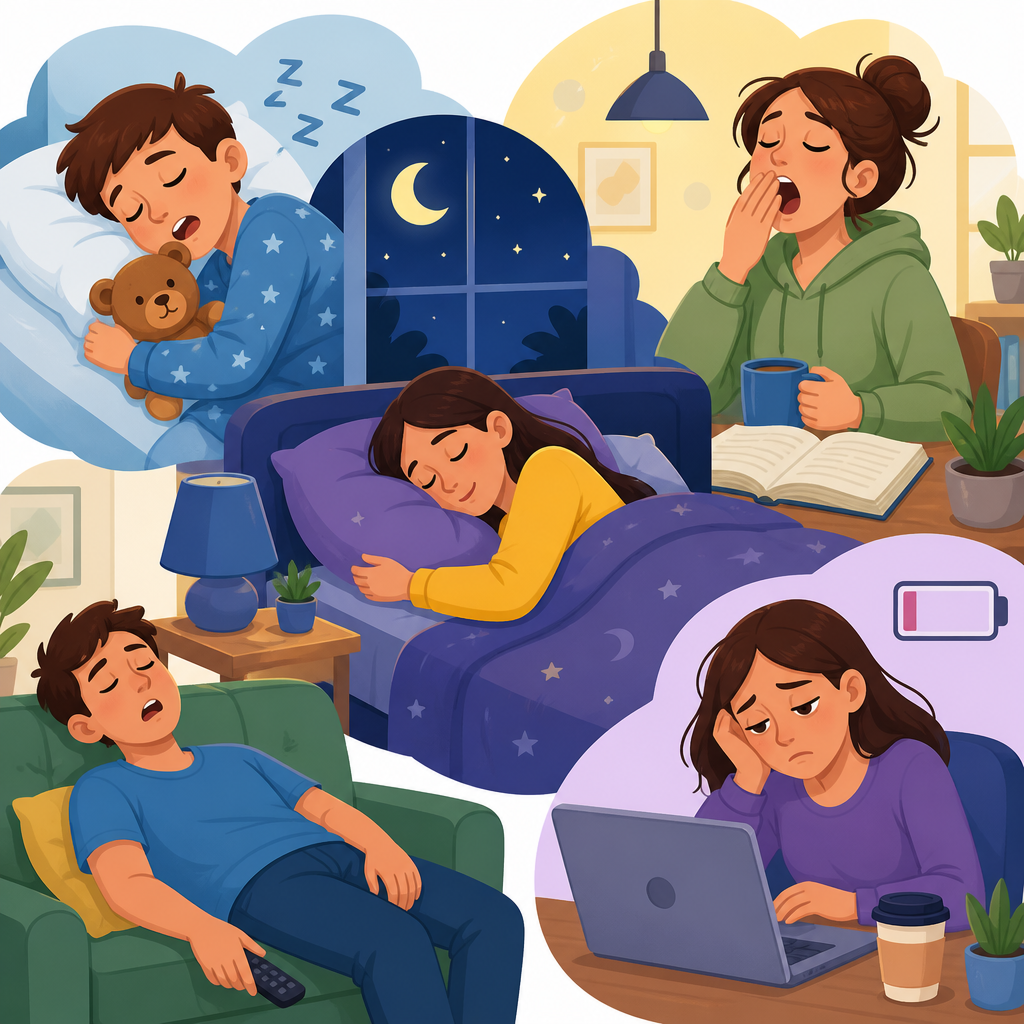
English has a surprisingly rich set of words for sleep, rest, and low energy, and understanding the differences matters if you want to sound natural instead of merely correct. Learners often meet basic pairs such as sleep and rest early, but everyday conversation relies on a wider vocabulary: sleepy, tired, exhausted, drowsy, nap, doze, lie down, drained, fatigued, and many others. These words are not interchangeable. Some describe a physical need for sleep, some describe reduced strength after work or stress, and some suggest a medical or formal tone. I have taught these distinctions in conversation classes and editing sessions for years, and the same issue appears repeatedly: a student says “I am sleepy” when they mean “I am tired,” or “I took a rest” when a native speaker would usually say “I took a nap.” Small choices change tone, accuracy, and clarity.
In practical English, this vocabulary matters because it appears in daily routines, workplace communication, health conversations, travel, and hospitality. If you tell a manager “I feel drowsy,” that suggests trouble staying awake. If you say “I feel worn out,” that sounds more informal and idiomatic. If a doctor asks whether you feel fatigued, the register becomes more clinical. Knowing these shades of meaning helps you understand films, podcasts, customer service interactions, and spoken advice. It also helps with writing, because clear vocabulary is part of sounding competent in emails, messages, and personal statements. This article focuses narrowly on the most useful English words for sleep, rest, and low energy, explaining what each word means, when native speakers use it, and which common mistakes to avoid.
Sleep and rest: the core words learners need first
The foundation begins with sleep and rest. Sleep is both a noun and a verb. As a verb, it means to be in the natural state when your body and mind are inactive: “I slept badly last night.” As a noun, it refers to that state or the amount of it: “I need more sleep.” Rest is broader. As a verb, it means to stop activity in order to recover energy: “You should rest after the trip.” As a noun, it means a period of relaxation or recovery: “Get some rest.” In plain terms, all sleep is rest, but not all rest is sleep. You can rest by sitting quietly, lying on a sofa, or taking a break without actually sleeping.
That distinction explains a frequent learner mistake. “I need to rest” does not necessarily mean “I need to sleep.” It may mean you need to stop working, walking, or thinking intensely. “I need to sleep” is much more specific. Another useful phrase is go to bed, which means getting into bed, not necessarily falling asleep immediately. Native speakers often say, “I went to bed at eleven, but I didn’t get to sleep until one.” Get to sleep means begin sleeping, while fall asleep is the more common phrase in general conversation. Wake up means stop sleeping, and oversleep means sleep longer than intended, often causing a problem such as being late.
Sleepy, tired, exhausted, and fatigued: choosing the right level of low energy
Sleepy and tired are close, but they are not identical. Sleepy means ready to sleep or struggling to stay awake. It points directly to sleepiness: “The lecture made me sleepy.” Tired is wider and far more common. It can mean needing sleep, but it can also mean lacking energy after physical effort, emotional stress, or too much activity: “I’m tired after work.” In many daily situations, tired is the safest natural choice. If you say “I’m sleepy” at 3 p.m., people may imagine you are literally fighting sleep. If you say “I’m tired,” they simply understand that your energy is low.
Stronger words include exhausted, worn out, drained, and fatigued. Exhausted means extremely tired. It is common, direct, and slightly emphatic: “After the night flight and the meeting, I was exhausted.” Worn out and drained are also common in spoken English. Worn out often suggests long effort over time, while drained can include emotional depletion: “That conversation left me drained.” Fatigued is more formal and frequently appears in medical, workplace safety, and technical settings. A doctor may ask whether you have felt fatigued for several weeks. In ordinary conversation, many native speakers prefer tired or exhausted unless they want a more formal tone.
| Word | Main meaning | Typical context | Example |
|---|---|---|---|
| sleepy | ready to sleep | late night, boring lecture, after a meal | I’m getting sleepy, so I’m going to bed. |
| tired | low energy in general | daily conversation, work, travel | I’m tired after walking all day. |
| exhausted | extremely tired | after intense effort or lack of sleep | She was exhausted after the exam week. |
| drowsy | sleepy in a heavy, often unsafe way | medicine labels, driving warnings | This medication may make you drowsy. |
| fatigued | formal or clinical tiredness | medical notes, safety reports | Pilots must not fly while fatigued. |
Nap, doze, snooze, and lie down: short periods of sleep or rest
When the period is short, English offers several precise verbs. A nap is a short sleep, usually during the day. Both take a nap and have a nap are standard, with American English often favoring take a nap. A doze is a light sleep, often brief and sometimes unplanned. You might doze in a chair during a train ride. Snooze is similar but often lighter and more casual. It also appears in the expression hit the snooze button, meaning to delay an alarm for a few more minutes in bed. These words create different pictures. A nap can be intentional and refreshing; a doze may happen accidentally.
Lie down is different because it does not mean sleep by itself. It only means move into a flat position. You can lie down to rest your back, calm a headache, or try to sleep later. This is another common learner issue: saying “I slept on the sofa for ten minutes” when the more accurate idea is “I lay down on the sofa for ten minutes.” If sleep actually happened, nap or doze may fit better. Be careful with the verb forms too: the present form is lie down, but the past is lay down in this meaning. For vocabulary practice in other everyday situations, learners can also explore housing language in the main guide at English for renting an apartment: words you need before you sign.
Drowsy, groggy, sluggish, and lethargic: low energy with specific shades of meaning
Some low-energy words describe a condition more specific than simple tiredness. Drowsy means very sleepy, often in a way that affects alertness. It is common on medicine labels and in transport safety advice: “Do not drive if you feel drowsy.” Because of that usage, drowsy often sounds slightly more serious than sleepy. Groggy means weak, slow, and mentally unclear, especially after waking up, illness, anesthesia, or too little sleep. Someone can say, “I’m still groggy after that red-eye flight.” The image is not just low energy; it is low sharpness.
Sluggish and lethargic both suggest slow movement or low motivation, but their tone differs. Sluggish is common in both literal and figurative uses: “I feel sluggish after a heavy lunch,” or “Sales were sluggish in January.” Lethargic sounds stronger and somewhat more formal. In healthcare, it can describe a troubling lack of energy, especially in children or patients with infection. In ordinary conversation, a native speaker is more likely to say sluggish than lethargic unless the condition seems serious. These distinctions matter because low-energy vocabulary often carries implied cause. Sleepy points to sleep, groggy points to mental fog, sluggish points to heaviness or slow function, and lethargic can hint at illness or a significant drop in energy.
How context changes meaning, tone, and natural word choice
The best word depends on situation, register, and cause. In casual speech, tired, exhausted, worn out, and sleepy do most of the work. In health settings, fatigue, drowsiness, and lethargy appear more often because they are useful for symptoms and records. In workplaces, especially safety-sensitive ones, fatigue has a technical meaning tied to reduced alertness and performance. Aviation, trucking, and medicine treat fatigue as a risk factor, not just a feeling. That is why a pilot report may mention fatigue management rather than simple tiredness. Native speakers adjust vocabulary to fit these expectations, even when the basic idea is similar.
Cause also shapes word choice. After exercise, tired or worn out sounds natural. After poor sleep, sleepy, exhausted, or groggy may fit better. After emotional stress, drained is often the strongest plain-English choice. After medication, drowsy is the standard warning word used by pharmacists and regulators. If you want natural English, avoid translating directly from your first language and instead ask what the listener needs to understand: Do you need sleep now, or are you just low on energy? Are you speaking casually, medically, or professionally? Precision makes your English sound fluent because these are high-frequency everyday distinctions, not advanced literary details.
Mastering English words for sleep, rest, and low energy is less about memorizing long lists and more about matching each word to the right situation. Sleep is the act or state itself, while rest is any pause that helps recovery. Sleepy suggests an immediate pull toward sleep; tired is the broad everyday word for low energy. Exhausted, worn out, and drained increase intensity in different ways, while fatigued is more formal and often clinical. Nap, doze, snooze, and lie down describe short rest or sleep with important differences. Drowsy, groggy, sluggish, and lethargic add further precision when the cause or effect matters.
If you learn these distinctions, your English becomes clearer in conversations, more accurate in writing, and more natural in listening comprehension. Start by noticing which words native speakers choose in health advice, workplace messages, and daily talk, then practice with your own real examples. Use the right word the next time you feel tired, sleepy, or simply ready for a rest.
Frequently Asked Questions
What is the difference between sleep and rest in English?
Sleep usually means the natural state in which your body and mind are inactive and unconscious for a period of time, especially at night. If someone says, “I need to sleep,” they mean they need actual sleep, not just a break. Rest, by contrast, is broader. It means stopping activity in order to relax or recover energy, but you may still be awake. For example, “You should rest” could mean sit down, lie down, avoid work, or take it easy for a while. This is why “I slept for an hour” and “I rested for an hour” are not identical. The first clearly describes being asleep; the second may or may not include sleep. In natural English, people often use rest when talking about recovery from illness, exercise, stress, or overwork, while sleep is more specific to the act of sleeping itself.
This distinction matters because choosing the wrong word can make your English sound slightly unnatural. For instance, after a long walk, a native speaker is more likely to say, “I need to rest,” not necessarily “I need to sleep,” unless they are truly very sleepy. Likewise, a doctor might advise, “Get plenty of rest,” because that includes sleep, reduced activity, and general recovery. A useful rule is this: use sleep for actual sleeping, and use rest for recovery more generally. They overlap sometimes, but they are not interchangeable in every situation.
How are sleepy, tired, drowsy, and exhausted different?
These words all relate to low energy, but they describe different kinds and degrees of it. Sleepy means you feel that you want to sleep. It points directly to a need or desire for sleep. If you say, “I’m sleepy,” native speakers understand that you may fall asleep soon or that staying awake is becoming difficult. Tired is wider and more flexible. It can mean low energy from work, stress, exercise, or lack of sleep. You can be tired without being ready to sleep immediately. For example, after a long day at work, someone might say, “I’m tired,” even if they still plan to cook dinner, watch television, or go out.
Drowsy is similar to sleepy but often sounds slightly more formal, descriptive, or medical. It suggests heaviness, slower reactions, and difficulty staying alert. You might see it in warnings such as “This medicine may make you drowsy.” It is also common when describing someone in a half-awake state, such as after waking up too early or sitting in a warm room. Exhausted is much stronger than all three. It means extremely tired, often physically, mentally, or both. Someone who is exhausted may need serious recovery, not just a short break. In everyday speech, many learners overuse exhausted when tired would sound more natural. A good scale is: drowsy/sleepy when sleep is the issue, tired for general low energy, and exhausted when the tiredness is intense.
When should I use nap, doze, and lie down?
Nap can be both a noun and a verb, and it usually means a short sleep during the day. If you say, “I took a nap,” that suggests you intentionally slept for a limited period, often to recover energy. Naps are usually planned at least a little, even if they are spontaneous. Doze, on the other hand, often suggests light sleep, brief sleep, or sleep that happens unintentionally. If someone is sitting on a sofa and begins to sleep lightly for a few minutes, you can say they dozed off. That phrase is especially common in conversation. Doze often carries the idea that the person was only partly asleep or drifted in and out of sleep.
Lie down does not mean sleep by itself. It simply means move into a flat or resting position. You can lie down to rest your back, to relax, because you are ill, or because you plan to sleep. This makes it different from both nap and doze. For example, “I’m going to lie down for a bit” may or may not mean the person intends to sleep, while “I’m going to take a nap” clearly means they expect to sleep. A useful practical distinction is this: use lie down for body position, nap for a short intentional sleep, and doze for light or accidental sleep.
What is the difference between drained, fatigued, and worn out?
These words all describe reduced energy, but they differ in tone and usage. Drained suggests that your energy feels used up, as if nothing is left. It often has an emotional or mental side as well as a physical one. After a difficult conversation, a stressful week, or too much social interaction, someone might say, “I feel drained.” It is a very natural everyday word and often implies complete depletion rather than simple sleepiness. Fatigued means very tired, but it is more formal and often appears in medical, workplace, academic, or technical contexts. A patient may report fatigue, or a safety notice may warn that drivers become fatigued after long hours. In ordinary casual conversation, people usually say tired or really tired more often than fatigued.
Worn out is informal and vivid. It means extremely tired from effort, stress, or repeated activity. It often sounds warmer and more conversational than fatigued. For example, a parent might say, “The kids were worn out after the trip,” or an employee might say, “I’m worn out after this week.” Compared with exhausted, worn out can sound slightly less dramatic, though in many situations they are close. The best way to choose is by tone: use drained when you want to emphasize empty emotional or mental energy, fatigued in formal or medical contexts, and worn out in natural everyday speech about strong tiredness.
Why are these words not interchangeable, and how can I sound more natural when talking about low energy?
These words are not interchangeable because English separates different experiences that learners often group together. Some words describe a need for sleep, such as sleepy and drowsy. Some describe reduced energy more generally, such as tired. Others emphasize severity, such as exhausted. Still others focus on type or cause, such as drained for emotional depletion or fatigued for formal or medical discussion. The result is that a sentence can be grammatically correct but still sound slightly off if the word choice does not match the situation. For example, saying “I’m sleepy after the meeting” is possible, but if the meeting was stressful rather than boring or late at night, “I’m drained” or “I’m tired” may sound more accurate and natural.
To sound more like a fluent speaker, connect the word to the situation. If you need actual sleep, say sleepy. If your energy is low in general, say tired. If your condition is severe, use exhausted or worn out. If you mean a short daytime sleep, say nap. If you only mean relaxing in a horizontal position, say lie down. Also pay attention to common combinations: people take a nap, doze off, get some rest, feel drained, and look exhausted. Learning these typical patterns is often more useful than memorizing dictionary definitions alone. The key is not just knowing what the words mean, but knowing when native speakers naturally choose each one.





