
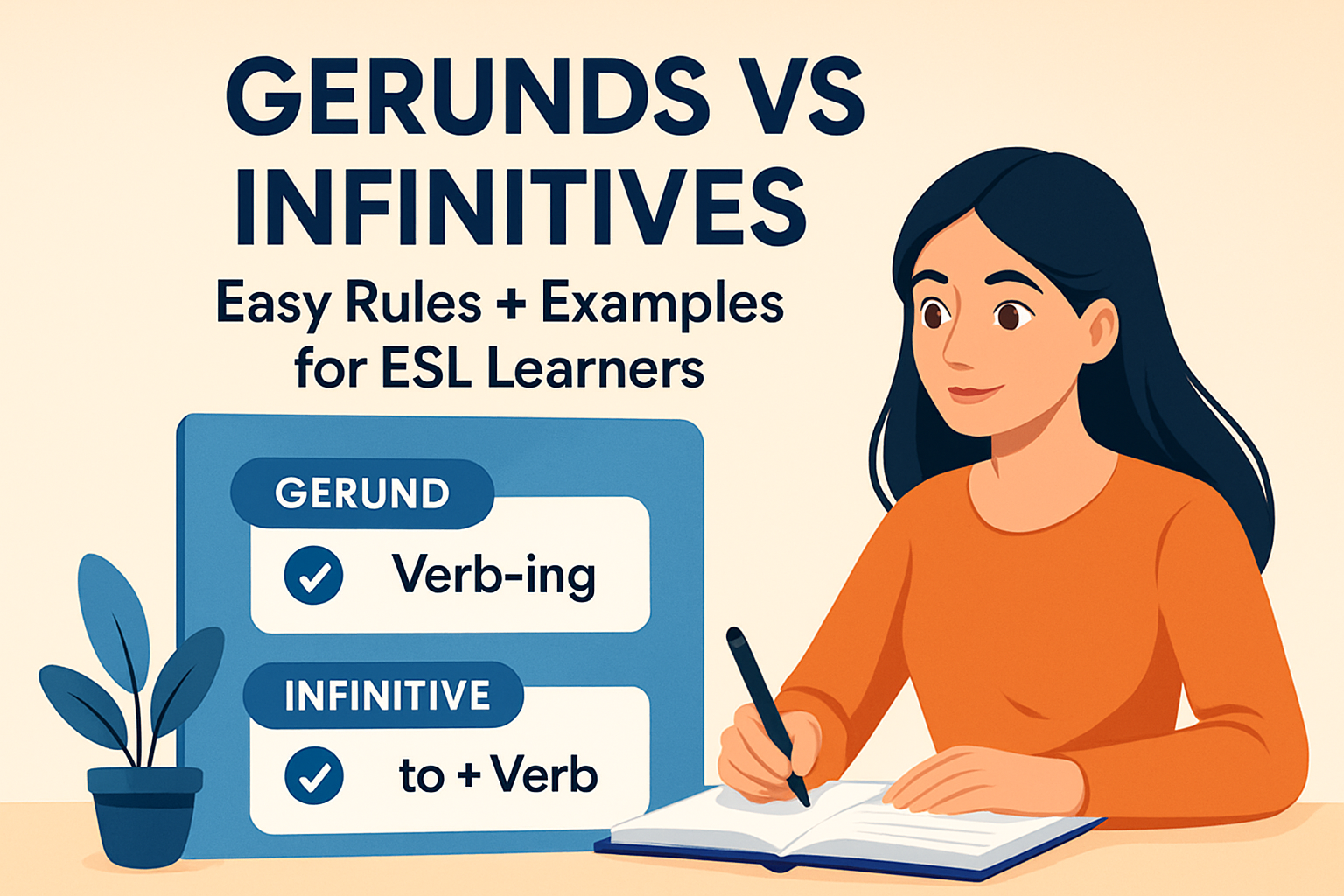
Gerunds and infinitives are two of the most important verb patterns in English, and they cause problems for nearly every ESL learner I have taught. A gerund is the -ing form of a verb used as a noun, as in Swimming is good exercise. An infinitive is the base form of a verb with to, as in I want to swim. The difficulty is not forming them; the challenge is knowing which verbs, adjectives, and expressions take a gerund, which take an infinitive, and which can take both. This matters because the choice affects accuracy, naturalness, and sometimes meaning. If you say I enjoy to read instead of I enjoy reading, fluent speakers will still understand you, but the sentence sounds clearly incorrect. Mastering gerunds vs infinitives improves speaking, writing, listening, and test performance in exams such as IELTS, TOEFL, and Cambridge English.
In practical teaching, I find that learners improve fastest when they stop looking for one universal rule and start learning patterns. English uses gerunds after certain verbs, after prepositions, and as subjects or objects that act like things. English uses infinitives after many other verbs, after adjectives, and to express purpose. Some verbs accept both forms, but sometimes with no change in meaning and sometimes with a major change. This article gives you the core rules, the common exceptions, and the real-world examples you need. Because this is a hub page for miscellaneous grammar points, it also connects the topic to related areas such as verb patterns, phrasal verbs, prepositions, and sentence structure. If you can recognize where the verb sits in the sentence, you can usually choose the correct form with confidence.
What Is a Gerund and When Do You Use It?
A gerund looks like a present participle because both end in -ing, but the function is different. In She is running, running is part of the verb phrase. In Running helps me relax, running is a gerund because it acts as a noun. Gerunds commonly appear as subjects, objects, and complements: Reading before bed improves sleep; He avoids driving at night; Her favorite hobby is painting. They are especially common after prepositions, and this is one of the most reliable rules in English grammar. After in, on, at, for, about, without, and similar words, use a gerund: She is interested in learning Arabic; Thank you for helping me; He left without saying goodbye.
Many high-frequency verbs require a gerund. The most useful ones for learners are enjoy, avoid, consider, mind, suggest, finish, keep, practice, recommend, admit, and deny. Native speakers say I enjoy cooking, not I enjoy to cook. They say We considered moving, not We considered to move. A useful test is this: if the action is being discussed like an activity, process, or general experience, a gerund is often likely. That is why signs say No smoking and teachers say Learning a language takes time. The form turns the action into a thing you can discuss, allow, prohibit, prefer, or continue.
What Is an Infinitive and When Do You Use It?
An infinitive is usually to plus the base verb, such as to study, to write, or to travel. In learner English, infinitives appear most often after verbs like want, need, hope, plan, decide, promise, learn, offer, refuse, and agree. For example: I want to improve my pronunciation; They decided to leave early; She promised to call. Infinitives also follow many adjectives: happy to help, ready to start, difficult to understand, important to remember. Another core use is purpose. I went to the library to study explains why I went. This purpose use is extremely common and one reason learners overuse infinitives in other patterns.
Infinitives are also common in structures with objects: ask someone to do something, tell someone to wait, encourage someone to apply, remind someone to lock the door. This pattern is worth memorizing because it appears constantly in conversation, classrooms, and workplaces. Compare The teacher told us to rewrite the paragraph with The teacher suggested rewriting the paragraph. The first requires an object plus infinitive; the second takes a gerund and no object. I often see advanced learners confuse these because both sentences are about advice. The correct choice depends on the verb pattern, not just the meaning. That is the central lesson of gerunds vs infinitives: English grammar often stores the answer inside the controlling word.
Common Verb Patterns ESL Learners Should Memorize
If you want faster improvement, memorize verb patterns in groups instead of one by one. That is how I teach them in class, and retention is much better. Start with the most frequent patterns you will see in textbooks, graded readers, meetings, email, and everyday conversation. The table below gives practical examples you can reuse immediately.
| Pattern | Common verbs | Example |
|---|---|---|
| Verb + gerund | enjoy, avoid, finish, consider, suggest | She enjoys reading before class. |
| Verb + infinitive | want, hope, decide, plan, need | We plan to visit the museum. |
| Verb + object + infinitive | tell, ask, invite, encourage, remind | He reminded me to send the file. |
| Preposition + gerund | about, for, without, after, before | Thank you for coming early. |
| Adjective + infinitive | happy, glad, ready, eager, surprised | I am glad to meet you. |
| Be used to + gerund | expression, not modal use | She is used to working late. |
Some patterns deserve special attention because they are common sources of error. After look forward to, use a gerund because to is a preposition here, not part of an infinitive: I look forward to seeing you. The same is true for be committed to, object to, and be dedicated to. Another frequent trap is used to. In I used to play tennis, use the base verb because this phrase describes a past habit. But in I am used to playing tennis, use a gerund because the meaning is “accustomed to.” Learners who notice these chunks, rather than isolated rules, make fewer mistakes and sound more natural.
Verbs That Take Both Forms: Same Meaning or Different Meaning?
Some verbs can be followed by either a gerund or an infinitive. This is where many grammar guides become vague, so it helps to divide the verbs into two groups. First, some verbs allow both forms with little or no change in meaning. The most common are begin, start, continue, like, love, hate, and prefer. You can say It started raining or It started to rain. You can say I like reading at night or I like to read at night. In real usage, there may be slight differences in style or emphasis, but in most everyday contexts both are acceptable.
Second, some verbs change meaning depending on the form. These verbs are essential for exam writing and precise communication. Remember doing means you have a memory of a past action: I remember meeting her in Seoul. Remember to do means not forget a future responsibility: Remember to email the report. Stop smoking means quit the habit; stop to smoke means pause another activity in order to smoke. Try calling means experiment with one method; try to call means make an effort, perhaps unsuccessfully. Regret telling him means you feel sorry about a past action; regret to tell you is a formal way to announce bad news now. Mean doing expresses result, as in This job means traveling often; mean to do expresses intention, as in I meant to reply earlier. These distinctions are not small. They change the message.
Common Mistakes, Useful Tips, and Related Grammar Topics
The most common learner mistake is choosing a form based on direct translation from the first language. Many languages do not match English verb patterns, so translation often fails. Another mistake is focusing only on the word immediately before the verb. In She made me clean the kitchen, the pattern is not infinitive with to; after make and let, English usually uses the bare infinitive: make someone do, let someone go. Modal verbs work the same way: can swim, must leave, should study. By contrast, be able to and have to take the full infinitive. Small structural differences like these matter.
For reliable improvement, build a notebook of verb patterns, not single words. Group entries under headings such as gerund after prepositions, infinitive after adjectives, and verbs with meaning changes. When reading, highlight chunks like interested in learning, decided to postpone, or encouraged us to participate. When writing, check whether your verb needs an object before the infinitive. This grammar point also connects to broader miscellaneous grammar topics: prepositions, collocations, passive structures, and sentence patterns. If you study those areas together, gerunds and infinitives become easier because you stop guessing and start recognizing complete structures. Review your own speaking and writing this week, collect ten examples, and practice them aloud until the patterns feel automatic.
Frequently Asked Questions
What is the difference between a gerund and an infinitive in English?
A gerund is the -ing form of a verb used as a noun, while an infinitive is the base form of a verb with to. This is the most important distinction to understand. For example, in Swimming is good exercise, the word swimming is a gerund because it acts like a noun and is the subject of the sentence. In I want to swim, to swim is an infinitive because it follows the verb want and expresses the action someone wishes to do.
Gerunds and infinitives often appear in similar positions, which is why they confuse ESL learners. Both can function as subjects, objects, or complements in a sentence. Compare Reading helps you learn vocabulary with It is important to read every day. Both sentences talk about the same activity, but the grammar pattern is different. In many cases, the choice depends on the word that comes before the verb form. Some verbs are followed by gerunds, some by infinitives, and some allow both.
It also helps to remember their general tendencies. Gerunds are more common when talking about activities in a general sense, especially as ideas or experiences: I enjoy cooking, She avoids driving at night. Infinitives often express purpose, intention, or future possibility: He plans to travel, They hope to find a solution. These are not absolute rules, but they are useful patterns that make the system easier to understand.
Which verbs are followed by a gerund, and which are followed by an infinitive?
This is one of the biggest challenges in learning English verb patterns, because there is no single rule that works for every verb. Some verbs are commonly followed by a gerund. These include enjoy, avoid, finish, consider, suggest, mind, and keep. For example: I enjoy reading, She avoided answering the question, They suggested taking a break. In these patterns, using an infinitive would sound unnatural or incorrect.
Other verbs are followed by an infinitive. Common examples include want, need, decide, plan, hope, promise, and learn. For example: I want to improve my English, We decided to leave early, He promised to call me. These verbs usually point to a desired action, a plan, or an intention, which is why the infinitive is so common after them.
There are also verbs that can take both a gerund and an infinitive. Sometimes the meaning stays almost the same, as with begin, start, like, love, and hate. For example: She started working and She started to work are both acceptable. However, with some verbs, changing from a gerund to an infinitive changes the meaning. For example, I stopped smoking means I quit the habit, but I stopped to smoke means I stopped another activity in order to smoke. Because of this, memorizing common verb patterns with examples is much more effective than trying to guess every time.
Are there adjectives and expressions that take gerunds or infinitives too?
Yes, absolutely. Gerunds and infinitives are not only controlled by verbs. Many adjectives and expressions also determine which form should follow. Infinitives are especially common after adjectives. For example: I am happy to help, She was surprised to see him, It is important to practice every day. In these sentences, the infinitive explains the reason for the feeling or describes the action connected to the adjective.
There are also fixed expressions that use gerunds, especially after prepositions. This is a rule ESL learners should pay close attention to: after a preposition, English normally uses a gerund, not an infinitive. For example: She is interested in learning English, Thank you for coming, He left without saying goodbye. Because in, for, and without are prepositions, the verb that follows takes the -ing form.
Some common expressions also require certain patterns. For example, look forward to is always followed by a gerund: I look forward to meeting you. This confuses many learners because to looks like part of an infinitive, but here it is actually a preposition. On the other hand, expressions such as be ready to, be able to, and be likely to are followed by infinitives: We are ready to begin, She is able to solve the problem. Learning these chunks as complete expressions is one of the fastest ways to sound more natural and make fewer grammar mistakes.
Which verbs can take both a gerund and an infinitive with a change in meaning?
Several high-frequency English verbs can be followed by either a gerund or an infinitive, but the meaning changes depending on the form you choose. These are especially important because the grammar choice affects the message. One classic example is remember. I remembered to lock the door means I did not forget to perform the action. I remember locking the door means I have a memory of doing it. The first refers to something necessary or intended; the second refers to a memory of a completed action.
The verb stop works the same way. He stopped talking means he ended the activity of talking. He stopped to talk means he paused another activity in order to talk. With try, try studying at night means experiment with that method to see if it helps, while try to study at night means make an effort to study. With forget, I forgot to send the email means the action was not done, but I’ll never forget meeting her means the meeting happened and remains in memory.
Another very common pair is regret. We regret to inform you is used for giving bad news and refers to something you are about to say. I regret telling him the secret means I feel sorry about a past action. These differences are not small details; they change the whole meaning of a sentence. For that reason, students should not simply memorize a verb as “takes both.” It is much better to memorize the verb together with two example sentences so the meaning difference becomes clear and easy to remember in real communication.
What is the easiest way for ESL learners to master gerunds and infinitives?
The easiest and most effective approach is to learn gerunds and infinitives in patterns, not as isolated grammar rules. Many learners make the mistake of trying to understand every sentence through theory alone. In reality, fluency comes faster when you group words into families and memorize them with example sentences. For instance, learn a set of verbs followed by gerunds such as enjoy reading, avoid making mistakes, and finish doing homework. Then learn a set of verbs followed by infinitives such as want to learn, decide to study, and hope to improve. Repeated exposure to these chunks helps the correct form feel natural.
It is also smart to focus on the most useful rules first. A very reliable rule is that verbs after prepositions usually become gerunds: before leaving, after eating, without speaking. Another strong pattern is that many verbs of desire, decision, and intention take infinitives: want to go, plan to visit, decide to wait. Once these core patterns are solid, you can move on to verbs that take both forms and study the meaning differences carefully.
Finally, practice is essential. Reading, listening, and producing your own sentences will help far more than





