
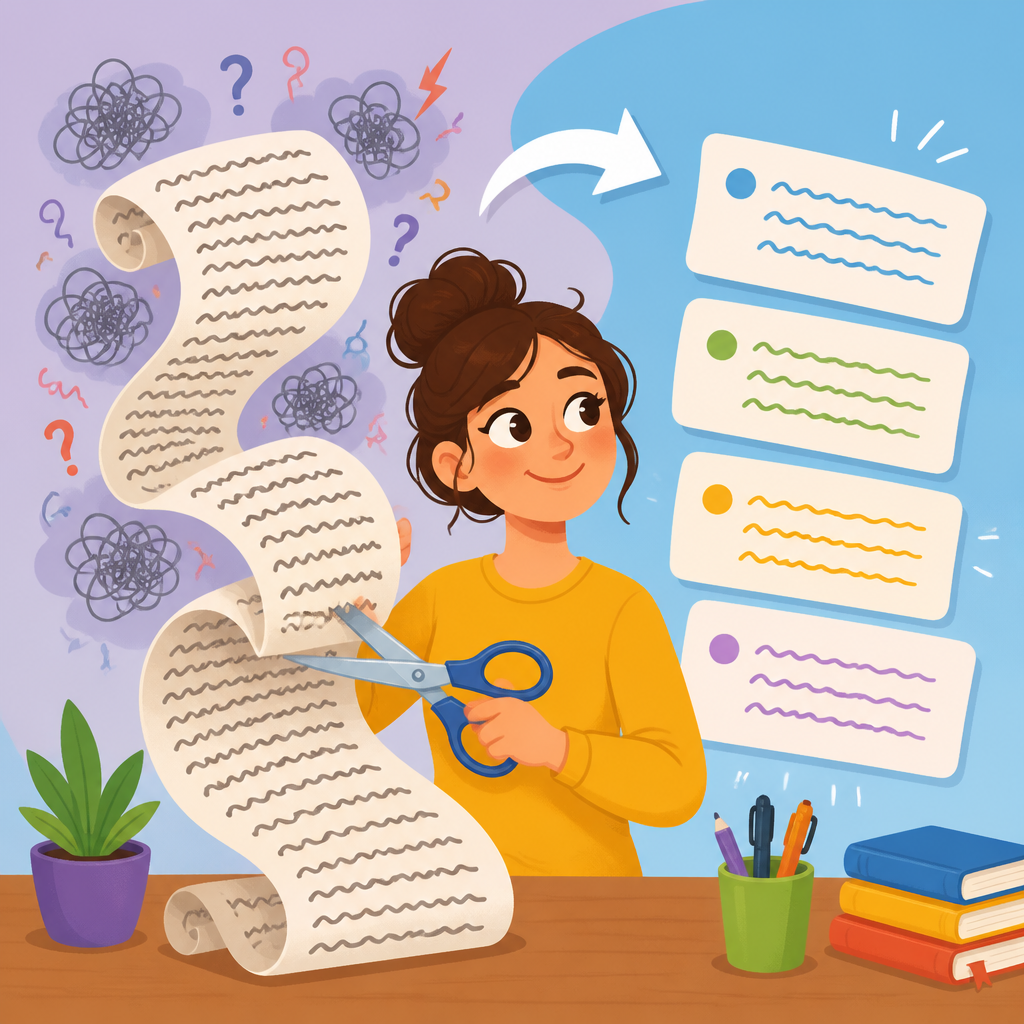
Long sentences can make reading feel slow, confusing, and tiring, especially for beginner English learners who are still building vocabulary and grammar awareness. Knowing how to break long sentences into readable parts is a practical reading skill that helps learners find meaning faster, follow instructions more accurately, and avoid getting lost in extra detail. In simple terms, breaking a sentence into readable parts means dividing it into smaller chunks based on punctuation, grammar, and meaning, then reading each chunk as one unit before connecting it to the next. I teach this skill early because it works immediately: students who struggle with signs, labels, directions, and short passages often improve once they stop trying to decode every word one by one.
This matters because written English often packs several ideas into one sentence. A school notice may include time, place, rules, and exceptions in a single line. A product label may describe use, warning, and storage in one statement. Even short workplace messages can contain conditions such as if, when, before, or unless. Readers who cannot identify the main idea and supporting details inside a long sentence tend to misread key information. Readers who can chunk a sentence usually understand more, read with less stress, and remember more of what they read.
When I coach learners, I define a readable part as a group of words that naturally belongs together. It may be a subject and verb, a time phrase, a place phrase, a condition, or an extra description. For example, in the sentence “After you finish the form, place it in the blue tray near the front desk,” the first readable part is “After you finish the form,” and the second is “place it in the blue tray near the front desk.” The first part tells when. The second tells what to do. This kind of separation is not guessing. It is a repeatable method based on structure, and once learners understand that method, long sentences stop looking like unbroken walls of text.
Find the main action first
The fastest way to break a long sentence is to locate the main action. In most English sentences, that means finding the core subject and the main verb before looking at extra information. I tell students to ask, “Who or what is this sentence about?” and “What is happening?” Consider: “Passengers traveling without a printed boarding pass must check in at the service desk before entering security.” The core is “Passengers … must check in.” Once that frame is clear, the other parts become easier. “Traveling without a printed boarding pass” describes which passengers. “At the service desk” gives place. “Before entering security” gives time.
This approach prevents a common reading mistake: treating descriptive phrases as the main message. In real notices and instructions, the central action usually carries the important rule. If a learner focuses only on “printed boarding pass” or “entering security,” they may miss the rule that check-in is required. I have seen this often with adult learners reading workplace instructions. They understand many individual words but miss the action because they do not separate core meaning from added detail. Start with the action, then attach the details one piece at a time.
Use punctuation as a map, not a decoration
Punctuation gives strong clues about where to pause and divide meaning. Commas often separate opening phrases, extra information, or items in a list. A dash can mark an added explanation. A colon usually introduces a list or clarification. Semicolons often join closely related complete ideas. When learners ignore punctuation, they read too fast through boundaries that writers intended to mark clearly. Take this example: “If the library is full, students may study in Room 204, which remains open until 9 p.m.” A useful split is “If the library is full,” then “students may study in Room 204,” then “which remains open until 9 p.m.”
Each chunk answers a different question. The first gives the condition. The second states the action and place. The third adds extra information about Room 204. This is especially useful for beginners reading public information, because notices often use commas to stack details efficiently. For more practice with short real-world texts, learners can build this skill alongside the main guide at https://5minuteenglish.com/a1-reading-practice-signs-labels-and-simple-instructions/. The goal is not to stop at every punctuation mark mechanically. The goal is to use punctuation to predict meaning boundaries and keep the sentence organized in your mind.
Recognize common meaning blocks
Most long sentences are built from a small set of common blocks. Once readers can spot these blocks, sentence chunking becomes much easier. The most useful ones are time phrases, place phrases, conditions, reasons, examples, and relative clauses. Time phrases answer when: “after lunch,” “before the meeting begins,” “by Friday afternoon.” Place phrases answer where: “at the back entrance,” “on the second shelf,” “near the ticket machine.” Conditions often begin with if, unless, or when. Reasons often begin with because or since. Relative clauses often begin with who, which, or that and add description.
| Meaning block | Signal words | Example chunk | Question it answers |
|---|---|---|---|
| Time | before, after, by, until | before the shop closes | When? |
| Place | in, on, at, ליד, near | at the front desk | Where? |
| Condition | if, unless, when | if you need help | Under what condition? |
| Reason | because, since | because the road is closed | Why? |
| Description | who, which, that | which opens at 8 a.m. | Which one? |
When students learn these categories, they stop seeing long sentences as random strings of words. For example, “Employees who work the late shift should leave completed reports on the supervisor’s desk before going home” becomes manageable very quickly. “Employees … should leave” is the core action. “Who work the late shift” is a description. “Completed reports” is the object. “On the supervisor’s desk” gives place. “Before going home” gives time. This labeling method is effective because it turns reading into a sequence of small, answerable questions instead of one large act of guessing.
Read in phrases, not single words
Word-by-word reading is one of the biggest reasons long sentences feel difficult. Skilled readers process language in phrases. They do not mentally stop after every word. They group words into units that carry meaning together, such as “take a seat,” “at the main entrance,” or “as soon as possible.” In my lessons, I mark slashes to show phrase groups, then remove the marks after students gain confidence. For instance: “Please / return all borrowed equipment / to the storage room / before 5 p.m. today.” This method improves speed because the brain handles fewer units.
Phrase reading also improves comprehension because many English expressions function as set patterns. “According to,” “in case of,” “at least,” and “no longer” are easier to understand as whole groups than as isolated words. Beginners often know the dictionary meaning of each word but still misread the sentence because they have not learned the phrase as a unit. That is why sentence chunking should include repeated exposure to common word groups, especially in instructions and notices. Once learners can hear and see these groups together, long sentences become more predictable and less intimidating.
Handle extra details without losing the main message
Long sentences often include extra details that are helpful but not central. A confident reader knows how to set those details aside briefly, understand the main message, and then return to them. Parenthetical information, nonessential relative clauses, and inserted examples commonly work this way. Consider: “Visitors, except those with staff ID cards, must sign in at reception.” The essential message is “Visitors must sign in at reception.” The middle phrase “except those with staff ID cards” changes who the rule applies to, but it should not hide the main structure.
This skill is especially important when a sentence includes multiple modifiers. For example: “The package, which was delivered to the wrong office on Monday morning, should be returned immediately to the mail room.” A learner can first read the backbone: “The package should be returned immediately to the mail room.” Then add the descriptive detail: “which was delivered to the wrong office on Monday morning.” This layered reading strategy mirrors how experienced readers process dense sentences. They do not treat every word as equally important at the same moment. They prioritize structure, then absorb precision.
Practice with real sentences and spoken pauses
The best way to master this skill is to practice with authentic sentences from signs, instructions, labels, school notices, transport messages, and workplace communication. Start with one sentence, underline the main verb, mark punctuation, and divide the line into meaning chunks. Then read it aloud, making a short pause between chunks. Spoken pauses reveal whether the grouping makes sense. If a pause sounds unnatural, the chunking is probably wrong. For example, “For safety reasons / children under twelve / must remain with an adult / at all times” sounds clear because each part carries one function.
I have found that recording and replaying these readings helps learners notice rhythm and structure faster than silent rereading alone. It also shows where confusion begins. If a student rushes through “who,” “which,” or “before,” that usually signals they are not recognizing clause boundaries yet. Progress comes from short, repeated practice, not from reading harder texts immediately. Use a pencil, mark chunks, read aloud, check the main action, and ask what each chunk adds: time, place, reason, condition, or description. That simple routine builds reading control. The payoff is clear understanding of longer sentences without panic, and the next step is to practice this method every day with the real materials you already read.
Frequently Asked Questions
1. What does it mean to break long sentences into readable parts?
Breaking long sentences into readable parts means dividing one difficult sentence into smaller meaning groups, or “chunks,” so you can understand it more easily. Instead of trying to process every word at once, you notice where ideas naturally separate. These breaks often appear around punctuation marks such as commas, dashes, semicolons, and parentheses, but they can also follow grammar patterns like clauses, prepositional phrases, and connector words.
For example, a long sentence may contain a main idea, extra description, a reason, and a result. When you learn to separate those parts, the sentence becomes much less overwhelming. You can first find the main action, then add the details one by one. This is especially helpful for beginner English learners because it reduces mental overload and makes vocabulary and grammar easier to follow.
In practical terms, this skill is not about changing the original sentence right away. It is about reading strategically. You are training yourself to pause in the right places, identify the most important information first, and understand how smaller pieces connect to create the full meaning.
2. Why is this skill important for beginner English learners?
This skill is important because long sentences often contain multiple ideas, and beginner learners may not yet recognize how those ideas are organized. When everything appears in one line, reading can feel slow, confusing, and tiring. A learner may understand many of the individual words but still miss the overall meaning because the sentence structure feels too heavy.
By breaking the sentence into readable parts, learners can focus on one section at a time. This makes it easier to find the subject, verb, and main message before dealing with examples, explanations, or extra details. As a result, learners can read more confidently, follow instructions more accurately, and avoid getting lost in less important information.
It also supports long-term language development. Chunking improves reading fluency, strengthens grammar awareness, and helps learners notice common sentence patterns in English. Over time, students become better at predicting meaning, recognizing clause boundaries, and understanding how ideas are linked. In other words, this is not just a reading trick. It is a foundational comprehension skill that supports stronger English overall.
3. How can I tell where to split a long sentence while reading?
The best place to start is punctuation. Commas, semicolons, colons, dashes, and parentheses often signal a natural pause or a shift in meaning. These marks can separate examples, explanations, lists, contrast, or additional information. When you see them, try reading the sentence in smaller sections instead of as one continuous block.
You can also look for grammar signals. Words such as “because,” “although,” “when,” “if,” “which,” “that,” and “who” often introduce new clauses. Coordinating conjunctions like “and,” “but,” “or,” and “so” may connect two equal ideas. Prepositional phrases, such as “in the morning,” “after the meeting,” or “with her teacher,” often add detail and can be treated as smaller supporting parts rather than the core message.
A useful strategy is to ask yourself three questions: What is the main idea? What information is supporting it? What information is extra detail? Once you identify the core message, the rest of the sentence becomes easier to organize. With practice, you will start to notice that most long sentences are not random. They usually follow predictable patterns, and those patterns show you where to pause and how to understand the sentence step by step.
4. What is a simple step-by-step method for understanding a long sentence?
A reliable method is to begin by locating the main clause. Find the subject and the main verb, because these usually carry the central meaning of the sentence. Once you know who or what the sentence is about and what is happening, you already have the backbone of the idea.
Next, separate the sentence into smaller chunks based on punctuation and connector words. Read each chunk one at a time. After each section, briefly ask yourself what role it plays. Is it giving a reason? Adding an example? Showing contrast? Explaining time, place, or condition? This turns a difficult sentence into a sequence of manageable parts.
Then, put the chunks back together in a logical order. Start with the main clause and add the supporting details around it. If necessary, rephrase the sentence in your own words using shorter sentences. This helps confirm that you understood the meaning correctly. For learners, this process is especially effective because it combines grammar awareness with active comprehension. The more often you practice this method, the faster and more natural it becomes.
5. How can I practice breaking long sentences into readable parts more effectively?
The most effective practice is consistent, active reading. Choose short passages that are slightly challenging but not too difficult. When you find a long sentence, mark its chunks using slashes, brackets, or line breaks. This visual separation helps you see the structure clearly. Then read each part aloud slowly, paying attention to pauses and meaning. Reading aloud is powerful because it trains your ear as well as your eyes.
Another strong method is sentence rewriting. After chunking a long sentence, rewrite it as two or three shorter sentences without changing the meaning. This teaches you how ideas connect and helps you distinguish between essential information and extra detail. You can also underline the main clause, circle connector words, and label supporting clauses as reasons, examples, conditions, or descriptions.
Finally, review patterns regularly. Many long English sentences are built from familiar structures, such as a main idea followed by explanation, a contrast introduced by “although” or “but,” or a condition introduced by “if.” The more examples you study, the more quickly you will recognize these patterns in new texts. Progress often feels gradual, but it is very real. With repeated practice, long sentences stop feeling intimidating and start feeling organized, readable, and much easier to understand.





