
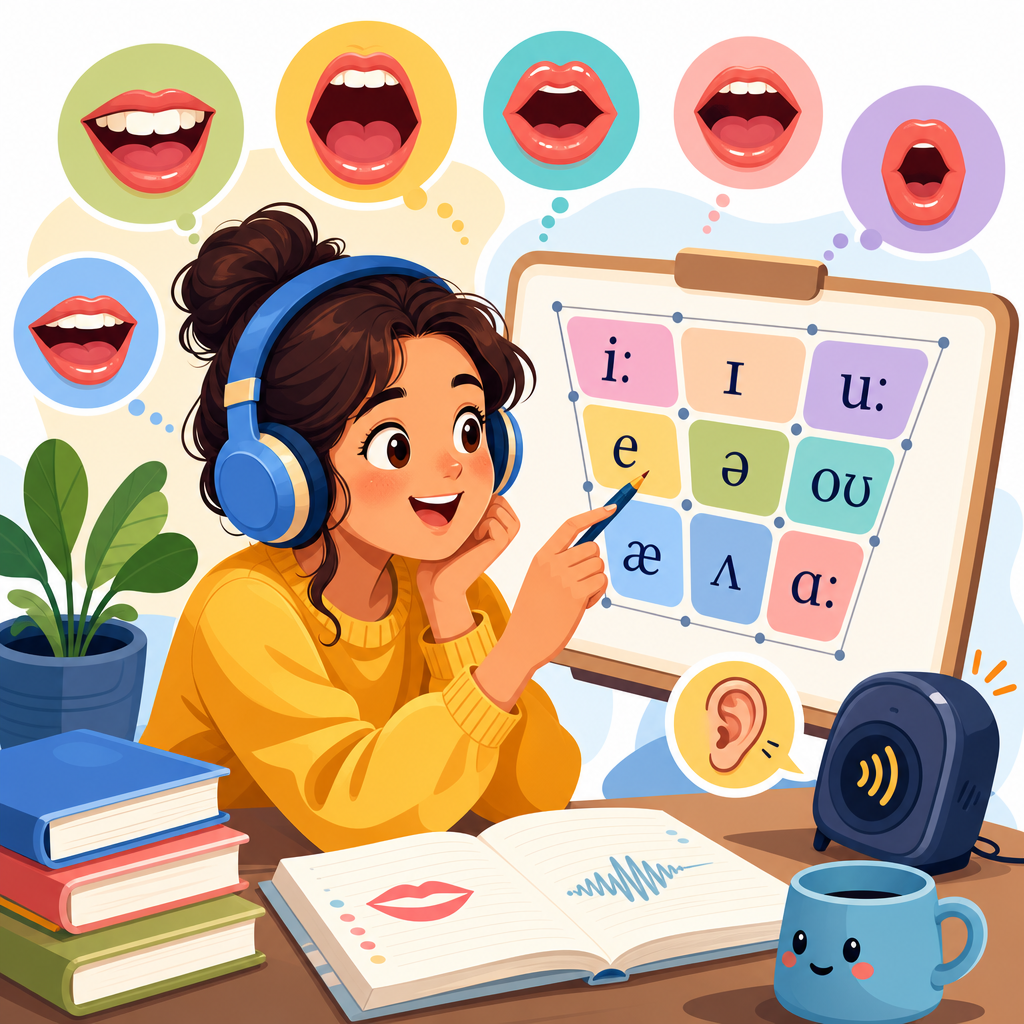
The International Phonetic Alphabet, usually shortened to IPA, gives every speech sound a dedicated symbol, making pronunciation visible instead of guesswork. For learners working on speaking, basic IPA symbols for vowels are especially useful because English spelling is unreliable: the letter “a” sounds different in cat, cake, father, and about. When students ask me how to pronounce a word correctly without hearing a teacher first, I point them to the vowel chart and a good learner’s dictionary. Once you can read basic IPA vowels, you can decode pronunciation, compare accents, and practice listening with much more precision.
IPA matters because vowels carry much of a word’s identity. Change /ɪ/ to /iː/ and ship becomes sheep. Change /æ/ to /ʌ/ and bat starts sounding like but. These are not tiny details; they affect intelligibility in everyday conversations, presentations, interviews, and exams. In language teaching, I have seen learners improve faster when they stop relying only on spelling and start matching symbols to mouth position, tongue height, and lip shape. IPA is not just for linguists. It is a practical speaking tool that helps you hear differences, produce them more accurately, and notice where your accent may confuse listeners.
For this Speaking hub on miscellaneous pronunciation skills, this article explains the core vowel symbols, how to pronounce them, and how to build listening practice around them. “Basic IPA symbols for vowels” usually includes short vowels, long vowels, and common diphthongs found in learner dictionaries such as Cambridge, Oxford, and Longman. Symbols can vary slightly by accent, especially between British and American English, but the system is consistent enough to guide pronunciation confidently. If you have ever wondered what /ə/, /ɜː/, or /eɪ/ means, this guide answers that directly and gives you a framework you can use across all your pronunciation study.
What Basic IPA Vowel Symbols Mean and How to Read Them
IPA vowel symbols represent sounds, not letters. That is the first rule. When you see /iː/, think of the vowel sound in fleece in many dictionaries, not the written letters “ee.” When you see /ʊ/, think of foot. The colon-like mark /ː/ shows vowel length in many dictionary transcriptions, so /iː/ is longer than /ɪ/, and /ɑː/ is longer than /ʌ/. Another essential symbol is schwa, /ə/, the unstressed vowel in about, problem, and teacher in many accents. Schwa is the most common vowel in English connected speech, and recognizing it is one of the fastest ways to improve listening.
To read IPA vowels accurately, connect each symbol to three physical features: tongue height, tongue position, and lip shape. High front vowels like /iː/ and /ɪ/ are produced with the tongue raised toward the front of the mouth. Low open vowels like /æ/ and /ɑː/ are produced with the jaw more open. Rounded vowels such as /ɔː/, /ʊ/, and /uː/ use lip rounding, while unrounded vowels like /e/ and /ʌ/ do not. In class, I often tell learners to stop thinking abstractly and start checking a mirror. If your mouth shape does not change, your vowels usually will not either.
Diphthongs are vowel glides, meaning the mouth moves during the sound. For example, /eɪ/ in face starts near /e/ and moves upward, while /aɪ/ in price begins open and glides toward /ɪ/. This movement matters because learners often shorten diphthongs into single vowels, which can make speech sound flat or create misunderstandings. In careful dictionary-based study, separate monophthongs, which stay relatively stable, from diphthongs, which move. That distinction helps both speaking and listening because your ear starts expecting either a steady vowel or a glide.
Core English Vowels: Symbols, Example Words, and Mouth Position
The fastest way to learn basic IPA vowels is to group them by type and attach each symbol to a keyword. Use dictionary keywords rather than isolated spelling patterns. Below is a practical reference based on common British-style dictionary notation, with notes that remain useful for many learners even if they speak with an American accent.
| IPA symbol | Keyword | How to pronounce it |
|---|---|---|
| /iː/ | fleece | Long, high front vowel; lips spread slightly |
| /ɪ/ | kit | Shorter, lower than /iː/; relaxed tongue |
| /e/ | dress | Mid front vowel; jaw slightly open |
| /æ/ | trap | Open front vowel; mouth wider, jaw lower |
| /ɑː/ | palm | Long open back vowel; relaxed lips |
| /ɒ/ | lot | Short open back rounded vowel in many British accents |
| /ɔː/ | thought | Long mid-back rounded vowel |
| /ʊ/ | foot | Short near-high back rounded vowel |
| /uː/ | goose | Long back rounded vowel; lips more rounded |
| /ʌ/ | strut | Central open-mid vowel; relaxed, unrounded |
| /ɜː/ | nurse | Long central vowel; common before /r/ in rhotic accents |
| /ə/ | comma | Unstressed central vowel; very short and neutral |
| /eɪ/ | face | Glides from mid front upward |
| /aɪ/ | price | Opens then glides toward /ɪ/ |
| /ɔɪ/ | choice | Rounded start, front glide |
| /aʊ/ | mouth | Open start, rounded finish |
| /əʊ/ | goat | Central to back glide in many British accents |
| /ɪə/ | near | Centering diphthong in non-rhotic British speech |
| /eə/ | square | Front-mid to central glide |
| /ʊə/ | cure | Less common today; often merges in modern speech |
Two cautions matter. First, accent changes the inventory. Many American dictionaries use /oʊ/ instead of /əʊ/, and rhotic accents pronounce the /r/ in words like near and nurse. Second, vowel quality can shift by region. For example, the vowel in lot and palm may merge in many North American accents. That does not make IPA less useful; it makes accent awareness essential. Always choose one reference accent when learning, then compare others later.
How to Pronounce IPA Vowels Clearly in Real Speech
Pronouncing vowels well starts with contrast practice, not isolated repetition. If you train /iː/ and /ɪ/ together using pairs like sheep and ship, leave and live, or seat and sit, your mouth and ear learn the boundary between sounds. The same is true for /e/ versus /æ/ in pen and pan, /ʊ/ versus /uː/ in full and fool, and /ʌ/ versus /ɑː/ in cut and cart. I have found that learners plateau when they repeat one sound alone for too long. Contrasts create sharper categories, and sharper categories improve intelligibility faster.
Use a simple production routine. First, listen to the target word in a reputable dictionary audio file. Second, read the IPA transcription aloud slowly. Third, copy the mouth shape and length. Fourth, place the word in a short phrase, such as “a cheap seat” or “full food.” Fifth, record yourself and compare. Tools like the Cambridge Dictionary, Oxford Learner’s Dictionaries, Forvo, YouGlish, and speech analysis apps can support this process. If you teach yourself, recording is non-negotiable. What feels correct in your mouth often sounds different in playback.
Stress and reduction also shape vowel pronunciation. In connected speech, unstressed syllables often weaken to schwa /ə/, as in photograph, support, and banana. Learners who pronounce every written vowel strongly may sound unnatural and become harder to follow. At the same time, you should not reduce stressed vowels carelessly. The word record as a noun and record as a verb differ not only in stress but also in vowel quality around the stressed syllable. Clear speaking depends on both accurate vowel targets and accurate stress placement.
Listening Practice for Basic IPA Vowels
Listening practice works best when it is targeted. Start with one contrast and train your ear before expanding. For example, if /iː/ and /ɪ/ are difficult, collect ten minimal pairs and listen without reading first. Mark what you hear, then check the IPA and audio. Repeat until you can identify the sounds at normal speed. This kind of narrow listening is far more effective than passively consuming random audio. In pronunciation coaching, focused listening drills consistently outperform general exposure when the goal is sound discrimination.
A strong routine has three stages. Stage one is identification: hear a word and choose the IPA symbol or keyword. Stage two is dictation: hear a short phrase and write the stressed vowel symbols. Stage three is imitation: shadow the speaker immediately, copying vowel length, stress, and rhythm. YouGlish is useful because it shows words in many real contexts, while dictionary audio gives cleaner baseline models. Podcasts and interviews become valuable after you already know what contrast you are tracking. Otherwise, the listening task is too broad and the learning signal is weak.
For self-checking, use short sentences built around one vowel family. Try “The sheep is eating green leaves” for /iː/, “The ship is in the big river” for /ɪ/, or “The man had a black bag” for /æ/. Listen, repeat, and then transcribe key words in IPA from memory. If that feels difficult, that is a good sign: effort strengthens perception. Over time, you will notice that vowel listening improves not just pronunciation but also comprehension of fast speech, because reduced vowels and linked syllables stop sounding like a blur.
Common Problems Learners Face and How to Fix Them
The most common problem is trusting spelling more than sound. English orthography hides vowel differences, so learners say beat and bit too similarly or pronounce every “o” with one default sound. The fix is systematic: learn IPA with keyword anchors and review from dictionary examples, not spelling rules alone. Another frequent issue is producing the correct tongue position but the wrong length. Long-short contrasts matter, especially in pairs like pool and pull or cart and cut. Time your vowels deliberately at first; natural rhythm comes later.
A second problem is overlearning one accent without recognizing variation. If your dictionary uses British symbols but your listening practice is mostly American, some vowels will look unfamiliar even when the words are common. Keep a note of equivalent transcriptions, such as /əʊ/ and /oʊ/. Finally, do not try to master every symbol in one week. Build a core set, practice it in words and sentences, and revisit troublesome contrasts regularly. If you want better speaking, start today: choose five vowel symbols, learn their keywords, and do ten minutes of listening and recording daily.
Frequently Asked Questions
What are basic IPA vowel symbols, and why should beginners learn them?
Basic IPA vowel symbols are the phonetic signs used to show vowel sounds clearly and consistently, no matter how a word is spelled. In English, spelling often does not match pronunciation in a reliable way, which is why the same written vowel letter can sound completely different from one word to another. For example, the letter “a” is pronounced differently in words like cat, cake, father, and about. The International Phonetic Alphabet solves that problem by assigning a specific symbol to each sound, so learners can see pronunciation instead of guessing it.
For beginners, learning the most common IPA vowel symbols is one of the fastest ways to improve spoken English. It helps you use dictionaries more effectively, notice sound differences more accurately, and build better listening skills. Instead of memorizing pronunciation word by word without a system, you start recognizing patterns. Once you know symbols such as /iː/, /ɪ/, /e/, /æ/, /ʌ/, /ɑː/, /ɒ/, /ɔː/, /ʊ/, /uː/, /ə/, and /ɜː/, you can decode thousands of words more confidently. That makes IPA especially valuable for self-study, because you no longer need to depend entirely on hearing a teacher say every new word first.
How can I tell the difference between similar IPA vowel symbols like /iː/ and /ɪ/ or /æ/ and /ʌ/?
This is one of the most important parts of learning vowel pronunciation. Many English vowel sounds are close to each other, but small differences in tongue position, mouth shape, and vowel length can change the word completely. For example, /iː/ in sheep is longer and tenser than /ɪ/ in ship. If you say them the same way, listeners may misunderstand you. The same is true for /æ/ in cat and /ʌ/ in cut, which differ in both mouth opening and tongue placement.
A practical way to hear the difference is to study minimal pairs, which are word pairs that differ by only one sound. Examples include beat and bit, full and fool, cap and cup, or cart and cut. Say the two words slowly, compare the IPA, and pay attention to how your mouth moves. With /iː/, the mouth is more spread and the sound is held slightly longer. With /ɪ/, the sound is shorter and more relaxed. With /æ/, the mouth opens wider and the tongue is lower toward the front of the mouth; with /ʌ/, the tongue is more central and the jaw is usually less open. The key is not just reading the symbols, but connecting each symbol to a physical mouth position and a real listening contrast.
Do I need to memorize the whole IPA chart to read vowel pronunciation correctly?
No, most learners do not need to memorize the entire IPA chart at the beginning. If your goal is to read basic IPA symbols for vowels and improve pronunciation, it is far more effective to start with the most common English vowel sounds you will see in learner’s dictionaries. Focus first on the symbols that appear often in everyday vocabulary and practice them repeatedly in real words. Once those become familiar, you can gradually expand to diphthongs and less common sounds.
For most beginners, the best approach is to learn the chart in small sections rather than all at once. Start with short vowels like /ɪ/, /e/, /æ/, /ʌ/, /ɒ/, and /ʊ/, then move to longer vowels such as /iː/, /ɑː/, /ɔː/, /uː/, and /ɜː/, and then add the schwa /ə/, which is extremely common in unstressed syllables. This staged approach makes IPA practical instead of overwhelming. You are not trying to become a linguist overnight. You are learning a tool that helps you pronounce words more accurately, check dictionary entries with confidence, and hear differences that ordinary spelling hides. That is why targeted familiarity matters more than perfect memorization.
How do I use a dictionary and listening practice together when learning IPA vowel symbols?
The most effective method is to combine visual and audio input. First, look up a word in a good learner’s dictionary and study its IPA transcription carefully. Notice which vowel symbol appears in the stressed syllable and whether the word contains a long vowel, a short vowel, or a schwa in an unstressed syllable. Then listen to the dictionary audio and compare what you hear to what you see. This trains your brain to link the symbol directly to the sound, which is the real purpose of IPA study.
After listening, repeat the word aloud several times and imitate the vowel quality, not just the general rhythm of the word. Record yourself if possible, then compare your version to the model. You can strengthen this practice by grouping words with the same vowel. For instance, if you are studying /æ/, practice cat, man, laugh in some accents, and apple; if you are studying /ə/, practice unstressed syllables in words like about, teacher, and support. Listening practice becomes much more useful when you know what feature to listen for. Instead of hearing a word as one unclear block of sound, you begin listening for a specific vowel target. That is when pronunciation training becomes more accurate and more efficient.
What is the best way to practice basic IPA vowels if I want better pronunciation and listening skills?
The best practice combines daily repetition, focused listening, and active speaking. Start by choosing a small set of vowels rather than trying to study everything in one session. Learn the symbol, listen to a model sound, read several example words, and repeat them out loud. Then test yourself by looking at the IPA alone and trying to predict the pronunciation before listening. This helps you move from passive recognition to active reading skill, which is essential if you want to use dictionaries independently.
It also helps to organize your practice around contrasts, because English vowel mistakes usually happen when two nearby sounds are confused. Work with pairs like /iː/ versus /ɪ/, /uː/ versus /ʊ/, /e/ versus /æ/, and /ɑː/ versus /ʌ/. Listen, repeat, record, and compare. Short listening drills are especially useful: hear a word, identify the vowel symbol, and then say the word yourself. Over time, this improves both perception and production. If you can hear the difference, you are much more likely to pronounce the difference. Keep your practice regular, use reliable dictionary audio, and revisit the same symbols many times in different words. That steady repetition is what turns IPA from a confusing chart into a practical pronunciation tool you can actually use in real conversation.





