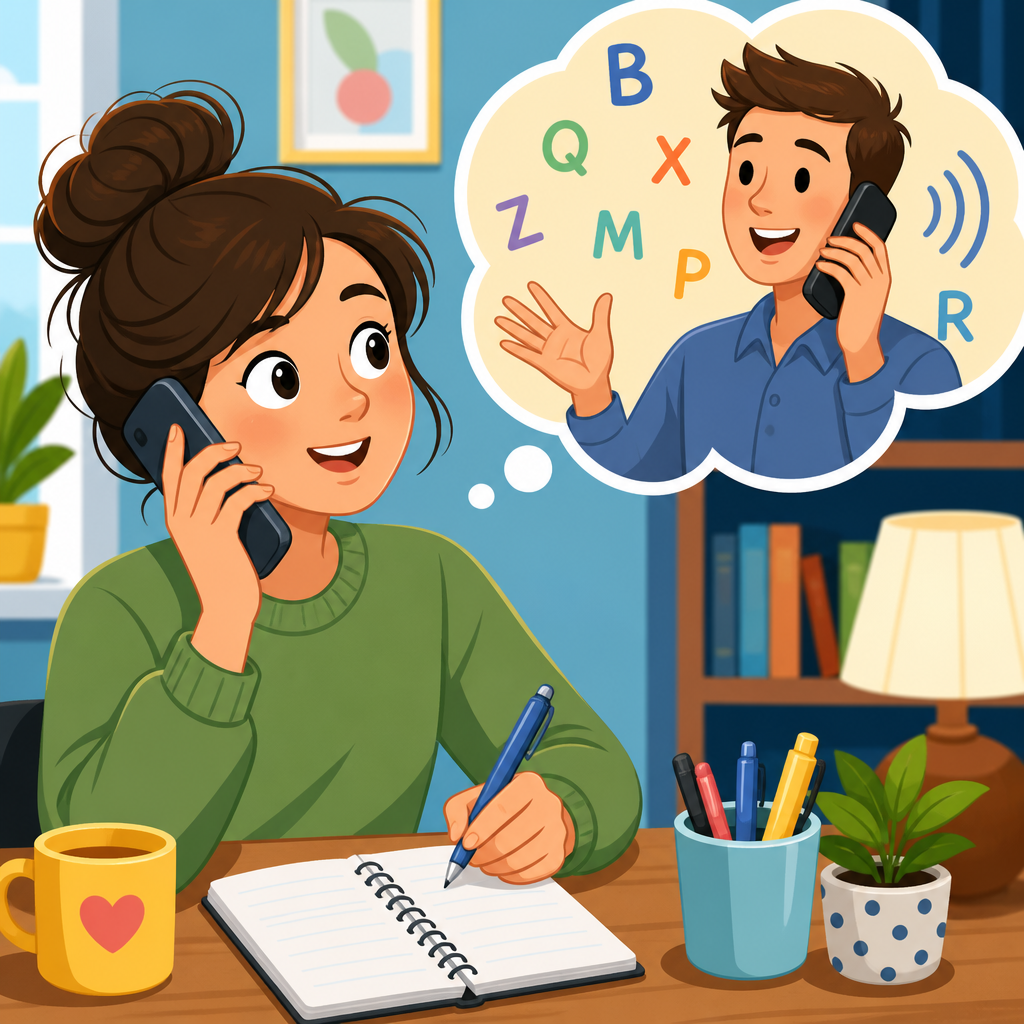
How to understand fast spelling over the phone starts with a simple truth: letters are harder to hear than words. In normal conversation, context fills gaps. When someone says “I missed the train,” your brain predicts the final word before it arrives. A spelled sequence like “B, D, G, P” offers almost no context, especially on a mobile call with compression, background noise, accents, or a weak connection. That is why people who follow phone conversations well can still miss names, email addresses, booking codes, and street references when the caller switches to rapid spelling.
Fast spelling over the phone means receiving letters or mixed letter-number strings at conversational speed and converting them accurately in real time. This skill matters in customer support, healthcare reception, travel booking, sales, logistics, and any role where one wrong character creates a costly error. I have seen a single misheard letter send invoices to the wrong email address, delay parcel dispatch, and force clinics to recreate patient records. The problem is not poor hearing alone. It is a listening task shaped by phonetics, working memory, turn-taking, and signal quality.
To improve, you need a method rather than better concentration. The most reliable approach combines three habits: hearing each character distinctly, confirming unclear sounds immediately, and grouping the sequence into manageable chunks. You also need to know which letters are commonly confused and why. English has several high-risk pairs because they share similar vowel sounds when spoken alone, including B and D, C and Z, M and N, and P and T. Numbers create extra trouble because “fifteen” and “fifty,” or “nine” and “five,” can blur on poor audio.
Why fast spelling breaks down on phone calls
Phone audio removes useful detail. Traditional landlines cut parts of the frequency range, and modern mobile networks compress speech to prioritize efficiency. Voiced consonants and soft distinctions often suffer first. In practice, that means “B” and “D” may sound nearly identical if the initial burst is clipped. Add a speaker who is moving, using a headset badly, or spelling while looking away from the microphone, and letter recognition drops further. This is one reason call center quality teams often audit address capture and account verification separately from general communication.
Memory load is the second issue. Most adults can hold only a limited amount of unfamiliar verbal information briefly without rehearsal. A ten-character password reset code given at full speed exceeds that limit for many listeners unless they chunk it. Chunking means breaking a stream into smaller units such as three letters, then two numbers, then three letters. It works because the brain stores grouped information more efficiently than isolated items. Experienced agents do this automatically when writing references like “KTM-47-BQX” as three meaningful blocks rather than eight separate sounds.
A third factor is expectation. If you do not know whether the caller is spelling a surname, an email handle, or a serial number, your brain cannot narrow possibilities. Skilled listeners quickly establish the category first. Asking “Is that a name, an email, or a code?” reduces ambiguity before the spelling starts. In my experience, this single question prevents more errors than trying to catch every character on the first pass, because categories shape what combinations are likely and what follow-up checks make sense.
The letters and numbers most often confused
Some characters fail more often than others, and understanding the pattern helps you respond faster. The highest-risk letters are those built around similar long vowel sounds: B, C, D, G, P, T, V, and Z. Nasals also cause trouble: M and N often collapse together, especially with low volume. F and S can blur because both are high-frequency fricatives, while A and H may be lost if the speaker rushes. Among numbers, thirteen and thirty, fourteen and forty, and fifteen and fifty are classic traps in business calls.
The practical answer is not guessing better; it is forcing distinction. If you hear a risky letter, verify it using a word label immediately: “Was that B as in Bravo, or D as in Delta?” Standard radiotelephony alphabets are useful because they were designed to maximize distinction across noisy channels. Even when callers do not know the formal set, you can supply the clarifier yourself and ask for confirmation. This is faster than asking for the whole string again and usually feels more professional to the caller.
| Common confusion | Why it happens | Best confirmation prompt |
|---|---|---|
| B / D / P / T | Similar stop consonants on compressed audio | “Was that B as in Bravo, D as in Delta, P as in Papa, or T as in Tango?” |
| M / N | Nasal sounds merge at low volume | “M as in Mike, or N as in November?” |
| F / S | Fricatives lose clarity on weak lines | “F as in Foxtrot, or S as in Sierra?” |
| Fifteen / Fifty | Unstressed endings disappear in fast speech | “One-five or five-zero?” |
| A / 8 / H | Short isolated sounds lack context | “Is that the letter A, the number 8, or H as in Hotel?” |
A repeat-back system that catches errors early
The strongest technique is structured repeat-back. First, let the speaker give a short chunk, ideally three to four characters. Second, repeat that chunk back before moving on. Third, mark any uncertain item with a verbal flag instead of silent guessing. For example: “I have J-N-unclear, please repeat the third letter.” This keeps the repair local. If you wait until the end of a twelve-character string, both parties must reconstruct the entire sequence, which is slower and more frustrating.
Good repeat-back also mirrors grouping. If the caller says an email handle as “michael dot r taylor 82,” repeat it in the same units: “michael, dot, r, taylor, eight-two.” Mirrored rhythm reassures the speaker that you are tracking correctly and makes corrections easier. In training new reception staff, I recommend writing separators exactly as spoken: hyphen, dot, underscore, slash. Many mistakes come not from letters but from missed symbols in usernames and addresses. Saying symbols aloud during confirmation reduces this risk sharply.
Precision language matters. Avoid vague repairs like “Sorry?” or “Can you say that again?” Use specific prompts: “Please spell the surname in pairs,” “Pause after every three characters,” or “Give the final four again with words for each letter.” Specificity turns a failing exchange into a guided task. It also lowers caller stress, because people spell faster when they think the listener is struggling. Once you take control of pace and format, accuracy usually improves within seconds.
How to train your ear for rapid spelling
This is a trainable micro-skill. Start with minimal-pair drills using the riskiest letters: B/D, G/J, M/N, P/T, and F/S. Listen to recorded letter pairs on different devices, then write what you hear and check accuracy. Next, practice mixed strings such as “BDT-491-MN” because real calls rarely present clean alphabetic runs. I have found that five minutes a day of targeted drills produces better results than occasional long practice sessions, because the goal is automatic recognition under time pressure.
Shadowing helps as well. Ask a colleague to read names, email handles, and booking codes at natural speed while you repeat each chunk instantly. This trains auditory processing and speech production together. If you work in a multilingual environment, include different accents from the start. A listener who handles only one accent in practice will often fail in live conditions. Free tools such as voice memo apps, spreadsheet-generated code lists, and call simulation platforms are enough; expensive software is unnecessary for most teams.
Build domain-specific familiarity. If you regularly capture vehicle registrations, medicine names, apartment numbers, or account IDs, practice those exact patterns. Familiarity reduces cognitive load because you recognize likely structures. A hotel front desk agent who often hears confirmation numbers like “AB7Q9” benefits from drilling alternating letter-number sequences. A medical receptionist needs extra practice with surnames and email addresses, where uncommon spellings are normal. Listening improves fastest when the material matches the calls you actually handle.
What to do during a difficult live call
When a line is poor, do not push through at normal speed. Reset the task. Say, “The line is unclear. Please give it to me three characters at a time.” If needed, ask the speaker to move to a quieter place, face the microphone, or remove speakerphone. These changes often improve intelligibility more than repeated listening. On critical data such as payment emails or legal names, offer a backup channel when policy allows: “I can send a verification text,” or “Please reply to the confirmation email so I can match the spelling exactly.”
Write in uppercase block letters when capturing live spelling, even if the final text will be formatted later. Uppercase reduces your own visual confusion between handwritten forms such as a, o, and e. Leave clear spacing between chunks and circle uncertain characters instead of erasing them. This preserves the repair point. In audited environments, that matters because you can reconstruct how the sequence was confirmed. Many transcription errors come from messy note-taking rather than from the call itself.
Finally, know when to slow the entire interaction. Accuracy beats speed when the content is irreversible or sensitive. A one-minute verification is cheaper than a failed prescription pickup, a bounced invoice, or a shipment sent to the wrong address. The best listeners are not those who catch every fast-spelled string perfectly the first time. They are the ones who control the exchange, confirm intelligently, and finish with a verified result. Practice these methods on your next calls, and fast spelling over the phone will become manageable, not stressful.
Frequently Asked Questions
Why is fast spelling over the phone so much harder to understand than normal speech?
Fast spelling is harder to understand because individual letters carry very little context on their own. In everyday conversation, your brain constantly predicts what is coming next based on grammar, topic, and common word patterns. If someone says, “I missed the…,” you can often anticipate the last word before you hear it clearly. But when a caller spells out a name, username, or email address, a sequence like “B, D, G, P” does not give your brain the same helpful clues. Each sound has to be identified accurately in real time, with almost no support from context.
Phone calls make this even more difficult. Mobile networks often compress audio, which can blur the subtle differences between similar-sounding consonants. Background noise, speakerphone use, poor microphones, regional accents, and weak connections can all reduce clarity further. Letters such as B, D, G, P, T, V, and Z are especially easy to confuse because they share similar sound shapes over the phone. That is why someone can follow a normal conversation perfectly well and still struggle when a caller suddenly starts spelling quickly. The problem is not usually attention or intelligence; it is that the task itself is acoustically demanding.
What are the most commonly confused letters when someone spells quickly over the phone?
The letters most often confused are the ones that sound alike when heard in isolation. Common problem pairs and groups include B, D, P, and T; M and N; F and S; G and J; V and B; and Z and C. Depending on accent and call quality, A and H can also be unclear, and letters like R, Y, and I may blend together if they are spoken too quickly. Short vowel-heavy letters and stop consonants are especially vulnerable because a bad connection can flatten the sound and remove the tiny details that distinguish one letter from another.
Email addresses and names create additional problems because they often combine unfamiliar words, initials, numbers, and symbols. A caller might say a surname you have never heard before, then immediately spell it at speed, which increases cognitive load. The best way to handle this is to expect confusion in advance and slow the process down on purpose. Instead of relying on the raw letter sounds alone, ask for each letter with a keyword, such as “B as in Bravo” or “D as in Delta.” That extra word adds context and dramatically reduces the chance of error. If the person is not using phonetic keywords, it is completely reasonable to ask them to do so.
What is the best way to ask someone to repeat or clarify spelling without sounding awkward?
The most effective approach is to be direct, polite, and specific. You do not need to apologize excessively or pretend you caught more than you did. Simple requests work well, such as, “Could you spell that a little more slowly?” “Can you give me that one letter at a time?” or “Could you use words for each letter?” These requests sound professional, keep the conversation moving, and signal exactly what kind of help you need. Most people appreciate clear instructions because they want to be understood too.
It also helps to repeat back what you think you heard in short chunks. For example: “I have B as in Bravo, then D as in Delta—what comes next?” This turns the exchange into a confirmation process rather than a total restart. If you wait until the entire sequence is finished before checking, both of you are more likely to get frustrated. For longer items such as email addresses, ask the caller to pause after each section: the name, the symbol, the domain, and the extension. Breaking the task into manageable units is one of the fastest ways to improve accuracy and reduce pressure.
How can I train myself to understand spelled letters faster and more accurately on calls?
The most reliable way to improve is through focused listening practice rather than general conversation practice. Because spelling over the phone is a specific skill, it responds best to targeted repetition. Start by becoming familiar with commonly confused letters and training your ear to hear the differences between them. Listening drills that contrast pairs like B and D, M and N, or G and J can help you notice subtle distinctions that you might miss during a live call. Practicing with both clear recordings and lower-quality audio is especially useful because real phone calls are rarely perfect.
It is also worth learning a standard phonetic alphabet, such as Alpha, Bravo, Charlie, Delta, and so on. Even if other people do not always use it, your own knowledge of phonetic keywords makes it easier to verify letters quickly and request clarification with confidence. Another strong technique is shadow practice: listen to someone spell names, email addresses, or codes and repeat them back immediately. Over time, this builds faster auditory processing and better short-term retention. You can also practice chunking, where you mentally group letters into smaller units instead of trying to hold a long sequence all at once. These habits make a noticeable difference, especially if you regularly take calls involving contact details, bookings, customer records, or technical support.
What should I do if I need to catch a name or email address accurately on an important phone call?
When accuracy matters, the goal is not to prove that you can keep up with fast spelling. The goal is to get the information right. Start by taking control of the pace early. Ask the caller to say the item once normally, then spell it slowly. If it is an email address, confirm each part separately: the user name, the “at” symbol, the domain, and the ending such as .com or .org. If it is a personal or company name, repeat it back immediately and confirm each uncertain letter before moving on. This prevents small mistakes from snowballing into a completely wrong result.
You should also use every available support cue. Write while listening, say letters back aloud, and ask for phonetic words when needed. If a letter still is not clear, compare options directly: “Was that B as in Bravo or D as in Delta?” That kind of narrow question is often easier for the caller to answer than repeating the entire sequence. On critical calls, it is smart to confirm the final version one last time from beginning to end. If the situation allows, ask the person to send the information by text or email as a backup. In professional settings, this is not overcautious; it is good communication practice. A short verification step can save time, prevent mistakes, and avoid the problems that come from recording a name, address, or account detail incorrectly.