
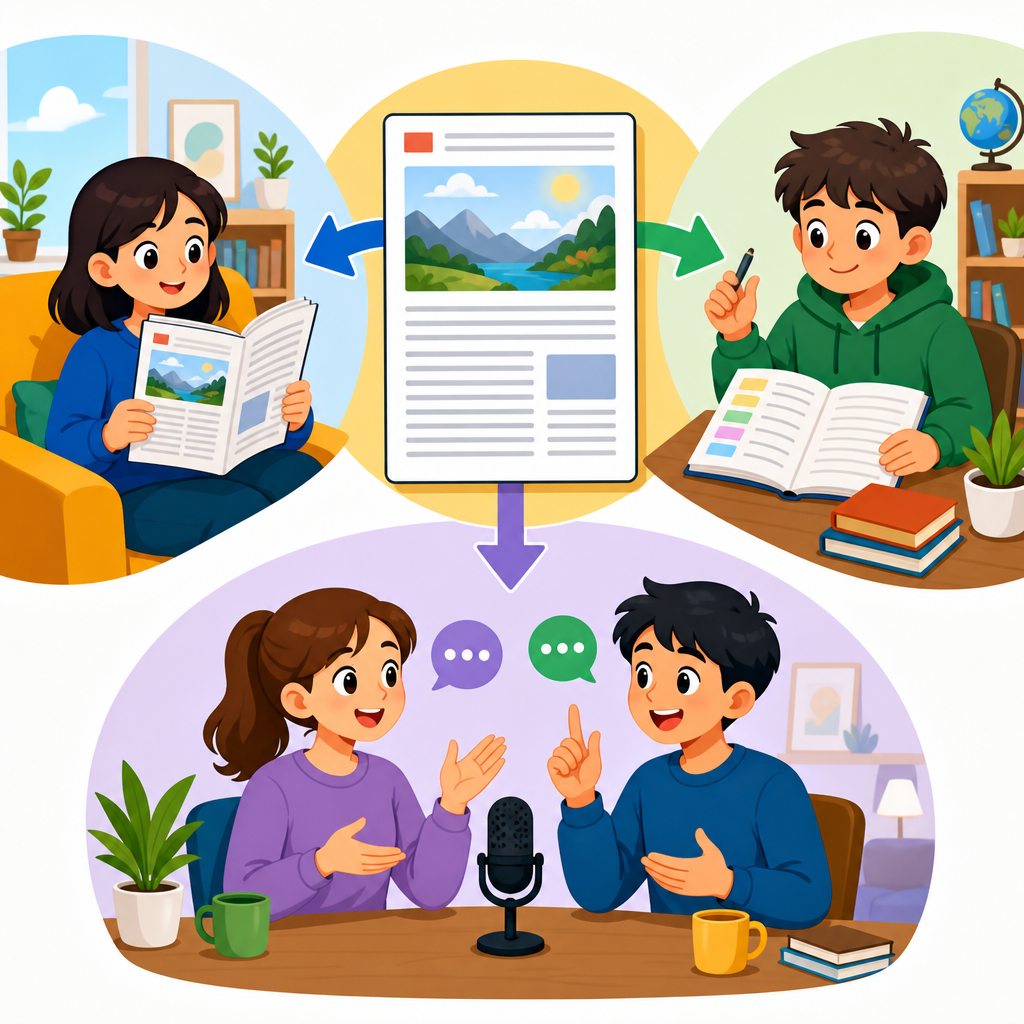
Reusing one article for reading, vocabulary, and speaking practice is one of the most efficient ways to improve English when study time is limited. Instead of jumping between unrelated materials, you work deeply with a single text and turn it into a complete lesson. In practical terms, that means one short article can train comprehension, expand active vocabulary, and build speaking fluency in the same session. I have used this method with busy adult learners for years because it reduces friction, saves planning time, and produces measurable progress within weeks.
The key idea is simple: a well-chosen article becomes a repeatable language resource rather than a one-time reading exercise. Reading practice means understanding the main idea, structure, and details of the text. Vocabulary practice means noticing useful words, collocations, and example sentences, then reusing them accurately. Speaking practice means retelling the ideas, expressing reactions, and answering follow-up questions aloud. When these three skills are connected through the same content, learners remember more because every pass through the article reinforces the last one.
This matters because many learners study hard without creating enough repetition. They read one text, memorize a word list from another source, then speak about a different topic entirely. That approach feels productive, but it often creates shallow familiarity instead of durable language control. By contrast, reusing one article creates retrieval practice, spaced review, and contextual learning, all of which are supported by cognitive science and visible in classroom results. If you want a low-prep method that turns ten or fifteen minutes into focused English practice, this is the best way to do it.
Why one article works better than scattered materials
One article works better than scattered materials because it lowers cognitive load and increases useful repetition. Cognitive load refers to the amount of mental effort required to process information. When learners switch among a video, a grammar worksheet, and a separate speaking prompt, part of their attention is wasted adjusting to new contexts. With one article, all effort stays on a single topic, so more mental energy goes toward understanding and producing language.
I have seen this difference repeatedly with adults who study before work or during lunch breaks. When they use disconnected resources, they often forget vocabulary by the next day because the words were never reused. When they revisit one article three or four times in different ways, they begin to use the same phrases naturally in speech. A text about sleep habits, for example, can produce vocabulary such as “fall asleep,” “sleep quality,” “screen time,” and “establish a routine,” then feed directly into a one-minute spoken summary and a personal opinion response.
There is also a strong motivational benefit. Finishing a complete cycle with one article feels achievable. Learners can clearly see progress: first they struggled with the text, then they understood it, then they used its language in conversation. That visible improvement builds confidence and makes consistency easier.
How to choose the right article for multi-skill practice
The best article for this method is short, clear, and rich in reusable language. In most cases, 300 to 700 words is ideal. Shorter texts may not provide enough vocabulary or ideas for speaking, while longer texts can become tiring and reduce repetition. The topic should be specific enough to summarize easily, such as remote work habits, healthy breakfasts, public transportation, or managing stress.
Look for articles written in natural modern English, not texts overloaded with technical jargon or literary language. News explainers, blog posts, short opinion pieces, and educational articles usually work well. A strong article includes a clear main claim, two to four supporting points, and several phrases that are useful outside the article itself. Good reusable language includes collocations, transition phrases, and opinion structures, such as “one major reason is,” “in contrast,” “a common challenge,” or “this can lead to.”
Difficulty matters. Learners should understand roughly 85 to 95 percent of the article on the first read. If every sentence contains unknown language, speaking practice will collapse because too much effort goes into decoding. If the text is too easy, there will be little vocabulary growth. I usually test this by asking whether the learner can explain the article’s main point after one read, even with imperfect grammar. If the answer is yes, the level is probably right. For learners who want a broader structure for daily study, this article-reuse method fits naturally inside this simple daily English routine for busy adults.
The step-by-step method to turn one article into three kinds of practice
The most effective approach is to move through the article in stages, not all at once. First, read for the main idea without stopping for every unknown word. Mark confusing sentences, but finish the article. Second, read again and identify key vocabulary: words, collocations, and phrases that seem useful for your own life. Third, speak using the article as support. This sequence mirrors how language is processed in real communication: understand first, notice patterns second, produce third.
| Stage | What to do | Time | Output |
|---|---|---|---|
| Read 1 | Skim for topic, main idea, and structure | 3 minutes | One-sentence summary |
| Read 2 | Underline useful vocabulary and check only essential meanings | 5 minutes | Five to eight target items |
| Speak 1 | Retell the article in your own words | 2 minutes | Short spoken summary |
| Speak 2 | Give your opinion and connect the topic to your life | 3 minutes | Personal response |
| Review | Repeat the summary the next day without looking | 2 minutes | Retrieval practice |
This structure works because it creates immediate recycling. Suppose the article is about walking meetings at work. After reading, you collect “boost concentration,” “sedentary lifestyle,” “hold a meeting,” and “fresh perspective.” Then you say: “The article argues that walking meetings can boost concentration and give teams a fresh perspective. They may also reduce the effects of a sedentary lifestyle.” At that moment, vocabulary study becomes speaking practice, not a separate task.
How to study vocabulary from the article without wasting time
The biggest mistake learners make with article vocabulary is collecting too many words. A shorter, selective list works better. Choose five to eight items only, and prioritize high-utility language you can imagine using this week. In my experience, collocations are often more valuable than isolated words because English is phrase-based. “Make progress,” “raise awareness,” “take a break,” and “face pressure” are easier to transfer into conversation than single-word entries memorized without context.
Write each item with a short definition, the original article sentence, and your own new sentence. That third step is essential. Without personal use, recognition stays passive. If the article says, “Many workers face burnout after long periods of stress,” your sentence might be, “New teachers often face burnout during their first year.” This proves you understand both meaning and grammar.
Use trusted tools for checking meaning and usage. Cambridge Dictionary and Oxford Learner’s Dictionaries are reliable for learner-friendly definitions, pronunciation, and example sentences. For collocations and frequency, the Corpus of Contemporary American English and Ludwig can help confirm whether a phrase sounds natural. Translation tools are useful for speed, but they should not be the final authority on usage. The goal is not to build a giant notebook; it is to move article vocabulary into active speech.
How to turn the same article into real speaking practice
Speaking practice from one article should progress from controlled to flexible output. Start with a 30-second summary. Use simple prompts: What is the article about? What are the two main points? What example does it give? Then expand into a one-minute retelling in your own words. Do not read sentences aloud as your main speaking task. Reading aloud can help pronunciation, but it does not fully train spontaneous speaking.
After the summary, shift to reaction questions. Do you agree with the article? Have you seen this in your country or workplace? What is one advantage and one disadvantage? This step matters because fluency grows when learners connect input to personal experience. If the article is about digital detox weekends, a learner might say, “I agree with the main idea, but it is difficult for freelancers because clients expect fast replies.” That sentence shows comprehension, vocabulary transfer, and independent thought.
Recording yourself is especially effective. In coaching sessions, recorded summaries often reveal repeated grammar gaps, pronunciation issues, and overused filler words more clearly than live conversation does. Listen once, note one or two corrections, then record again. Improvement is usually audible by the second attempt, which makes practice concrete rather than vague.
Common mistakes and the best way to build a repeatable routine
Several mistakes make this method weaker than it should be. The first is overexplaining every sentence before understanding the whole text. That kills momentum. The second is memorizing definitions without using the words aloud. The third is changing articles too quickly. Repetition is the point; if you abandon the text after one pass, you lose most of the benefit.
A repeatable routine is straightforward. On day one, read and identify vocabulary. On day two, review the same article and give a short spoken summary. On day three, answer opinion questions and reuse the vocabulary again. This three-day cycle is manageable even for busy adults, and it mirrors how durable memory is formed through repeated retrieval. If time is very limited, use one article for an entire week and gradually improve the same spoken response.
The best way to reuse one article for reading, vocabulary, and speaking practice is to treat the text as a mini language lab. Read for meaning, extract a small set of useful phrases, then speak about the ideas until they become your own language. This method is efficient because every step reinforces the others, and it is practical because it works with short study sessions. Choose one good article this week, follow the sequence, and measure how much more you can understand, remember, and say by the end of it.
Frequently Asked Questions
Why is reusing one article more effective than using separate materials for reading, vocabulary, and speaking?
Reusing one article is effective because it creates continuity. Instead of spending mental energy adjusting to a new topic, new context, and new language patterns every time you switch activities, you stay inside one clear piece of content and explore it from different angles. That makes your study session more efficient, especially if your time is limited. You first understand the main ideas through reading, then notice and learn useful words and expressions in a meaningful context, and finally use those same ideas and phrases in speaking. This sequence helps move language from passive recognition to active use.
Another reason this method works so well is that repetition becomes natural rather than boring. You are not rereading the same text for no reason. Each pass has a different purpose. One reading may focus on general comprehension, the next on key vocabulary, and the next on summarizing or responding aloud. Because the article stays the same, your confidence increases with each step. That reduced friction is especially important for busy adult learners, who often lose momentum when study routines feel complicated or scattered.
It also reflects how language learning actually develops. Strong English ability is not built by collecting random exercises. It grows when learners repeatedly meet useful language, process it deeply, and then produce it themselves. A single well-chosen article can support all three stages in one session. In practical terms, that means less preparation, better retention, and more speaking confidence without needing a large amount of study time.
What kind of article should I choose for this method?
The best article is short, clear, and interesting enough that you can return to it several times without losing focus. For most learners, a text between roughly 300 and 800 words works well. It should be long enough to contain useful vocabulary and a few ideas worth discussing, but not so long that the session becomes heavy or exhausting. If the article is too difficult, you will spend all your energy decoding it. If it is too easy, there will not be enough language to stretch your skills.
Topic choice matters just as much as level. Choose an article about something you genuinely care about or find useful: work, health, technology, travel, education, habits, or current trends are often good options. Interest supports attention, and attention supports memory. When learners connect emotionally or professionally with a topic, they are more likely to notice vocabulary, remember examples, and speak more freely about the content afterward.
You should also look for articles with practical language, not just specialized jargon. A good article contains phrases, sentence patterns, and opinions that can transfer into real conversation. For example, texts that explain causes and effects, compare ideas, describe problems and solutions, or present a clear argument are excellent for speaking practice. They give you structure as well as vocabulary. In general, the ideal article is one you can understand with some effort, learn from in context, and talk about afterward without needing to invent a completely new topic.
How should I structure a study session if I want to use one article for all three skills?
A simple structure works best. Start with a first reading focused only on general understanding. Read the article once without stopping too much, and ask yourself basic questions: What is the main idea? What problem or topic is being discussed? What are the key supporting points? This builds overall comprehension before you focus on details. If needed, read it a second time more slowly and underline sentences that seem important, confusing, or especially useful.
Next, move into vocabulary work. Do not try to learn every unfamiliar word. Instead, choose a small number of high-value items, usually five to ten words or expressions that appear useful for future speaking and writing. Look at how they are used in the article, note the surrounding words, and write simple example sentences of your own. This step is important because vocabulary becomes active more easily when you connect meaning, form, and personal use rather than memorizing isolated definitions.
After that, use the article as a speaking prompt. Summarize the text out loud in your own words. Then react to it. Do you agree with the main point? Have you seen something similar in your own life or work? Can you explain the issue, compare it to another situation, or suggest a solution? This is where the method becomes especially powerful. You are no longer just consuming English. You are transforming input into output. If you have more time, record yourself, listen back, and repeat the task with better clarity and more of the target vocabulary. That final step helps build fluency, accuracy, and confidence at the same time.
How many times should I reuse the same article without making practice feel repetitive?
In most cases, using the same article across one to three sessions is enough to get strong benefits without making the process stale. The key is not the number of times you see the article, but the variety of tasks you do with it. If every review feels identical, motivation drops. If each round has a new focus, repetition becomes productive. For example, the first session can center on understanding the message, the second on vocabulary and useful phrases, and the third on speaking, summarizing, or discussing personal opinions related to the text.
You can also vary the level of challenge. One day you might give a short summary with notes. Another day you might explain the article from memory with no support. You could answer comprehension questions, create discussion questions, rewrite key sentences in simpler English, or use selected vocabulary in a personal story. These small changes keep the material fresh while still giving you the memory benefits of repeated exposure.
A good rule is to keep reusing the article as long as it is still helping you produce better English. If you are noticing vocabulary more quickly, speaking more smoothly, or recalling the content with less effort, the article is still valuable. Once it feels fully familiar and no longer challenges you, move on to a new text. The goal is not endless repetition. The goal is deep enough repetition to turn one piece of input into comprehension, vocabulary growth, and confident speaking practice.
Can this method really help speaking fluency, even if I study alone?
Yes, absolutely. Speaking fluency improves when you practice organizing ideas quickly, retrieving vocabulary under light pressure, and expressing meaning in connected speech. You do not need a conversation partner for every stage of that process. In fact, using one article as the basis for solo speaking practice can be extremely effective because it gives you something concrete to talk about. Many learners struggle with speaking alone because they have no topic, no structure, and no language support. An article solves all three problems.
When you read first, you build a knowledge base. When you study vocabulary from the same text, you collect words and phrases you can immediately reuse. Then, when you speak, you are not starting from zero. You already have content in your mind and language on the page. That reduces hesitation and makes it easier to speak in full sentences. You can summarize the article, explain the main argument, describe the most interesting point, say whether you agree, or connect it to your own experience. All of that is real fluency practice.
To make solo speaking even more effective, record yourself and listen critically but calmly. Notice where you pause too much, where your ideas are unclear, or where you avoid useful vocabulary from the article. Then try again. This repeat-and-improve cycle is one of the fastest ways to develop stronger spoken English independently. It may not replace live conversation entirely, but it absolutely builds the core skills that make live conversation easier: clearer thinking, faster recall, better phrasing, and more confidence using English out loud.





