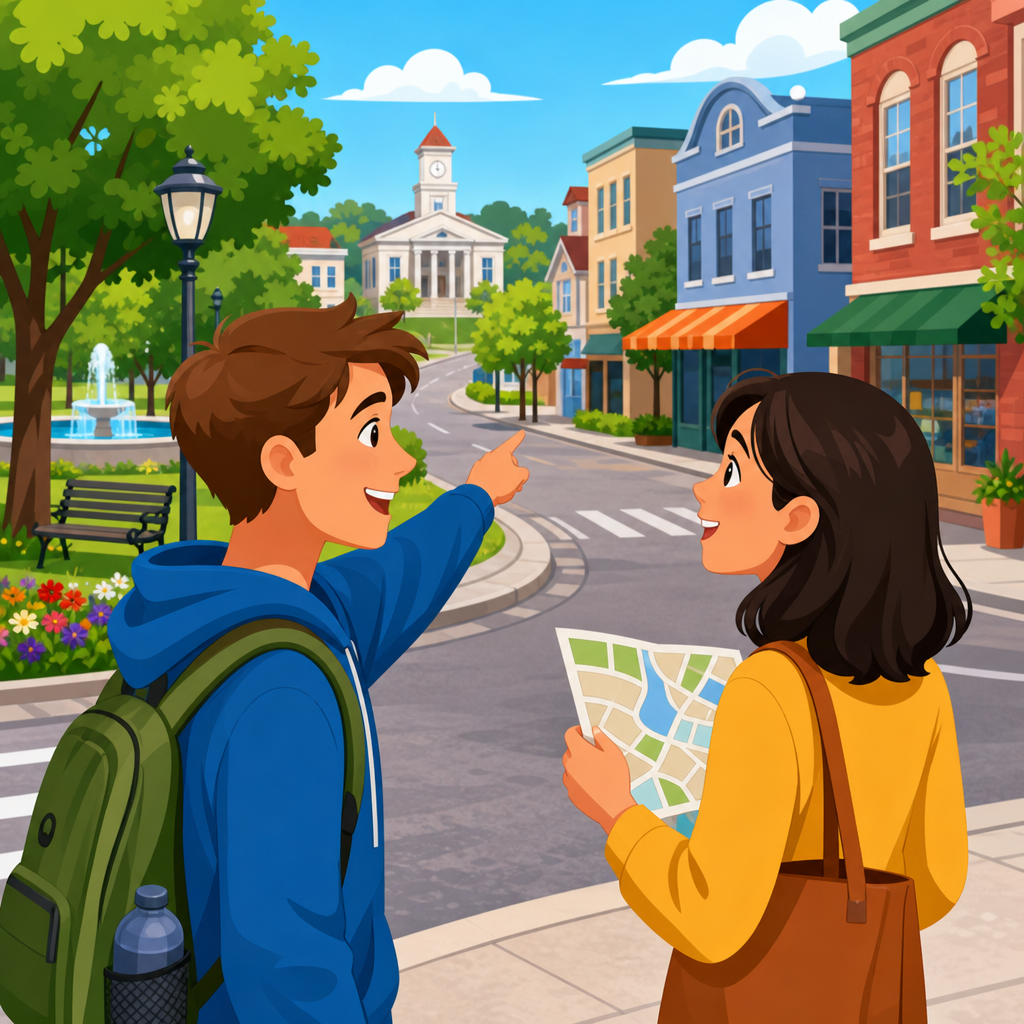
Useful phrases for giving directions in a community setting help people move through shared spaces confidently, safely, and politely. In everyday English, “giving directions” means explaining how to reach a place, while a “community setting” includes neighborhoods, schools, libraries, clinics, parks, apartment buildings, and local events where residents, visitors, and staff interact face to face. I have taught practical English for community use, and this topic consistently matters because a simple set of phrases can prevent confusion, reduce stress, and make public spaces feel more welcoming. Clear directions are not only about vocabulary such as “turn left” or “go straight.” They also involve choosing landmarks, checking understanding, using respectful tone, and adjusting language for children, older adults, newcomers, or anyone unfamiliar with the area.
Good direction-giving supports inclusion. A parent asking for the nearest restroom at a school open house, a new resident looking for the community center, or a patient trying to find the correct clinic entrance all need fast, accurate guidance. In many cases, the best phrases are short, concrete, and organized by sequence: start point, route, landmark, and destination. That structure helps listeners remember what to do next. It also reduces the risk of overload, especially in noisy places or stressful moments. Learning useful phrases for giving directions in a community setting therefore improves communication, everyday courtesy, and access to local services.
Another reason this skill matters is that community interactions often happen with people who do not share the same first language. Plain English works better than idioms, slang, or complex sentences. Saying “Walk past the playground and the library will be on your right” is more effective than “You can’t miss it.” The second phrase is common, but it offers no real navigational detail. Practical direction-giving should be observable, step based, and easy to repeat. When people can explain a route clearly, they help others participate more fully in community life.
Core phrases that make directions clear
The most useful phrases for giving directions in a community setting are direct, familiar, and anchored in visible features. Start with attention and orientation: “Sure, I can help,” “Where are you now?” or “Are you starting from the front desk?” Then give the route in order. Effective verbs include “go,” “walk,” “turn,” “cross,” “enter,” “follow,” “take,” and “stop.” For example: “Go straight down this hall,” “Turn left at the elevator,” “Cross the street at the traffic light,” and “Enter through the second door.” These verbs are easier to process than more abstract wording.
Prepositions do much of the real work in directions. Learners need phrases such as “next to,” “across from,” “between,” “on the corner of,” “at the end of,” “behind,” and “in front of.” In a library, you might say, “The meeting room is next to the children’s section.” In an apartment complex, “The mailboxes are between Building B and the parking lot” is clearer than “over there.” Distance markers are equally important: “about two minutes from here,” “the second building on your left,” or “just past the bus stop.” These details create a mental map instead of a vague impression.
Landmarks are often more memorable than street names, especially for short local routes. In practice, I have seen people follow “past the bakery, then right at the pharmacy” more successfully than a list of road names. Reliable landmarks are permanent or highly visible: a reception desk, a statue, a crosswalk, a playground fence, a blue sign, or a row of lockers. Avoid temporary landmarks like parked cars or a food truck that may move. If the space is large, add confirmation points such as “You’ll see the gym on your left; keep going until the nurse’s office.”
Polite and inclusive language for community interactions
Directions are more effective when they sound respectful. Community settings include strangers, elders, children, and people under stress, so tone matters as much as content. Useful opening phrases include “Of course,” “Let me show you the easiest way,” and “It’s a little tricky, so I’ll break it into steps.” These phrases lower anxiety and signal patience. If someone looks uncertain, add reassurance: “It’s close,” “You’re almost there,” or “I can repeat that.” In customer-facing environments, this politeness supports trust and improves the overall experience.
Inclusive direction-giving also means avoiding assumptions. Not everyone drives, sees small signs easily, or understands local shorthand. Replace “Head north” with “Walk toward the main gate.” Instead of “Take the accessible route if you need it,” say “There’s a ramp on the right if stairs are difficult.” That wording is practical without singling someone out. If a route includes obstacles, mention them early: “The shortest path has stairs,” or “That entrance is closed today, so use the side door by the garden.” Clear warnings prevent frustration and make advice genuinely useful.
Questions can improve accuracy. Before giving directions, ask, “Are you walking or driving?” “Do you know where the front entrance is?” or “Would landmarks help more than street names?” This takes seconds and leads to better guidance. For broader conversational confidence in shared spaces, learners can also build social language through the main guide on small talk in English before a meeting or class, because many direction exchanges begin with brief polite conversation. In real community interactions, clarity and courtesy usually work together.
Common community scenarios and practical examples
Different settings call for slightly different phrases. In a school, concise sequential language works best because families are often moving quickly. You might say, “Go through the main doors, turn right at the office, and the auditorium is at the end of the hall.” In a health clinic, reduce ambiguity and mention check-in points: “Take the elevator to the second floor, turn left, and check in at Window 3.” In a park, outdoor landmarks are essential: “Follow the paved path past the fountain, then the restrooms are beside the picnic area.”
Residential communities need phrases that reflect entrances, building numbers, and security procedures. For example: “Building D is behind the leasing office. Walk past the mailroom, then use the second staircase on your left.” In a community center during an event, crowd flow matters, so include alternate routes: “The front hall is busy; the quieter way is through the courtyard entrance.” At public transit stops, timing matters too: “The shuttle picks up across from the library sign, not in front of the main doors.” Specificity prevents people from ending up close to the right place but not at the correct access point.
| Situation | Useful phrase | Why it works |
|---|---|---|
| School visit | “Go past the office and the gym will be on your right.” | Uses a fixed landmark and side reference. |
| Clinic | “Take the elevator to Level 2 and check in at Desk B.” | Adds destination and required action. |
| Library | “The study room is across from the computers.” | Short, visible, easy to confirm. |
| Apartment complex | “Building C is behind the parking area, next to the playground.” | Combines two strong landmarks. |
| Park event | “Follow the path to the fountain, then turn left for the stage.” | Organizes movement step by step. |
How to avoid confusion and check understanding
Even familiar phrases can fail if directions are too long, too fast, or too abstract. A common mistake is giving five or six steps without pauses. In practice, three-step chunks are easier to follow: starting point, first turn, final landmark. If the route is complicated, write it down or point visually. Another mistake is using relative language without a shared frame of reference, such as “over there” or “down that way.” Replace those with exact phrasing: “Use the door beside the vending machines,” or “Turn at the red information board.” Precision saves time.
Checking understanding is part of good direction-giving, not an extra courtesy. Simple follow-up questions include “Would you like me to repeat that?” “Does that make sense from where you’re standing?” or “Can you see the sign I mean?” In teaching and front-desk work, I often use confirmation prompts: “First the elevator, then left, correct?” This lets the listener restate the route and reveal misunderstandings immediately. The teach-back method is widely used in healthcare communication because repeating instructions improves comprehension and reduces errors, and the same principle works well for everyday navigation.
When language barriers exist, shorter sentences and gesture support are more effective than louder speech. Pointing, tracing a route on a posted map, or walking someone to the first landmark can bridge gaps quickly. Digital tools also help, but they should support, not replace, human clarity. Many public buildings now use standardized wayfinding principles, including consistent icons, high-contrast signs, and plain-language labels, because environmental graphics experts know that people navigate best when spoken instructions match visible cues. The strongest directions combine simple words, stable landmarks, and a quick check that the listener knows what to do next.
Building confidence with reusable direction phrases
The fastest way to improve is to learn reusable sentence patterns rather than isolated words. Strong templates include “Go straight until you reach…,” “Turn left at…,” “It’s next to…,” “You’ll see… on your right,” and “If you pass…, you’ve gone too far.” That last phrase is especially useful because it gives an error signal, which many speakers forget to include. In training sessions, I encourage learners to practice one route they know well, such as from the entrance to the restroom or from the bus stop to the office. Familiar routes build fluency before harder scenarios.
Confidence also comes from adapting your phrasing to the setting. Indoors, use floors, doors, desks, and hallways. Outdoors, use corners, crossings, gates, and paths. For children, keep instructions shorter: “Go to the big tree, then turn right.” For older adults or people carrying bags, mention seating, elevators, or curb cuts when relevant. Accuracy matters more than sounding advanced. The best useful phrases for giving directions in a community setting are the ones people understand immediately and can follow without asking three more questions.
Clear community directions depend on a simple formula: start from the listener’s location, give steps in order, anchor them to visible landmarks, and confirm understanding. Phrases like “go straight,” “turn left,” “next to,” “across from,” and “at the end of the hall” remain essential because they are concrete and widely understood. When paired with polite openings, accessible wording, and brief follow-up questions, these phrases do more than guide movement. They make schools, clinics, libraries, parks, and neighborhoods easier to use for everyone.
The main benefit is practical trust. People feel welcomed when they receive accurate, respectful help, and that improves everyday community interaction. Focus on short sentences, stable landmarks, and step-by-step order. Practice a few common routes in your own environment, and use these phrases the next time someone asks for help.
Frequently Asked Questions
What are the most useful phrases for giving directions in a community setting?
The most useful phrases are the ones that are simple, polite, and easy to follow in real time. In community settings such as neighborhoods, schools, libraries, clinics, parks, apartment buildings, and local events, people usually need clear step-by-step language rather than long explanations. Common phrases include: “Go straight,” “Turn left,” “Turn right,” “It’s on your left,” “It’s on your right,” “It’s next to the library,” “It’s across from the park,” “It’s between the clinic and the school,” and “Keep going until you see the main entrance.” These expressions work well because they rely on visual landmarks that most people can identify quickly. It is also helpful to use transition phrases such as “First,” “Then,” “After that,” and “Finally” so the listener can follow the sequence without confusion.
In addition, practical community English often includes reassurance and checking for understanding. For example, a helpful speaker might say, “You’ll see the reception desk as soon as you enter,” or “You can’t miss it; it’s beside the large blue sign.” If the route is more complicated, adding timing or distance can make directions stronger: “Walk two blocks,” “It’s about a five-minute walk,” or “Take the second door on the left.” In face-to-face interactions, polite phrases such as “Let me show you,” “I can point it out on the map,” or “Would you like me to repeat that?” are especially valuable. These phrases do more than give directions; they build comfort and confidence, which is important in shared spaces where people may already feel rushed, stressed, or unfamiliar with the environment.
How can I give directions clearly and politely to someone who may be nervous or unfamiliar with the area?
Clear and polite directions begin with empathy. In a community setting, the person asking for help may be new to the neighborhood, visiting a clinic, attending a school meeting, looking for a local service, or trying to find an event room for the first time. That means your tone matters as much as your words. Start with a calm and friendly response such as, “Of course,” “I’d be happy to help,” or “Sure, let me explain.” Then give directions in small, manageable steps. Instead of saying everything at once, break the route into parts: “Go through the front doors, turn right at the information desk, and take the hallway to the end.” This approach makes it easier for the listener to process and remember what to do.
Politeness also means choosing language that supports rather than overwhelms. Use familiar landmarks, avoid slang, and keep your sentences direct. For example, “Walk past the playground and the library will be on your left” is better than a long description filled with extra details. You can also pause and check comprehension by asking, “Does that make sense?” or “Would you like me to say that again more slowly?” If the location is especially important, such as a health office, a child pickup area, or an accessible entrance, mention that clearly. In many cases, the best community communication combines verbal directions with gestures, maps, signs, or even walking part of the way with the person if appropriate. That kind of practical kindness is often what makes directions truly effective.
What landmarks and location words should I use when giving directions in shared public spaces?
Landmarks and location words are essential because they turn directions into something visible and easy to follow. In shared public spaces, people understand routes more quickly when you connect them to obvious places such as entrances, exits, elevators, reception desks, bus stops, playgrounds, parking lots, community bulletin boards, staircases, or large signs. For example, saying “The office is next to the main entrance” is more helpful than simply saying “The office is over there.” Useful location words include “next to,” “across from,” “between,” “behind,” “in front of,” “near,” “around the corner from,” and “at the end of the hall.” These phrases help create a mental picture of the space and reduce uncertainty.
When possible, choose landmarks that are stable and easy to notice. A permanent sign, a front desk, a gate, or a large building is usually better than something temporary such as a parked car or a moving crowd. In places like apartment buildings or schools, indoor landmarks are just as important as outdoor ones. You might say, “Take the elevator to the second floor; the meeting room is across from the stairs,” or “The nurse’s office is beside the main office.” In parks or event spaces, direction words like “past,” “through,” and “toward” are also useful: “Walk through the gate and head toward the picnic area.” The best landmark-based directions are specific enough to guide someone confidently without overloading them with too much information at once.
How do I give directions to English learners or people with limited English in a community setting?
When speaking to English learners or people with limited English, the goal is not to sound advanced; it is to be understandable. Use short sentences, common words, and a steady pace. Instead of saying, “Proceed down the corridor adjacent to the administrative office,” say, “Go down this hall. The office is next to the main office.” Plain English is usually the most effective form of community communication. It also helps to give one step at a time and avoid unnecessary vocabulary. Words like “left,” “right,” “straight,” “next to,” “across from,” and “behind” are practical and widely taught, so they are often easier to understand than more formal alternatives.
Support your words with visual and physical cues whenever possible. Pointing, showing a map, circling a location on a printed schedule, or using signage in the environment can make a major difference. You can also confirm understanding by asking the person to repeat the route back in their own words: “Can you tell me where you will go first?” This is often more effective than simply asking, “Do you understand?” because many people will say yes even if they are still unsure. In community settings, patience matters. If the person seems confused, repeat the directions using fewer words and clearer landmarks. If your workplace or local center has translated materials, multilingual signs, or bilingual staff, use those resources. Giving directions well to English learners is not only a language skill; it is a community inclusion skill.
What common mistakes should I avoid when giving directions face to face?
One of the most common mistakes is giving too much information too quickly. When people are trying to find a room, office, service desk, or event area, they usually need only the most important steps. Long explanations with side comments, extra background, or multiple alternative routes can create confusion. Another common mistake is using vague language such as “over there,” “that way,” or “you’ll see it.” Those phrases are only helpful if you are also pointing clearly and the destination is visible. It is much better to say, “Turn left at the front desk, then take the first hallway on the right.” Specific language reduces stress and helps the listener act immediately.
Other mistakes include forgetting the listener’s perspective, using landmarks that are unclear, and failing to check for understanding. For example, if you say “Go to the back,” the person may not know what “back” means in an unfamiliar building. If you say “It’s by the old office,” that landmark may only make sense to long-time staff. It is also easy to assume someone knows directional terms such as “north entrance” or “east side,” when in fact they may not. In community settings, strong direction-giving means adapting your language to the person in front of you. Use clear landmarks, keep the route logical, speak politely, and ask if they want the directions repeated. If the route is complicated or the person seems unsure, offering to point it out on a map or walk with them part of the way can prevent frustration and ensure they arrive safely and confidently.