
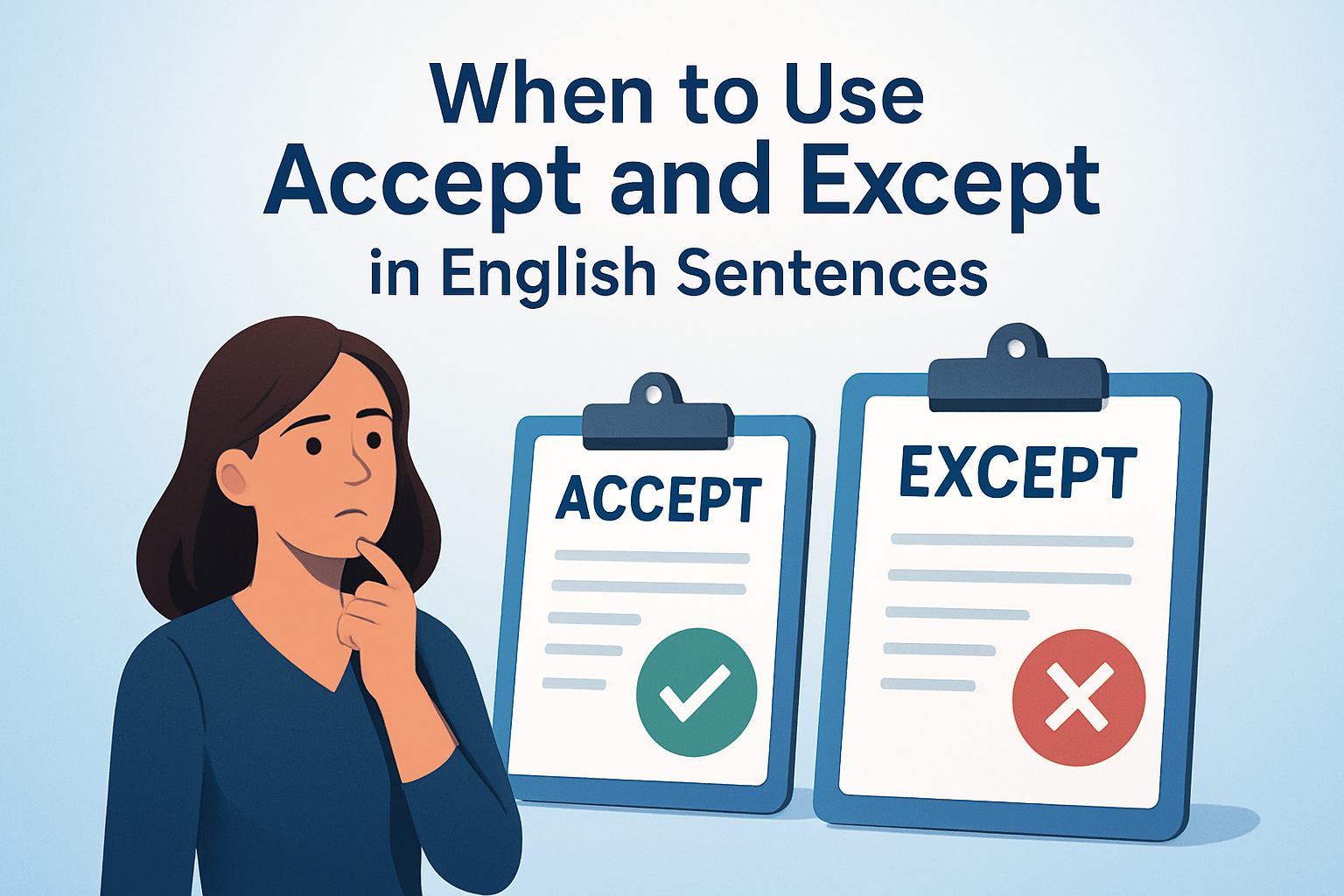
Confusion between accept and except is common because the words sound almost identical, yet they perform very different jobs in English. Accept usually means to receive, approve, or agree to something, while except means to exclude or leave something out. I have taught this distinction in editing sessions, business writing workshops, and ESL classrooms, and the same pattern appears every time: writers know the meaning they want, but the wrong spelling slips in because the ear hears the same sound. Learning when to use accept and except matters because the error can change the logic of a sentence, weaken credibility, and confuse readers in formal contexts such as emails, reports, applications, and academic papers. If you want cleaner grammar, stronger SEO writing, and more precise communication, this pair is worth mastering.
The easiest way to remember the difference is grammatical function. Accept is most often a verb. It names an action: someone accepts an offer, accepts responsibility, or accepts payment. Except is most often a preposition meaning “other than” or “excluding.” It identifies what is left out: everyone came except Maria; the shop opens daily except Sunday. In some cases, except can also act as a conjunction, as in “I would go, except I am working,” but the core idea remains exclusion. This distinction is not just a spelling tip. It is a meaning tip, a syntax tip, and a usage tip all at once. Once writers connect each word to its function in the sentence, errors drop quickly and sentence clarity improves.
What accept means and how it works in real sentences
Accept is a verb that means to receive willingly, regard as true, approve, or consent to. In practical writing, it usually answers the question “What action is the subject taking?” For example, “The company accepted the proposal” means the company approved it. “She accepted the apology” means she chose to receive it. “We accept major credit cards” means a business receives those forms of payment. In my editing work, I often tell writers to test accept by replacing it with receive, agree to, or approve. If one of those alternatives fits, accept is probably the right choice. That quick test works especially well in email writing, customer service language, and workplace documents where the verb is doing obvious action.
Accept also appears in common fixed expressions that make its meaning easy to spot. You accept an invitation, accept a job offer, accept terms and conditions, accept a diagnosis, accept criticism, or accept defeat. In each case, the subject is taking something in mentally, emotionally, legally, or physically. Standard dictionaries such as Merriam-Webster and the Oxford English Dictionary list these senses consistently, and style guides treat them as straightforward verb uses. The main problem is not complexity but sound confusion. Because accept begins with the prefix ac-, some writers mistakenly connect it with exclusion, but the word historically comes through Latin forms meaning “to receive.” That history supports the modern use: accept brings something in rather than leaving something out.
What except means and how it works in real sentences
Except usually means excluding, apart from, or other than. It sets a boundary around a group and then identifies what does not belong inside it. In the sentence “All staff attended except Jordan,” Jordan is excluded from the group of attendees. In “The museum is open every day except Monday,” Monday is the one day left out. This use is common in schedules, policies, rules, and instructions because it creates efficient exceptions without repeating an entire sentence. In legal and business writing, precision here matters. “All items are refundable except clearance merchandise” has a very different meaning from any sentence with accept. One word changes whether something is included or excluded.
Except can function as a preposition, conjunction, or, more rarely, a verb. The preposition use is the one most learners need first: “Everyone passed except two students.” As a conjunction, it can introduce a clause: “I would help, except I already promised someone else.” As a verb, except is less common and often appears in formal contexts, meaning to exclude or object, as in legal phrasing. Most everyday writers will mainly use the preposition form. A useful test is to try replacing except with excluding, aside from, or other than. If the sentence still makes sense, except is probably correct. This is the fastest accuracy check I use when proofreading web copy and client content.
Accept vs. except: the clearest way to tell them apart
The most reliable distinction is this: accept takes something in, while except leaves something out. That contrast sounds simple because it is. Yet writers need a dependable method they can apply under pressure, especially when drafting quickly. I recommend checking three things in order: part of speech, sentence meaning, and substitute word. First, ask whether the word is acting as a verb. If yes, accept is likely right. Second, ask whether the sentence is about approval or receipt, or about exclusion. Third, swap in a synonym. If receive or approve fits, use accept. If excluding or other than fits, use except. This process is mechanical enough to work during fast revisions and accurate enough for formal writing.
| Word | Usual Part of Speech | Core Meaning | Example |
|---|---|---|---|
| Accept | Verb | Receive, approve, agree to | The editor accepted the revised draft. |
| Except | Preposition or conjunction | Exclude, leave out, other than | Everyone approved the draft except the editor. |
Examples make the difference stick. “Please accept my application” is correct because the reader is being asked to receive or approve it. “Everyone was ready except the speaker” is correct because the speaker is excluded from the ready group. “The store accepts cash except for damaged bills” uses both words correctly in one sentence: the store receives cash, but damaged bills are excluded. This dual-use pattern is common in customer policies and often helps learners understand the contrast immediately. When you see both words in one sentence, the meanings separate clearly: one includes, one excludes.
Common mistakes, tricky contexts, and memory aids that actually work
The most common mistake is using accept when the sentence needs an exception. For instance, “Everyone accept Ben” is wrong because Ben is being left out, not received. The correct sentence is “Everyone except Ben.” The reverse error appears in business communication: “We except online payments” is wrong unless the writer means “we exclude online payments,” which is rare. Usually the intended sentence is “We accept online payments.” Homophone confusion increases when people write from dictation, type quickly, or rely on spellcheck. Since both are correctly spelled words, grammar tools may not catch the mistake unless they analyze the sentence deeply. That is why intentional proofreading still matters.
Some contexts are trickier because except can sound natural in longer, more conversational structures. Consider “I would join you, except I have an early meeting.” Here except introduces the reason the action will not happen. It still carries the idea of exclusion: one condition prevents the plan. Meanwhile, accept can be abstract: “He finally accepted that the plan had failed.” In this sentence, no physical object is being received; instead, a fact is being acknowledged as true. That abstract use often appears in psychology, leadership writing, and conflict resolution. Writers who understand that accept can involve mental agreement, not just physical receipt, make fewer errors in nuanced prose.
For memory, I use two devices that work well with students and professionals. First, accept begins with A, and you can connect A with acquire or agree. Both point toward taking something in. Second, except begins with EX, and you can connect EX with exit or exclude. Both point toward leaving something out. These are not formal linguistic rules, but they are effective recall tools. Another practical method is to inspect the noun that follows. If the word after it names a thing being received, approved, or acknowledged, accept is likely. If it names a person, item, time, or category being omitted, except is likely. Fast, concrete checks beat vague memorization.
How to use accept and except correctly in professional and academic writing
In professional writing, the difference affects clarity, tone, and trust. A hiring manager who writes “We are pleased to except your application” creates an avoidable credibility problem. A policy page that says “All users may login accept guests” may confuse readers about access rights. In academic writing, the mistake can damage precision in analysis, especially when describing categories, limitations, or rule-based systems. I have corrected this pair in grant proposals, university essays, ecommerce product pages, and SaaS onboarding content, and the risk is always the same: one wrong homophone can reverse meaning. That is why careful writers do not treat accept and except as a minor typo issue. It is a meaning issue first.
The best editing habit is to review these words during the final pass, especially in documents with rules, exceptions, approvals, or permissions. Read the sentence aloud, then ask a direct question. Is someone receiving or agreeing? Use accept. Is something being excluded? Use except. If the sentence still feels uncertain, rewrite it for clarity. “All employees except contractors” can become “Contractors are not included.” “We accept returns within 30 days” can become “We approve returns within 30 days” during testing, then changed back if needed. Clear alternatives expose the intended logic. Mastering this pair improves not only grammar but also confidence. Use that distinction in your next draft, and your sentences will be more accurate, polished, and trustworthy.
Frequently Asked Questions
1. What is the main difference between accept and except?
The main difference is that accept means to receive, agree to, approve, or say yes to something, while except means to leave something out or exclude it. Even though the two words sound very similar, they do completely different jobs in a sentence. For example, if you accept an invitation, you agree to it. If everyone is invited except John, John is excluded from the group. This confusion is common because many writers choose the word by sound rather than by function. A reliable way to separate them is to ask what the sentence is trying to express. If the meaning is about approval, agreement, receiving, or willingness, use accept. If the meaning is about exclusion, omission, or leaving out one person or thing from a larger set, use except. Once you focus on meaning rather than pronunciation, the distinction becomes much easier to remember and apply correctly.
2. How can I tell which word to use when writing a sentence?
A practical way to choose the correct word is to test the sentence with a quick meaning check. If you could replace the word with phrases like receive, agree to, approve, or take, then accept is usually the right choice. For instance, “She accepted the job offer” means she agreed to take the offer. On the other hand, if you could replace the word with excluding, other than, apart from, or leaving out, then except is the correct word. For example, “Everyone came except Maria” means Maria was the one person excluded. This method works especially well in business writing, academic writing, and editing because it forces you to look at sentence function instead of sound. Another useful check is grammar. Accept is most often a verb, while except is commonly a preposition or conjunction. If the sentence needs an action, such as receiving or agreeing, you probably need accept. If it needs a word that marks exclusion, you probably need except.
3. Can you give some example sentences showing accept and except used correctly?
Yes, and seeing them side by side is one of the best ways to understand the difference clearly. Here are a few examples with accept: “I accept your apology,” “The company accepted her proposal,” “He accepted the award on behalf of his team,” and “We cannot accept late applications.” In each of these sentences, the word expresses receiving, agreeing, or approving. Now compare those with examples of except: “All the stores were open except the pharmacy,” “Everyone passed the test except one student,” “I like all vegetables except beets,” and “The office is open every day except Sunday.” In these examples, the word signals exclusion. The contrast becomes even clearer if you place both words in related contexts. For example: “She accepted every suggestion except the last one.” Here, accepted shows agreement, while except identifies what was left out. This kind of paired example is useful because it trains your eye to recognize the separate role each word plays. If you review enough correct examples, the difference starts to feel natural rather than memorized.
4. Why do writers and English learners confuse accept and except so often?
Writers and learners confuse these words because they are near-homophones, meaning they sound almost the same in normal speech. In fast conversation, the small pronunciation difference is easy to miss, so many people rely on what they hear instead of what the sentence means. That leads to spelling errors such as writing “I except your offer” when the intended meaning is “I accept your offer.” This is especially common in ESL classrooms, workplace emails, student essays, and first drafts, where people are focused on ideas and communication rather than fine spelling distinctions. Another reason for the confusion is that both words are common in everyday English, so the brain recognizes each one as familiar. The problem is not usually vocabulary knowledge but word selection under pressure. In editing sessions, this mistake appears repeatedly because writers often know the concept but type the wrong form automatically. The best solution is to slow down during proofreading and check the meaning of the sentence. Ask yourself whether the word indicates agreement or exclusion. That simple habit catches most errors before they reach the final version.
5. Are there any easy memory tricks for remembering accept versus except?
Yes, a few simple memory tricks can help. One of the most effective is to connect accept with agreement. Both words begin with a similar sound, and both involve saying yes, receiving something, or approving it. You can think, “If I accept it, I agree to it.” For except, remember the idea of an exception. The words are closely related, and both refer to something left out or excluded. If there is one person missing from a group, that person is the exception, so the sentence will often need except. Another useful trick is to watch the role in the sentence: accept usually names an action, while except usually marks a limit or exclusion. You can also create a personal contrast sentence to remember them together, such as “I accepted every item except the broken one.” That kind of sentence reinforces both meanings at once. Memory aids work best when combined with regular reading and proofreading, because repeated exposure helps the correct choice become automatic over time.





