
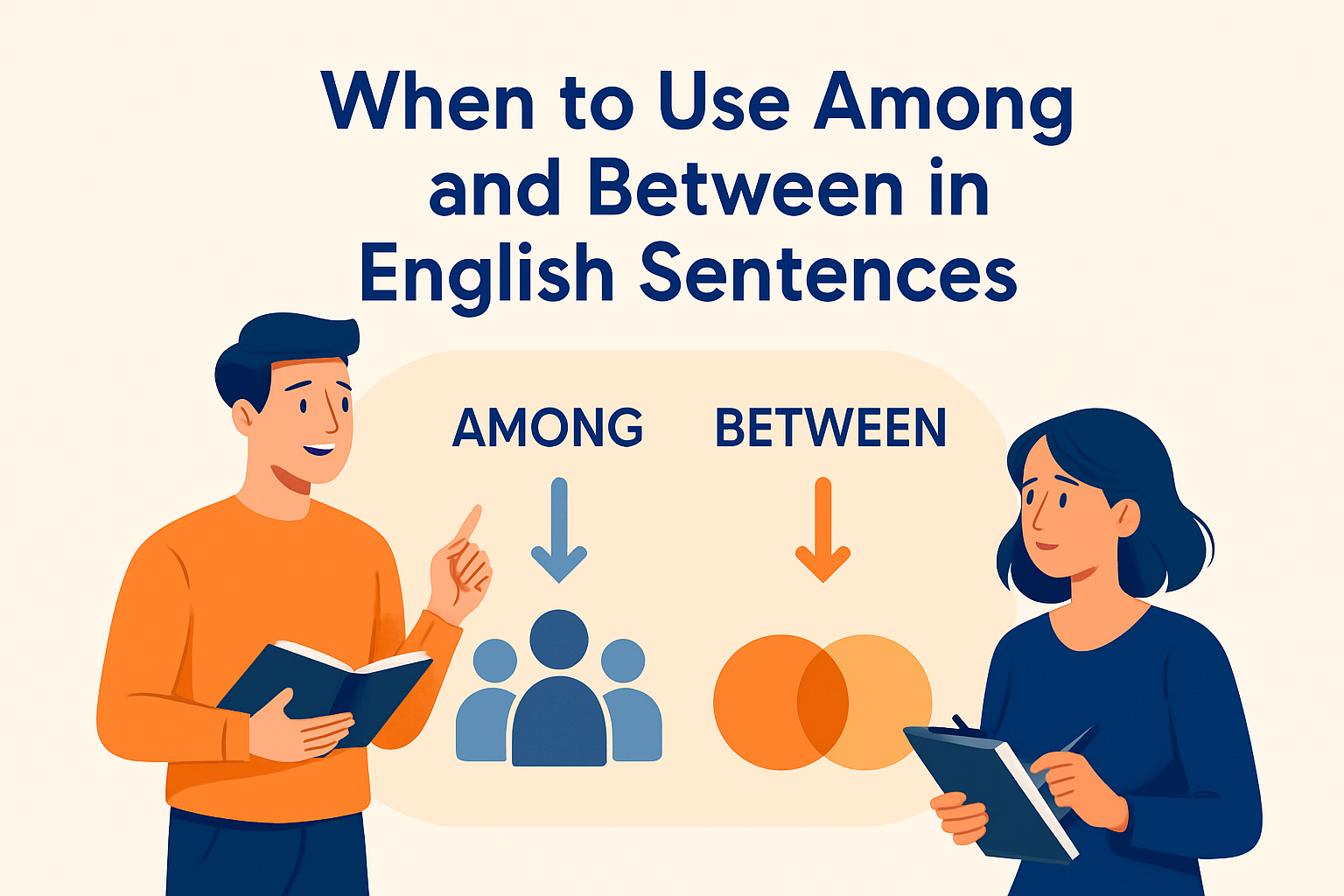
Choosing between among and between looks simple until you start editing real sentences and realize how often even fluent writers hesitate. These two prepositions both describe relationships, position, and distribution, yet they do different jobs in English grammar. In everyday speech, people often use them interchangeably, but careful writing benefits from knowing the distinction. I use this rule constantly when reviewing web copy, academic drafts, and business emails, because a small preposition choice can sharpen meaning immediately. If you want cleaner sentences, stronger grammar, and more confidence in formal and informal writing, understanding when to use among and between is essential.
At the most basic level, between usually points to a relationship involving separate, distinct items, while among refers to being part of a group or surrounded by many members of that group. That definition helps, but it is not the whole story. Many learners are taught that between is for two and among is for three or more. That shortcut works sometimes, yet it fails in common constructions such as negotiations between five departments or agreements between several countries. Modern usage, supported by major style authorities including Merriam-Webster and the Cambridge Grammar tradition, focuses less on the number involved and more on whether the relationship is one-to-one and distinct or collective and undefined. That difference matters because good grammar is not about memorizing slogans; it is about choosing the word that matches the structure of meaning.
Writers search this topic because they want direct answers to practical questions. Should you say divide the money between the four children or among the four children? Is a secret shared between friends or among friends? Can a person stand between trees, or should it be among the trees? These are not trivial points. They affect tone, accuracy, and readability. In professional settings, grammatical precision also influences credibility. Clear preposition use helps readers understand whether you mean individual relationships, shared participation, or physical placement. Once you understand the logic behind the choice, the pattern becomes much easier to apply in real sentences.
The core rule: distinct relationships versus group inclusion
The most reliable way to choose is this: use between when the sentence highlights separate, identifiable entities in relation to one another, and use among when the sentence emphasizes a group, mass, or collective setting without focusing on each member individually. I rely on this test more than any textbook shortcut because it works across most modern English contexts.
For example, you would write an agreement between the manager, the designer, and the client because each party is distinct and the agreement connects them individually. You would write a feeling of trust among the team because the trust exists within the group as a whole. In the first sentence, the entities are clearly separated. In the second, the group matters more than each person as an isolated unit.
This is why between can correctly apply to more than two items. Consider trade talks between Canada, Mexico, and the United States. There are three countries, but each is treated as a distinct participant. By contrast, conversation among the guests suggests a shared social atmosphere within a larger group. The emphasis is collective rather than itemized.
A quick editing question helps: are you thinking about individual links or group membership? If the answer is individual links, choose between. If the answer is group membership or immersion in a crowd, choose among. That principle explains most correct usage in modern English.
When to use between in English sentences
Use between when naming separate people, places, things, or ideas that are considered individually. This applies to physical position, comparisons, choices, transactions, relationships, and distributions where the items remain distinct. I see this constantly in business and legal writing because precision requires naming exactly who or what is connected.
Physical location is one common case. The cafe sits between the bank and the pharmacy. Even if there are more than two reference points, between still works when each point is individually identified: The bike path runs between the river, the highway, and the industrial district. The same logic applies to time and range: between 9 a.m. and 5 p.m., or between chapters three and six.
Comparison is another major use. Writers say the difference between editing and proofreading, the contrast between debit cards and credit cards, or the tension between speed, cost, and quality. In each case, the elements are distinct. Choices follow the same pattern: You must choose between remote work, hybrid work, and full-time office work. Although there are three options, each one stands separately.
Distribution can be tricky. Use between when something is divided in a way that preserves separate shares or responsibilities. We split the budget between the sales, support, and training teams assigns a distinct portion to each team. This is standard modern usage and appears in major dictionaries and usage guides. The old rule that distribution among is always required for more than two recipients is too rigid for current English.
| Situation | Use | Example |
|---|---|---|
| Distinct participants | between | The contract was signed between the publisher, the author, and the agent. |
| General group setting | among | There was excitement among the audience before the speech. |
| Separate options | between | She had to choose between law, medicine, and engineering. |
| Shared feeling in a group | among | Trust grew among the volunteers over time. |
| One-to-one comparison | between | We studied the differences between diesel and petrol engines. |
Use between also in reciprocal relationships: negotiations between unions and management, a partnership between three founders, or conflict between neighboring countries. The sentence points to structured links among distinct entities, so between is the precise choice.
When to use among in English sentences
Use among when someone or something is in the middle of a group, included within a collection, or associated with members of that group in a general way. The focus is not on separate pairings but on the overall set. This is especially common in descriptions of crowds, communities, categories, and shared social conditions.
Physical placement offers the clearest examples. A cabin hidden among the trees suggests surrounding enclosure by many trees, not a position defined by specific ones. A child standing among dancers at a festival is part of a larger scene. If you name two or three exact landmarks, between may fit better; if you evoke a surrounding group, among is the natural preposition.
Social and abstract meanings often call for among as well. You might describe unrest among workers, disagreement among scholars, or popularity among teenagers. These phrases refer to a condition present within a group. In editorial work, I often change between to among when a sentence is clearly about broad participation rather than distinct links. For example, trust among employees sounds more natural than trust between employees if the point is workplace culture overall. However, trust between employees and managers is correct because the relationship is framed across two distinct sides.
Among also fits when selecting from a collective. She was among the finalists means she belonged to the group of finalists. The report ranked among the best-selling titles means it fell within a set, not in relation to specific named items. In these constructions, among signals inclusion rather than pairwise connection.
Common mistakes and how to fix them
The most common mistake is relying only on the number rule. People learn between equals two and among equals more than two, then produce awkward sentences like negotiations among the five board members even when each board member is acting as a separate participant. If the sentence highlights distinct parties, between is better. A useful correction is negotiations between the five board members.
Another frequent mistake appears in location descriptions. Writers say the bench is among the house and the garage when they really mean a point in the middle of two named objects. That should be between the house and the garage. On the other hand, the bench is among the roses is correct because the flowers form a surrounding group.
Distribution errors also cause confusion. Divide the prize among the winners is fine when the winners are treated as a collective pool. Divide the prize between the top three winners is also fine when each winner receives a separate share. Both can be correct depending on emphasis. The best writers do not force a single formula; they match the preposition to the intended meaning.
A final problem is overcorrection. Some writers avoid between with more than two nouns because they fear sounding wrong. In fact, respected authorities have long accepted between with multiple distinct items. If the entities are named individually and the sentence stresses separateness, using between is not just acceptable; it is often the clearest choice.
Easy tests for choosing the right word every time
When I edit quickly, I use three practical tests. First, ask whether the nouns are distinct and individually named. If yes, between is likely correct. Second, ask whether the sentence describes a general condition inside a group. If yes, among probably fits. Third, imagine replacing the phrase with one another or each other. If that idea works, between is often the stronger option.
For example, cooperation between the research, marketing, and product teams works because the teams cooperate with one another as distinct units. Camaraderie among the staff works because the sentence describes a shared group atmosphere. The phrase hidden among old books works because the object is surrounded by a collection, not positioned in relation to specific titles.
It also helps to notice fixed patterns in natural English. We commonly say between you and me, among friends, between lines, among the ruins, between departments, and among the candidates. Exposure matters. The more you read edited English in newspapers, books, and reputable websites, the more these patterns become intuitive.
Examples in formal, academic, and everyday writing
In formal writing, precision is especially important. A legal document may refer to a contract between four companies because each company has defined obligations. An academic article may discuss differences between qualitative, quantitative, and mixed-method research because the categories are analytically distinct. A policy memo may note growing frustration among residents, where the emphasis is community-wide sentiment.
In everyday English, the same rule applies. She sat between her two cousins is simple and specific. He felt relaxed among friends expresses comfort within a group. The teacher divided the class into teams and shared the materials between the team leaders suggests separate responsibility, while excitement spread among the students describes a collective mood.
Digital communication offers useful examples too. In UX writing, I often revise sentences like collaboration among design, engineering, and compliance teams to collaboration between design, engineering, and compliance teams when the process involves clearly defined coordination. But if a survey measures morale among employees, among remains the better choice because morale belongs to the group as a whole.
Mastering among and between is less about memorizing a school rule and more about seeing how English structures relationships. Use between for distinct, individual entities connected in a specific way, even when there are more than two. Use among for inclusion in a group, shared conditions, or surroundings formed by many members. That distinction improves clarity in professional writing, academic work, and daily communication.
If you remember one principle, let it be this: between separates, among surrounds. Apply that test when you edit sentences about position, comparison, distribution, and social relationships. With a little practice, the choice becomes automatic, and your writing sounds more precise. Review your recent emails, essays, or website copy today and correct a few examples. Small grammar decisions like this create noticeably stronger English.
Frequently Asked Questions
What is the basic difference between between and among?
The simplest rule is this: use between when you are talking about distinct, separate items, and use among when you are talking about a group, mass, or collection viewed less individually. In other words, between highlights one-to-one or clearly defined relationships, while among places something within a larger set. For example, you would say, “The negotiations between the manager, the client, and the vendor continued all week,” because each party is separate and identifiable. By contrast, you would say, “She felt comfortable among friends,” because the emphasis is on being part of a group rather than on individual relationships. This distinction matters in careful writing because it improves precision. Even though casual conversation often blurs the line, choosing the right preposition helps your sentence sound polished and grammatically controlled.
Can between be used for more than two people or things?
Yes, absolutely. This is one of the most common misunderstandings in English grammar. Many writers are taught that between is only for two items, but that is not correct. Between can be used for two or more people or things as long as the relationship is clear and the items are considered individually. For example, “The treaty between France, Germany, and Italy” is correct because each country is named and treated as a separate participant in the relationship. The same applies in sentences like, “We divided the responsibilities between the design team, the editor, and the project manager.” What matters is not the number alone but whether the sentence focuses on distinct entities. If the relationship involves identifiable members with separate roles, between is often the better choice, even when more than two are involved.
When should I use among instead of between?
Use among when the noun that follows is a group or when the individuals are not being separated out one by one. It works best when you want to show inclusion within a collective setting. For instance, “There was disagreement among the staff” sounds natural because the staff is being treated as a group. Likewise, “The rumor spread quickly among students” emphasizes movement through a crowd or collective rather than a series of distinct pairings. Among is also common when the exact number or identity of the members is either unknown or unimportant. If your sentence is more about being surrounded by, included with, or distributed through a group, among is usually the right choice. This is why phrases like “among colleagues,” “among the audience,” and “among experts” are standard in natural English.
How do I choose correctly in sentences about sharing, dividing, or comparing things?
In sentences about distribution, division, and comparison, the choice depends on how specifically the members are being treated. Use between if the division is made across distinct recipients or categories that are individually recognized. For example, “The budget was split between marketing, sales, and customer support” is correct because the sentence identifies separate departments. Use among when something is distributed through a group more generally, as in “The prizes were handed out among the children.” The same principle applies to comparison. You would write, “She had to choose between three offers,” because each offer is separate and defined. But you might say, “The issue caused tension among coworkers,” because the idea is collective rather than individual. A useful editing trick is to ask yourself whether the sentence points to individual relationships or to membership in a group. That answer usually makes the correct preposition obvious.
Are there common mistakes writers make with among and between?
Yes, and most of them come from oversimplified rules. The biggest mistake is assuming that between must only refer to two things. That leads writers to choose among in sentences where between is actually more precise, such as “the agreement between the three partners.” Another common problem is using between when the noun is really a general group, as in “among the crowd” rather than “between the crowd.” Writers also get tripped up when revising sentences quickly, especially in business emails, academic drafts, or web copy, where clarity matters. To avoid mistakes, focus less on counting and more on the kind of relationship the sentence expresses. If the parties are distinct and individually linked, use between. If the meaning is collective, shared, or within a group, use among. That small choice can make your writing sound more natural, accurate, and professional.





