
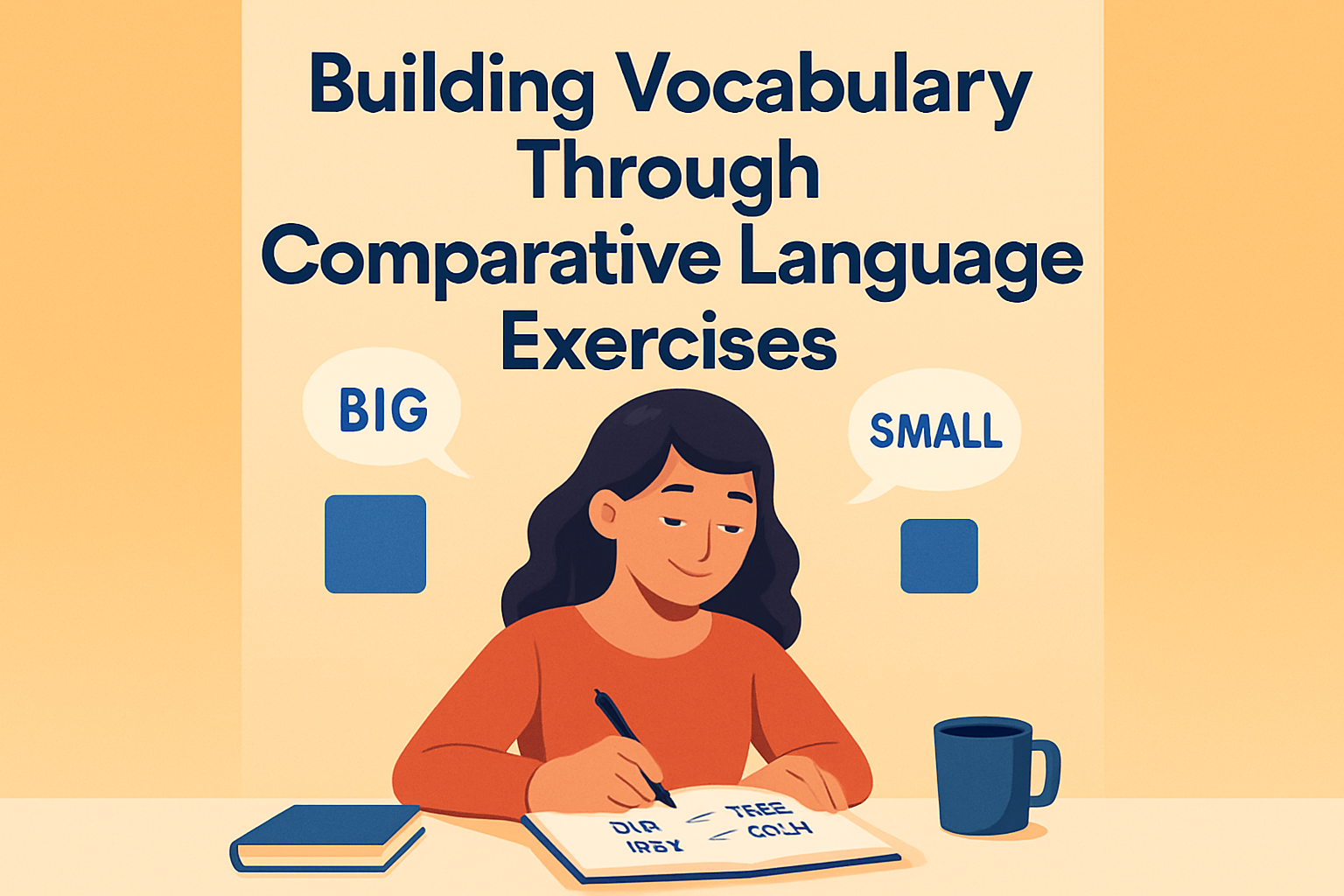
Building a robust vocabulary is an essential skill that empowers individuals to communicate effectively and excel in various areas of life. Those with a strong command of language often have an advantage in academic settings, professional environments, and social interactions. Thus, enhancing one’s vocabulary can have far-reaching effects on personal and career development. One effective method to develop vocabulary is through comparative language exercises. These exercises involve the practice of understanding vocabulary words in relation to one another, often through synonyms, antonyms, and analogies. Understanding these relationships can deepen comprehension and recall of words. Moreover, it provides a richer grasp of nuances and subtleties in language use.
Comparative language exercises offer a structured approach to vocabulary building, enabling learners to engage with words in a meaningful way. By contextualizing vocabulary, learners are encouraged to think critically about language and its usage. These exercises are not only about memorization but also about developing the capability to use words creatively and diversely. In this article, we will explore the significance of building vocabulary through comparative language exercises, breaking it down into various aspects that highlight its benefits, application, and methodology in detail.
The Role of Synonyms in Vocabulary Expansion
Synonyms are words that have the same or nearly the same meaning as another word. Incorporating synonyms into one’s vocabulary is a highly effective way to expand language skills. This method increases the ability to express similar ideas in different ways, enhancing both written and verbal communication. For instance, consider the word “happy.” Synonyms such as “joyful,” “elated,” “content,” and “cheerful” provide alternative ways to convey the same sentiment, each carrying a slightly different connotation or intensity.
In a real-world setting, utilizing synonyms adeptly can significantly impact interactions. In professional communications, for example, the precise choice of words may convey the right tone and intention, which is crucial for effective collaboration and negotiation. Furthermore, synonyms aid in avoiding repetition, making communication more engaging and dynamic.
By regularly practicing with synonyms, whether through reading diverse materials or participating in language exercises that challenge one to find synonyms in context, individuals can learn to utilize language more fluently and flexibly. This practice not only strengthens vocabulary but also improves confidence in communication across various contexts.
Understanding Antonyms to Enhance Word Power
Antonyms are words with opposite meanings, and their role in vocabulary building is equally significant. Understanding antonyms helps individuals appreciate the full range of a word’s meaning and offers a clear contrast to highlight differences and similarities. For example, the word “hot” has antonyms like “cold,” “cool,” and “frigid,” each providing a distinct understanding of temperature contexts.
In real-world applications, having a firm grasp of antonyms can improve one’s ability to articulate thoughts with precision. Consider a scenario in a debate or a persuasive speech, where effectively deploying antonyms can strengthen arguments by emphasizing contrasting ideas. Additionally, antonym exercises aid in cognitive development by requiring learners to think critically and analytically about language constructs.
Participating in antonym exercises can involve creating lists of common words and their opposites or engaging in activities that require identifying antonyms in reading passages. These activities not only strengthen vocabulary but also enhance analytical thinking, making individuals more proficient in understanding and using complex vocabulary.
Unlocking the Power of Analogies
Analogies are a form of comparison that highlights relationships between different concepts. They are a powerful tool in language learning that develops understanding through relational thinking. For example, the analogy “finger is to hand as toe is to foot” establishes a structural similarity, aiding comprehension of word pair relationships.
In practical applications, analogies enhance problem-solving skills and comprehension abilities. They are commonly used in standardized tests, educational settings, and leadership training programs to assess and develop critical thinking and relational reasoning. Through analogical reasoning, individuals can transfer knowledge from familiar contexts to unfamiliar ones, expanding their cognitive and conceptual frameworks.
To practice with analogies, learners can engage in exercises that challenge them to identify the relationship between word pairs and create their own analogies. This not only builds vocabulary but also strengthens mental agility, facilitating the ability to navigate complex linguistic and intellectual challenges.
Synonym and Antonym Exercises: A Comparative Approach
Effective vocabulary enhancement through comparative language exercises can be systematically structured using exercises that focus on both synonyms and antonyms. By studying these concepts concurrently, learners can develop a more rounded and comprehensive vocabulary skill set. Consider the following table, which outlines some synonyms and antonyms of words to illustrate their relationships:
| Word | Synonyms | Antonyms |
|---|---|---|
| Quick | Fast, Swift, Rapid | Slow, Sluggish |
| Bright | Luminous, Brilliant | Dark, Dull |
| Strong | Robust, Sturdy | Weak, Fragile |
Through exercises that challenge learners to fill in or construct similar tables, they can strengthen their understanding and recall of words by creating multiple associations. This comparative approach not only aids memory but also develops a nuanced appreciation of language.
Practical Application in Educational and Professional Contexts
Comparative language exercises have broad applications in both educational and professional settings. In classrooms, teachers can incorporate these exercises into regular lessons to help students build comprehensive language skills that prepare them for academic success. By often revisiting and practicing these exercises, students develop proficiency and gain confidence in using language in various subjects and disciplines.
In professional realms, effective communication is key to success. Professionals who actively engage in vocabulary building through comparative exercises can leverage their enhanced language skills to improve their presentation ability, engage in effective negotiations, and convey ideas clearly to colleagues and clients. For instance, using precise language can help clarify intentions in business communications and contribute to successful projects and collaborations.
Employers today seek individuals who possess strong communication skills, often highlighting them as one of the most desired competencies. Regular practice with vocabulary exercises can provide a competitive edge in the job market and contribute to professional advancement and fulfillment.
Conclusion: Empower Your Communication Capabilities
The most significant takeaway from exploring vocabulary building through comparative language exercises is the myriad benefits it offers to individuals who are willing to invest effort into enhancing their language skills. By focusing on synonyms, antonyms, and analogies, learners can develop a multi-dimensional understanding of words, enriching their ability to communicate effectively across diverse settings.
These comparative language exercises are not just about enhancing vocabulary; they are instrumental in fostering critical thinking, creativity, and cognitive processing. With consistent practice, individuals can see a marked improvement not only in their language skills but also in their overall ability to express themselves.
Now that you understand the importance of these exercises, consider incorporating them into your learning routine. Begin with simple exercises and gradually progress to more complex ones as your skills improve. With patience and perseverance, you’ll unlock a world of new words and possibilities, enhancing both your personal and professional life. Start today, and empower your communication capabilities for success!
Frequently Asked Questions
1. What are comparative language exercises, and how do they help in building vocabulary?
Comparative language exercises are activities designed to foster vocabulary development by nurturing the ability to analyze and contrast words and their meanings. These exercises require individuals to look at words side-by-side, such as synonyms, antonyms, or words in similar categories, which helps to deepen understanding and appreciation of word meanings and nuances. By engaging in these types of exercises, learners start uncovering the subtle distinctions between words that at first glance might appear similar, as well as recognizing connections between seemingly unrelated terms. For example, comparing the words “happy” and “ecstatic” allows one to explore the spectrum of emotion that spans between these terms, enhancing one’s ability to accurately express varying degrees of emotion.
Additionally, through repeated practice, comparative exercises significantly improve the ability to recall and use words appropriately in both speech and writing. This method capitalizes on the natural human tendency to categorize information to embed vocabulary into memory more effectively. As learners become more adept at using these exercises, they often find that they can navigate and articulate complex ideas more fluidly, as the act of comparing reinforces memory and aids in solidifying language concepts in the mind.
2. Can you give examples of comparative language exercises that can help expand vocabulary?
Certainly! There are a myriad of comparative language exercises that can effectively bolster vocabulary. One popular exercise involves creating a list of synonyms and antonyms for a given word and using them in sentences to better understand their different contexts. This not only aids in the expansion of vocabulary but also improves comprehension skills.
Another engaging activity is to provide learners with a paragraph full of less common words and ask them to rewrite it using more commonly known terms, or vice versa. This exercise helps in developing a greater understanding of nuanced language choices and encourages learners to expand their vocabulary in practical contexts.
Word association games where learners identify relationships between words, such as categorizing words into groups either by meaning or by shared characteristics, is another beneficial comparative exercise. Think about connecting words like “apple,” “pear,” and “banana” under the category “fruits,” or comparing “dismal” and “dreary” when considering describing bad weather.
Additionally, storytelling or narrative exercises where individuals must create parallel narratives using different sets of vocabulary can be a fun challenge that greatly aids in assimilating advanced vocabulary terms. Finally, discussing word etymology in groups, where learners engage with the origins and evolution of words, can enlighten them about the intricacies and history embedded in language, helping to foster an even deeper vocabulary bank.
3. How often should I engage in comparative language exercises to notice improvement in my vocabulary?
Consistency is key when it comes to vocabulary expansion, just as it is with any skill acquisition. Engaging in comparative language exercises regularly—ideally on a daily basis—will yield the most significant improvements. Just dedicating a small portion of each day can contribute to steady progress over time. Even 15-20 minutes daily can make a tremendous difference in your vocabulary development.
The frequency with which these exercises are done can be adjusted based on personal goals and existing vocabulary level. For instance, if you’re preparing for an important examination, a concentrated burst of daily exercises can be highly beneficial. Students or professionals looking to incrementally build their vocabulary might space their sessions out over a week, with exercises conducted three or four times weekly.
Regardless of frequency, what’s critical is making these exercises a routine habit. Similar to building muscle, language acquisition centers in the brain respond well to regular stimulation. Engaging in exercises consistently over weeks or months helps to embed new vocabulary firmly into long-term memory. It’s also important to revisit older material periodically to reinforce retention and ensure that there is a robust foundation upon which to build further.
4. Are comparative language exercises suitable for all learning levels?
Yes, comparative language exercises can be tailored to accommodate all learning levels, from beginners to advanced learners. The key lies in adjusting the complexity of the words and the nature of the exercises to suit the learning stage of the individual.
For beginners, exercises might focus more on basic synonyms, antonyms, and simple categorization exercises that employ commonly understood words. This helps to build the foundational vocabulary necessary for more sophisticated language engagement.
Intermediate learners can explore thematic word groups and more abstract connections between words, diving deeper into synonyms with nuanced differences, as well as learning idiomatic expressions and their direct language comparisons.
Advanced learners can benefit from exercises that challenge them with advanced vocabulary and use literary contexts to contrast and compare language, such as analyzing text excerpts from notable authors or poets and then being asked to express the same ideas in different words. This not only aids vocabulary development but also enriches the learner’s capacity for critical thinking and analyzing complex ideas.
Tailoring the exercises for varying levels ensures that learners are neither overwhelmed nor under-stimulated, allowing them to extend their vocabulary range in a supportive and structured manner.
5. How can educators implement comparative language exercises in the classroom to maximize student engagement?
For educators looking to maximize student engagement through comparative language exercises, introducing variety and active participation should be the cornerstone of their approach. First, incorporating collaborative activities such as team-based vocabulary games encourages cooperation and can make the learning process fun and dynamic. These games can involve identifying connections between words, arranging words in hierarchically graded groups based on intensity, or competitive ‘bubble quizzes’ where students must match synonyms and antonyms under timed conditions.
Additionally, using multimedia tools such as vocabulary apps or interactive whiteboards can create visually appealing and interactive lessons that help to reinforce learning. Educators can use video snippets, audio clips, and interactive online exercises that encourage students to compare spoken language with its written form to truly grasp its nuance and complexity.
Another productive technique is to encourage students to create their own comparative language exercises or quizzes, which they can then present to the class. This not only reinforces their learning but also fosters a sense of ownership and engagement with the material.
Classroom discussions and debates where students are required to consciously apply newly acquired vocabulary in contrasting positions foster critical thinking and vocabulary application skills. Encouraging them to explicitly use newly acquired synonymous words or idiomatic expressions can make the exercises feel relevant and applicable beyond the classroom, particularly when facilitators draw real-world parallels to these assignments. These strategies, when implemented thoughtfully, ensure that they not only build robust vocabulary banks but are able to use it effectively and creatively.





