
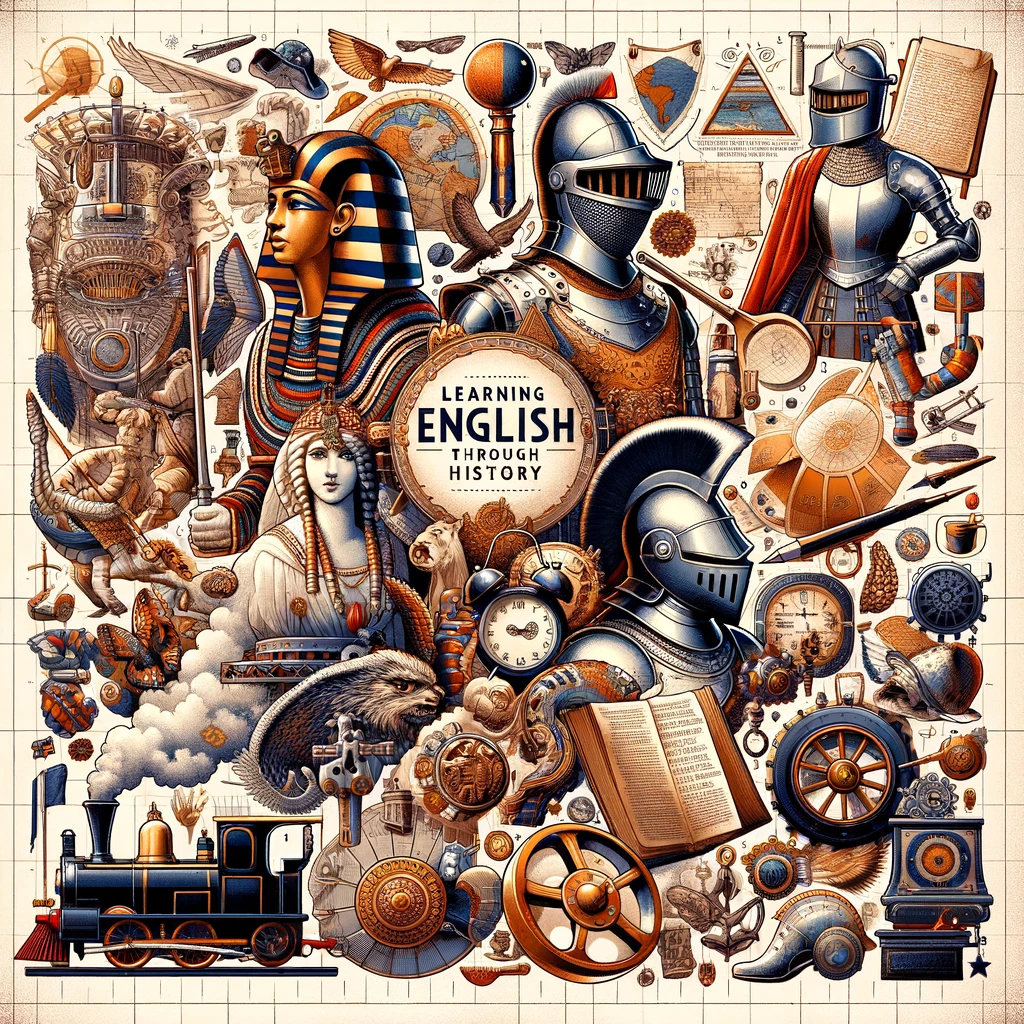
The English language, a tapestry of historical influences, offers a unique opportunity to explore the past. As learners of English as a Second Language (ESL), understanding historical terms and phrases not only enriches vocabulary but also provides a window into the events, cultures, and ideas that have shaped the modern world. This article delves into the historical evolution of English, highlighting key terms and phrases that carry the legacy of bygone eras.
The Birth of English: Old English and Middle English
Old English (450-1100 AD)
Old English, the earliest form of the English language, was influenced significantly by Germanic tribes, namely the Angles, Saxons, and Jutes. This era’s vocabulary was predominantly Germanic, with notable terms such as:
- King (Cyning): Derived from Old English ‘cyning’, indicating a leader of people.
- Woman (Wifman): A compound of ‘wif’ (woman) and ‘man’ (human being), illustrating the gendered language of the time.
Middle English (1100-1500 AD)
The Norman Conquest in 1066 introduced French influence, marking the transition to Middle English. This period saw a significant infusion of French vocabulary into English:
- Court (Courte): Reflecting the influence of the Norman aristocracy.
- Army (Armée): Originating from French, symbolizing the militaristic aspects of the era.
The Renaissance and the Enrichment of English
The Renaissance (14th to 17th century) was a period of great intellectual and cultural flourishing, which significantly impacted the English language:
- Humanism (Umanesimo): Borrowed from Italian, reflecting the era’s intellectual movement.
- Sonnet (Sonetto): Also from Italian, showcasing the influence of Renaissance literature.
The Age of Exploration and Expansion
The 15th to 17th centuries marked an era of exploration and colonial expansion, introducing numerous terms from around the globe:
- Potato (Patata): Borrowed from Spanish, indicative of the New World’s influence.
- Hurricane (Huracán): Originating from Taino, reflecting the impact of Caribbean cultures.
The Industrial Revolution and Technological Advancement
The Industrial Revolution (18th to 19th century) heralded significant technological advancements, bringing new terminology:
- Locomotive (Locomotiva): Deriving from Latin, symbolizing the era’s transportation revolution.
- Factory (Factorie): Indicating the rise of mass production and industrialization.
The World Wars and Their Linguistic Impact
The 20th century’s World Wars introduced numerous terms into everyday language:
- Trench Warfare (Guerre des Tranchées): From French, depicting the unique warfare style of WWI.
- Propaganda (Propaganda): Italian in origin, representing the psychological aspect of warfare.
Modern Terms Reflecting Our Digital Age
The late 20th and early 21st centuries have been marked by rapid technological advancement, influencing English with terms like:
- Internet (Internet): Symbolizing the digital revolution.
- Blog (Weblog): A blend of ‘web’ and ‘log’, reflecting the rise of personal online expression.

The Victorian Era: Elegance and Industry
The Victorian Era (1837-1901) was a period of industrial, cultural, political, scientific, and military change within the United Kingdom, under the reign of Queen Victoria. This era brought about distinctive linguistic contributions:
- Gentleman (Gentilhomme): A term that became synonymous with a man of good manners, education, and financial independence.
- Telegraph (Télégraphe): From Greek, illustrating the era’s communication revolution.
The Roaring Twenties and Cultural Transformation
The 1920s, often referred to as the Roaring Twenties, was a decade of economic prosperity and cultural edge in the wake of World War I:
- Jazz (Jazz): A music genre that symbolized the era’s artistic and cultural dynamism.
- Flapper (Flapper): A term used to describe a new generation of young Western women who flaunted their disdain for traditional, conservative behavior.
Post-War Era: A Time of Change and Growth
The period following World War II was marked by significant social and economic change, which was reflected in the English language:
- Cold War (Guerre Froide): From French, representing the prolonged state of political and military tension between powers in the Eastern Bloc and the Western Bloc.
- Suburbia (Suburbia): Indicating the growth of suburban areas as a consequence of post-war prosperity and the rise of the middle class.
The Swinging Sixties: Revolution in Social Norms
The 1960s, known as the Swinging Sixties, were a time of great cultural, social, and technological change:
- Hippie (Hippie): A youth movement that rejected the mores of mainstream American life.
- Moon Landing (Atterrissage sur la Lune): A term that came into use after the Apollo 11 moon landing, symbolizing the era’s technological advancements.
The Information Age and Globalization
The late 20th century ushered in the Information Age, characterized by the rapid shift from traditional industry to an economy based on information technology:
- Globalization (Globalisation): Reflecting the increasing interconnectedness and interdependence of the world’s markets and businesses.
- Cyberspace (Cyberespace): A term coined in the 1980s to describe the digital universe created by interconnected networks of information technology.
The 21st Century: The Digital and Social Media Era
The onset of the 21st century has been dominated by the rise of digital and social media:
- Emoji (Émoji): Originating from Japanese, representing the way digital communication has evolved to include visual elements.
- Hashtag (Hashtag): A symbol of the social media age, indicating the growing influence of platforms like Twitter and Instagram.
Conclusion
The historical journey through the English language is a fascinating exploration of how words and phrases encapsulate the essence of their times. For ESL learners, this exploration is more than academic; it’s a pathway to understanding the cultural, social, and technological nuances that have shaped the language. As history continues to unfold, the English language will inevitably evolve, continuing to tell the story of its people and times. By learning English through the lens of history, students gain not just linguistic skills, but also a deeper appreciation for the rich tapestry of human experience.





