From the dawn of humanity, the night sky has captivated our curiosity. It serves as a canvas for storytelling, a source of religious inspiration, and even a navigational guide. With the advent of advanced technologies and space exploration, our understanding of the universe has dramatically expanded. This expansion brings with it a rich vocabulary that helps capture the awe, wonder, and scientific precision characteristic of astronomical sciences. For those learning English as a second language, understanding this vocabulary can enrich both your linguistic skills and your comprehension of the universe. This article will guide you through key astronomical terms, their origins, and their practical applications.
Astronomy, deriving from the Greek words “astron,” meaning star, and “nomos,” meaning law, fundamentally revolves around the scientific study of celestial bodies. It’s an ancient science that has evolved over centuries, now intersecting with fields like physics, chemistry, and mathematics. As you dive into the intricacies of English vocabulary associated with this fascinating subject, you will not only acquire new words but also gain insights into a field that continuously pushes the boundaries of our knowledge about space and time.
Why learn the vocabulary of astronomy? For starters, it opens up a new world of information, discussions, and opportunities. As space exploration becomes more relevant in the current global narrative, having a grasp of basic and advanced terms in this field enhances one’s ability to participate in discussions, understand scientific articles or documentaries, and perhaps even inspire future academic or career pursuits in related fields.
In this exploration, we will cover several categories of astronomical and space vocabulary, ranging from commonplace terms you might encounter in everyday conversations, to more specialized jargon used by scientists and researchers alike. Embrace this journey of learning, and let the stars guide your path toward enriching your language skills and expanding your perception of the universe.
Basic Terminology: The Building Blocks
Understanding the foundational vocabulary of astronomy and space is the first step in navigating this vast field. These terms are essential building blocks that are frequently used in both casual conversations about the night sky and in more scientific contexts.
1. Galaxy: A system of millions or billions of stars, together with gas and dust, held together by gravitational attraction. The Milky Way is our own galaxy, containing our Solar System.
2. Planet: A celestial body moving in an elliptical orbit around a star. Earth is a planet that orbits the Sun. Other notable planets in our solar system include Mars, Jupiter, and Saturn.
3. Star: A massive, luminous ball of plasma held together by its gravity. The closest star to Earth is the Sun, which provides the energy necessary for life on our planet.
4. Asteroid: A rocky body that orbits the sun, typically found in the asteroid belt between Mars and Jupiter. These celestial objects vary in size and shape.
5. Comet: A celestial object consisting of a nucleus of ice and dust. When near the sun, comets present a noticeable atmosphere and sometimes a tail.
6. Meteor: Commonly referred to as a shooting star, a meteor is a space rock that enters Earth’s atmosphere and burns up, creating a flash of light.
These fundamental terms serve as the foundation for more advanced topics in astronomy, and mastering them can greatly enhance your comprehension of this exciting field.
Space Exploration: Beyond Earth
As humans continue to explore beyond our planetary boundaries, the vocabulary related to space missions and exploration warrants attention. This set of terms not only captures the essence of human curiosity but also the technological advancements that fuel our endeavors into the unknown.
1. Rocket: A vehicle designed to launch spacecraft into space. Rockets have been instrumental in sending satellites, probes, and humans beyond Earth’s atmosphere.
2. Satellite: An artificial object placed in orbit around a planet or star for communication, weather monitoring, and scientific observation.
3. Spacecraft: A vehicle designed for travel or operation in outer space. They are used for a variety of missions, including landing on other planetary bodies.
4. Space Shuttle: A reusable spacecraft for traveling to space and returning to Earth, primarily used by NASA from 1981 to 2011.
5. International Space Station (ISS): A space station, or habitable artificial satellite, in low Earth orbit, which serves as a lab for scientific research.
6. Astronaut: A person trained to travel in a spacecraft, conduct scientific experiments, and explore extraterrestrial environments. The term is derived from the Greek word “astronáutēs,” meaning “star sailor.”
These words connect to stories of innovation, courage, and the relentless pursuit of knowledge that defines human engagement with the cosmos.
Advanced Scientific Terms: Delving Deeper
For those wishing to delve deeper into the technical aspects of astronomy, here are some advanced vocabulary terms. These words often appear in scientific papers or discussions among professionals but can be fascinating to learn for anyone interested in the complexities of our universe.
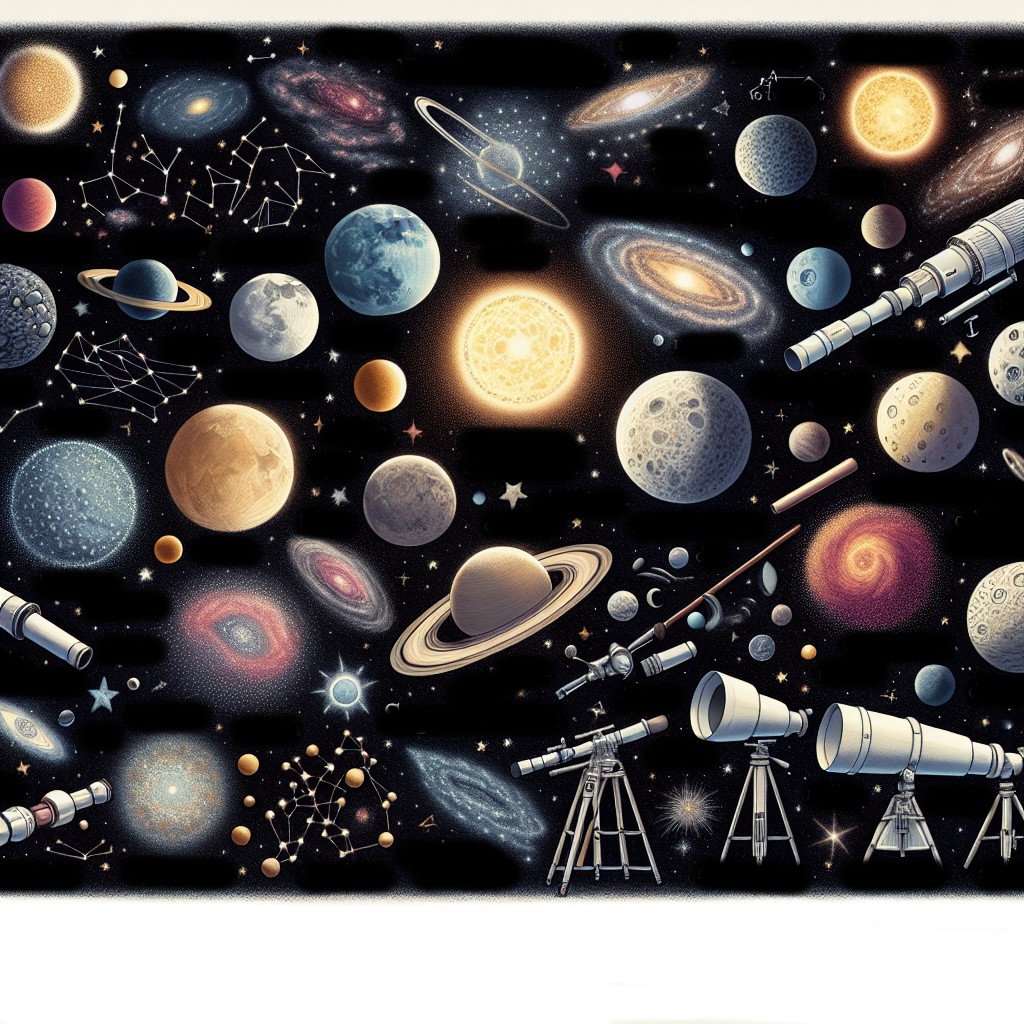
1. Black Hole: A region in space with an extremely strong gravitational pull, from which nothing, not even light, can escape. Black holes are formed from the remnants of large stars that collapse under their own gravity.
2. Quasar: A highly luminous object powered by a supermassive black hole at the center of a distant galaxy, emitting vast amounts of energy.
3. Nebula: A giant cloud of dust and gas in space, some of which are regions where new stars are born, while others are remnants of dead or dying stars.
4. Redshift: A phenomenon where light from an object moving away from us is stretched to longer wavelengths, towards the red end of the spectrum. This is a key concept in understanding the expanding universe.
5. Supernova: A powerful and luminous explosion that occurs when a star reaches the end of its lifecycle, often resulting in the formation of a neutron star or black hole.
6. Exoplanet: A planet outside our solar system that orbits a star. The discovery of exoplanets has opened up new possibilities in the search for extraterrestrial life.
Familiarity with these terms not only boosts your vocabulary but enhances your appreciation of the scientific methods and discoveries that shape our understanding of the universe.
The Cultural Impact of Space Vocabulary
Beyond scientific dialogues, the terminology of space has permeated popular culture, influencing art, literature, and media. Understanding these terms can offer a new lens through which to view cultural productions.
1. Sci-Fi (Science Fiction): A genre of speculative fiction that explores imaginative concepts such as advanced science, space exploration, and extraterrestrial life.
2. Warp Speed: A term popularized by the Star Trek series, referring to faster-than-light travel. While fictional, it embodies our aspirations for future space travel.
3. Astrobiology: The study of life in the universe, including origins, evolution, and potential for life elsewhere. It combines elements of biology, chemistry, and astronomy.
4. Terraforming: The theoretical process of modifying a planet’s environment to make it habitable for Earth-like life. The concept is frequently explored in fiction and scientific theorizing.
5. Universal Translator: A fictional device that instantly translates languages, famously used in Star Trek, reflecting our hopes for overcoming communication barriers.
6. Star Wars: Known for its influence on entertainment, it’s a film series that incorporates themes of space opera, drawing on archetypes related to space adventure.
These terms illuminate how space vocabulary has expanded beyond academic and scientific circles, leaving a lasting imprint on our cultural and creative narratives.
Enhancing ESL Skills Through Astronomical Vocabulary
Teachers and learners of English as a Second Language (ESL) can find the exploration of space vocabulary both engaging and beneficial. Incorporating this theme into language learning exercises not only diversifies the learning experience but also captivates interest.
1. Interactive Activities: Use planetarium visits or virtual reality apps to explore solar systems and galaxies, boosting vocabulary retention through immersive experiences.
2. Multimedia Resources: Incorporate documentaries, podcasts, and articles on astronomy to enhance listening and reading skills. Discussing these resources in class enforces vocabulary in context.
3. Word Games: Engage students with crossword puzzles or word searches focused on space terminology, promoting both fun and learning.
4. Project-Based Learning: Encourage students to research and present on topics like the life cycle of a star or the history of space exploration. This activity develops speaking, writing, and critical thinking skills.
5. Storytelling: Have students write creative stories set in space, using as much of the new vocabulary as possible to reinforce their understanding.
6. Discussion and Debates: Facilitate discussions on contemporary issues in astronomy, such as space tourism or the ethical implications of extraterrestrial mining, to practice advanced language skills.
Integrating the vocabulary of astronomy into ESL teaching not only expands language skills but also inspires learners by connecting them with the grand narrative of the cosmos.
Conclusion: Reaching for the Stars in Language Learning
The vocabulary of astronomy and space offers ESL learners a dynamic pathway to expand their English proficiency. This journey through terms and concepts allows learners to engage with one of humanity’s oldest sciences and explore its numerous intersections with technology, culture, and art.
The evolving field of astronomy continuously presents new terms and ideas that reflect our understanding of the universe. Whether you are interested in scientific discovery, fantasy fiction, or cultural discourse, mastering this vocabulary opens up numerous avenues for exploration and personal growth.
For educators, the inclusion of space-related content in the classroom is an exciting opportunity to broaden student horizons, creating engaging, interdisciplinary learning experiences that resonate with curiosity and wonder.
As we gaze into the night sky and ponder our place within the vast cosmos, we are reminded of the power of words to capture the mysteries of the universe. Embrace this vocabulary, and let it enrich your journey of learning English and understanding the wonders above.