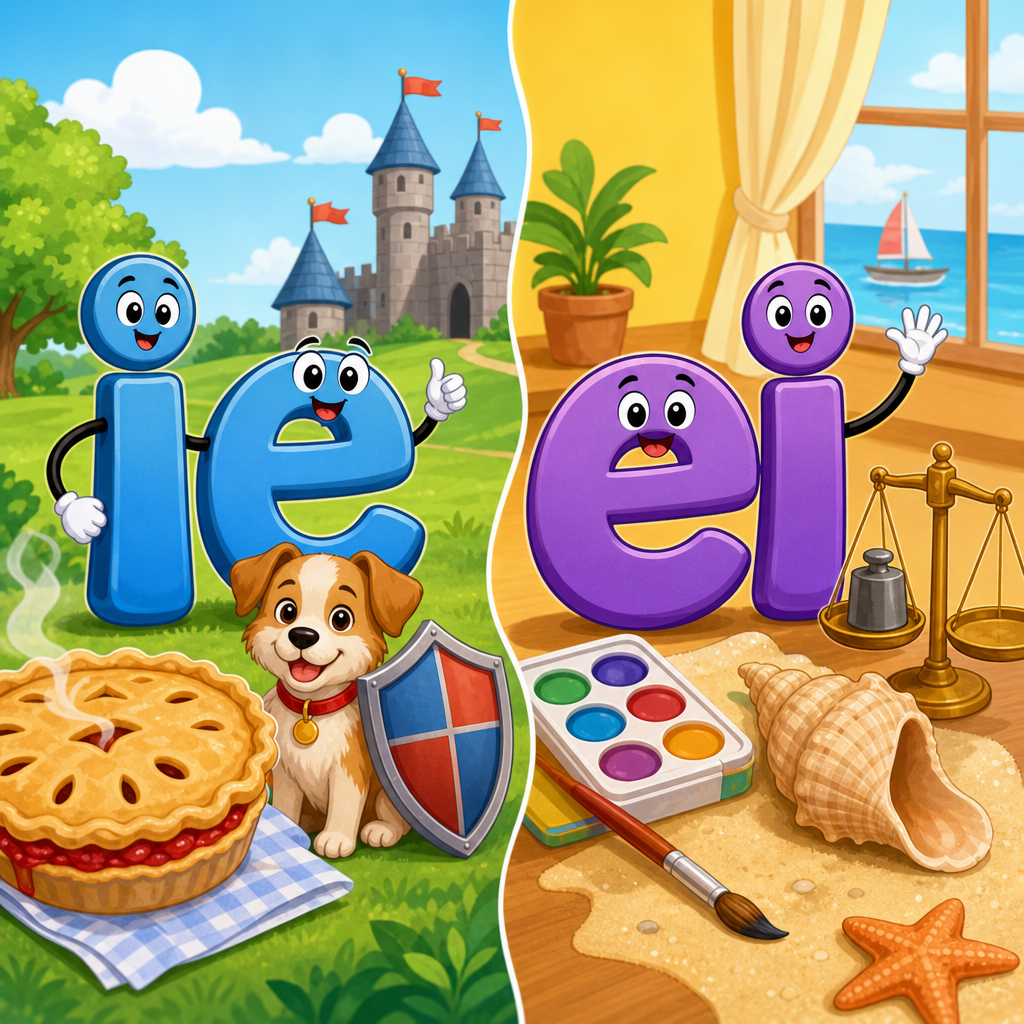
English learners run into few spelling questions as often as the ie vs ei spelling patterns, because the rule sounds simple, the exceptions are memorable, and real usage is messier than classroom slogans suggest. In literacy instruction, “ie” and “ei” refer to two common letter sequences that often represent long e, long a, or other vowel sounds in words such as chief, field, receive, and weigh. This matters for far more than spelling tests. These patterns affect decoding, dictation, reading fluency, and confidence in everyday writing. I have taught this topic in intervention groups and mainstream classrooms, and the same problem appears every year: students may remember “i before e except after c,” yet still miss words like their, science, and seize. A useful guide needs to do more than repeat a rhyme. It should show when the rule works, when it breaks, and how to practice it efficiently.
This article serves as a hub for miscellaneous spelling and literacy questions connected to ie and ei. You will find the core rule, the major exception groups, pronunciation clues, morphology links, and a practical way to teach or learn the pattern. You will also see why frequency matters. In school texts and general English, ie words are much more common than ei words, so defaulting to ie is often statistically safer, though not always correct. At the same time, several high-frequency ei words, including their, foreign, and receive, appear often enough that they must be learned as automatic sight spellings. The goal is accuracy with reasoning. When students understand sound, origin, and word family patterns together, they stop guessing and start choosing spellings with evidence.
The core rule and what it really means
The familiar rule is usually stated as “i before e except after c, or when sounding like a as in neighbor and weigh.” It remains worth teaching, but only as a starting point. In practice, the first part means that many words with the long e sound use ie when the sequence is not preceded by the letter c: believe, brief, chief, field, piece, and yield. The second part explains a major group of ei words after c, especially in verbs and nouns built from Latin roots: receive, ceiling, conceit, deceive, and receipt. The added clause about the long a sound covers words like eight, neighbor, vein, and weigh.
What the rule really means is that spelling depends on both letter position and sound. That is why students who rely only on the rhyme overgeneralize. They hear /ee/ and choose ie, then write recieve. Or they see c and automatically choose ei, then miss science. A more accurate classroom explanation is this: most long e words use ie, many words after c use ei, and several common words must be learned as exceptions by pattern group. This wording reflects real English better and leads to fewer false assumptions.
Where ie appears most often
The ie pattern is the more common default in English, especially for the long e sound. If a learner is unsure between the two spellings and has no other clue, ie is often the better first guess. High-utility examples include achieve, belief, fierce, grief, pier, priest, relief, and thief. Many of these words are frequent in school reading, which is why literacy programs often introduce ie before ei.
It also helps to teach ie through word families. Students who know believe can connect belief; students who know grieve can connect grief. Family study reduces memory load because one known spelling supports another. I have found this especially effective in intervention sessions with older students who need efficient review rather than isolated worksheets. Instead of memorizing ten unrelated spellings, they learn a network of linked words and notice that ie often stays stable across related forms.
Where ei appears most often
The ei pattern is less common overall, but it appears in several important groups. One major group follows c and often represents long e: ceiling, conceive, deceit, perceive, receipt, and receive. Another group represents long a, as in eight, freight, neighbor, rein, vein, and weigh. A third group includes irregular high-frequency words such as their, foreign, and either, where pronunciation varies by dialect or does not align neatly with the old rhyme.
Because ei words are less numerous but often more noticeable, they deserve explicit teaching. The verb receive is a classic example. It appears constantly in school writing, business communication, and digital forms, yet many capable writers still reverse the vowels. Direct attention to the c + ei structure works well here. When students link receive, receipt, and reception, they begin to see how spelling reflects morphology and etymology rather than random chance.
Common exceptions you should memorize
No serious guide to ie vs ei can avoid the exceptions, because some are among the most common words in English. These should be taught as “must-know” spellings, not treated as failures of the learner. The best known include science, efficient, species, their, weird, seize, either, and neither. The reason they matter is simple: students will encounter them constantly in reading and need to produce them accurately in writing.
| Pattern group | Examples | Useful note |
|---|---|---|
| Usually ie for long e | belief, chief, field, piece, priest | Good default when no stronger clue exists |
| Usually ei after c | ceiling, deceive, perceive, receipt, receive | Especially common in Latin-based academic words |
| Usually ei for long a | eight, neighbor, rein, vein, weigh | Often taught with the “a” part of the rhyme |
| High-frequency exceptions | their, weird, science, seize, either | Best learned as individual words or families |
Some exceptions make sense once pronunciation history and word origin are considered, but learners do not need a full linguistics lecture to benefit. They do need repeated, accurate exposure. In my own practice, the fastest gains came from short daily review with dictation, sorting, and sentence use. Seeing their in meaningful context beats copying it ten times. So does contrasting their, there, and they’re, because spelling sticks better when confusion points are addressed directly.
Pronunciation, morphology, and why the rule breaks
The old rhyme fails because English spelling is not built on a single principle. It reflects sound, meaning, and history at the same time. Pronunciation shifts across regions and across centuries. For example, either may begin with /ee/ or /eye/, yet the spelling remains fixed. The word weird breaks the standard expectation for long e, while science keeps ie after c because the letters belong to a larger orthographic pattern tied to the stem sci-, seen in scientific and conscience.
Morphology often gives stronger guidance than the rhyme. If a student knows perceive, then perception and deceive become easier to organize conceptually, even though the vowel sound changes. This is one reason structured literacy approaches emphasize morphemes alongside phonics. Spelling becomes more predictable when words are taught as systems. Etymology helps too. Many ei-after-c words entered English through French or Latin pathways, which is why they cluster in academic vocabulary. That is not trivia; it is a useful explanation for recurring patterns.
Quick practice methods that actually improve recall
The most effective quick practice for ie vs ei uses retrieval, sorting, and immediate feedback. Start with a two-column sort: place word cards under ie or ei, then explain each choice aloud. Follow with oral dictation in phrases rather than single words, such as “receive the package,” “their science project,” or “a weird piece of ceiling tile.” Context improves retention because the brain stores spelling with meaning and syntax, not as isolated letter strings.
Next, use contrast sets. Pair receive with the common error recieve and have learners identify the correct form and state why. Pair chief with ceiling; pair piece with their. Finally, revisit the words after a delay. A two-minute review the next day is more valuable than twenty minutes of cramming once. Teachers can build this into warm-ups, and parents can do it at home with sticky notes, mini whiteboards, or spelling apps that allow custom lists.
How to use this hub for broader spelling and literacy study
As a sub-pillar hub within Spelling & Literacy, this topic connects naturally to phonics, syllable types, morphemes, high-frequency irregular words, dictation routines, and reading fluency. If a learner struggles with ie vs ei, the issue may not be only these two letter sequences. The deeper need may involve vowel teams, orthographic mapping, or weak awareness of word families. That is why this miscellaneous hub should guide readers toward related study: long-vowel spellings, homophones, common exception words, morphology instruction, and editing strategies for student writing.
The practical takeaway is straightforward. Teach the rule, but do not stop there. Emphasize that ie is the more common default, teach the strong ei-after-c pattern, group long-a ei words together, and require automatic recall for major exceptions. Use word families, sentence dictation, and spaced review. When learners understand how sound, structure, and history interact, spelling stops feeling arbitrary. Review your current word lists, add pattern groups instead of random words, and practice a few targeted examples today.
Frequently Asked Questions
What is the basic rule for choosing between “ie” and “ei” in English spelling?
The traditional guideline most learners hear is: “i before e, except after c, or when sounding like long a as in neighbor and weigh.” This rule can be useful as a starting point, but it works best as a memory aid rather than as a perfect law. In many common words, ie appears after most letters, as in field, chief, belief, brief, piece, and friend. By contrast, ei often appears after the letter c, especially in words like receive, ceiling, receipt, deceit, and perceive. The second part of the rule points to words in which the vowel sound is not long e but more like long a, as in weigh, neighbor, eight, and vein.
Still, real English spelling is more complicated than the rhyme suggests. Some words follow the rule clearly, some only partly, and some break it entirely. That is why it helps to think in patterns instead of relying on one slogan. Ask three questions: Is the word using ie after a consonant, as in field? Is it using ei after c, as in receive? Or is it one of the common exception groups, such as their, weird, leisure, or science? For learners, the most effective approach is to combine the rule with word-family study, repeated reading, and short spelling practice, so the patterns become familiar in real context.
Why does the “i before e except after c” rule have so many exceptions?
English spelling developed from many different language sources, including Old English, French, Latin, and Greek. Because of that mixed history, spelling patterns are often the result of etymology, sound changes, and borrowed forms rather than one neat modern system. The ie and ei combinations do not always represent the same sound, and that is one major reason the rule breaks down. In chief and field, the sequence often represents a long e sound. In weigh and vein, ei is linked to a long a sound. In words like their or heir, the vowel quality changes again. A single rhyme cannot reliably cover all of those sound-spelling relationships.
Another reason for the exceptions is that many high-frequency words simply preserved older spellings. Words such as weird, seize, their, and science do not fit the classroom version of the rule neatly, but they remain standard because English values consistency within word history and word families, not just phonics regularity. This is important for literacy instruction: learners should not view exceptions as random mistakes in the language. Instead, they should understand that English is pattern-rich but not perfectly rule-governed. The most practical mindset is this: use the rule when it helps, expect exceptions, and build accuracy through exposure, dictation, and noticing how specific words are used in connected reading and writing.
Are there reliable sound patterns that can help with “ie” and “ei” words?
Yes, and this is often more useful than memorizing the rhyme alone. One common pattern is that ie frequently appears in words where the vowel sounds like long e, especially after letters other than c. Examples include brief, relief, piece, field, chief, and yield. A second useful pattern is that ei often appears after c in words that also sound like long e, such as receive, ceiling, deceit, receipt, and conceive. This “after c” pattern is one of the strongest and most teachable clues in the entire topic.
There is also a helpful sound-based group in which ei appears in words with a long a or similar sound, including weigh, weight, neighbor, vein, reins, and beige. However, learners should be careful not to assume that every long a word uses ei, because English offers other spellings too. In addition, some words with ie or ei do not behave predictably by sound alone. For example, friend has ie but does not sound like long e, and their has ei but does not fit the full rule as many learners expect. So yes, sound patterns can guide spelling, but they work best when paired with visual memory and word grouping. Studying words in clusters like receive/reception, deceive/deception, and weigh/weight can strengthen both spelling and reading fluency.
What are some of the most common “ie” and “ei” words learners should memorize first?
A smart way to begin is by focusing on high-frequency, useful words that appear often in school reading and everyday writing. For ie, strong starter words include believe, brief, chief, field, piece, friend, priest, quiet, and tie. For ei, learners should know receive, ceiling, deceive, receipt, seize, their, foreign, neighbor, weigh, and height. These words matter because they come up often, and several of them are exactly the kinds of words that cause repeated spelling errors in student writing.
It also helps to memorize words by category. One group is the “after c” set: receive, ceiling, deceit, perceive, and conceit. Another is the “long a” set: weigh, weight, neighbor, eight, and vein. Then there are the important exceptions and irregulars: their, weird, seize, foreign, leisure, and science. If learners keep these groups separate instead of trying to force every word into one rule, retention improves. Teachers and independent learners often get the best results by using short review lists, sentence-level dictation, and quick contrast practice such as believe/receive, chief/ceiling, and piece/receipt. The goal is not just to recite the rule, but to recognize these spellings automatically while reading and to produce them accurately while writing.
What is a quick and effective way to practice “ie” vs “ei” so the spelling sticks?
The most effective quick practice combines recognition, retrieval, and use in context. Start with a short list of 8 to 12 words divided into pattern groups: for example, field, chief, believe, piece for ie; receive, ceiling, deceive, receipt for ei after c; and weigh, neighbor, their, weird for exceptions or special cases. First, read the words aloud and notice both spelling and sound. Next, cover the words and try to write them from memory. Then check each one carefully, paying attention to the exact letter order rather than just whether the word “looks familiar.” This retrieval step is where long-term learning begins.
After that, move to sentence practice because isolated word drills are not enough. Write or say sentences such as “I believe the chief stood in the field,” or “Please receive the package under the painted ceiling,” or “Our neighbor checked the weight of the box.” This helps connect spelling to meaning and improves transfer into real writing. For an even better routine, keep a personal “tricky words” list and review it for a few minutes several times a week. Short, repeated practice works better than one long session. If a learner repeatedly misspells a word like