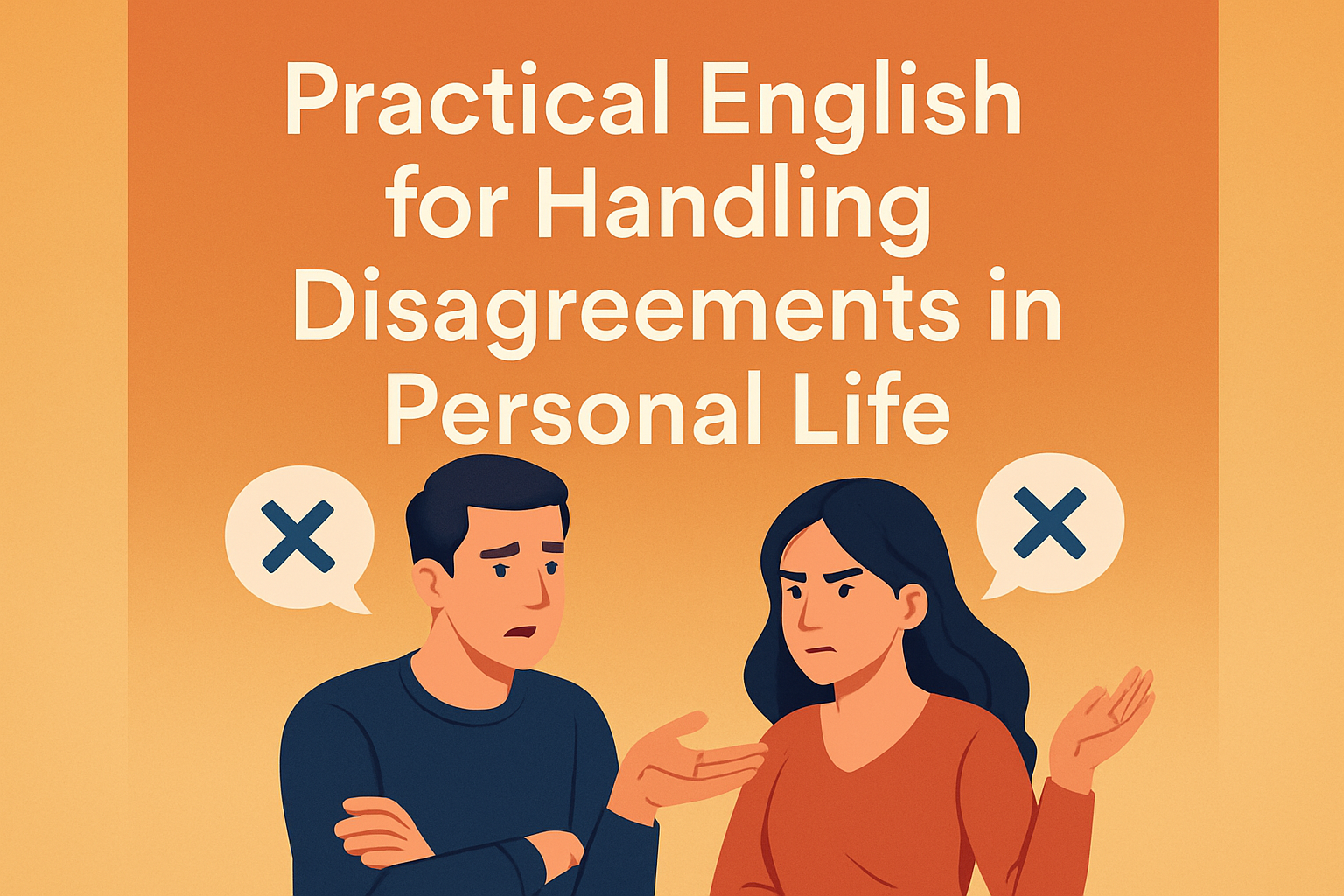
In our personal lives, disagreements are as inevitable as they are diverse. From small squabbles over who left the dishes in the sink to more significant disagreements about family decisions, the abilities to communicate effectively and resolve conflicts are indispensable. “Practical English for Handling Disagreements in Personal Life” addresses the linguistic skills required to navigate these disputes constructively. Understanding key communication strategies not only helps in defusing tension but also fosters healthier relationships, which is why this subject holds significant relevance for everyone.
English, being a global language, provides various expressions and techniques to convey thoughts and emotions accurately. Terms like ‘active listening,’ ‘constructive criticism,’ and ‘compromise’ are essential to handling disagreements effectively. Active listening involves fully concentrating, understanding, and responding thoughtfully, rather than passively hearing the words of the other person. Constructive criticism, on the other hand, requires providing feedback in a manner that is both helpful and respectful, without damaging the other individual’s self-esteem.
Moreover, compromise is crucial, where both parties come to a mutual agreement, each giving up something to meet somewhere in the middle. It is not only essential to learn these strategies but also to understand the nuances of their application in daily life, making this an invaluable resource for anyone looking to improve their interpersonal communication skills.
Understanding the Roots of Disagreements
Often, disagreements arise due to misunderstandings, emotional mismanagement, or differing value systems. For instance, let’s consider the example of a couple arguing over family roles—one partner may feel overwhelmed by chores while the other remains oblivious to their struggles. Such situations typically stem from assumptions made without thorough communication.
To manage such conflicts, one needs to address the underlying issues. The first step is active listening, where each person is given a chance to express their feelings and perspectives without interruptions. This strategy echoes the importance of empathy and makes room for genuine understanding, allowing both parties to validate each other’s emotions and intentions.
- Example Situation: Household chores distribution
- Misunderstanding: Imbalance in perceived responsibilities
- Resolution Technique: Active listening and empathy
Active Listening and Its Benefits
Active listening is an integral skill in resolving disagreements. When disagreements surface, they often come with heightened emotions. For example, when siblings argue about shared responsibilities, the emotion can quickly overtake logic. Engaging in active listening can de-escalate the situation by making each individual feel heard.
Active listening goes beyond simply hearing words; it involves acknowledging the other person’s perspective and showing genuine concern. An active listener will paraphrase or summarize the speaker’s points to ensure understanding, then follow up with clarifying questions to delve deeper into the issues at hand.
Constructive Criticism Over Blame
When someone is upset or disappointed, the tendency to cast blame is natural but rarely productive. To illustrate, think of a scenario where a friend forgets a prior engagement, and the immediate reaction might be frustration and anger. Instead of resorting to blame, effective communication requires the use of constructive criticism.
Constructive criticism should be provided with the intent to improve or benefit the other individual. Rather than saying, “You always forget about our plans,” which can come across as accusatory, one might say, “I feel hurt when our plans are forgotten; can we find a way to remind each other going forward?” This method keeps dialogue open and solutions-focused instead of riddled with animosity.
| Scenario | Blame | Constructive Criticism |
|---|---|---|
| Missed Meet-Up | “You never care about our plans.” | “I felt disappointed when we missed the meet-up.” |
| Unmet Expectations | “You always let me down.” | “Can we discuss ways to avoid disappointments in the future?” |
Finding Compromise While Disagreeing
In situations where disagreements seem impassable, compromise is critical. Imagine two roommates disagreeing on monthly expenses. They might have entirely different valid viewpoints—one prioritizes groceries while the other emphasizes savings. Here, the compromise might involve jointly creating a budget that addresses both needs.
Effective compromise requires each party to identify and communicate what is genuinely important to them, along with the willingness to make concessions on lesser issues. This not only solves the immediate problem but also enhances mutual respect and strengthens the relationship. Compromise should always aim for a win-win situation, where both parties feel fairly treated and satisfied with the resolution.
Using “I” Statements to Express Feelings
The language used during disagreements can determine the tone and outcome of the conversation. Employing “I” statements rather than “you” statements can significantly reduce defensiveness. For example, instead of saying, “You are always late,” which can create defensiveness, one might instead say, “I feel anxious when our meetings start late,” focusing on personal feelings rather than assigning blame.
“I” statements encourage ownership of feelings, facilitating a more open environment for dialogue. Regularly using this format can diminish perceived criticism and foster more constructive exchanges. They subtly shift the perspective from blaming to problem-solving, which is essential for turning a disagreement into an opportunity for understanding and growth.
Resolving Disagreements Through Empathy
Empathy—understanding and sharing another person’s experiences and emotions—is a pivotal part of conflict resolution. When a disagreement arises, practicing empathy can help identify the underlying issues and address them from a place of understanding rather than discord.
Consider a situation where two friends disagree over a shared project. Mutual frustration can quickly escalate, but pausing to acknowledge and understand the other person’s pressures and concerns can reframe the conversation towards mutual cooperation. This can be achieved by respectful listening, expressing sympathy, and consciously working to view the situation through the other person’s perspective.
Empathy not only resolves the immediate conflict but also lays the foundation for stronger relationships. It encourages people to step outside their preconceptions and signals genuine interest in maintaining harmony, paving the way for more effective collaboration.
Summarizing the Importance of Practical English in Managing Disagreements
Key strategies such as active listening, constructive criticism, compromise, the use of “I” statements, and empathy, form the backbone of practical English for resolving disagreements. Each technique focuses on maintaining respect and fostering better understanding, ensuring that conflicts do not escalate unnecessarily.
By adopting these methods, you can transform potential confrontations into opportunities for dialogue and learning. They arm you with the tools to manage your emotions and communicate more effectively, ultimately enriching your personal relationships.
The main benefit of mastering these communication strategies is the improvement of interpersonal connections, leading to healthier and more satisfying relationships. As a next step, consider setting intentions to practice these techniques consciously, thereby enhancing your ability to handle disagreements more effectively in everyday life.
Remember, effective communication is a skill that requires effort and practice. Begin today by assessing a recent disagreement you had and see which of these methods could have helped the situation. Making this a regular practice will soon transform how you communicate and connect in your personal relationships.
Frequently Asked Questions
1. How can I use practical English to handle everyday disagreements at home?
When it comes to everyday disagreements, such as those over household chores or financial decisions, using practical English effectively can go a long way. Start by calmly expressing how you feel using “I” statements, such as “I feel frustrated when the dishes are left in the sink because it disrupts my routine.” This way, you are communicating your feelings without blaming the other person, reducing the chance of the conversation turning adversarial. It’s important to be as specific as possible about what the issue is. Avoid words like “always” and “never” as they tend to exaggerate and escalate tension. Additionally, ask questions to understand the other person’s perspective, like “Can you help me understand why that’s your preferred way to do it?” Effective communication involves active listening, so pay attention to their response without interrupting. Once both sides have been heard, aim to collaborate on a solution. Phrases like, “What if we try this approach?” or “Can we agree on a plan where both our needs are met?” empower you to work as a team rather than opponents.
2. What is the significance of tone and body language in resolving conflicts?
Tone and body language hold immense significance in conflict resolution. While what you say is certainly important, how you say it can significantly influence the outcome of the discussion. A calm and composed tone tends to de-escalate potential conflicts, allowing for a more productive conversation. Avoid using a sarcastic or aggressive tone as it can provoke defensiveness. Instead, aim for a gentle and understanding tone that conveys your intention of reaching a resolution. Body language further complements verbal communication; maintaining open body posture, making eye contact, and nodding affirmatively can indicate that you are engaged and willing to listen. Conversely, actions like eye-rolling, crossed arms, or turning away can imply disinterest or hostility, which might hinder constructive dialogue. Remember, communication is as much nonverbal as it is verbal, and ensuring that your tone and body language are aligned with your words can greatly aid in managing disagreements effectively.
3. What role does empathy play in resolving personal disputes?
Empathy plays a crucial role in resolving personal disputes because it helps to bridge the understanding gap between individuals. When you’re empathetic, you make a conscious effort to put yourself in the other person’s shoes and understand their emotions and perspectives. This practice not only validates their feelings but also makes them more open to understanding your standpoint. You can express empathy by acknowledging the emotions involved in the disagreement and showing respect for the other person’s feelings and opinions. For instance, saying, “I can see that this is really important to you and I want to find a resolution that works for both of us,” demonstrates both understanding and a willingness to collaborate. By prioritizing empathy, you lay the groundwork for mutual respect and cooperation, which is essential for achieving amicable resolutions to conflicts.
4. Can you give examples of phrases that help in defusing tension during a disagreement?
Using the right phrases during a disagreement can make all the difference in defusing tension and moving towards resolution. Here are some examples of phrases that can be particularly effective: – “I understand where you’re coming from,” shows you are acknowledging their perspective. – “Let’s find a solution together,” emphasizes collaboration. – “What can we do to improve the situation?” invites joint problem-solving. – “I appreciate you sharing your thoughts,” conveys respect for their input. – “Let me make sure I understand you correctly,” ensures clarity and reduces misunderstandings. These phrases open up channels for empathetic and effective communication, making it easier to progress through the disagreement smoothly. Couple these with a soothing tone and approachable body language to reinforce their positive intent.
5. How can I prepare myself to handle disagreements more effectively in the future?
Effective preparation for handling disagreements involves developing communication skills and emotional intelligence continuously. Start by building self-awareness, recognizing your emotional triggers, and understanding your conflict style. Practice active listening and empathy in everyday conversations to strengthen these skills over time. Role-playing scenarios can also be beneficial—consider potential disagreements and practice responding in ways that are calm, logical, and empathetic. Another key aspect is stress management techniques like deep breathing or mindfulness, which help you remain calm and composed under pressure. Regularly reflecting on past disagreements and identifying what strategies worked or didn’t work will further contribute to your problem-solving repertoire. Keep learning about communication techniques and applying them in real-life situations, so that when a disagreement arises, you’re well-equipped to handle it constructively and confidently.