
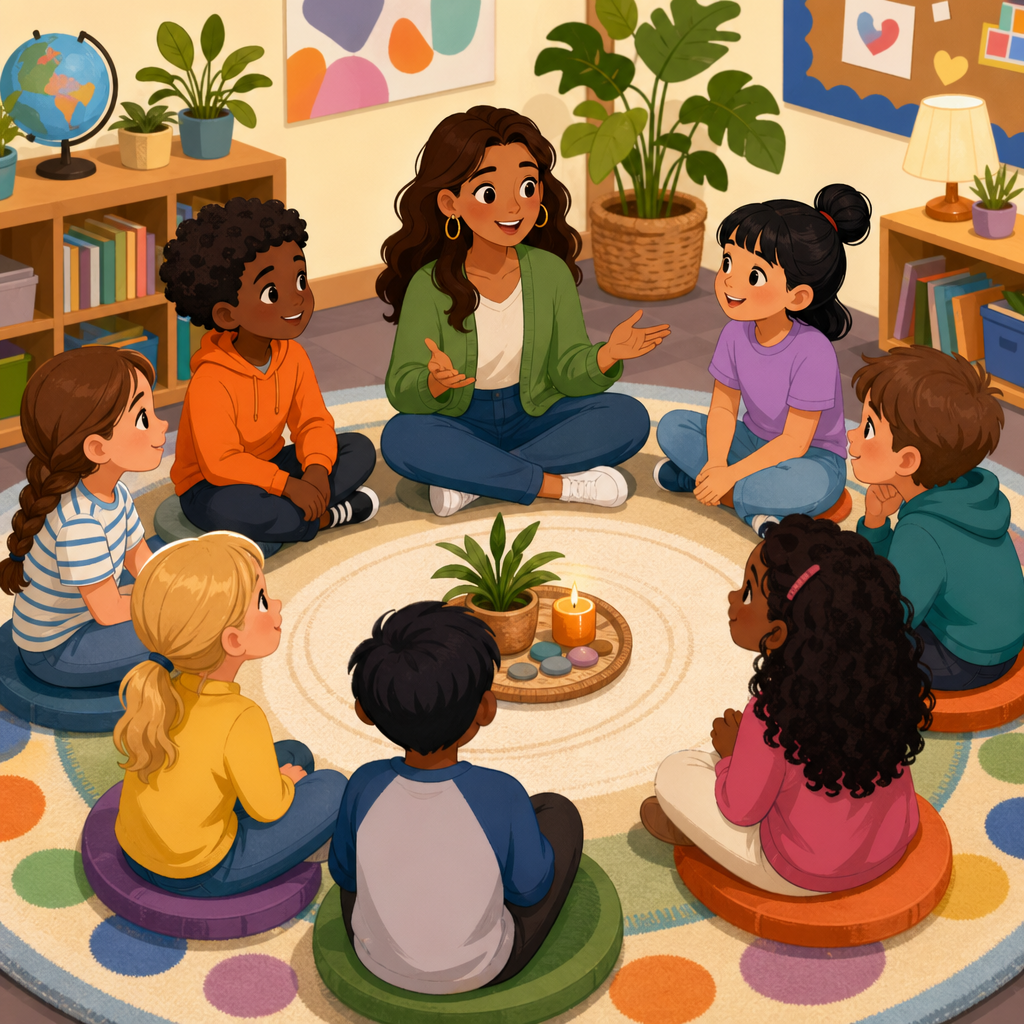
Conversation circles give teachers a practical structure for building speaking skills, listening habits, classroom trust, and reflective thinking in one routine. In simple terms, a conversation circle is a planned discussion format where students sit or stand in a circle, respond to a shared prompt, and follow clear norms that make every voice easier to hear. I have used conversation circles in elementary literacy blocks, middle school advisory periods, and mixed-ability language support groups, and the format works because it solves several problems at once: it reduces teacher talk, increases equitable participation, and turns discussion into a skill that can be taught, practiced, and assessed. For a teacher toolkit, this matters because many “discussion activities” fail without structure. A conversation circle provides that structure. It can support social-emotional learning, oral language development, reading response, restorative practice, and quick formative assessment. When teachers ask how to run a conversation circle, they are usually asking five things: how to set it up, what norms to teach, what prompts to use, how to keep students engaged, and how to handle common issues like silence, domination, or off-topic comments. This hub article covers those essentials and connects the miscellaneous uses that make conversation circles one of the most flexible routines in the wider Learning Tips & Resources toolkit.
What a conversation circle is and when to use one
A conversation circle is a whole-group or small-group discussion routine built around equal visibility, predictable turn-taking, and active listening. Unlike a free-form class discussion, it is intentionally designed. Students usually face one another, a prompt is introduced, and the teacher facilitates with norms, time limits, and reflection. The circle can be highly structured, with sentence stems and a talking piece, or more open, with students building on each other’s ideas after a brief check-in round.
The best time to use a conversation circle depends on the instructional goal. Use it at the start of a unit to activate background knowledge, after reading to deepen comprehension, during conflict repair to rebuild relationships, or at the end of a lesson to assess understanding. In practice, I have found that circles are especially effective after students encounter something worth discussing but not easily answered by a worksheet: a challenging chapter, a current event, a group project setback, or a schoolwide issue that affects classroom climate. They are also valuable in multilingual classrooms because they provide repeated, low-risk speaking practice with authentic audience feedback.
Age matters, but less than many teachers assume. Primary students can handle a two-minute greeting circle with one sentence each. Upper elementary students can compare opinions with modeled stems. Secondary students can sustain longer discussions around claims, evidence, and counterarguments. The key is not student age alone; it is the level of scaffolding. If students know what to say, when to speak, and how to listen, the circle becomes productive quickly.
How to set up the room, routine, and norms
Start with physical setup. Remove barriers where possible. Chairs in a true circle work best because every student can make eye contact. If space is limited, use a seated oval, standing circle, or inner-outer circle. Keep materials minimal: a visible prompt, timer, participation tracker if needed, and optional talking piece. Position yourself as facilitator, not center stage. I usually sit inside the circle line or join the circle itself to signal that the discussion belongs to students.
Next, teach the routine explicitly. Do not assume students know how to discuss respectfully. Model how to enter the circle, how to speak loudly enough, how to refer to a classmate’s idea, and how to disagree without escalating tension. Strong norms are concrete and observable. “Respect others” is too vague. Better norms include: face the speaker, wait until they finish, build on ideas with evidence, invite quieter voices, and pass if you need thinking time. For accountability, post the norms and revisit one before each circle.
The opening matters. A predictable opening lowers anxiety and improves participation. Many teachers use a brief check-in question, breathing pause, or one-word mood round. That warm-up is not wasted time; it calibrates the room. According to classroom discussion research associated with accountable talk practices and dialogic teaching, participation rises when students have rehearsed a low-stakes response before moving into analytical discussion. In my own classes, a thirty-second warm-up often prevented the first five minutes of awkward silence.
Planning prompts that generate real discussion
The quality of a conversation circle depends heavily on the prompt. Strong prompts are open enough to invite multiple viewpoints but focused enough to keep students anchored. Weak prompts ask for a single correct answer or are so broad that students drift. For literature, ask, “Which decision changed the story most, and why?” rather than “What happened in chapter three?” For science, ask, “What evidence best supports this claim?” For advisory, ask, “What helps a group feel safe enough to participate?”
Good prompts usually do one of four jobs: invite personal connection, require interpretation, ask for evaluation, or surface a problem that needs collective thinking. I recommend planning one core prompt and two follow-ups. The first gets everyone talking. The second pushes for evidence. The third opens space for disagreement or revision. This sequence creates momentum. It also helps the teacher avoid rescuing the discussion with too many extra questions.
| Goal | Prompt Type | Example | Why It Works |
|---|---|---|---|
| Community building | Personal reflection | What is one class routine that helps you learn? | Accessible for all students and builds ownership |
| Reading response | Interpretation | Which character showed the most growth, and what proves it? | Requires claim plus textual evidence |
| Problem solving | Shared challenge | What should our group do differently before the next project? | Turns discussion into action planning |
| SEL or advisory | Perspective taking | How can classmates disagree without shutting others down? | Builds empathy and practical language |
Sentence stems make prompts more usable, especially for students who need language support. Useful stems include “I agree with ___ because…,” “I want to add…,” “My evidence is…,” and “A different perspective is….” These stems are not crutches; they are participation tools. Over time, students internalize them and discussion becomes more natural.
Facilitation moves that keep the circle productive
Running a conversation circle well is mostly about facilitation, not performance. The teacher’s job is to maintain pace, safety, and depth without dominating airtime. Start by naming the purpose and time frame. Then use simple facilitation moves: invite, paraphrase, press, redirect, and summarize. Invite a quieter student with a low-pressure option: “Would you like to add on or pass for now?” Paraphrase to clarify meaning. Press for specificity with “What makes you think that?” Redirect side comments back to the group. Summarize periodically so students can hear the thread of the discussion.
Turn-taking structures prevent the same three students from carrying the conversation. In some circles, every student speaks once in a round before open dialogue begins. In others, a talking piece regulates turns. For older students, I prefer a hybrid: one opening round to ensure access, then open discussion with a norm that no one speaks twice until three others have spoken. That single norm dramatically improves equity.
Assessment should be light but intentional. A conversation circle is ideal for formative assessment because it reveals misconceptions, vocabulary gaps, and confidence levels in real time. I often track only two indicators: whether a student contributed and whether they used evidence or elaboration. Detailed rubrics have a place, but over-scoring can flatten genuine discussion. If the circle is part of a graded speaking standard, share the criteria in advance and keep them few, observable, and fair.
Common problems and practical fixes
The most common problem is silence. Usually silence means one of three things: the prompt is unclear, the risk feels too high, or students need processing time. Fix it by restating the question, adding think-pair-share before the circle, or allowing written notes. Another common issue is domination by confident speakers. Address that with explicit airtime norms, a tracker, or a requirement to paraphrase someone else before adding a new point. Students who interrupt often respond well to visible cue cards such as “listen,” “build,” and “pause.”
Off-topic comments usually signal weak anchoring, not bad intentions. Bring students back by restating the focus and connecting their comment to the prompt: “How does that relate to our question about evidence?” If conflict rises, slow the pace. Use sentence frames for disagreement and insist on responding to ideas, not people. Restorative practice frameworks are helpful here because they emphasize harm, impact, and repair rather than blame.
Inclusion requires planning. Students with language-processing needs, anxiety, or speech differences may need previews, visual supports, or alternate ways to enter. Offer choices: speak during the round, share a written response that you read aloud, or contribute after hearing others first. Universal Design for Learning principles support this flexibility. A circle should expand participation, not punish students who communicate differently.
Using conversation circles across the curriculum
Conversation circles belong in miscellaneous classroom practice because they fit almost anywhere. In English language arts, they support comprehension, argument, and vocabulary transfer. In social studies, they help students weigh evidence, perspective, and civic issues. In science, they work well for claim-evidence-reasoning discussions before lab write-ups. In math, they can uncover problem-solving strategies by asking students to explain how they knew a method worked. In advisory or homeroom, circles strengthen belonging and help teachers identify concerns early.
The hub value of this routine is that it links naturally to many other teacher resources. A circle can follow close reading, precede journaling, support project reflection, or feed into peer feedback. It also complements digital tools. Teachers may collect warm-up responses in Google Forms, display prompts in Google Slides, track participation in a simple spreadsheet, or use Padlet for prewriting. The technology is optional. The routine itself is the toolkit.
The most successful conversation circles are short enough to sustain energy, structured enough to feel safe, and flexible enough to match the lesson. Begin with a small, repeatable format. Teach the norms directly. Use prompts that deserve more than one answer. Facilitate with restraint and purpose. When problems appear, treat them as teachable moments rather than proof the routine failed. If you want students who can listen closely, speak clearly, and think with others, add a conversation circle to your weekly plan and refine it through practice.
Frequently Asked Questions
What is a conversation circle, and why does it work so well in classrooms?
A conversation circle is a structured discussion routine in which students gather in a circle, respond to a common prompt, and follow agreed-upon norms for speaking and listening. The physical circle matters because it reduces hierarchy, improves visibility, and helps students focus on one another rather than only on the teacher. In practice, this format gives students a repeated opportunity to organize their ideas out loud, listen carefully, wait their turn, and build on what classmates say. That combination makes conversation circles especially effective for strengthening oral language, social-emotional awareness, and reflective thinking at the same time.
What makes the routine work is not just the seating arrangement, but the predictability. When students know how the conversation will begin, what the prompt is asking, how long they have to think, and what respectful participation sounds like, they can spend more energy on communicating instead of guessing the expectations. Teachers often see that students who hesitate in whole-group discussions feel safer in a circle because the structure is more balanced and every voice has a defined place. Over time, conversation circles can improve classroom trust, increase the quality of student responses, and create a dependable space for practicing speaking and listening in a purposeful way.
How do I set up and run a conversation circle step by step?
Start by choosing a clear goal for the discussion. A conversation circle can support reading comprehension, community building, vocabulary development, conflict resolution, or reflection after a shared experience, but the purpose should be specific. Next, prepare one strong prompt that is open enough to invite multiple responses yet focused enough to keep the group on track. Then decide on the logistics: where students will sit or stand, whether you will use a talking piece or speaking order, how long the circle will last, and what participation norms you want to reinforce.
At the beginning of the routine, gather students in the circle and quickly review expectations. Effective norms usually include listening without interrupting, speaking one at a time, referring to others respectfully, and allowing space for different perspectives. Many teachers also build in think time before anyone speaks, which helps students generate stronger responses and supports those who need processing time. Once the prompt is introduced, you can choose a format such as a go-around, voluntary sharing, partner think-and-share before whole-circle discussion, or a first round where everyone gives a brief response followed by a second round for elaboration.
During the circle, your role is to facilitate without dominating. That means watching for balance, encouraging quieter students, redirecting gently if comments drift off topic, and modeling how to connect ideas across speakers. Keep the pace steady and the tone calm. At the end, close with a short reflection, such as asking students what they noticed, what they learned, or how well the group followed the norms. That final reflection is important because it teaches students that discussion skills are learned, practiced, and improved over time. With repetition, the circle becomes a routine students can enter with confidence.
What are the best norms and rules to teach before starting a conversation circle?
The best norms are simple, observable, and directly connected to the kind of classroom culture you want to build. A strong starting set includes listening with full attention, speaking one at a time, using respectful language, responding to the prompt, and allowing everyone an opportunity to participate. You may also want to teach sentence stems such as “I agree with ___ because…,” “I would like to add…,” “I see it differently because…,” or “Can you explain what you mean?” These tools help students move from taking turns talking to actually having a conversation.
It is also helpful to define what participation does and does not mean. Participation should not always require long comments; sometimes it means sharing one sentence, asking a clarifying question, paraphrasing a peer’s idea, or using nonverbal listening behaviors. Establishing that range makes the routine more inclusive for multilingual learners, shy students, and students who are still developing confidence. Teachers should explicitly model each norm, show examples and non-examples, and practice the routine in short low-stakes circles before using it for more demanding academic topics.
Finally, revisit norms regularly instead of treating them as a one-time introduction. If students interrupt, side-talk, or disengage, pause and reteach the specific behavior rather than abandoning the routine. Norms become effective when students can name them, recognize them, and reflect on how well they used them. Over time, conversation circles often become one of the clearest places where students learn that respectful discussion is both a skill set and a shared responsibility.
How can I make conversation circles inclusive for shy students, multilingual learners, and mixed-ability groups?
Inclusive conversation circles begin with planning for access, not fixing problems in the moment. One of the most effective supports is providing the prompt in multiple forms: spoken aloud, displayed visually, and, when helpful, paired with images, vocabulary support, or examples. Give students time to think before speaking, and consider using quick writes, partner rehearsal, or response cards so they can organize ideas privately first. These steps reduce pressure and make participation more manageable for students who need additional processing time or language support.
For multilingual learners, preteach key vocabulary and offer sentence frames that make academic conversation more accessible. Frames such as “My idea is…,” “I noticed…,” or “I want to respond to…” help students focus on meaning rather than getting stuck on how to begin. For shy students, establish predictable routines and low-risk entry points, such as allowing them to pass once, share with a partner before speaking to the group, or contribute in a shorter first round. For mixed-ability groups, keep the prompt open enough to allow multiple levels of complexity, so every student can respond meaningfully without feeling set up to fail.
It also helps to broaden what successful participation looks like. Some students may speak at length, while others may contribute a concise but thoughtful statement, ask a question, or make a connection to a peer’s idea. The teacher’s language matters here: affirm substance, not just volume. When students see that thoughtful listening, careful word choice, and respectful engagement are valued, the circle becomes more equitable. Over time, that consistency can significantly increase confidence and belonging for students who may otherwise remain on the edges of classroom discussion.
How often should teachers use conversation circles, and how can they assess whether the routine is effective?
Conversation circles work best when they are used consistently enough to become familiar, but not so often that they lose their purpose. For many classrooms, once or twice a week is a strong starting point, though some teachers use brief circles daily during morning meetings, literacy blocks, advisory periods, or closing reflections. The right frequency depends on your goals, your schedule, and your students’ stamina. A short, well-run 10-minute circle can be more powerful than a longer discussion with unclear focus, so it is wise to begin small and build from there.
To assess effectiveness, look beyond whether students appeared engaged in the moment. Strong evidence includes improved turn-taking, more complete oral responses, stronger listening behaviors, increased willingness to participate, and greater ability to refer to peers’ ideas. If your circles are academically focused, you can also listen for use of target vocabulary, evidence-based reasoning, or deeper comprehension of a text or topic. Informal assessment tools such as observation checklists, reflection forms, anecdotal notes, or simple participation trackers can help you see patterns over time without turning the circle into a high-pressure evaluation.
Student reflection is another important measure. Ask students what helps them speak, what makes listening easier, which norms are working, and what they want to improve. Their responses can tell you whether the circle feels safe, purposeful, and fair. If the routine is effective, you will usually notice that students become more thoughtful, more responsive to one another, and less dependent on the teacher to carry the discussion. That is the long-term goal: not just one successful conversation, but a classroom culture where students know how to speak with intention, listen with care, and think together.





