
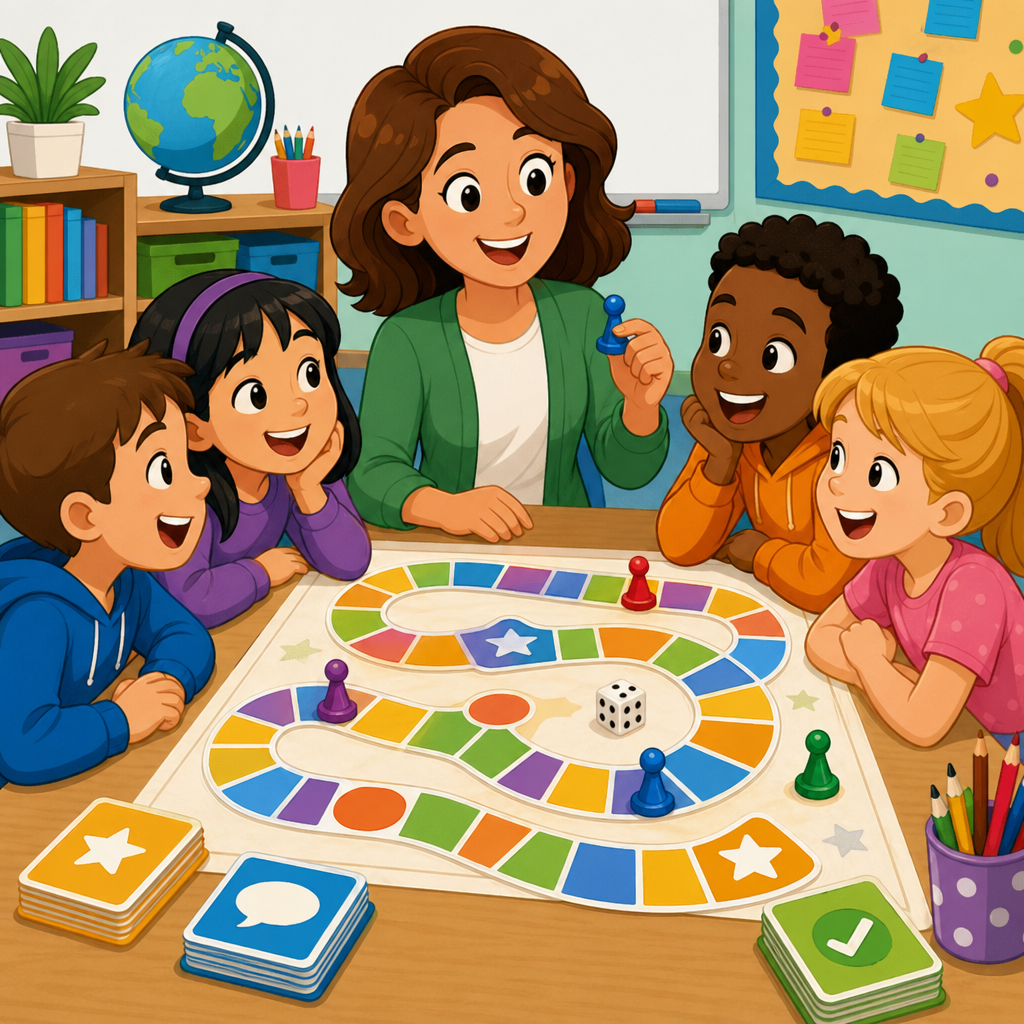
Teachers need grammar practice that feels purposeful, repeatable, and easy to adapt, and a grammar review board game template delivers all three. In classrooms, tutoring sessions, and after-school programs, I have seen the same pattern: students often understand a grammar rule during direct instruction, then freeze when asked to apply it independently. A board game changes that dynamic by turning review into structured conversation, quick retrieval, and low-stakes correction. Instead of completing another worksheet in silence, students speak, listen, justify answers, and notice patterns in real time.
A grammar review game board game template is a reusable classroom resource built around spaces, prompts, movement, and rules that can be customized for parts of speech, sentence structure, punctuation, verb tense, subject-verb agreement, pronoun reference, and editing skills. The template stays constant while the content changes. That matters because teachers rarely have time to design a new activity from scratch for every lesson. A strong template cuts prep, supports differentiated instruction, and creates a consistent routine students can learn quickly.
This kind of resource matters within a broad learning tips and resources collection because it connects planning, assessment, engagement, and reinforcement. It is also flexible enough to serve as the hub for miscellaneous classroom needs: fast finishers, literacy centers, substitute plans, intervention groups, homework alternatives, and end-of-unit review. When built well, a grammar game is not just entertaining. It is a practical instructional tool that helps teachers check understanding, surface misconceptions, and keep practice varied without sacrificing rigor.
What a Grammar Review Board Game Template Should Include
The best grammar review board game template has six core elements: a clear path, leveled prompt cards, concise rules, answer verification, opportunities for discussion, and built-in variation. I recommend a simple path with 20 to 30 spaces because it is long enough for meaningful review but short enough to finish within one class period. Spaces can include standard moves, challenge spaces, skip-a-turn penalties, or bonus opportunities tied to correct language use.
Prompt cards are the heart of the game. In my own classroom materials, I organize them by skill type rather than by textbook chapter. For example, one deck might target nouns, verbs, adjectives, and adverbs; another might focus on commas, apostrophes, capitalization, and quotation marks; a third might require sentence revision. This structure makes the board game template reusable across grade levels and standards. A fourth-grade teacher can use sentence fragments and basic punctuation, while a middle school teacher can swap in clauses, parallel structure, or commonly confused words such as their, there, and they’re.
Answer verification must be simple and reliable. That can mean answer keys on the back of cards, teacher reference sheets, or peer-check protocols. Without a verification method, games can reinforce errors. Discussion also matters. Students should not only say an answer but explain why it is correct. That short verbal justification is where much of the learning happens, especially for multilingual learners and students who can recognize a rule but struggle to articulate it in writing.
How to Build the Template for Different Grammar Skills
A useful board game template starts with a neutral structure and then layers in specific grammar objectives. Begin by deciding whether the game will review identification, correction, production, or application. Identification asks students to label language features. Correction asks them to find and fix errors. Production asks them to create an example. Application asks them to choose the right grammar in context. The strongest games blend all four because grammar mastery depends on transfer, not memorization alone.
For punctuation review, create cards such as “Add commas where needed,” “Choose the sentence with correct end punctuation,” or “Rewrite the dialogue correctly.” For parts of speech, use “Identify the adjective,” “Replace the verb with a stronger one,” or “Sort the underlined word by function.” For sentence structure, ask students to combine simple sentences, identify fragments and run-ons, or revise for clarity. A grammar review game board game template becomes much more effective when prompts move from isolated sentences to short authentic passages. Students need to see grammar as a meaning-making tool, not just a set of labels.
Differentiation is easier when the template includes color-coded cards. Green cards can cover foundational review, blue cards can require explanation, and red cards can involve editing a more complex sentence. That system works especially well in mixed-readiness groups because students still use the same board and rules while receiving prompts at an appropriate level.
| Grammar focus | Sample prompt | Best grade span | Teacher note |
|---|---|---|---|
| Parts of speech | Identify the adverb and explain what it modifies. | Grades 3–6 | Use short sentences first, then move to paragraphs. |
| Verb tense | Rewrite the sentence in past perfect tense. | Grades 5–8 | Pair with timeline cues to support understanding. |
| Punctuation | Add commas and quotation marks correctly. | Grades 3–8 | Use dialogue examples from class reading. |
| Sentence structure | Fix the run-on and explain your revision. | Grades 4–9 | Require students to justify each edit aloud. |
| Usage and editing | Choose the correct word: their, there, or they’re. | Grades 3–7 | Embed choices in a meaningful context sentence. |
Using the Game in Real Classrooms
The most successful implementation is straightforward. I introduce the rules in under five minutes, model one full turn, and project two sample cards so students understand how much explanation I expect. Groups of three or four work best. Pairs move too quickly and reduce peer discussion; groups larger than four often leave one student passive. Each student should have a role, such as reader, recorder, checker, or mover, rotating every few turns.
Time limits keep the activity focused. In a 45-minute class, I usually allow 20 to 25 minutes for play, five minutes for setup, and the remaining time for debrief. That debrief is essential. Ask which errors were hardest to spot, which rule came up repeatedly, and what clues helped students choose the correct answer. Those reflections turn a fun review game into visible formative assessment.
This resource is especially useful for literacy stations and intervention. For small groups, remove chance elements and emphasize direct response. For whole-class review, project the board digitally and let teams answer from their seats. For sub plans, keep the board simple and include a printed answer key. For homework extensions, send a condensed version home with a spinner and cards. The template remains the same, but the use case shifts easily.
Common Mistakes and How to Avoid Them
The biggest mistake is designing a game that emphasizes movement more than grammar. If students spend more time rolling dice and reacting to surprise spaces than thinking about language, the activity becomes a distraction. Keep game mechanics light and the prompts substantial. Another common problem is using only multiple-choice questions. Recognition has value, but students also need to generate and explain answers. Include correction and revision tasks so the game measures deeper understanding.
Teachers also sometimes overload cards with dense text. If a prompt takes too long to read, gameplay stalls. Keep directions concise and use one target skill per card unless the objective is integrated editing. It is also important to avoid ambiguous answers. Grammar can involve nuance, but classroom game cards should be written so students can verify correctness consistently. If a sentence could accept two answers, revise it.
Finally, do not skip alignment. A grammar review game board game template works best when tied to current standards, recent mini-lessons, and actual student errors from writing samples. I often pull anonymous mistakes from journals, quizzes, or drafts and turn them into review cards. Students respond more seriously when the language resembles what they really write.
Why This Template Belongs in a Learning Tips and Resources Hub
As a miscellaneous hub resource, this template earns its place because it solves several classroom problems at once. It supports spiral review, gives teachers a flexible printable they can reuse all year, and connects easily to reading and writing instruction. It can also link naturally to adjacent resources such as editing checklists, sentence-combining practice, vocabulary review games, test-prep routines, and classroom management strategies for centers. In other words, it is not an isolated activity. It is a practical anchor for a wider collection of teaching tools.
It also serves different audiences. New teachers need reliable structures that reduce planning time. Experienced teachers want adaptable frameworks they can tailor to curriculum demands. Tutors need compact resources for one-to-one instruction. Homeschool families benefit from low-prep language activities that break up workbook routines. A well-designed board game template speaks to all of them because the underlying need is the same: consistent grammar practice without monotonous repetition.
A grammar review board game template is most effective when it is simple, reusable, and tied directly to real learning goals. It should help students identify errors, explain rules, revise sentences, and talk about language with confidence. When teachers build the template around clear objectives, leveled prompts, and dependable answer checking, the result is more than a game. It becomes a reliable review system that saves prep time and improves participation.
For a learning tips and resources hub, this kind of miscellaneous classroom tool has lasting value because it adapts to multiple grades, settings, and instructional needs. It can support centers, intervention, homework, substitute plans, and end-of-unit review without requiring a complete redesign each time. If you are building a stronger teacher toolkit, start with a grammar review board game template, customize it to your standards, and use it as a foundation for more engaging language practice all year.
Frequently Asked Questions
What is a grammar review board game template, and why is it effective for grammar practice?
A grammar review board game template is a reusable classroom activity structure that turns grammar review into an interactive, discussion-based game. Instead of giving students another isolated worksheet, teachers place grammar prompts, sentence-editing tasks, parts-of-speech questions, punctuation challenges, or usage examples into a board game format. Students move around the board, respond to prompts, explain their thinking, and often correct mistakes out loud. That combination matters because grammar learning improves when students repeatedly retrieve rules, apply them in context, and hear language explained in clear, simple terms.
What makes this approach especially effective is that it lowers the pressure students often feel during independent practice. Many students can identify a grammar rule during direct instruction but hesitate when they must use it without support. A board game creates a low-stakes routine where they can test ideas, make revisions, and get immediate feedback from a teacher, peer, or small group. The game format also increases participation because students are not just filling in blanks; they are speaking, listening, editing, and making decisions. Over time, that repeated exposure helps grammar concepts become more automatic, which is exactly what strong review activities should do.
How can teachers adapt a grammar review board game template for different grade levels and skill levels?
One of the strongest advantages of a grammar review board game template is its flexibility. The structure stays the same, but the content can change to match student age, language proficiency, and instructional goals. For younger students, prompts might focus on capital letters, end punctuation, common nouns and proper nouns, simple verb tense, or sentence vs. fragment identification. For upper elementary and middle school students, the same board can be filled with pronoun agreement, subject-verb agreement, comparative adjectives, conjunctions, quotation marks, and editing tasks. For older students, teachers can increase complexity by including sentence combining, parallel structure, misplaced modifiers, comma rules, or tone and usage analysis.
Teachers can also differentiate within the same classroom by color-coding cards, offering leveled question sets, or assigning different challenge paths. For example, one group may identify the correct verb form, while another must explain why a verb form is correct in context. English language learners may benefit from visual supports, sentence stems, and oral response options, while advanced students may be asked to justify edits using formal grammar vocabulary. Because the template is reusable, teachers can keep the game familiar while rotating in new content. That consistency saves planning time and helps students focus on grammar thinking rather than learning a brand-new activity routine each time.
What kinds of grammar skills work best in a board game format?
A board game template works best for grammar skills that benefit from repetition, quick application, and discussion. This includes foundational concepts such as parts of speech, verb tense, punctuation, capitalization, plural nouns, pronouns, and sentence structure. It is also highly effective for editing and revising skills because students can look at short sentences, spot errors, and explain how to fix them. That explanation piece is important. When students say why a comma belongs in a sentence or how they know a pronoun is incorrect, they move beyond guessing and begin to internalize the rule.
The format is also useful for mixed review. Instead of practicing just one isolated standard, teachers can combine multiple grammar targets into one game session. That more closely reflects real writing, where students must use several grammar skills at once. Prompt types can include multiple choice, sentence correction, error hunting, fill-in-the-blank, oral explanation, or “write your own example” challenges. Teachers can even include bonus spaces that require students to use a grammar skill in authentic speech or writing. In other words, the board game is not limited to simple recall; it can support identification, correction, explanation, and transfer, which makes it a practical tool for meaningful grammar review.
How do you keep a grammar review board game purposeful instead of just making it feel like a time-filler?
The key is to align the game directly to current learning goals and to build accountability into the activity. A grammar review board game should not be random. It should focus on standards students have already been taught and now need to revisit through structured practice. Before using the game, teachers should decide exactly what students need to demonstrate: identifying errors, applying a rule, explaining a correction, or editing for accuracy. Once the objective is clear, every prompt on the board can serve that goal. That is what makes the activity purposeful rather than just entertaining.
To strengthen the instructional value, teachers can require students to answer in complete sentences, justify responses, record missed questions, or track which grammar skills still need review. Small answer sheets, peer-check systems, and teacher observation notes can all turn the game into useful formative assessment. It also helps to include reflection at the end, such as asking students which rule was easiest, which was hardest, and what they need to practice next. When teachers use the board game as part of a review cycle rather than as a standalone reward, it becomes a repeatable, data-informed tool. Students stay engaged, but the learning remains the priority.
When and where can teachers use a grammar review board game template most effectively?
A grammar review board game template is useful in far more settings than a whole-class lesson. It works well in literacy centers, small-group instruction, intervention blocks, tutoring sessions, after-school programs, partner review, and even fast finishers with the right expectations in place. Because the template is easy to reuse, teachers can pull it out whenever students need extra repetition without creating an entirely new activity. It is especially effective after direct instruction, before a quiz, during spiral review, or when students need to revisit previously taught skills that have not yet become consistent in writing.
It is also a strong option for classrooms that need routines that are predictable but not boring. Students quickly learn how the game works, which means teachers can spend less time on directions and more time listening to student responses. In tutoring or intervention settings, the board game can make repeated grammar practice feel less intimidating and more conversational. In mixed-ability groups, it encourages participation because students take turns, hear multiple examples, and learn through discussion. Ultimately, the best use of the template is any moment when teachers want grammar review to be structured, repeatable, adaptable, and engaging enough that students will actually keep practicing.





