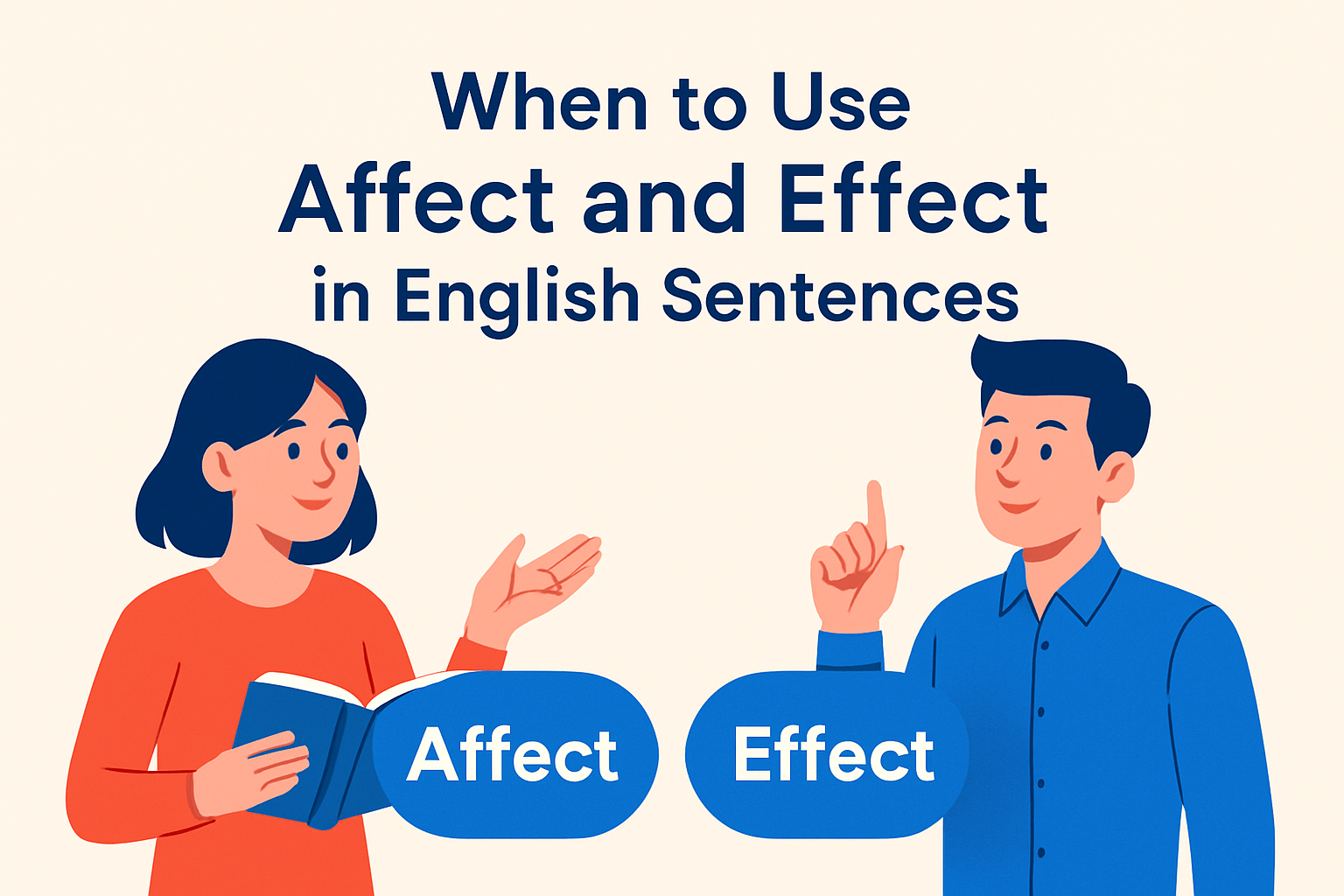
English learners and native speakers alike often pause over affect and effect because the two words look similar, sound related, and can both appear in discussions about change. The difference matters in academic writing, workplace communication, journalism, and everyday emails, where a small word choice can change whether a sentence sounds polished or careless. In practical terms, affect is usually a verb meaning to influence something, while effect is usually a noun meaning a result or outcome. That basic rule solves most cases, but not all of them.
I have edited business reports, student essays, and marketing copy for years, and this pair is one of the most common usage problems I correct. The confusion is understandable because English allows both words to operate in more than one grammatical role. Affect can also appear as a noun in psychology, and effect can function as a verb meaning to bring about. If you only memorize a short slogan, you will still get trapped by advanced cases. What helps is understanding how each word behaves in real sentences.
This article explains when to use affect and effect in English sentences, how to test your choice quickly, and where exceptions appear. You will see plain definitions, reliable sentence patterns, common mistakes, and examples taken from professional contexts. If you want a simple answer first, use affect for influence and effect for result. Then learn the exceptions so your writing remains accurate when the sentence becomes more technical. That approach is the most dependable way to master the difference and avoid second-guessing yourself under deadline pressure.
The core rule: affect is usually a verb, effect is usually a noun
The most useful starting point is grammatical function. In most English sentences, affect acts as a verb and effect acts as a noun. A verb names an action, and a noun names a thing, idea, state, or result. So if your sentence needs the action of influencing, choose affect. If your sentence needs the result produced by that influence, choose effect. This is the rule I teach first because it resolves the vast majority of real-world examples.
Consider these sentence pairs. “The weather affected attendance at the concert” uses affected because the weather influenced attendance. “The effect of the weather was clear in the half-empty stadium” uses effect because it names the outcome. In business writing, “Rising fuel costs affect shipping prices” is correct because affect describes influence. “One effect of rising fuel costs is higher shipping prices” is correct because effect names the consequence. If you can replace the word with influence, affect usually fits. If you can replace it with result, effect usually fits.
A quick editing question helps: are you describing what something does, or what happened because of it? What something does points to affect. What happened because of it points to effect. In sentence-level proofreading, that distinction is faster and more reliable than trying to remember the words by sound alone. It also aligns with how dictionaries and style guides, including Merriam-Webster and the AP Stylebook, present the standard usage.
How to choose the right word in everyday sentences
Most writers do not struggle with definitions; they struggle at the moment of drafting. The easiest solution is to identify the slot the word fills in the sentence. If the word follows a subject and performs an action, affect is often correct: “Noise affects concentration.” If the word follows an article such as the, an, or any adjective like major, lasting, or negative, effect is often correct: “Noise has a negative effect on concentration.” I use this pattern constantly when line-editing reports because it catches errors quickly.
Prepositions also offer clues. Effect commonly appears in phrases like “the effect of,” “an effect on,” “side effects,” and “cause and effect.” Affect often appears after a subject before an object, as in “Stress affects sleep,” “Policy changes affect hiring,” or “Drought affects crop yields.” These are not arbitrary habits; they reflect normal English syntax. Once you notice the patterns, your decisions become easier and faster.
Here is a practical way to decide under pressure. First, locate the subject and main verb. Second, ask whether the target word names an action or a result. Third, test a substitution. Replace affect with influence or alter. Replace effect with result or consequence. If the sentence still makes sense, you probably have the right choice. For example, “The new law affected small businesses” becomes “The new law influenced small businesses,” which works. “The new law had a significant effect on small businesses” becomes “The new law had a significant result on small businesses,” which is slightly less natural but still points you toward a noun.
| Sentence need | Use | Example |
|---|---|---|
| An action of influence | Affect | Screen brightness can affect sleep quality. |
| A result or outcome | Effect | One effect of screen brightness is poorer sleep. |
| After “to” meaning bring about | Effect | The board hopes to effect change next quarter. |
| Psychology noun meaning observable emotion | Affect | The patient showed flat affect during the interview. |
The important exceptions advanced writers should know
If you write for school, healthcare, law, policy, or corporate leadership, you need the exceptions because they appear in formal material. The first exception is effect as a verb. In this use, effect means to bring about, execute, or make happen. It is less common than affect, but it is fully correct. You might read, “The CEO plans to effect a restructuring,” meaning the CEO plans to carry out or cause the restructuring. In government and legal writing, this usage appears regularly: “The agreement will effect changes in trade enforcement.”
The second exception is affect as a noun, mostly in psychology and psychiatry. In that field, affect refers to an observable emotional expression rather than an internal mood. A clinician may write, “The client displayed restricted affect,” or “The patient’s affect was appropriate to the conversation.” This is technical vocabulary, not a substitute for everyday words like emotion or feeling. Outside mental health contexts, using affect as a noun often sounds incorrect because readers expect the common verb form.
These exceptions matter because they explain why intelligent writers still hesitate. If you have seen “effect change” in serious publications, you were not seeing a mistake. If you have read clinical notes describing “flat affect,” that wording was standard professional usage. The key is frequency and context. In ordinary writing, stick to the basic rule. In specialized writing, use the exception only when it says exactly what the field requires. Precision is better than trying to force every sentence into a simplified schoolroom formula.
Common mistakes and how to fix them
The most frequent error is using effect where affect should be the verb. Writers produce sentences like “The shortage will effect production schedules” when they mean influence, not bring about. Unless the shortage is actually causing a schedule system to be created or enacted, the correct sentence is “The shortage will affect production schedules.” Another common mistake goes the other way: “The new software had a positive affect on productivity.” Here the sentence needs a noun after the article and adjective, so effect is correct.
I also see problems in phrases built around cause and result. Writers may say “This policy could have a bad affect” because they hear the final sound and guess. The fix is structural. After “have a” or “has an,” you usually need the noun effect. So write, “This policy could have a bad effect.” In contrast, if the sentence says “This policy could affect morale,” you need the verb because morale is receiving the influence.
Another mistake is overusing the exception “effect change” to sound formal. Many writers pick effect because it seems more sophisticated, but sophistication is not accuracy. “Our campaign will effect customer trust” is awkward unless you truly mean bring customer trust into existence. Most of the time, “Our campaign will affect customer trust” is the intended meaning. Strong editing favors the plain, correct word over the impressive-looking one. That principle improves clarity and preserves credibility.
Memory tricks that actually help
Many memory tricks circulate online, but only a few are dependable. The best one links grammar rather than sound: A in affect for action, E in effect for end result. Because verbs express actions and nouns often name results, this mnemonic aligns with how the words usually function. Another useful reminder is the phrase “affect changes, effect is change.” It is not elegant, but it mirrors real sentence behavior and works during quick proofreading.
A second strategy is pattern memorization instead of isolated memorization. Learn complete chunks such as “affect performance,” “affect outcomes,” “effect on sales,” “side effects,” and “cause and effect.” Native-like accuracy often comes from storing word combinations, not from recalling abstract rules every time. This is the same reason style professionals rely on repeated phrasing patterns when editing under time pressure. It reduces hesitation and increases consistency.
Do not depend too heavily on pronunciation as a guide. In many accents, the words are pronounced differently, but in fast speech the distinction may not help. Spelling by ear is one reason the error appears so often in emails and social posts. Grammar-based checks are safer. If you build the habit of asking action or result, influence or consequence, you will make the correct choice more reliably than someone using a sound-based guess.
When context changes the best choice
Context can shift meaning in subtle ways, which is why advanced editing looks beyond a single sentence. In science writing, for example, researchers often discuss variables that affect an outcome and then measure the effect. “Temperature affects reaction speed” describes influence, while “The effect was strongest at 40 degrees Celsius” identifies the measured result. In economics, “Interest rates affect borrowing” differs from “The effect of higher rates includes lower consumer spending.” The pair often appears together because one names cause-like influence and the other names outcome.
In workplace writing, choosing correctly affects professionalism. A manager who writes, “Budget cuts will effect employee morale” may confuse readers because morale is not something being formally enacted. “Budget cuts will affect employee morale” is clear and idiomatic. But a policy team could correctly write, “The new procedure will effect a reduction in approval time,” because the procedure is intended to bring about that reduction. These distinctions are not pedantic; they prevent ambiguity in documents where decisions and accountability matter.
My recommendation is simple: default to the standard rule, then pause only if the sentence belongs to a specialized context such as law, policy, or psychology. If it does, test whether effect truly means bring about or whether affect is serving as a technical noun. If not, return to the ordinary pattern. That approach keeps your writing accurate, natural, and easy for readers to process.
Knowing when to use affect and effect comes down to one dependable principle: affect usually means to influence, and effect usually means a result. That single distinction will correct most sentences you write in school, at work, or online. From there, learn the two notable exceptions: effect as a verb meaning to bring about, and affect as a psychology noun referring to visible emotional expression. Once you understand both the rule and the exceptions, the confusion drops sharply.
The practical advantage is clarity. Readers should not have to stop and decode whether you meant influence or outcome. Clean usage makes reports sound professional, essays read smoothly, and emails carry authority without extra explanation. The fastest editing method is to ask whether the word names an action or a result, then test it with influence or consequence. That habit works far better than guessing from sound or choosing the word that looks more formal.
If you want to master affect and effect, start noticing them in published writing and practice correcting your own sentences. Review a few examples each week until the pattern feels automatic. With steady use, the distinction becomes intuitive, and your writing becomes more precise every time you revise.
Frequently Asked Questions
What is the main difference between affect and effect?
The simplest way to remember the difference is this: affect is usually a verb, and effect is usually a noun. In most everyday sentences, affect means “to influence” or “to change something in some way,” while effect means “the result” or “the outcome” of a change. For example, in the sentence, “Lack of sleep can affect your concentration,” the word affect describes an action. In the sentence, “Lack of sleep can have a negative effect on your concentration,” the word effect names the result of that action.
This distinction matters because these two words often appear in similar contexts, especially when discussing causes, consequences, behavior, performance, health, and communication. That is why writers frequently hesitate before choosing one. If you are describing what something does, you likely need affect. If you are naming what happened because of it, you likely need effect. Keeping that action-versus-result contrast in mind will help you make the correct choice much more consistently in both formal and informal writing.
How can I tell whether I need affect or effect in a sentence?
A reliable way to choose the right word is to identify the role the word plays in the sentence. Ask yourself: am I describing an action, or am I naming a thing such as a result, consequence, or outcome? If the word is doing the job of a verb, meaning something is influencing or changing something else, affect is usually correct. If the word is functioning as a noun, meaning the result of an action or condition, effect is usually the better choice.
For example, “The new policy will affect employee morale” is correct because the policy is actively influencing morale. By contrast, “The new policy will have a positive effect on employee morale” is correct because effect refers to the outcome of the policy. A useful editing trick is to substitute a simpler word. If you can replace the word with “influence,” then affect probably fits. If you can replace it with “result” or “outcome,” then effect is probably the right choice. This quick test is especially helpful in business writing, essays, reports, and emails where precision matters.
Are there any exceptions to the usual affect and effect rule?
Yes, there are exceptions, although they are much less common than the standard usage. In some formal, academic, or specialized contexts, effect can be used as a verb meaning “to bring about” or “to cause to happen.” For example, “The committee hopes to effect meaningful change” is correct. In this case, effect does not mean result; it means to create or accomplish something. This usage is perfectly valid, but it tends to appear more often in formal writing than in everyday conversation.
There is also a less common noun use of affect, especially in psychology and psychiatry, where it refers to an observable emotional expression or mood. For example, a clinician might write, “The patient displayed a flat affect.” Most general readers and writers do not need this meaning often, but it is useful to know it exists so it does not cause confusion. For the vast majority of everyday writing, however, the practical rule still works well: affect is usually the verb, and effect is usually the noun. Learn the common pattern first, and then treat the exceptions as advanced usage.
What are some easy examples that show affect and effect in real sentences?
Looking at side-by-side examples is one of the best ways to make the difference feel natural. Consider these pairs: “Stress can affect your sleep” and “Stress can have a serious effect on your sleep.” In the first sentence, affect shows the action of influencing. In the second, effect names the result of that influence. Another pair is: “The weather affected our travel plans” and “The weather had a major effect on our travel plans.” Again, the first sentence emphasizes what the weather did, while the second emphasizes the outcome.
You can apply the same pattern in school, work, and daily communication. For example: “Poor lighting affects productivity,” “The medication affected his appetite,” “The new software had an immediate effect on efficiency,” and “Her speech had a powerful effect on the audience.” Reading and writing examples like these helps build instinct over time. If you notice that both words can often appear in similar sentences, that is exactly why they are so easy to confuse. The key is not memorizing isolated definitions alone, but recognizing whether your sentence needs an action word or a result word.
Why is using affect and effect correctly important in professional and academic writing?
Choosing between affect and effect correctly shows control over language, and that matters in settings where clarity and credibility are important. In academic essays, research papers, news articles, business reports, and workplace emails, small word choices shape how polished your writing sounds. Because these two words are so commonly confused, readers often notice mistakes immediately. A sentence may still be understandable, but the wrong choice can make the writing look rushed, imprecise, or less professional than intended.
Correct usage also helps prevent subtle meaning errors. Saying that something “affects” a situation focuses on the process of influence, while referring to its “effect” focuses on the result. In analytical or persuasive writing, that distinction can be important. For example, if you are discussing how a new law changes behavior, affect may be the better fit. If you are discussing the outcome of that law, effect may be more accurate. Mastering this pair improves not just grammar, but also the precision of your thinking and communication. That is why it is worth learning well, even for native speakers who already use English confidently in most other situations.