
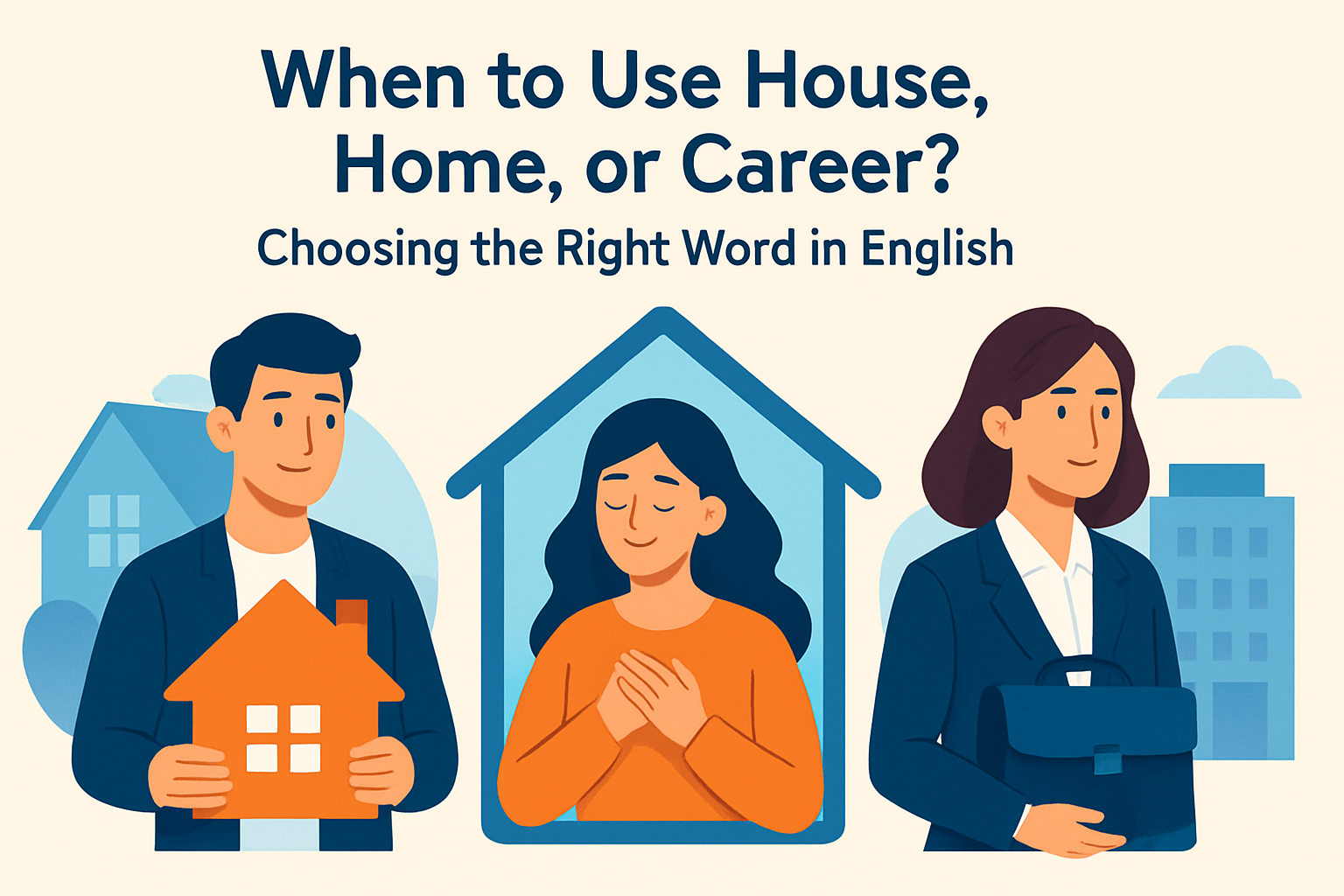
English learners quickly notice that house, home, and career are common words with different emotional weight, grammar patterns, and real-world uses. Choosing the right one matters because a small vocabulary mistake can make a sentence sound awkward, imprecise, or even unintentionally funny. I have taught this distinction to students, edited it in business documents, and corrected it in website copy, and the same pattern appears every time: people know the dictionary meaning, but they miss how native speakers actually use each word. In practical English, house usually refers to a building, home refers to a place of belonging, and career refers to a person’s long-term working life. That basic definition is helpful, but it is not enough. You also need to understand collocations, context, tone, and the difference between literal and emotional meaning. This matters in conversation, job interviews, essays, real estate listings, and even search queries, because English rewards precision. If you say I am going to my house, that can be correct, but in many situations I am going home sounds more natural. If you say my home is teaching, you may mean passion, but my career is teaching is the standard phrase for professional identity. Learning the distinction improves fluency immediately because these words appear in daily speech and formal writing. Once you understand where each word fits, you will sound more natural, clearer, and more confident in English.
What “house” means and when to use it
House is the most concrete of the three words. It usually means a physical building where people live. In plain English, if you can point to the structure, describe its rooms, discuss its price, or talk about repairs, house is probably the right word. Real estate agents use house when discussing square footage, number of bedrooms, detached versus semi-detached design, roofing, plumbing, and property value. For example, We bought a house in Manchester means you purchased a building or property. The sentence The house needs a new roof is also correct because the focus is on the structure, not the feeling of living there.
In my editing work, I often see learners use house where home is more natural in personal speech. A student may write After work I like to relax in my house. That sentence is grammatical, but After work I like to relax at home sounds more idiomatic because the meaning is comfort and everyday life, not architecture. Still, house is essential when you need factual detail. Common collocations include house prices, house hunting, house keys, house plant, house fire, and house insurance. British English also uses terraced house, semi-detached house, and council house with very specific meanings. In American English, you will hear single-family house and open house in property discussions.
House also appears in institutional and figurative expressions. The House of Commons and House of Representatives do not mean homes; they mean legislative bodies. Publishing house, coffee house, and house style all use house in specialized ways. These are fixed phrases, so learners should memorize them as units instead of translating word by word. A reliable rule is this: use house when the physical structure, ownership, market value, or type of building is the central idea.
What “home” means and why it feels different
Home is about belonging, familiarity, and the place where someone feels rooted. It may be a house, an apartment, a dorm room, a mobile home, or even a temporary place in some contexts. The key difference is emotional meaning. When native speakers say I want to go home, they are usually expressing return, rest, safety, or identity. They are not describing the building materials. That is why home appears so often in personal conversations, songs, branding, and public messaging. Hospitals talk about home care, charities discuss homelessness, and governments measure home ownership because the word carries social meaning beyond walls and windows.
From experience, this is one of the easiest distinctions to demonstrate. Compare These workers build houses with These workers help families find homes. The first sentence focuses on construction. The second focuses on human life and belonging. Both can describe the same property, but the perspective changes. Home also works as an adverb in common expressions: go home, come home, drive home, stay home, and work from home. That last phrase became globally familiar during the COVID-19 pandemic, when remote work policies changed language habits in offices everywhere. We almost never say work from house because English does not use house that way.
Home has important figurative uses too. People say This town feels like home or Make yourself at home. Sports commentators refer to the home team. Technology companies describe a home screen or smart home devices. In each case, home signals centrality, familiarity, or base location. A practical rule is simple: choose home when you mean personal connection, daily living, comfort, or the place someone returns to physically or emotionally.
What “career” means in professional English
Career does not belong to the same category as house and home, which is why learners sometimes confuse the decision. House and home refer to living places. Career refers to a person’s long-term professional path, usually across years of work, skill development, promotions, and changing roles. A job is the position you hold now. A career is the broader pattern. For example, She has a job as a pharmacist describes current employment. She has a career in pharmacy describes a sustained profession with training, expertise, and future direction.
In recruiting, education, and workplace writing, the distinction is critical. Career development, career progression, career change, career goals, and career path are standard collocations recognized by employers, universities, and career services offices. If a graduate says I want to build my home in marketing, native speakers may understand the intended idea, but I want to build my career in marketing is the correct phrase. Career also implies deliberate growth. It often includes qualifications, performance reviews, networking, management responsibility, and industry reputation. LinkedIn profiles, CVs, and cover letters rely on this word because it signals long-term professional identity.
That said, career can sound more formal than job. In casual speech, someone may say I’m looking for a new job rather than I’m pursuing a new career opportunity, unless the change is major. The rule I give learners is direct: use career for your professional life over time, especially in formal or strategic contexts; use job for a specific role; never use house or home when referring to employment unless you are speaking metaphorically.
Quick comparison: house vs home vs career
The fastest way to choose the right word is to ask what you are really describing: a building, a feeling of belonging, or a professional path. This distinction becomes clearer when you compare typical contexts side by side.
| Word | Core meaning | Best used for | Example |
|---|---|---|---|
| House | Physical building | Property, rooms, repairs, buying, selling | They rented a two-bedroom house near the station. |
| Home | Place of belonging | Comfort, daily life, family, return, identity | After the trip, everyone was happy to be home. |
| Career | Long-term professional life | Work goals, growth, qualifications, industry direction | She built a successful career in civil engineering. |
If you remember one sentence, make it this: a house is where you live physically, a home is where you belong emotionally, and a career is how you grow professionally.
Common mistakes learners make and how to correct them
The most frequent mistake is using house in every situation because it seems like the safest translation. For instance, I stayed in my friend’s house last weekend is understandable, but native speakers often say I stayed at my friend’s house or I stayed with my friend. Another common error is saying I returned to house at midnight. The correct phrase is I returned home at midnight or I went home at midnight. Home behaves differently in grammar because it often acts like an adverb, so no preposition is needed after verbs like go, come, or arrive.
A second mistake is overusing home in professional writing. I have edited sentences such as She wants to improve her home in finance. That is incorrect unless the writer is intentionally being poetic. The standard expression is improve her career in finance or build a career in finance. Learners also confuse home and house in compounds. Housework means cleaning tasks in a residence, not homework done at home. Housekeeper is a person who manages domestic cleaning. Homeland means a native country, while hometown means the town where you grew up. These are established forms that must be learned individually.
There are also subtle tone issues. In real estate marketing, developers often mix the two words intentionally: Find your dream home in a modern riverside house. This works because house describes the property type and home appeals to emotion. Understanding that difference helps learners read advertisements, write naturally, and avoid literal translation errors.
How to choose the right word in real situations
Use a simple three-step test. First, ask whether you are talking about a structure. If yes, choose house. Example: The house was built in 1928 and renovated in 2019. Second, ask whether you mean comfort, identity, or the place someone returns to. If yes, choose home. Example: Even after ten years abroad, Kyoto still feels like home to her. Third, ask whether the topic is long-term work life. If yes, choose career. Example: He changed careers after completing a data analytics certificate through Google Career Certificates.
This approach works in exams, workplace writing, and conversation. In IELTS or TOEFL speaking tasks, precision improves lexical resource scores because examiners notice accurate collocations. In business communication, saying career objectives instead of job dreams sounds more professional. In daily conversation, saying I’m home instead of I’m in the house sounds more natural when you mean you have arrived. Corpus-based resources such as the Cambridge Dictionary, Merriam-Webster, and the British National Corpus confirm these usage patterns clearly. If you want to practice, collect ten real examples from news articles, property listings, and LinkedIn profiles, then classify each one. That method trains your ear quickly because it connects vocabulary with authentic context rather than isolated definitions.
Choosing between house, home, and career becomes easy once you focus on meaning, context, and common usage instead of simple translation. House is the physical structure. Home is the place of belonging. Career is the long-term path of professional work. Those distinctions shape how native speakers understand your message, and they affect everything from casual conversation to academic writing and job applications. The most important benefit of learning this contrast is clarity. You will describe property more accurately, express personal feelings more naturally, and talk about work with the right professional vocabulary. You will also notice collocations faster, which is one of the clearest signs of growing fluency.
My practical advice is to learn these words through patterns, not isolated lists. Memorize phrases like buy a house, go home, and build a career. Then test yourself with real examples from media, workplace documents, and everyday speech. When you choose the right word consistently, your English sounds more natural immediately. Keep practicing with authentic sentences, and soon the difference between house, home, and career will feel automatic.
Frequently Asked Questions
What is the main difference between house, home, and career in English?
The simplest way to understand these three words is to focus on function, feeling, and context. A house is usually a physical building. It is the structure itself: the walls, roof, rooms, and location. You can buy a house, paint a house, or describe a house as large, small, modern, or old. A home, by contrast, is more emotional and personal. It refers to the place where someone feels they belong, live comfortably, or have a sense of family and security. A home may be a house, but it could also be an apartment, a studio, a dorm room, or any place that feels like your own. Career is completely different from both because it relates to work, professional development, and long-term employment goals. It refers not just to a job, but to the broader path of a person’s working life.
This difference matters because English speakers naturally choose one word or another depending on what they want to emphasize. If you say, “They bought a new house,” you are talking about property or a building. If you say, “They finally found a home,” you are stressing comfort, belonging, or emotional meaning. If you say, “She is building a successful career,” you are talking about professional growth over time. Learners often know these basic definitions, but the challenge comes from usage. In real communication, the wrong word can make a sentence sound unnatural. For example, “I returned to my house country” is incorrect because English uses “home country,” not “house country.” Similarly, “I want a good home in marketing” sounds wrong if you mean professional future; the natural phrase is “a good career in marketing.”
When should I use house instead of home?
Use house when you want to talk about the physical property, building type, or practical features of where someone lives. This is the right choice in real estate, architecture, construction, insurance, repairs, and descriptions of size or design. For example, “Their house has three bedrooms,” “We are renting a house near the station,” and “The house needs a new roof” all sound natural because the speaker is focused on the building itself. In these cases, home would either change the meaning or sound less precise.
Use home when the emotional or personal meaning is more important than the structure. “After ten years abroad, she came home” feels natural because it refers to the place where she belongs, not simply a building. “Make yourself at home” is also a fixed expression that communicates comfort and welcome. In many cases, native speakers choose home even when a house is involved, because they are talking about daily life, family feeling, or personal identity rather than walls and furniture. Compare these two sentences: “They bought a beautiful house” focuses on the property; “They created a beautiful home” focuses on the atmosphere and life inside it. That distinction is subtle, but very important in natural English.
Can home be used as an adverb or in fixed expressions?
Yes, and this is one of the key reasons learners sometimes struggle with the word home. Unlike house, home often appears in expressions where it does not behave like a simple countable noun. For example, native speakers say “go home,” “come home,” “get home,” and “arrive home” in some varieties of English, especially British English. In these examples, home functions almost like an adverb of place, so it usually does not need “to” or “the.” That is why “I went home” sounds natural, while “I went to home” is incorrect. This is one of the most common learner mistakes.
There are also many fixed expressions with home that must be learned as natural combinations. Common examples include “at home,” “home address,” “home cooking,” “home town,” “home country,” “home office,” and “feel at home.” Each has a specific meaning shaped by usage, not just dictionary logic. You can also hear metaphorical uses such as “The message really hit home,” which means it had a strong emotional effect, or “This idea is close to home,” which means it feels personal. By contrast, house is much more limited in this way. You would say “go home,” not “go house,” and “feel at home,” not “feel at house.” Learning these patterns is essential because vocabulary accuracy in English depends not only on meaning, but also on the combinations words naturally form.
What does career mean, and how is it different from job or work?
Career refers to the long-term path of a person’s professional life. It includes progress, goals, development, reputation, and often a sense of direction over many years. A job is a specific position or role you do to earn money, while work is the general activity of doing tasks or employment in a broad sense. For example, someone may have a job as a sales assistant, do a lot of work each week, and still hope to build a career in business management. That is why career is often used in discussions about ambition, training, promotions, industries, and future plans.
This distinction matters because using career in the wrong place can make a sentence sound too formal or too broad, while using job instead can make a statement sound less ambitious than intended. “I am looking for a career in healthcare” suggests a serious long-term professional goal. “I am looking for a job in healthcare” suggests an immediate employment need. Both may be correct, but they communicate different things. Common verb combinations include “build a career,” “pursue a career,” “start a career,” “change careers,” and “advance your career.” These are far more natural than expressions such as “make a career” in many contexts. For English learners, understanding these collocations is just as important as knowing the basic definition, because real fluency comes from choosing the word that fits both the meaning and the situation.
What are the most common mistakes English learners make with house, home, and career?
One very common mistake is using house where English requires home. Learners may say “I’m going to my house now,” which is grammatically possible, but often less natural than “I’m going home” if the meaning is simply returning to where you live. Another frequent error is adding unnecessary words in phrases with home, such as “go to home” instead of “go home.” Learners also sometimes choose home when they should use house, especially when discussing property details. For instance, “We bought a home with a large garage” is possible, but in many practical contexts, especially real estate, “We bought a house with a large garage” is more precise because the focus is on the physical structure.
With career, the most common mistakes involve confusing it with job, using awkward collocations, or choosing it in situations that do not imply long-term professional development. For example, “My career starts at 9 a.m.” sounds unnatural because a daily schedule relates to your job or workday, not your career as a whole. Another issue is mixing emotional and professional vocabulary in ways that English does not normally allow, such as “My career is my home” when the speaker simply means they are committed to their work. That kind of sentence may be possible in poetry, but not as ordinary usage. The best way to avoid these mistakes is to learn each word in real phrases and situations. Ask yourself: am I talking about a building, a sense of belonging, or a professional path? If you answer that clearly, choosing between house, home, and career becomes much easier.





