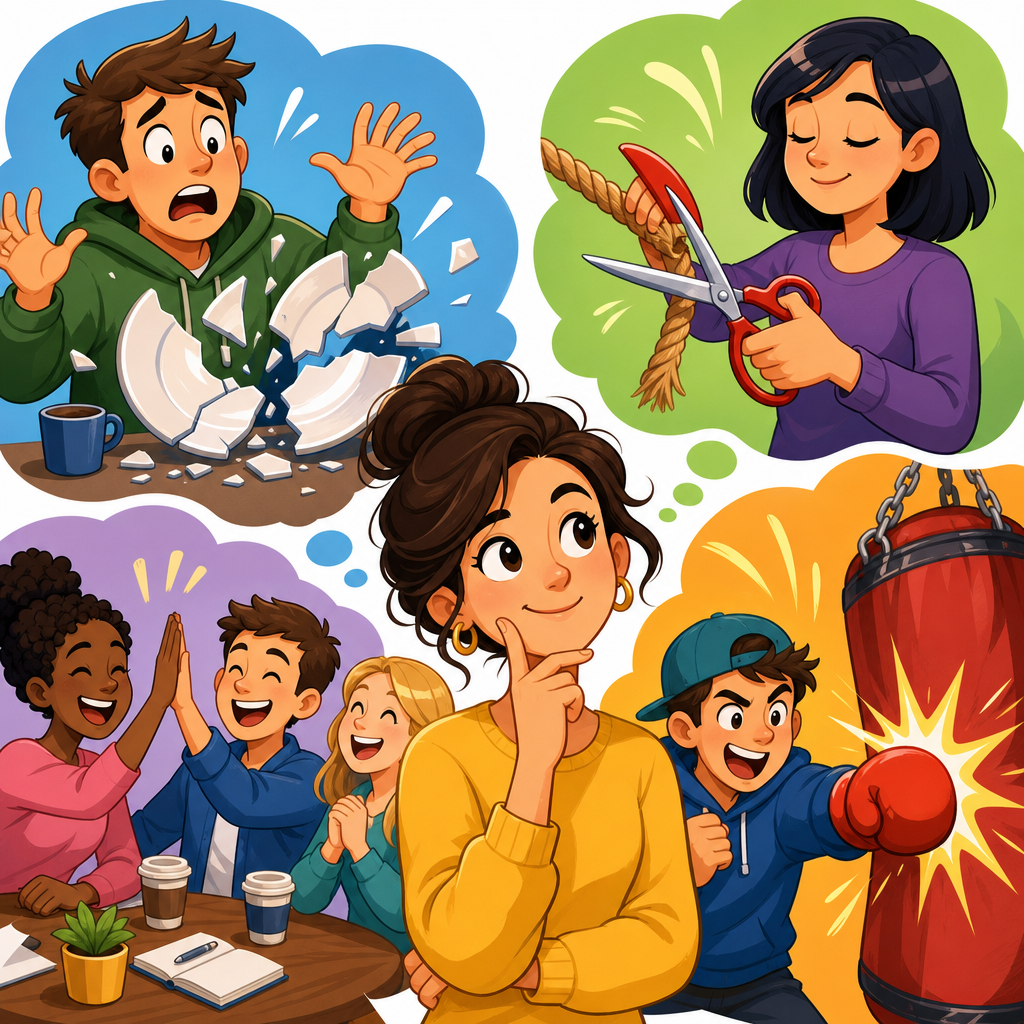
Idioms with break, cut, and hit show up constantly in everyday English, business conversations, films, news coverage, and casual text messages, yet many learners still struggle to use them naturally. An idiom is a fixed expression whose meaning cannot always be understood from the literal meanings of the individual words. When someone says “break the ice,” no actual ice is involved. When a manager says “cut corners,” nobody is using scissors. When a headline says inflation “hit hard,” the phrase points to impact, not physical violence.
I work with English learners on this exact problem: they may know the dictionary meanings of break, cut, and hit, but they hesitate when these verbs become part of idiomatic phrases. That hesitation matters because these expressions are high-frequency, especially in spoken English. Native speakers use them to signal tone, attitude, urgency, and social awareness. Understanding them helps you follow conversations faster, while using them correctly makes your English sound more fluent and precise.
This article focuses only on idioms built around break, cut, and hit, with meanings you can actually use in real situations. You will learn what each expression means, when it sounds natural, and where learners commonly make mistakes. The goal is not to memorize long lists. It is to recognize useful patterns, understand register, and choose idioms that fit daily communication.
Idioms with break: starting, stopping, and changing the mood
Many useful idioms with break involve change. “Break the ice” means to reduce social tension and make people feel comfortable. In a meeting, a simple question or light joke can break the ice. I often tell learners to use this idiom for first meetings, team workshops, and classroom introductions. It is neutral, common, and safe in both personal and professional contexts.
“Break the news” means to tell someone important information, often bad news or sensitive news. A doctor may break the news gently. A manager may break the news about layoffs. Because it usually involves emotional weight, the phrase often appears with adverbs like “carefully,” “gently,” or “personally.”
“Break a habit” means to stop doing something regularly, usually something negative. You can break a habit of checking your phone late at night or eating too much sugar. Unlike some idioms, this one is very practical and widely used in health, productivity, and self-improvement conversations.
“Break even” means to reach a point where income and costs are equal. Small businesses often say they hope to break even in the first year. This is a core financial expression, not just conversational slang, so it is worth learning early.
Another common phrase is “break down.” It can mean stop functioning, as with a car, but it can also mean lose emotional control. Context decides the meaning. If someone says, “My car broke down,” the meaning is mechanical. If they say, “She broke down during the interview,” the meaning is emotional. Learners should pay attention to the subject and situation before interpreting it.
Idioms with cut: reducing, avoiding, and acting efficiently
Idioms with cut often relate to removing, reducing, or simplifying. “Cut corners” means to save time or money by doing something poorly or skipping necessary steps. A builder who uses cheap materials to finish faster is cutting corners. The phrase is negative because it implies lower standards and possible risk. In workplace English, this idiom appears often in discussions about quality control, budgeting, and deadlines.
“Cut to the chase” means get to the main point without wasting time. If a colleague gives too much background in a meeting, another person may say, “Let’s cut to the chase.” It is direct but not automatically rude; tone matters. Used politely, it signals efficiency.
“Cut back on” means reduce the amount of something. People cut back on spending, screen time, or sugar. This is one of the most useful everyday expressions because it works in personal finance, health, and environmental topics. It is more natural than simply saying “reduce” in many spoken contexts.
“Cut off” has several common meanings. It can mean disconnect, as when the phone call was cut off. It can also mean stop supplying, as when a country is cut off from trade routes. In conversation, it often means interrupt someone before they finish speaking: “Sorry, I didn’t mean to cut you off.” That usage is especially valuable in meetings and discussions.
“Make the cut” means meet the required standard and be selected. An athlete may make the cut for the national team. A candidate may not make the cut after final interviews. This idiom is common in hiring, sports, competitions, and media auditions, where selection criteria matter.
Idioms with hit: impact, realization, and timing
Idioms with hit usually involve force, effect, or sudden recognition. “Hit the nail on the head” means describe exactly what is right or true. If someone accurately identifies why a project failed, you can say they hit the nail on the head. It is a strong phrase for agreement because it praises precision.
“Hit the road” means leave or begin a journey. Friends might say, “We should hit the road by six.” It is informal but extremely common in American English and widely understood elsewhere through film, television, and travel content.
“Hit hard” means strongly affect someone or something. Rising fuel prices can hit small businesses hard. Bad news can hit a family hard. This phrase is common in journalism because it communicates serious impact quickly and clearly.
“Hit the books” means begin studying seriously. Students hit the books before exams. This idiom is informal, but it remains current and useful, especially in school or university settings.
“It hit me” means I suddenly realized or emotionally felt something. For example, after moving abroad, it may hit you that you will not see your family for months. This phrase often combines realization and emotion, which makes it especially expressive in storytelling.
How to choose the right idiom in real conversations
The biggest mistake learners make is treating idioms as simple vocabulary replacements. In real use, each one carries context, tone, and collocation patterns. “Break the ice” fits social openings, but not financial reports. “Break even” fits business and budgeting, but not emotional discussions. “Cut corners” implies criticism, so using it about your own company can sound serious. “Hit the road” is friendly and informal, so it does not belong in a legal memo.
I advise learners to learn idioms through situations, not isolated lists. Pair the phrase with a speaker, setting, and purpose. For example: a team leader breaks the news, a traveler hits the road, a startup hopes to break even, and a student hits the books. This method improves recall because your brain stores meaning with context.
Another practical strategy is to notice grammar patterns. We say “cut back on expenses,” not “cut back expenses” in many common cases. We say “break the news to someone.” We say “it hit me that…” These patterns matter as much as the core idiom. The more complete chunk you learn, the more naturally you will speak.
| Idiom | Meaning | Natural example |
|---|---|---|
| break the ice | reduce social tension | The host told a quick story to break the ice. |
| cut corners | save effort by lowering quality | The contractor cut corners and the roof leaked. |
| hit the nail on the head | say exactly what is correct | Your comment about poor planning hit the nail on the head. |
| break even | have no profit or loss | The cafe finally broke even in month ten. |
| cut to the chase | get to the main point | We only have ten minutes, so let’s cut to the chase. |
| it hit me | suddenly realize something | It hit me that I had sent the file to the wrong client. |
Common mistakes, register, and smarter study habits
One frequent mistake is mixing literal and idiomatic meanings in the same sentence without control. Saying “I cut the corner on the report” is wrong if you mean “cut corners.” The idiom is fixed. Another issue is overusing idioms to sound fluent. Native speakers do use them often, but they do not force them into every sentence. Natural English balances plain language with a few well-chosen expressions.
Register also matters. “Hit the road” works with friends, classmates, or relaxed colleagues. “Break the news” works almost anywhere because it is neutral. “Cut to the chase” can sound efficient or impatient depending on delivery. If you are speaking to a senior client, a softer version such as “Let me get to the main point” may be safer.
To study effectively, collect idioms from real sources: podcast transcripts, interviews, business articles, and streaming subtitles. Write down the full sentence, the speaker, and the situation. Then reuse the idiom in your own example within twenty-four hours. That active recall method is more effective than memorizing bilingual lists. If you want another focused idiom guide, this related resource explains a different high-frequency set clearly: hand idioms in English.
Idioms with break, cut, and hit are worth learning because they are not decorative extras; they are functional tools for modern English. They help you describe financial results, social dynamics, study habits, emotional reactions, interruptions, and direct communication with fewer words and more natural rhythm. Start with the expressions you are most likely to need: break the ice, break even, cut back on, cut corners, hit the nail on the head, and it hit me.
Focus on meaning, situation, and pattern together. Learn the exact phrase, notice who uses it, and practice it in a realistic sentence. That approach will help you understand native speakers faster and sound more confident without memorizing dozens of expressions you will never use. Pick three idioms from this article today and use each one in a sentence out loud.
Frequently Asked Questions
What are idioms with break, cut, and hit, and why are they so common in English?
Idioms with break, cut, and hit are fixed expressions in which the overall meaning is different from the literal meaning of the individual words. For example, break the ice does not mean damaging frozen water, cut corners does not involve physically cutting anything, and hit hard often describes a strong impact on emotions, finances, health, or business rather than a physical strike. These verbs appear in a huge number of everyday idioms because they are basic action words in English, and over time they developed figurative meanings that native speakers now use automatically.
They are especially common because they work well in many contexts. In business, someone may say a company had to cut back, a team needs to break even, or a new policy could hit small businesses hard. In social situations, people talk about breaking the ice or hitting it off. In the news, journalists use phrases like hit record highs or break with tradition. Learning these idioms matters because understanding them helps you follow real conversations, films, emails, headlines, and meetings more naturally. They are not advanced decoration; they are core everyday English.
How can I tell whether break, cut, or hit is being used literally or as part of an idiom?
The best way to tell is to look at the context and ask whether the literal meaning makes sense. If someone says, “He broke the window,” that is literal because something physical was damaged. But if someone says, “She broke the news gently,” it is idiomatic because break the news means to tell important or upsetting information. The same pattern applies to cut and hit. “He cut the paper” is literal, while “The company cut corners” is idiomatic because it means doing something cheaply or carelessly to save time or money. “She hit the ball” is literal, while “The recession hit hard” is figurative because it means the effect was severe.
Another clue is whether the phrase appears as a common word partnership. Idioms are often fixed or semi-fixed, so expressions like break the ice, cut ties, cut back on, hit the nail on the head, and hit a dead end are recognized chunks of language. If you try to interpret each word separately, the phrase may seem confusing. That is usually a sign you are dealing with an idiom. A practical strategy is to learn the entire expression, its meaning, and one natural example sentence rather than memorizing the verb alone. That makes it much easier to recognize the idiom immediately when you hear or read it.
Which idioms with break, cut, and hit are the most useful for everyday conversations and work situations?
Some idioms are much more useful than others because they appear across casual, professional, and media contexts. With break, high-value expressions include break the ice meaning to make people feel more comfortable, break even meaning to have no profit and no loss, break the news meaning to tell important news, and take a break meaning to pause from work or activity. With cut, especially useful idioms include cut corners meaning to do something badly in order to save resources, cut back meaning to reduce spending or use, cut ties meaning to end a relationship or connection, and cut to the chase meaning to get to the main point quickly.
With hit, very common and practical idioms include hit hard meaning to affect something severely, hit the road meaning to leave or begin a trip, hit the nail on the head meaning to be exactly right, and hit it off meaning to connect well with someone immediately. These are useful because they fit real-life situations learners often face: meetings, presentations, workplace feedback, travel, budgeting, and socializing. If you want a smart starting point, focus on idioms that can be used in more than one context. For example, cut back works for money, time, food, expenses, and energy use, while hit hard works for economics, emotions, weather, illness, and personal setbacks. That flexibility makes them especially valuable.
How can I use these idioms naturally without sounding forced or making mistakes?
The key is to learn idioms as complete expressions with typical situations, not as random vocabulary items. Instead of memorizing that break can be figurative, learn a full pattern such as “We need to break the ice at the start of the meeting” or “Rising costs have hit small companies hard.” This helps you understand both meaning and grammar. It also prevents awkward errors like changing important words inside the expression. Many idioms are not fully flexible, so while native speakers may occasionally adapt them creatively, learners should first master the standard form. For instance, hit the nail on the head is the natural phrase; changing it too much can sound unnatural.
It also helps to match the idiom to the tone and situation. In casual conversation, hit it off or take a break sounds natural. In work settings, cut back on expenses, break even, or cut to the chase may be more appropriate. Read example sentences from reliable sources, notice who uses the idiom and why, and then create your own versions based on your real life. For example: “We had to cut back on travel costs this quarter,” “The new tax rules hit freelancers hard,” or “She really broke the ice with that opening joke.” Repetition in meaningful contexts is what makes idioms sound natural. If you only memorize definitions, they often stay passive; if you use them in realistic sentences, they become active vocabulary.
What is the best way to remember the meanings of idioms with break, cut, and hit?
One of the most effective methods is to group idioms by verb and then by theme. For example, with break, you can group idioms related to communication and change: break the news, break the silence, break with tradition. With cut, group idioms related to reduction or separation: cut back, cut down on, cut ties. With hit, group idioms related to impact or movement: hit hard, hit the road, hit a dead end. This creates mental connections that are easier to remember than isolated lists. It also helps you notice broad patterns in meaning, such as cut often suggesting reduction and hit often suggesting force or effect.
Another strong technique is to combine definition, example, and personal relevance. Do not just write “cut corners = do things cheaply.” Add a sentence like “If a builder cuts corners, the work may be unsafe,” and then connect it to your own experience: “My old employer never cut corners on safety.” That personal link makes the phrase much more memorable. You can also use spaced repetition, flashcards, and short dialogues. Listening to podcasts, watching films with subtitles, and reading news headlines are especially useful because these idioms appear there constantly. The goal is repeated exposure in context. Once you see how often English speakers say things like break even, cut back, or hit hard, the meanings stop feeling abstract and start becoming automatic.