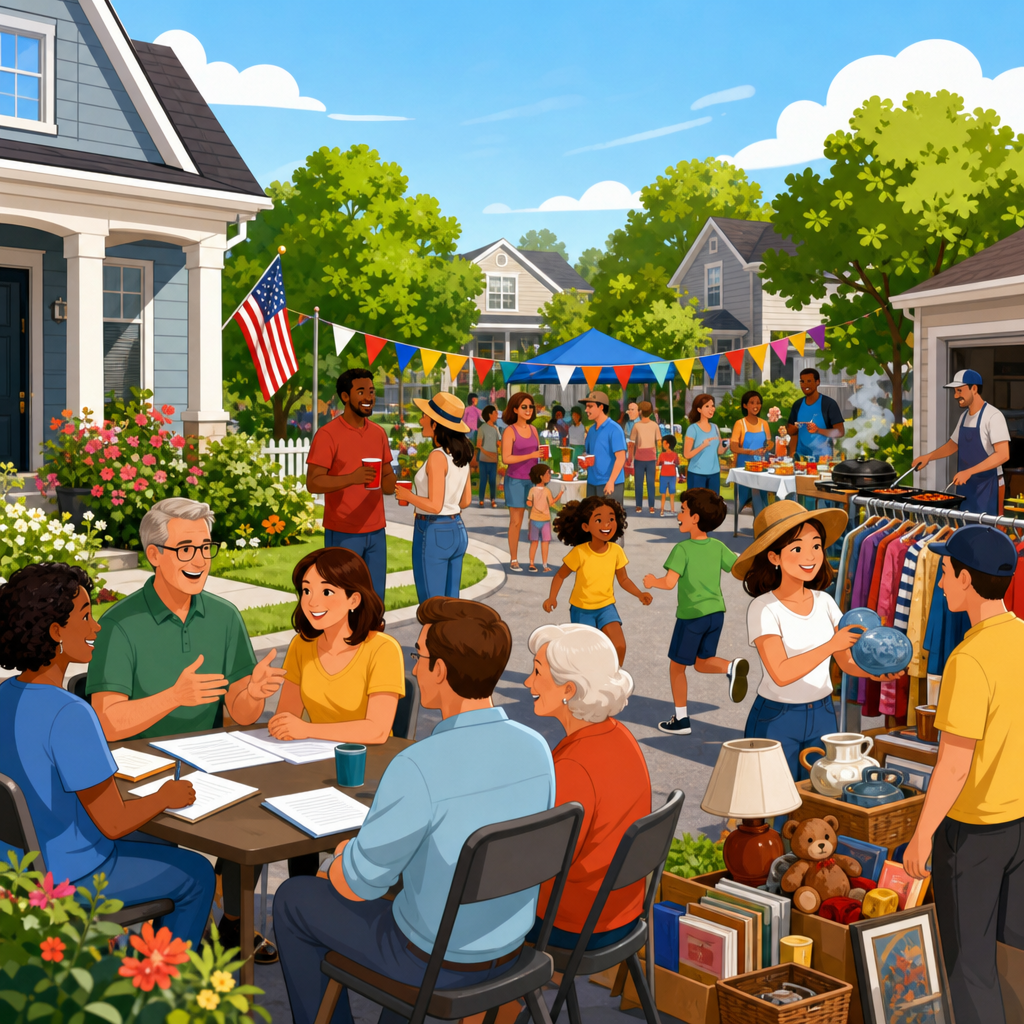
Neighborhood culture in the U.S. is often learned through everyday phrases rather than formal lessons, and three of the most revealing sets of terms are HOA language, block party language, and garage sale language. For English learners and newcomers, these words can sound simple while carrying strong social meaning. An HOA is a homeowners association, a private organization that creates and enforces community rules in many subdivisions, condo complexes, and townhouse developments. A block party is a social gathering organized by neighbors, usually on one street or within one section of a neighborhood. A garage sale is a home-based sale of used household items, often held in a driveway, garage, or front yard. I have seen people understand every dictionary definition and still miss the real message behind the words, because neighborhood culture in the U.S. depends heavily on tone, expectations, and unwritten rules. Knowing this language matters because it helps you read invitations correctly, avoid conflict with neighbors, understand what is optional versus required, and join community life without awkward mistakes. These expressions also reveal deeper American values: private property, volunteerism, friendliness with boundaries, and a practical approach to money and space.
Many neighborhood interactions in the U.S. happen in semi-private settings, where people are friendly but still protective of their time, rules, and property. That is why the language around HOAs, block parties, and garage sales deserves a close look. When a neighbor says, “The HOA is strict about trash cans,” they are not making casual conversation; they are warning you about enforcement. When someone says, “You should come by the block party,” it usually means the invitation is genuine, but not necessarily intimate. When a handwritten sign says, “Garage sale Saturday, cash only,” it signals an informal marketplace with its own etiquette. These situations are common in suburbs, planned communities, and residential city neighborhoods across the country. They also appear frequently in small talk, neighborhood apps like Nextdoor, local Facebook groups, and community email lists. Understanding the language gives you more than vocabulary. It gives you cultural fluency in how Americans share space, negotiate rules, and build low-pressure social ties with the people living nearby.
HOA Language: Rules, Compliance, and Polite Warnings
HOA language is one of the clearest examples of how neighborhood culture in the U.S. combines legal structure with social pressure. In practice, homeowners associations manage shared standards for appearance, maintenance, amenities, and conduct. Common terms include “covenants, conditions, and restrictions,” often shortened to CC&Rs, “bylaws,” “architectural review,” “violation notice,” “dues,” and “special assessment.” These are not abstract words. If an HOA sends a violation notice about peeling paint, basketball hoops, holiday decorations left up too long, or visible trash bins, the issue can escalate into fines. I have worked with residents who assumed a warning was a suggestion when it was actually the first step in a formal enforcement process. In many communities, HOA boards are made up of volunteer residents, but their authority comes from governing documents tied to the property. That means phrases such as “out of compliance” or “pending board approval” should be taken literally.
Just as important is the softer side of HOA language. Neighbors often refer to rules indirectly to avoid sounding confrontational. A person may say, “I think the HOA prefers neutral exterior colors,” instead of saying, “You may not paint your house bright purple.” “You might want to check with the board” often means “do not proceed until you have permission.” “They’ve been sending reminders” may actually mean repeated violations are creating tension. This indirectness is common in American residential culture, where people try to preserve friendliness while still defending standards. It helps to recognize when a comment is informational and when it is a social correction. If you want a broader sense of how indirect language works in everyday conversation, this guide on American small talk rules that surprise ESL learners gives useful context for reading tone and intent.
There is also a class and regional dimension to HOA language. In Sun Belt suburbs, master-planned developments may use polished terms like “community standards” and “lifestyle amenities,” while older condo buildings may sound more administrative and speak about “maintenance obligations” or “common elements.” Yet the cultural function is similar everywhere: the HOA language defines what counts as acceptable neighborhood behavior. Whether the topic is landscaping, parking, pet waste, short-term rentals, or noise, the vocabulary signals that individual choices are limited by community agreements. People who understand that dynamic navigate these communities more smoothly and avoid the common mistake of treating every home as fully autonomous private space.
Block Party Language: Invitation, Participation, and Social Distance
Block party language sounds warmer than HOA language, but it also contains hidden expectations. A block party is usually framed as casual, inclusive, and family friendly. Typical phrases include “bring a dish,” “potluck style,” “BYOB,” “kids welcome,” “everyone on the street is invited,” and “stop by anytime.” In real use, each phrase carries practical meaning. “Bring a dish” means contribute food to share, not just your own meal. “Potluck style” means there is no formal catering and the menu depends on what neighbors bring. “BYOB” means bring your own beer or other drinks, and do not assume alcohol will be provided. “Stop by anytime” often signals a flexible arrival window, not an all-day open invitation to remain indefinitely. I have seen newcomers misread these cues and either underparticipate or overstay, both of which stand out more than people expect.
Block party culture also reveals how Americans manage social closeness. These events can create real community trust, especially after storms, local emergencies, or long periods when neighbors barely interact. At the same time, the tone usually stays light. People talk about schools, pets, renovations, weather, and local traffic more than personal finances, politics, or religion. If someone says, “We should do this more often,” that expresses goodwill, not a binding plan. If a host says, “Help yourself,” they are inviting informal participation, but basic courtesy still applies: clean up after yourself, do not monopolize conversation, and supervise your children. In city neighborhoods, a block party may require a permit to close the street. In suburbs, it may simply happen in a cul-de-sac or shared green space. The language changes slightly by place, but the underlying message stays consistent: be friendly, contribute something, and respect boundaries.
| Phrase | What It Usually Means | Best Response |
|---|---|---|
| Bring a dish | Contribute shareable food for the group | Bring enough for several people, with serving utensils |
| BYOB | Bring your own drinks, often alcohol | Do not expect the host to supply beverages |
| Stop by anytime | Arrival time is flexible within the event window | Come during the stated hours, not extremely early or late |
| Everyone is invited | The event is broad and neighborhood-based | Attend even if you do not know many people yet |
| Help yourself | Service is informal, but manners still matter | Take a reasonable amount and clean up after yourself |
Garage Sale Language: Bargaining, Condition, and Informal Commerce
Garage sale language may look straightforward, but it reflects a distinct American attitude toward used goods, thrift, and neighborhood interaction. Common signs include “multi-family sale,” “moving sale,” “estate sale,” “cash only,” “all sales final,” “early birds welcome” or “no early birds,” and “firm on price.” These labels matter. A multi-family sale usually offers a wider variety of items because several households contribute goods. A moving sale suggests the seller wants to reduce possessions quickly, which sometimes means better prices. An estate sale usually follows a death, downsizing, or major transition and is often more organized than a basic garage sale. “Cash only” means exactly that, although mobile payment apps like Venmo are increasingly common. “All sales final” tells buyers not to expect returns. “Firm on price” is a direct signal that bargaining is unwelcome, while unstated prices often invite negotiation.
The social rules of garage sale language are especially important for nonnative speakers because these events mix commerce with neighborliness. People often greet each other warmly, but the goal is still to sell items efficiently. Asking “Will you take five?” is a standard way to negotiate a lower price. “Can you do better on this?” is softer and more conversational. Sellers may say, “I can come down a little,” “That one’s spoken for,” or “I just put that out,” each carrying a clear message about price or availability. Condition words matter too: “like new” suggests minimal wear, “gently used” implies ordinary use without major damage, and “as is” means the buyer accepts the item with no guarantee. I advise people to listen closely to these formulaic expressions because they are consistent across regions and can save both money and embarrassment.
Garage sales also show how neighborhood trust works at a very local level. Shoppers walk onto private property, inspect possessions, and discuss price with strangers in a casual setting that still relies on basic honesty. The seller is expected to describe flaws accurately, and the buyer is expected not to create unnecessary conflict over very small amounts of money. Haggling is acceptable, but aggressive bargaining over a two-dollar lamp can seem rude. Likewise, arriving far before opening time after a sign says “no early birds” violates a clear social rule, even if the sale is technically visible from the street. In that sense, garage sale language is not only about buying used goods. It is a compact lesson in American ideas about fairness, convenience, and respectful distance between neighbors.
How These Three Language Systems Work Together
HOA, block party, and garage sale language may seem unrelated, but together they form a practical map of neighborhood culture in the U.S. HOA vocabulary governs order, block party vocabulary invites limited community, and garage sale vocabulary creates temporary informal trade. All three depend on reading direct statements and indirect cues at the same time. “Per HOA guidelines” sounds neutral but signals authority. “Come if you can” sounds optional but still communicates interest in your presence. “Price is firm” sounds blunt but protects time and avoids repeated negotiation. When people misunderstand these phrases, the problem is rarely grammar. It is usually a mismatch between literal meaning and social function.
The most useful habit is to treat neighborhood language as action-oriented. Ask yourself what response the phrase expects. Does it require compliance, contribution, negotiation, or simple politeness? That mindset prevents most mistakes. It also helps you participate more confidently, whether you are reading a community notice, accepting a block party invitation, or stopping at a Saturday garage sale. The main benefit of learning this vocabulary is not just better English. It is smoother daily life with neighbors, fewer misunderstandings, and a clearer sense of how local American culture actually works. Pay attention to these phrases the next time you hear them, and you will start noticing the rules, warmth, and boundaries that shape U.S. neighborhood life.
Frequently Asked Questions
1. What does “HOA” mean in the U.S., and why do people talk about it so much?
HOA stands for “homeowners association.” In many American neighborhoods, especially newer subdivisions, condo communities, and townhouse developments, the HOA is a private organization that manages shared spaces and enforces neighborhood rules. People talk about HOAs often because they can affect daily life in very practical ways. An HOA may set standards for lawn care, parking, exterior paint colors, trash can storage, holiday decorations, pet rules, noise expectations, and use of common amenities such as pools, clubhouses, or playgrounds.
For English learners and newcomers, the important thing to understand is that HOA language is not just vocabulary about housing. It also reflects ideas about order, appearance, property value, and community expectations. Phrases such as “HOA fees,” “covenants,” “bylaws,” “community guidelines,” “violation notice,” and “architectural approval” may sound administrative, but they carry social meaning. When neighbors mention these terms, they are often talking about what is considered acceptable behavior in that area.
In conversation, HOA language can be neutral, positive, or negative depending on context. Some residents appreciate the structure and say the HOA helps keep the neighborhood clean and organized. Others feel the rules are too strict or intrusive. That is why HOA discussions in the U.S. can quickly become emotional. Understanding the term means understanding both the legal side and the cultural side: an HOA is not only an organization, but also a symbol of how some American communities balance private freedom with shared standards.
2. What kinds of words and phrases are common in HOA conversations?
Common HOA vocabulary includes both formal terms and everyday expressions. Formal terms include “CC&Rs” or “covenants, conditions, and restrictions,” “board meeting,” “dues,” “assessment,” “rule enforcement,” “notice of violation,” and “common area.” These are the words residents may see in official letters, emails, or community documents. They matter because they explain what the association can regulate and what homeowners are expected to pay or follow.
There are also very common conversational phrases. Someone might say, “You need HOA approval for that fence,” “The board is strict about parking,” “We got a warning about our lawn,” or “The dues went up this year.” These sentences are simple, but they reveal how neighborhood life works in practice. They show that rules are not abstract; they shape visible parts of everyday living, from home improvement projects to where guests can leave their cars.
Another important feature of HOA language is tone. A phrase like “in compliance” sounds official and positive, while “out of compliance” suggests a problem. “The board” may refer to elected neighborhood leaders, but in casual conversation it can also represent authority more generally. If someone says, “Check with the HOA first,” they are really saying, “This decision is not entirely private.” For newcomers, learning these phrases helps with more than comprehension. It helps them understand how residents negotiate community rules, social pressure, and neighbor relations in many U.S. neighborhoods.
3. What is a block party, and what does block party language tell us about American neighborhood culture?
A block party is a neighborhood gathering, usually held outdoors on a residential street, in a cul-de-sac, or in a shared community area. It is often meant to bring neighbors together for food, music, games, and casual conversation. In many places, a block party may involve grilling, potluck dishes, folding chairs, children riding bikes, and people meeting one another beyond a quick wave from the driveway. Sometimes streets are temporarily closed with city permission, while in other cases the gathering is smaller and more informal.
Block party language tells us a great deal about American neighborhood culture because it emphasizes friendliness, participation, and informal community building. Common phrases include “bring a dish,” “potluck,” “everyone’s invited,” “RSVP,” “meet your neighbors,” “grill out,” “sign-up sheet,” and “rain date.” These words may seem ordinary, but they communicate expectations about contribution and inclusion. For example, “bring a dish” does not just mean bring food; it suggests shared effort and a cooperative social atmosphere. “Meet your neighbors” signals that the event is partly social and partly practical, since knowing nearby residents can strengthen trust and safety.
For newcomers, block party language is especially useful because it shows how casual English works in real communities. Invitations are often warm and low-pressure, but they still contain cultural cues. If someone says, “Stop by anytime,” that usually means the event is flexible and informal. If they say, “We’re doing a potluck,” guests are expected to contribute something, even if small. In this way, block party vocabulary reflects a broader American value: community is often built through relaxed, local events rather than formal instruction or ceremony.
4. What does “garage sale” mean, and why is garage sale vocabulary so culturally important?
A garage sale is a sale of used household items, typically held by residents at their home, often in the garage, driveway, or front yard. People sell clothing, toys, books, tools, furniture, kitchen items, decorations, and many other everyday objects. In different parts of the U.S., similar events may also be called a “yard sale,” “tag sale,” or “rummage sale,” though the exact term can vary by region. The basic idea is the same: neighbors sell secondhand goods directly to local shoppers.
Garage sale vocabulary is culturally important because it reflects American attitudes about thrift, informality, bargaining, and reuse. Common phrases include “early bird,” “cash only,” “firm on price,” “make an offer,” “multi-family sale,” “curb alert,” and “one person’s trash is another person’s treasure.” These expressions help people understand not just how the sale works, but how people interact during it. “Make an offer” invites negotiation. “Cash only” sets a practical boundary. “Early bird” refers to shoppers who arrive very early to find the best items, and sometimes it can carry a slightly humorous or even mildly annoying tone, depending on context.
For English learners, garage sale language is valuable because it teaches both literal and social meaning. A sign that says “everything must go” may sound dramatic, but it usually just means the seller wants to clear out items quickly. If someone asks, “Would you take five dollars for this?” they are using a common, polite bargaining style. Garage sales also show a side of neighborhood culture that is personal and direct. People speak casually, prices are flexible, and conversation often includes stories about the objects being sold. This makes garage sale vocabulary a practical introduction to everyday American speech and social interaction.
5. Why are HOA, block party, and garage sale terms especially useful for English learners and newcomers to the U.S.?
These three groups of terms are especially useful because they teach more than dictionary definitions. They reveal how American neighborhoods actually function. HOA language introduces rules, authority, shared property, and expectations about appearance and behavior. Block party language introduces hospitality, participation, and the informal ways neighbors build trust. Garage sale language introduces bargaining, casual speech, secondhand culture, and face-to-face local interaction. Together, they provide a small but powerful map of community life in the U.S.
For newcomers, the challenge is that these words often sound simple while carrying strong social meaning. A phrase like “you should check with the HOA” may sound like basic advice, but it can also mean there are binding rules behind the scenes. “Bring a dish” may seem like a literal request, but it also signals a shared social custom. “Make an offer” is not only about price; it reflects a comfortable, informal style of negotiation that is common in certain settings. Learning these phrases helps people read situations more accurately and respond with confidence.
There is also a larger cultural lesson here. Much of neighborhood culture in the U.S. is learned through repeated everyday experiences rather than formal explanation. People absorb meaning from signs, invitations, emails, chats with neighbors, and community announcements. That is why HOA, block party, and garage sale vocabulary matters so much. These terms help learners understand not just English words, but the unwritten rules of belonging, participating, and communicating in American local life. Once those phrases become familiar, neighborhoods become easier to navigate both linguistically and socially.