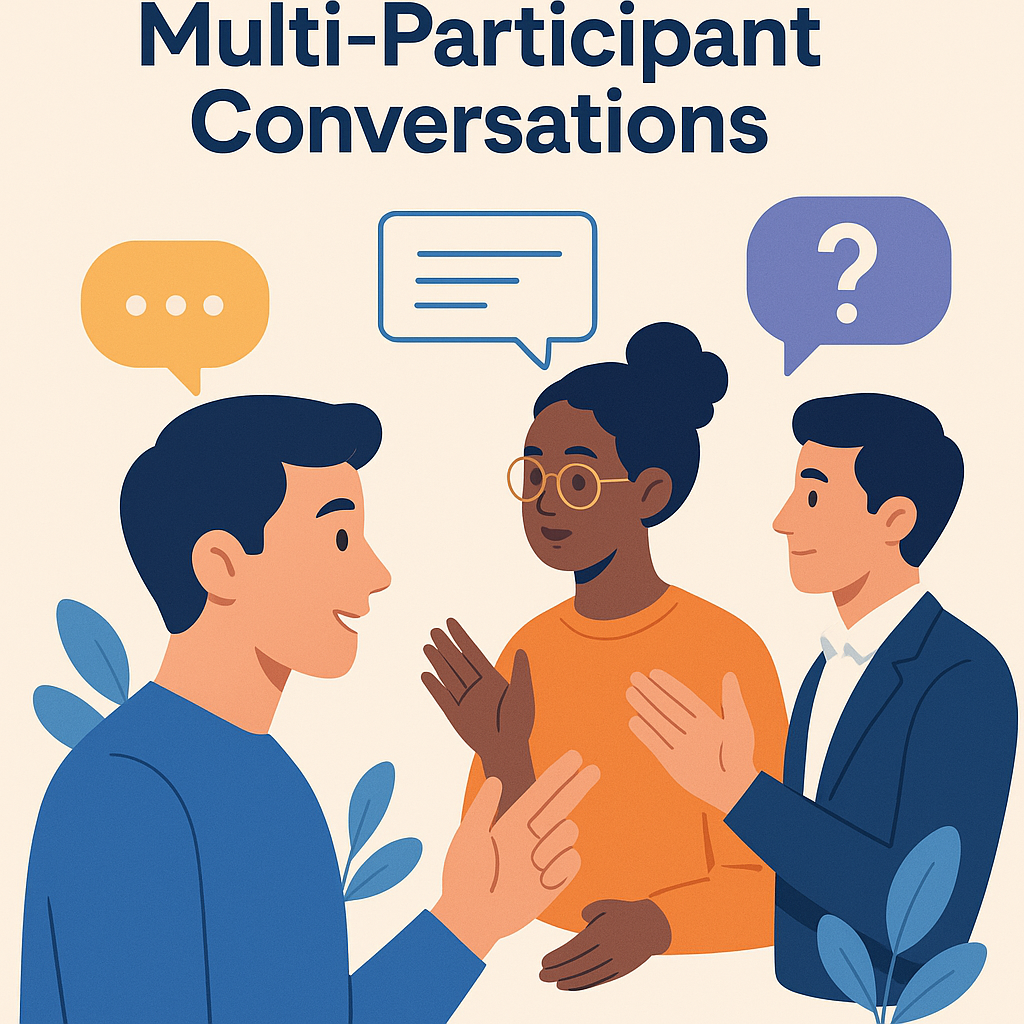
In our increasingly interconnected world, effective communication has become more important than ever. One specific area where many individuals struggle is in multi-participant conversations—those discussions involving more than two people. In such interactions, it’s easy to become overwhelmed, feel unheard, or miss out on key information. In navigating these complex discussions, it is crucial to understand and implement strategies that enhance the quality of communication while ensuring each participant’s contribution is acknowledged. But why exactly does this matter?
Multi-participant conversations occur in a myriad of everyday situations—from casual social gatherings and work meetings to online forums and collaborative projects. The ability to navigate these discussions effectively can avoid misunderstandings, foster collaboration, improve productivity, and enrich relationships. Developing skills for these interactions enhances not only personal but also professional life, as we live in a world where teamwork and group decision-making are often pivotal to success. Understanding strategies for managing these conversations can transform the way we communicate in various facets of our lives. This article will explore the key strategies for managing multi-participant discussions, supported by real-life examples and plain language explanations.
The Importance of Active Listening
Active listening is one of the most vital skills in any conversation, but its significance is amplified when multiple participants are involved. Active listening doesn’t only mean hearing the words being spoken; it involves fully concentrating, understanding, responding, and then remembering what has been said. This participatory form of listening helps in reducing misunderstandings and assures other participants that their views are valued, thereby creating a more inclusive conversation environment.
Consider a work meeting with five participants discussing a project. If each person is waiting merely for their turn to speak, the conversation may become disjointed, and misunderstandings can arise. However, if all participants engage in active listening, it becomes a collaborative discussion where different perspectives can be acknowledged and synthesized, leading to a more holistic solution.
Managing Turn-Taking
Ensuring fair and efficient turn-taking is fundamental in multi-participant conversations, allowing everyone to have a chance to contribute. This can be challenging in a scenario where people naturally have varying levels of assertiveness, with some dominating the conversation and others remaining silent.
In a classroom setting, for example, it might be common for one or two students to steer the discussion. However, when a teacher implements a structured approach, such as a round-robin method where each student contributes in sequence, all voices are heard, promoting a more balanced dialogue. This strategy can be adapted to boardroom meetings or team discussions by establishing clear guidelines at the outset, ensuring that no single voice overpowers another.
Clarifying and Summarizing
Clarifying and summarizing during the conversation are techniques that help ensure accuracy and shared understanding. When there are multiple contributors, confirming details can prevent misinterpretations and wrong assumptions.
Imagine participating in an online strategy session with several global teams. It’s easy for crucial points to become lost in translation. By periodically pausing to clarify one’s understanding—asking, “So, if I understand correctly, you’re suggesting that…”—participants can spark fruitful dialogues and cement agreements before proceeding. These interstitial clarifications ensure alignment among diverse voices and pave the way for a cohesive action plan.
Utilizing Non-Verbal Cues
Non-verbal communication can play an essential role in understanding multi-participant dynamics, helping convey emotions, complementing or contradicting spoken words, and managing interaction flow.
During a project team meeting, for instance, observing participants’ body language and facial expressions helps gauge interest levels, agreement, or confusion without uttering a word. If a team leader notices someone with arms crossed, they might probe further to explore any underlying concerns, fostering open dialogue. Moreover, gestures like nodding can subtly encourage the speaker, showing engagement and attentiveness.
Building Consensus
In multi-participant discussions, reaching a consensus can often be the goal, particularly in decision-making scenarios. Building consensus involves synthesizing the group’s ideas, refocusing on shared objectives, and facilitating agreement through collaboration and compromise.
A nonprofit’s executive board discussion on allocating funds, for instance, might present several conflicting opinions. By highlighting shared values and possible trade-offs, a facilitator can steer the narrative towards consensus. Utilizing visual aids such as decision matrices or voting can make preference clarification more transparent and engaging, as seen below:
| Option | Pros | Cons |
|---|---|---|
| Funding A | Addresses urgent need | Short-term impact |
| Funding B | Long-term sustainability | Limited immediate results |
Utilizing visual representations helps participants dissect options clearly, discuss the merits and drawbacks, and come to a collective decision.
Encouraging Diverse Perspectives
In any group conversation, fostering an environment where diverse perspectives are not only welcome but embraced is crucial for a rich exchange of ideas. This strategic openness facilitates creativity and innovation.
Take a brainstorming session for a marketing campaign involving different departments—creative, sales, and product development. Ensuring that each department can freely share their unique viewpoints enriches the conversation and results in a more nuanced and multidimensional campaign. Leaders can encourage this diversity by actively inviting quieter members to share, acknowledging all contributions, and valuing differences as assets rather than obstacles.
Handling Conflicts
Inevitable in discussions, conflicts or disagreements among participants can derail conversations if not managed effectively. However, these conflicts can also be opportunities for growth and deeper understanding when approached with the right mindset.
During community town hall meetings focused on controversial policies, for instance, conflicts regarding distinct viewpoints might arise. Mediators can defuse tension by allowing each party to express their perspective fully, finding areas of common ground, and developing mutually acceptable solutions. Conflict resolution models, like interest-based relational approaches, help shift focus from positions to interests, culminating in more constructive dialogue.
Summarizing Key Takeaways
Navigating multi-participant conversations is a skill that requires attention, patience, and strategic thinking. Mastering these discussions leads to improved communication outcomes, stronger relationships, and more effective team collaboration.
Key takeaways include the importance of active listening, ensuring clear turn-taking, the benefit of clarifying and summarizing information, reading non-verbal cues, building consensus through collaborative efforts, encouraging diverse viewpoints, and dealing with conflicts constructively. By integrating these strategies into daily interactions, individuals can enhance their communication efficacy, forge stronger connections, and contribute meaningfully to conversations in professional and personal spheres.
For the reader, embracing these strategies might require conscious effort and practice. Begin by selecting one or two techniques to focus on in upcoming group discussions, such as improving active listening or inviting diverse perspectives. With time and persistence, these practices can become second nature, greatly enhancing one’s capacity to lead and participate in conversations with multiple parties. The next time you find yourself in a multi-participant conversation, remember these tactics, and witness the positive transformation in the dialogue.
Frequently Asked Questions
1. What are the common challenges people face during multi-participant conversations?
Multi-participant conversations often present a unique set of challenges that can easily create obstacles for effective communication. One major challenge is the risk of feeling unheard amidst the din of multiple voices. This usually occurs when several people attempt to speak simultaneously, causing some participants to inadvertently dominate the conversation while others may struggle to get a turn to voice their opinions.
Another frequent issue is the difficulty in tracking and processing various streams of information. With several perspectives and ideas being exchanged, participants often find it hard to follow the conversation thread, leading to confusion or missing out on key points.
Interruptions and cross-talk are also prevalent in these discussions. When participants interrupt one another, it disrupts the flow of dialogue and may escalate into conflict if not managed properly. Additionally, some individuals may experience anxiety or discomfort, which can lead to withdrawal from the conversation altogether.
Strategies to mitigate these challenges include establishing clear communication norms, ensuring equal participation, active listening, and encouraging the use of non-verbal cues to signal engagement without interrupting the speaker. These strategies work together to create a more balanced and effective communication environment.
2. How can I make sure my voice is heard in a group conversation?
To ensure that your voice is heard in a group conversation, it’s important to utilize both verbal and non-verbal strategies. Start by observing the group’s dynamics. Pay attention to how participants exchange turns and look for natural pauses where you can interject respectfully without disrupting someone else’s train of thought.
When you see an opportunity, project your voice clearly and confidently. It’s not just about being loud; clarity and confidence can help convey your message effectively. If the group has agreed upon certain norms, like raising hands, be sure to follow these protocols as it can help organize the flow of conversation and provide everyone an opportunity to share.
Non-verbal cues, such as consistent eye contact and body language that signals engagement, can also be essential. Demonstrating active listening by nodding or signaling agreement not only keeps you engaged but also signals to others that you are a ready participant in the discussion.
Additionally, if faced with interruptions, calmly but assertively indicating that you were not finished speaking can help. Express your desire to complete your thought and encourage respectful turn-taking, thereby championing both your voice and those of others in the group.
3. What techniques can strengthen my active listening skills in multi-participant conversations?
Active listening is a crucial element in navigating multi-participant conversations. Begin with focusing your full attention on the speaker without allowing distractions to disrupt your concentration. This might involve facing the speaker directly, maintaining eye contact, and minimizing internal dialogues that can sidetrack your focus.
Practicing reflection and paraphrasing is another powerful technique. Once a speaker has finished sharing their point, restate or summarize what they said to confirm your understanding. For instance, “So what you’re saying is…” This approach not only verifies your comprehension but also demonstrates to the speaker that their input is valued and understood.
Asking open-ended questions is a vital component of active listening. These questions encourage elaboration and clarification without leading the conversation in a biased direction or making assumptions about the speaker’s intentions. Such questions facilitate deeper engagement and dialogue, which is fundamental in enhancing the quality of communication.
Finally, be conscious of your non-verbal signals. Nodding affirmatively, maintaining an open posture, and avoiding distractions like checking your phone will help maintain an environment of attentiveness and respect. These strategies combined can build more constructive and engaging multi-participant conversations.
4. How do I manage and guide conversations to avoid misunderstandings?
Avoiding misunderstandings in multi-participant conversations requires proactive engagement and strategic communication techniques. Start by setting a clear agenda or establishing common goals at the onset of the conversation. This helps align the participants’ focus towards shared objectives and minimizes the likelihood of diverging or unrelated discussion topics leading to confusion.
If you notice any emerging confusion or potential conflict, refer back to the common goals to steer the conversation back on track. Employ techniques like summarizing or paraphrasing what has been stated to clarify and verify understanding among the group.
Employing reflective questioning can further aid in managing potential misunderstandings. By asking questions aimed at clarification, such as “What I understand from what you’re saying is… Is that correct?” you provide an opportunity for others to expand on, correct, or further clarify their viewpoints.
Encourage participants to express their ideas and doubts openly and assure them that it is alright to make distinctions and seek clarification. Diplomatic language can help address potential disputes calmly without escalating tensions. Employ phrases such as “I understand your point, and I would like to add…” or “Let’s explore a different perspective” to maintain a constructive dialogue.
5. How can non-verbal communication play a role in enhancing understanding in group settings?
Non-verbal communication is an essential component of conveying messages beyond verbal interactions, especially in group settings. It helps in expressing emotions, reinforcing or contradicting spoken words, and thereby dramatically influencing the perceptions and responses of others involved in the conversation.
Facial expressions are key indicators of a person’s true feelings and reactions. They convey emotions such as agreement, skepticism, or confusion, oftentimes more accurately than words can. As you engage in conversations, ensure that your facial expressions are aligned with your verbal messages to avoid mixed signals.
Gestures, like nodding when you agree or using your hands to emphasize points, can also strengthen your verbal messages and show engagement with the conversation. They act as visual cues that enhance the understanding of your speech and drive your points across more effectively.
Your posture and body language equally provide vital signals about your attentiveness and openness towards the discussion. Maintaining an open stance—facing those speaking, uncrossed arms—can indicate engagement and willingness to participate, building a cooperative atmosphere. Conversely, being closed off or disengaged can unintentionally signal disinterest or disagreement.
Finally, tone of voice is a subtle yet powerful non-verbal element that can reflect confidence, doubt, enthusiasm, or impatience. Being mindful of vocal tone and modulating it according to the context can engender a more positive interaction and facilitate understanding in group conversations. These conscious uses of non-verbal elements can enhance overall communication, making for more successful multi-participant interactions.