
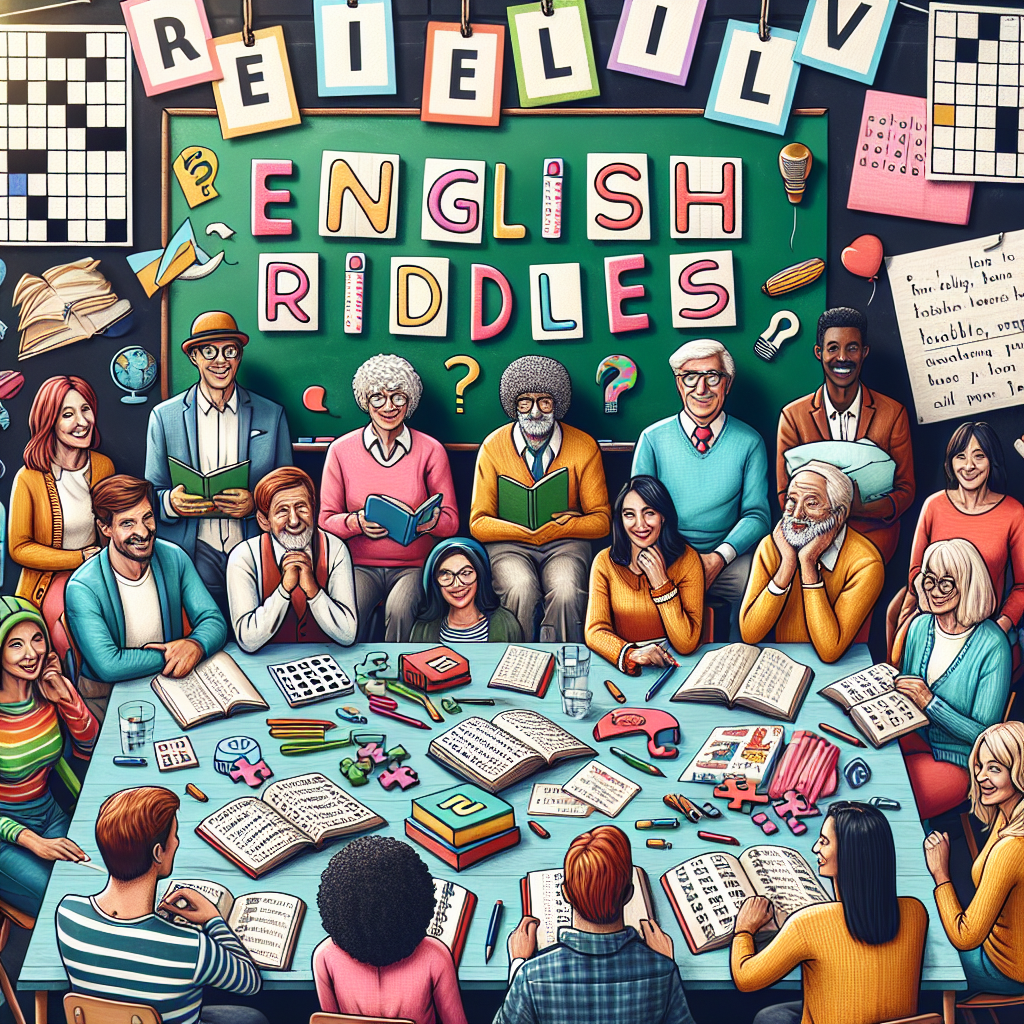
Learning a new language can often feel like trying to solve a complex puzzle, where each piece represents a new word, phrase, or grammatical rule that needs to be in place to see the whole picture. As any language enthusiast will tell you, a crucial key to successful language acquisition is consistent practice and exposure to various forms of language exercises. One interesting and engaging method that has been gaining popularity in English as a Second Language (ESL) learning is the use of riddles and word puzzles. These playful challenges not only make learning fun but also enhance cognitive skills, improve vocabulary, and foster a deeper understanding of the language.
Imagine sitting in a classroom or at your study desk at home, where instead of only going through lists of vocabulary words or grammar drills, you’re challenged to solve a word riddle. This form of learning deviates from the traditional rote learning method and adds a layer of excitement and engagement that stimulates you cognitively. Riddles are questions or statements intentionally phrased to require ingenuity in their answer. They tap into our problem-solving skills, critical thinking, and creativity. Meanwhile, word puzzles like crosswords or word searches help reinforce spelling, word recognition, and vocabulary usage.
What’s more, riddles and word puzzles can cater to individual or group settings, promoting both independent learning and collaborative learning environments. They are versatile tools that can be tailored to different language proficiency levels, accommodating beginners as well as more advanced learners. Whether you’re using them in a classroom, during your commute, or sitting at home, they offer a dynamic way of reinforcing language skills. Engaging in these activities regularly can greatly enhance one’s grasp of English, providing an enjoyable and effective alternative to traditional language exercises.
The Cognitive Benefits of Riddles
One of the key reasons riddles are effective for ESL learners is their ability to engage the brain’s cognitive functions. When learners process a riddle, they engage in a mental exercise that improves cognitive flexibility and enhances problem-solving skills. This is because solving a riddle requires the learner to interpret a question from different angles, making connections between disparate pieces of information to arrive at a solution. This type of critical thinking is crucial to mastering any language, as it helps students understand idiomatic expressions, puns, and other nuanced aspects of English.
For instance, consider a simple riddle: “What has keys but can’t open locks?” The answer is “a piano.” Solving this riddle requires thinking beyond the literal interpretation of “keys” and exploring other meanings, thus enhancing metaphorical thinking. This improves a learner’s ability to understand and use language creatively and flexibly, which is particularly useful when dealing with complex sentence structures or poetry.
Additionally, riddles can improve memory retention. When learners engage with these mental puzzles, they often remember the riddles themselves and their solutions, just as one might remember a particularly challenging math problem or logic puzzle. This retention is often aided by the sense of achievement and satisfaction that comes with solving a riddle, making the learning experience memorable and impactful. Moreover, because riddles are inherently playful and entertaining, they lower stress levels associated with language learning, creating a relaxed and positive environment conducive to learning.
Enhancing Vocabulary Through Word Puzzles
Word puzzles, like crosswords, word searches, and anagrams, are excellent tools for enhancing vocabulary in an ESL context. By engaging with these puzzles, learners are exposed repeatedly to new words in various contexts, reinforcing their understanding and retention. For example, a crossword puzzle on a particular theme, such as “nature” or “occupation,” introduces students to specific vocabulary groups in a context that enhances both understanding and recall.
Crossword puzzles, in particular, are useful for this purpose. They require learners to spell words correctly, understand definitions, and fit words into specific spaces that require logical, linguistic connections. For example, learners might use a clue like “a science of matter; often involves experiments” to guess the word “chemistry.” This process not only reinforces the meaning of the word but also its spelling and its relationship to other words—a holistic way of learning vocabulary.
Word searches, on the other hand, help with word recognition and spelling, especially for beginners. As they scan for words amidst a jumble of letters, learners enhance their ability to recognize familiar words and decipher patterns in spelling. Anagrams, which involve rearranging letters to form new words, also challenge learners to manipulate vocabulary creatively, thereby deepening their understanding and recall. Such activities encourage players to think about words as malleable entities, promoting linguistic flexibility and creativity.
Fostering Collaborative Learning in Group Settings
Riddles and word puzzles are not only valuable for individual ESL learners but also serve as effective tools in group learning settings. When learners work together to solve puzzles, they engage in a collaborative learning experience that can significantly enhance their language skills. Collaborative activities encourage communication, negotiation, and discussion, helping learners practice their speaking and listening skills in English.
In a classroom setting, teachers can use riddles as group tasks to promote teamwork and social interaction. For instance, a riddle competition where students are divided into teams encourages active participation and a collaborative effort to solve the riddles. This scenario provides learners with an opportunity to express their thoughts, discuss possible solutions, and learn from one another, making the learning experience social and interactive.
Additionally, word puzzles like crosswords or jigsaw puzzles can be solved in pairs or groups, facilitating an exchange of ideas and knowledge. In such activities, students can help each other with difficult words, share strategies for solving puzzles, and learn to work together in a supportive environment. This cooperative learning approach not only makes English learning enjoyable and dynamic but also helps build self-confidence and improve language fluency.
Incorporating Riddles and Puzzles into Everyday Learning
For ESL learners who wish to include riddles and word puzzles in their daily language practice, the possibilities are endless. With the advent of the digital age, there are numerous online resources and mobile applications dedicated to linguistic puzzles for all proficiency levels. Platforms like Duolingo or Babbel often incorporate puzzle-like elements to teach new vocabulary and test comprehension, making language practice both convenient and engaging.
Moreover, learners are encouraged to create their own puzzles or riddles. By crafting personal puzzles, learners can tailor them to their own interests, thus making vocabulary and language more relatable and significant. This process involves deeper involvement and creativity, as students must think critically about how to formulate clues or arrange letters and words in meaningful ways. Such activities further reinforce their grasp of vocabulary and language structure.
Incorporating these exercises into routine activities can also be beneficial. For example, engaging with a quick crossword or riddle during a coffee break or while commuting can transform mundane moments into opportunities for practice and improvement. This seamless integration into daily life helps learners maintain regular exposure to the language, a critical component of successful language learning.
Creating A Balanced ESL Learning Curriculum
Although riddles and word puzzles are fun and beneficial, it’s important to incorporate them as part of a balanced ESL learning curriculum. While they are excellent for vocabulary building, problem-solving, and engagement, they should complement other language learning tools and activities. A well-rounded ESL program should include listening exercises, speaking practice, reading comprehension, and writing assignments alongside puzzle-based activities.
Teachers are encouraged to blend puzzles with other interactive activities like role-playing or storytelling, which can further enhance language acquisition. For instance, after solving a series of riddles, students could write a short story incorporating new words they’ve learned, or perhaps present riddles in the form of a skit, thus utilizing both writing and speaking skills. This integrated approach ensures that language learning is comprehensive and well-rounded.
Ultimately, the goal is to create a learning environment that fosters active participation and continuous improvement. By diversifying the methods through which students engage with English, teachers can cater to different learning styles and preferences, enhancing the overall effectiveness of the language learning process.
Conclusion: The Joy of Learning with Riddles and Puzzles
Using riddles and word puzzles as part of ESL instruction offers an innovative and exciting way to learn English. These tools not only help improve vocabulary and language comprehension but also stimulate cognitive abilities such as problem-solving, critical thinking, and memory. Moreover, they promote collaboration and communication in group settings, making language learning a social, interactive, and enjoyable experience.
As learners navigate the sometimes challenging journey of mastering English, incorporating these playful elements into their study routine can make the process more enjoyable and less intimidating. The idea is to make language learning a journey of discovery, where each new word or grammar rule feels like uncovering a new piece of a puzzle. With this mindset, learners can foster a lifelong love for language learning, continuously seeking out new challenges and opportunities for improvement.
Ultimately, riddles and word puzzles embody the perfect balance of education and entertainment, turning traditional learning on its head by transforming it into a game. For teachers and learners alike, these activities redefine the boundaries of what it means to learn a language, proving that education can be both effective and enjoyable.





